Category: Home

  • New Anker 150W Power Bank Charging Base Now Available

    New Anker 150W Power Bank Charging Base Now Available

    Key Takeaways

    1. The new Anker 150W Charging Base (model A1903) is designed for Anker Prime Power Bank devices and follows the previous 100W version released in 2023.
    2. It features a 4-in-1 charging capability with outputs of 150W pogo pin, 140W USB-C, 100W USB-C, and 22.5W USB-A, allowing dynamic power distribution for multiple devices.
    3. The charging base includes a redesigned digital display for charging status and supports Bluetooth and 2.4 GHz Wi-Fi for app management.
    4. Dimensions of the charging base are 10.3 x 10.3 x 2.3 cm (about 4.1 x 4.1 x 0.9 inches) and it is compatible with various power bank models.
    5. The anticipated price for the Anker 150W Charging Base is $149.99 in the US, while the previous 100W model is currently priced at $109.99 on Amazon.


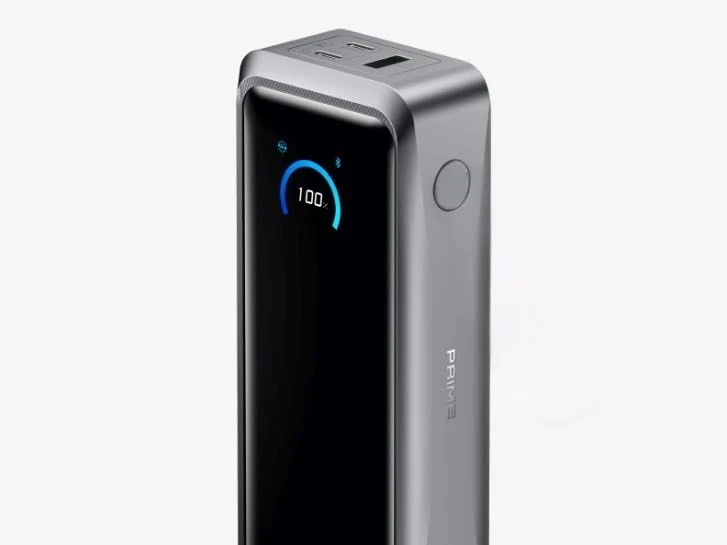
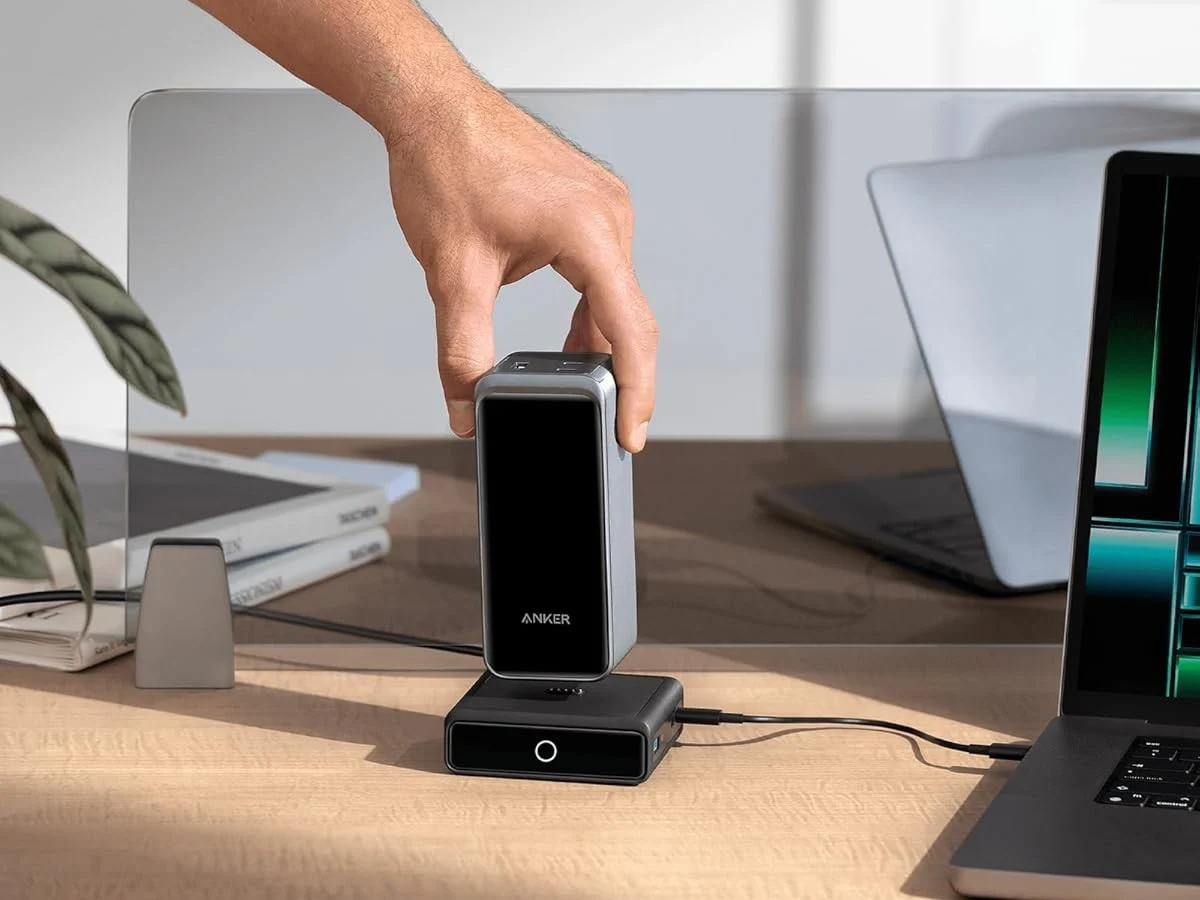
    A new 150W Charging Base designed for Anker Prime Power Bank devices is seemingly on the horizon. This fresh accessory, identified as model A1903, comes after the previous 100W Charging Base that hit the market in 2023.

    Details and Features

    Recently, AnkerInsider released information and images of this upcoming 150W Charging Base. Similar to the previous version, this model functions as a 4-in-1 charger. At the top, it features a robust 150W pogo pin output and supports Anker’s innovative 150W fast charging protocol for their power banks. Additional outputs include 140W USB-C, 100W USB-C, and 22.5W USB-A. When charging multiple devices simultaneously, it is said that the power is distributed dynamically, achieving a maximum combined output of 150W.

    Design and Connectivity

    The new model includes a redesigned digital display that shows the charging status. It also supports Bluetooth along with 2.4 GHz Wi-Fi connectivity, allowing users to manage the device via the Anker smartphone app. As per the report, the accessory’s dimensions are 10.3 x 10.3 x 2.3 cm (around 4.1 x 4.1 x 0.9 inches). It is claimed to be compatible with a variety of power banks, which are listed below.

    Pricing Information

    The Anker 150W Charging Base for Anker Prime Power Bank is anticipated to be priced at $149.99 in the US, although the exact cost is still unknown. Currently, the previous 100W Charging Base for Anker Prime Power Bank is available on Amazon for $109.99.

    Source:
    Link

  • New Philips Hue Devote: Affordable Slim Ceiling Light Now Available

    New Philips Hue Devote: Affordable Slim Ceiling Light Now Available

    Key Takeaways

    1. The Philips Hue Devote Slim ceiling light is available in two sizes (S and M) and is designed for living rooms, bedrooms, and kitchens.
    2. It features dimmable White and Color Ambiance lighting, similar to the Tento light, and includes a Philips Hue AI Assistant for scene creation.
    3. The S variant is 16W with 2,000 lumens, while the M variant is 23W with 2,900 lumens, both with a white frame.
    4. The lights can be controlled via the Philips Hue app and are compatible with voice commands through Amazon Alexa or Google Assistant if connected to a Hue Bridge.
    5. The Devote Slim is available on Amazon in several European countries, starting at £71.20/€79.99, making it more affordable than the Tento lights.


    A new product from Philips Hue has made its debut: the Devote Slim ceiling light. This round light comes in two sizes, S and M, and has been found on Amazon across various European countries. It’s important to note that this is not the same as the earlier Devote Pendant light; this new version is specifically made for use in living rooms, bedrooms, or kitchens.

    Similarities with the Tento

    The Devote ceiling light has quite a few features in common with the Tento, which was launched in 2024. It offers dimmable White and Color Ambiance lighting, allowing users to pick from an extensive selection of colors and color temperatures. You can select from preset scenes or come up with your own. Additionally, the new Philips Hue AI Assistant is available to help create scenes that match your mood or activities.

    Specifications and Pricing

    The smaller S variant is a 16W light, providing up to 2,000 lumens. The larger M version operates at 23W and offers a brightness of 2,900 lumens. Both lights come with a white frame; the S measures 300 x 31 mm (about 11.8 x 1.2 inches), while the M is 430 x 30 mm (roughly 16.9 x 1.2 inches). By way of comparison, the smaller Tento round light is 291 mm (around 11.5 inches across) and can produce up to 2,250 lumens. This previous model also features an additional light source at the back for softer, diffused light on the ceiling. You can manage the smart light via the Philips Hue app on your smartphone. If you connect it to a Hue Bridge (currently priced at $52.99 on Amazon), you can also control the ceiling light using voice commands through Amazon Alexa or Google Assistant.

    Availability in Europe

    The Philips Hue Devote Slim ceiling light is currently listed on Amazon in countries such as the UK and France. Customers can buy either a single unit or a 2-pack of the smaller size, starting at £71.20/€79.99. This pricing makes it more affordable than the Tento lights, which begin at £94.99/€109.99. It’s still uncertain if these smart lights are exclusive to Amazon. The timeline for a potential release in the US remains unknown.

    Source:
    Link


  • Affordable WiFi & Bluetooth E-Ink Display with 3-Month Battery Life

    Affordable WiFi & Bluetooth E-Ink Display with 3-Month Battery Life

    Key Takeaways

    1. TRMNL has launched a 7.5-inch DIY e-ink display kit for preorder at $35.92.
    2. The display is designed for static information, with a battery life of up to three months with infrequent updates.
    3. It features a circuit board using the XIAO ESP32-S3 Plus, compatible with ESPHome and Arduino IDE.
    4. The device supports over 375 plugins and 8 layouts, reducing the need for traditional programming.
    5. The display has a resolution of 800 x 480 pixels and supports WiFi and Bluetooth for data transfer.


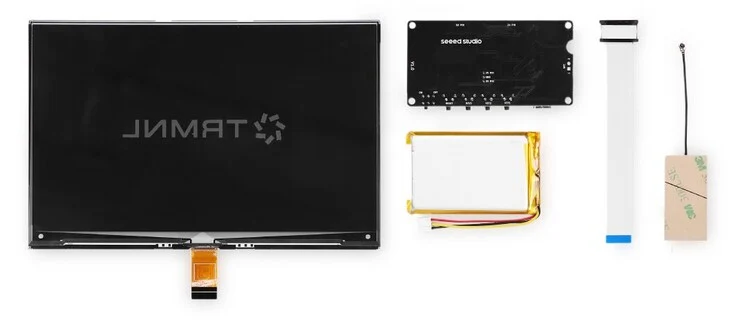
    Regular readers of Notebookcheck might remember the name TRMNL. The company has now introduced the TRMNL 7.5-inch (OG) DIY kit, available for preorder at the price of $35.92 on Seeed Studio. As always, it’s important for potential customers to review the shipping options to their area before placing an order.

    Features of the E-Ink Display

    This e-ink display comes packed with many features, including a circuit board that is already installed. It can be utilized to show sensor data, calendars, weather updates, or other relevant information in a smart home setup. This device is mainly designed for content that doesn’t need to change often. The manufacturer claims that static information can stay on the screen for months. For example, if the display is updated every six hours, the 2,000mAh battery is said to last up to three months.

    Technical Specifications

    The TRMNL display features a circuit board that uses the XIAO ESP32-S3 Plus. It’s compatible with ESPHome, allowing for seamless integration into smart home systems. Additionally, the manufacturer states that it works well with the Arduino IDE, which is a platform that many hobbyists are likely to recognize.

    User-Friendly Programming Options

    Moreover, the e-ink display fits within the TRMNL BYOD ecosystem and provides access to more than 375 plugins and 8 different layouts, meaning traditional programming isn’t always necessary. As suggested by the name, the screen has a size of 7.5 inches and a resolution of 800 x 480 pixels, but it doesn’t support color display. Thanks to the XIAO ESP32-S3, users can utilize WiFi or Bluetooth for data transfer.

    Source:
    Link


  • Don’t Miss These 3 Must-See Summer Celestial Events

    Don’t Miss These 3 Must-See Summer Celestial Events

    Key Takeaways

    1. Three meteor showers will occur this summer: Alpha Capricornids, Delta Aquariids, and Perseids.
    2. The Alpha Capricornids peak from July 29 to 30, with over five meteors per hour.
    3. The Delta Aquariids peak on July 28-29, with around 25 meteors per hour, best viewed in the early morning.
    4. The Perseids, peaking on August 12-13, can produce over 100 meteors per hour but may be affected by a bright full moon.
    5. Weather conditions, such as cloud cover, can impact visibility for all meteor showers.


    Every summer, the nighttime sky always presents a stunning array of sights. This year is no different, as three meteor showers are set to dazzle us.

    Celestial Wonders Await

    This means that plenty of celestial bodies are floating in space. Sometimes, they leave their impressions in our skies, reminiscent of a nova that appeared 600 years ago. So, this summer, if you gaze upward at specific moments, you’ll catch sight of numerous meteors blazing through our atmosphere. The first meteor shower will occur from July 29 to 30, peaking during this time.

    Alpha Capricornids Meteor Shower

    Known as the Alpha Capricornids and originating from comet 169P/NEAT, the American Meteor Society (AMS) states that over five meteors per hour can be seen at its peak. While this may not seem like a lot, the experience is truly mesmerizing, as fiery balls can occasionally light up the dark sky.

    The second meteor shower, the Delta Aquariids, is more likely to be spotted in the southern hemisphere. Though it might be harder to see, experts predict around 25 meteors per hour at its peak. NASA suggests that the best time for watching this shower is early morning when the sky is darkest and your viewing area is elevated above the horizon. This meteor shower is caused by comet 96P/Machholz, which orbits the Sun every 5.2 years, leaving behind a trail of debris that Earth moves through. The peak activity for this event is expected between July 28 and July 29.

    The Spectacular Perseids

    Finally, we have the most famous of the showers, the Perseids. Occurring with a peak between August 12 and 13, it’s possible to see more than 100 meteors per hour. However, there is a catch: a full moon may hinder visibility.

    The AMS notes it could be around 84% full, and its brightness might decrease visibility by as much as 75%. Even though you can still look up during this time, you’ll mainly spot the largest and brightest meteors. Additionally, you must keep an eye on the weather; if clouds cover the sky, your chances of seeing these wonders could be ruined.

    Source:
    Link

  • Longest Wireless Electricity Transmission Reaches New Milestone

    Longest Wireless Electricity Transmission Reaches New Milestone

    Key Takeaways

    1. DARPA successfully transmitted 800 watts over 8.6 kilometers using laser technology, setting a record for wireless energy transmission.
    2. The system used an infrared laser beam focused on a compact receiver that converted laser energy into electricity via photovoltaic cells.
    3. Advanced technologies like adaptive optics and beam-steering ensured stable energy transfer over long distances, achieving a conversion efficiency of about 20%.
    4. Other companies, like PowerLight Technologies and Emrod, have also made significant progress in wireless energy transmission using different technologies.
    5. Future phases of DARPA’s POWER program aim to scale the system to deliver up to 10 kilowatts over distances of 200 kilometers, potentially powering data centers.


    Transmission of electricity without wires has been a dream for people for a long time, particularly after Nikola Tesla spent his final years working towards this vision. Since then, various companies have begun exploring technologies to make this dream a reality.

    DARPA’s Achievement

    The Defense Advanced Research Projects Agency (DARPA) of the US military has reached a significant milestone that puts it at the forefront of this research. They successfully transmitted 800 watts across a distance of 8.6 kilometers for 30 seconds using laser technology. This amount of energy is similar to what is needed to power a microwave or a small refrigerator. With this accomplishment, DARPA’s Persistent Optical Wireless Energy Relay (POWER) program has set a new record for the longest distance of wireless transmission so far.

    How It Works

    The system operated with a carefully focused infrared laser beam aimed at a compact receiver on the ground. This receiver utilized a parabolic mirror to concentrate the incoming laser light onto photovoltaic (PV) cells, which transformed the laser energy into electricity. This design was selected due to its simplicity, quick production time (built in less than three months), and its ability to keep the beam aligned over large distances with little dispersion or scattering from the atmosphere.

    The system employed adaptive optics and beam-steering technology to stabilize the laser over long ranges and adjust for atmospheric disturbances, ensuring effective energy collection. The PV cells were optimized for the specific wavelength of the laser used, achieving conversion efficiencies of about 20%, which is quite good considering the distance and safety limits of the laser. Even at this long range, the beam maintained enough coherence and power density to transfer over 1 megajoule of energy in just 30 seconds.

    Other Milestones

    The agency has hit several other important milestones, for instance, in late 2024, they transmitted 230 watts over a distance of 1.7 kilometers for 20 seconds and also conducted tests over 3.7 kilometers.

    Nonetheless, other companies have reached their own milestones too. PowerLight Technologies demonstrated an infrared energy transmission of 400 watts over a kilometer, sustaining the energy flow for over 12 hours. In a similar vein, Emrod, a company based in New Zealand, transmitted around 2 kilowatts over a few hundred meters with an efficiency of approximately 97% by utilizing microwave technology.

    This demonstration was part of Phase 1 of the POWER project, which includes three distinct phases. The agency is currently focusing on refining beam direction, enhancing wavefront correction, and minimizing conversion losses.

    For the upcoming phases, the program aims to scale up the system to deliver as much as 10 kilowatts of optical electricity over distances reaching up to 200 kilometers. This energy could potentially power a small to medium data center, consisting of about 500 servers, which can consume between 150 to 250 kilowatts.

    Source:
    Link

  • Starlink Offers 20% Discount on Monthly Bills for Some Users

    Starlink Offers 20% Discount on Monthly Bills for Some Users

    Key Takeaways

    1. Starlink is offering a 20% discount on monthly fees for select Residential and Residential Lite subscribers without needing a promo code or enrollment.
    2. Eligible customers will receive notifications via email, stating the discount will automatically apply for the next six billing cycles.
    3. The discount applies to users in various regions, including the US, Australia, and Indonesia, but does not extend to Starlink Roam users.
    4. A Residential Lite customer reported a reduction in their monthly fee from $80 to $64, saving a total of $96 over six billing cycles.
    5. The discount strategy may help manage network capacity by incentivizing existing subscribers while discouraging new users in congested areas with high surcharges.


    Starlink has unexpectedly announced a 20% discount on monthly fees for certain Residential and Residential Lite subscribers. There’s no need for a promotional code or enrollment in a program. Instead, those eligible are receiving notifications directly through email.

    Low on Details

    In true Starlink style, the specifics are vague, and the situation is quite unpredictable. If you happen to be a Residential customer, take a look at your email—you may be among the fortunate recipients.

    The email states, “As a valued Starlink customer, you’re getting 20% off your monthly plan for the next six billing cycles.” It continues, “No action needed. Just keep enjoying your service and the discount will apply automatically.”

    Customer Reactions

    A Reddit user, KingofMemes2001, was one of the first to notice this offer. They’ve been using Starlink in Utah County for two years and are on the Residential Lite plan, which is priced at $80 a month. Thanks to the 20% discount, their monthly fee will drop to $64. This translates to a total savings of $96 over the next six billing cycles. For those who aren’t aware, Starlink Lite is a more affordable alternative to the standard Residential plan, providing unlimited deprioritized data.

    As reported by PCMag, this offer does not seem limited to the US, as some users in Australia and Indonesia have also mentioned receiving the email from Starlink. However, there have been no indications that users on Starlink Roam are getting this discount.

    Network Management Strategy

    This may seem puzzling to individuals who have recently encountered high fees in busy states just to start using the service. Last month, it was noted that in states like Washington, Oregon, and Idaho, new Residential subscribers are being asked to pay a $1,000 surcharge in addition to the equipment cost. Cities such as Seattle, Portland, and Redmond are among those impacted.

    This strategy is a part of how Starlink is handling its network capacity—discouraging new users in congested areas with high surcharges while providing discounts in locations where there is still capacity to expand.

    Source:
    Link

  • Ulysse Nardin Unveils Limited Edition Watch with Silver Dial

    Ulysse Nardin Unveils Limited Edition Watch with Silver Dial

    Key Takeaways

    1. Ulysse Nardin, founded in 1846, is renowned for its unique watch designs and in-house movements, with a recent focus on technical innovations.
    2. The Blast Free Wheel Maillechort is a limited edition watch, with only 50 pieces produced, featuring the UN-176 manual-winding caliber.
    3. The watch has a distinctive “floating” design, showcasing key components like double barrels and a flying tourbillon without traditional supports.
    4. It has a 45mm by 12.4mm case made of 18-carat white gold, a silver-grey dial, and is water-resistant up to 30 meters, protected by sapphire glass.
    5. Priced at $126,600 before taxes, the Blast Free Wheel Maillechort targets serious collectors and enthusiasts in the luxury watch market.


    Ulysse Nardin is a well-known watchmaker that has been around since 1846. This brand is particularly famous for creating its own movements and for its unique designs. While the company has a strong history in marine chronometry, it has recently shifted its focus towards more technical innovations. After going through a transition phase, Ulysse Nardin is now releasing more limited edition watches with impressive mechanical features, and the latest one certainly fits that trend.

    Introducing the Blast Free Wheel Maillechort

    The Blast Free Wheel Maillechort is a limited edition watch, with only 50 pieces made. It utilizes the UN-176 manual-winding caliber, which was previously used in earlier versions of the Blast line. This time, it is paired with a maillechort mainplate, which is also known as German silver. The dial has a silver-grey finish that is both coarse and subtle, offering a stark contrast to the sharply designed 18-carat white gold case. The measurements of the case are 45mm by 12.4mm, and it is water-resistant up to 30 meters. Both the front and back of the watch are protected by sapphire glass.

    Unique Features and Design

    This watch has a distinctive “floating” setup, where important components such as the double barrels located at 12 o’clock, the flying tourbillon at 6, and a static power reserve display at 4 o’clock seem to hover without traditional supports. The power reserve indicator remains still and shows three visible bands when the barrels are fully wound. As the power reserve decreases, the bands drop down to just one.

    When worn, the Blast Free Wheel Maillechort feels quite substantial at around 150 grams. It comes equipped with a blue velvet rubber strap for comfort. The price is marked at $126,600 before taxes, making it one of the most expensive contemporary releases from Ulysse Nardin, similar to the Blast Sparkling Rainbow. This price range attracts serious collectors and enthusiasts, as there are many alternatives available in this segment.

    Source:
    Link


  • Anker Prime 26K Power Bank Pricing Leaked: Details Inside

    Anker Prime 26K Power Bank Pricing Leaked: Details Inside

    Key Takeaways

    1. The Anker Prime 26K Power Bank (300W) is expected to launch in the US around November 2025, with a price of $199.99.
    2. It offers three output options: two USB-C ports (up to 140W each) and one USB-A port (up to 22.5W), with a total output of 300W when using multiple ports.
    3. The power bank features a 26,000 mAh battery with a 99.75 Wh capacity and supports the new Anker 150W charging protocol.
    4. Additional features include a built-in digital display, pass-through charging capabilities, a trickle charging mode, and temperature monitoring for overheating protection.
    5. Anker has not confirmed the release details for the Prime 26K Power Bank in other regions, such as Europe.


    Details about the Anker Prime 26K Power Bank (300W) set for a US launch seem to have been leaked. Speculation regarding this gadget started in June 2025, when a few features and product images were shared.

    New Pricing Revealed

    Recently, AnkerInsider, the source of the initial leak, disclosed the price for the much-anticipated Anker Prime 26K Power Bank (300W). It’s expected to be priced at $199.99 in the US market. This is $20 higher than its earlier version, the Anker Prime 27,650mAh Power Bank (250W), which is currently available for $179.99 on Amazon. Although an exact launch date hasn’t been confirmed, it’s anticipated to hit shelves around November 2025.

    Features and Specifications

    As mentioned earlier, the Prime 26K Power Bank (300W) is likely to come with three output options: two USB-C ports that can deliver up to 140W each and a USB-A port that provides up to 22.5W. When using multiple ports simultaneously, the total output can reach 300W. It will feature a 99.75 Wh 26,000 mAh battery and support the new Anker 150W charging protocol. Additional features include a built-in digital display, capabilities for pass-through charging, and a trickle charging mode. Furthermore, it will include safeguards against overheating thanks to its temperature monitoring technology.

    Anker has not yet officially confirmed the release of the Anker Prime 26K Power Bank (300W). It remains unclear if or when it will be available in other regions, such as Europe.

    Source:
    Link

  • Google Nest Doorbell and Camera Subscription Price Increases 66%

    Google Nest Doorbell and Camera Subscription Price Increases 66%

    Key Takeaways

    1. Nest Aware Subscription Benefits: The subscription enhances Nest Doorbell and security cameras with event-based alerts and video clip storage for 30 or 60 days, depending on the plan.

    2. Price Increase: The monthly cost for the basic Nest Aware subscription has risen to $10, a 66% increase, while the premium plan costs $20/month, a 50% increase.

    3. Limited Storage Without Subscription: Without a Nest Aware subscription, users can only store video clips for three hours.

    4. Single Fee for Multiple Cameras: The Nest Aware subscription fee is a one-time charge, regardless of the number of cameras in use.

    5. Alternative Options Available: There are alternatives to Nest that do not require a subscription, such as the Netatmo Video Doorbell and Eve Home’s cameras using Apple HomeKit Secure Video.


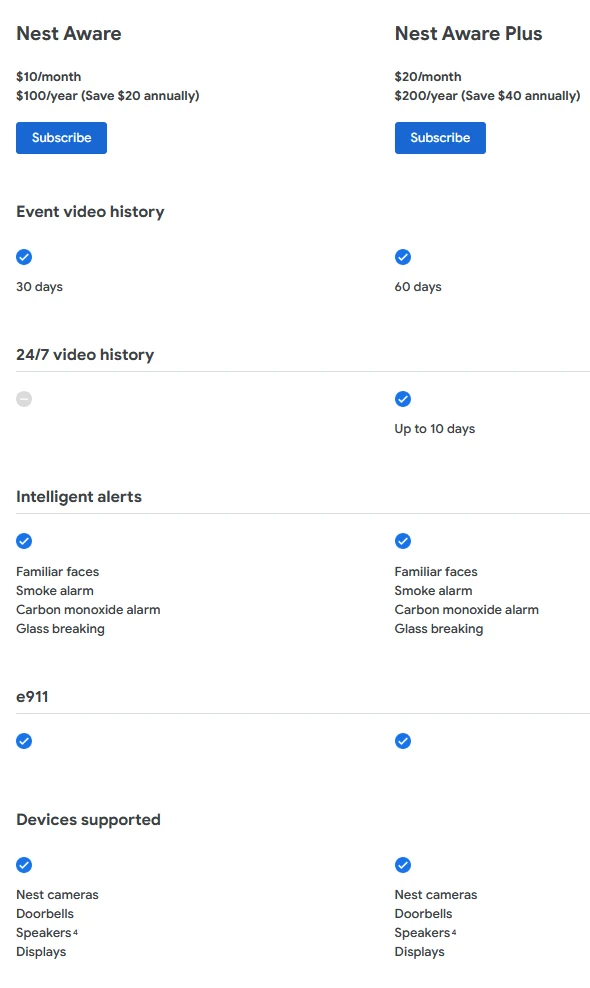
    The well-known Nest Doorbell and Nest security cameras are much more effective when paired with the Nest Aware subscription. This subscription provides several benefits, such as event-based alerts and the ability to save video clips for either 30 or 60 days, based on which plan you choose. The pricier option also offers continuous video history for the last ten days for compatible cameras. Without a subscription, users can only store video clips for a mere three hours.

    Price Changes for Subscriptions

    Not too long ago, Nest Aware cost $5 and then $6 a month. However, Google has now raised the price of the less expensive subscription to $10 monthly or $100 annually – marking a whopping 66% increase. For those who want to keep 60 days of video history rather than just 30 and need access to continuous recordings from the last ten days, they’ll have to cough up $20 each month or $200 yearly, which is a 50% jump. Google emphasizes that this fee is just paid once, no matter how many cameras are in use.

    Consider Alternatives

    Google has once again shown that consumers should tread carefully when buying products that rely on cloud services. There are plenty of alternatives available that either don’t require a subscription or can use an existing one. For instance, the Netatmo Video Doorbell saves video clips onto a microSD card instead of using the cloud. On the other hand, cameras from Eve Home utilize Apple HomeKit Secure Video, which enables clips to be stored in iCloud, and this is possible with the most basic iCloud plan at just $0.99 a month.

    Source:
    Link


  • Allpowers R1500 Lite Portable Power Station Launch with Discount

    Allpowers R1500 Lite Portable Power Station Launch with Discount

    Key Takeaways

    1. The Allpowers R1500 Lite is a lightweight portable power station designed for camping and brief power outages, weighing 15 kg (6.8 lbs).
    2. It features a 1,056 Wh LiFePO₄ battery with a maximum output of 1,600 W and a surge capacity of 3,200 W, supporting 3,500 discharge cycles.
    3. The power station includes multiple charging options, such as solar panels and a car charger, and has ports for powering up to 8 devices simultaneously.
    4. A companion app is available for users to adjust settings and monitor performance.
    5. The R1500 Lite is currently offered at a promotional price of $450, down from $799, valid until July 25.


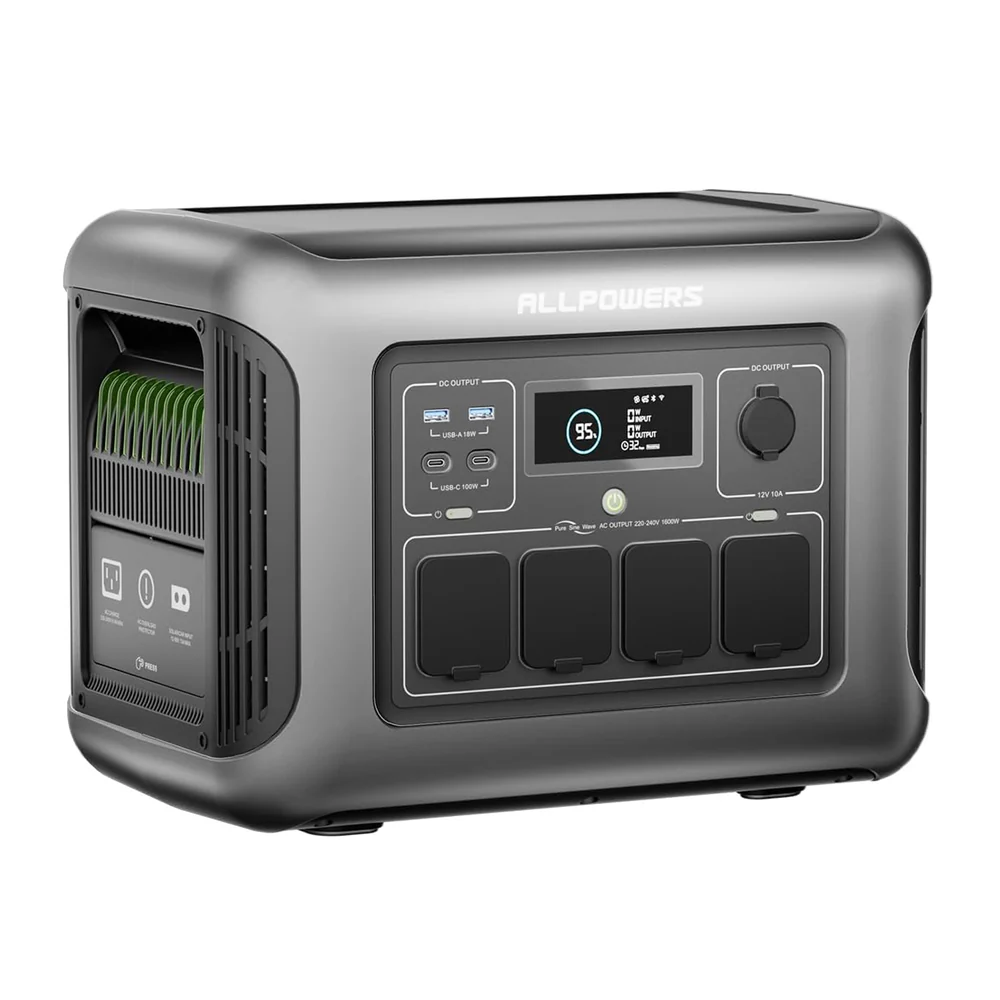
    Allpowers has introduced its new portable power station, the R1500 Lite, on a global scale. This latest model is tailored for use during camping trips and brief power outages, featuring a compact, lightweight structure and providing good output power. Specifically, the R1500 Lite weighs 15 kg (6.8 lbs), which is lighter than its predecessor, the R1500, that weighs 17 kg (7.7 lbs). The current price for the R1500 is $509.

    Battery and Power Output

    When it comes to power, the Allpowers R1500 Lite is equipped with a 1,056 Wh LiFePO₄ battery that can deliver a maximum output of 1,600 W, with a surge capacity of 3,200 W. The LiFePO₄ battery in this power station is rated for 3,500 discharge cycles. Like its earlier model, the R1500 Lite features quick charging capabilities, allowing it to go from 0 to 100% in just 1.5 hours when using AC input, as stated by the company.

    Charging Options and Ports

    For additional charging options, users can recharge the power station using solar panels or a car charger. The device is equipped with multiple ports, including four AC outlets, two USB-C ports (100 W max each), two USB-A ports, and a car socket. This setup enables the power station to power as many as 8 devices at once. Furthermore, Allpowers provides a companion app to help users adjust settings and monitor performance.

    Launch Offer

    The Allpowers R1500 Lite is available in a sleek black and silver color scheme and is currently offered at a 44% discount due to its launch promotion. This brings the price down to $450 from the regular price of $799. Customers can purchase the R1500 Lite through Allpowers’ official website and Amazon. It’s important to remember that this promotional price is valid only until July 25, after which it will revert to the original price.

    Source:
    Link