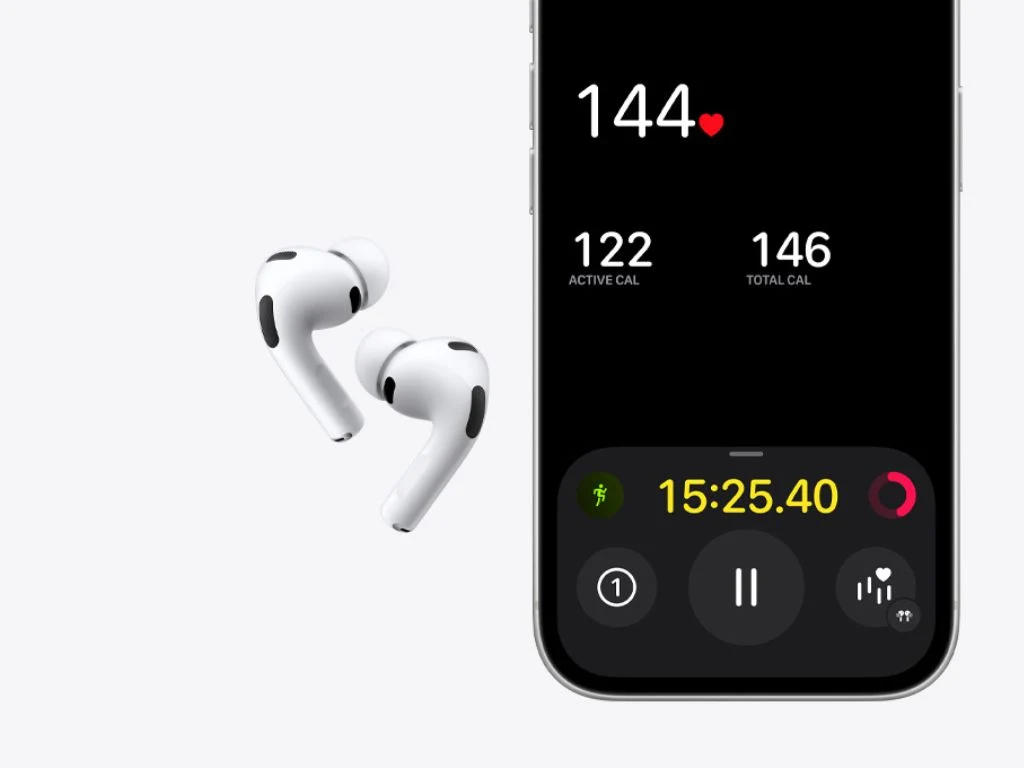
– AccLock proposes passive in-ear biometric authentication using heartbeat- or in-ear BCG signals from earbud accelerometers, aiming for unobtrusive verification with zero user involvement.
– Early tests reported average FAR of 3.13% and FRR of 2.99% (33 participants), indicating feasibility but not yet reliable enough for broad deployment.
– Current tech is experimental: performance varies with activity (better for music listening, worse while walking/jaw movement) and differs between 3D-printed buds and real AirPods; no commercial products yet.
Intro to Ear ID and biometrics After Touch ID and Face ID, we might get Ear ID next. Apple introduced Touch ID on the iPhone 5S as the first reliable iPhone security feature. It was discontinued in 2025 with the end of the iPhone SE (3rd generation) and has now been largely replaced by Face ID, which launched on the iPhone X in 2017 and has become the go-to facial security authentication system. However, that might change with AccLock’s AirPods-style earbuds, which authenticate users based on their unique heart rhythms.
Heartbeat based security concept
In this paragraph, the idea of heartbeat authentication is presented as a future security feature, as electrical impulses from a person’s heart and cardiac patterns create unique heartbeat rhythms for each individual (via ScienceDirect). The writing style shifts here to a more explanatory tone, while still keeping the idea of personalized heart rhythms and their potential use in security, and the sentence structure is varied to meet the requirement of a different style per section.
AccLock earbud system overview
Now, a research project based in China is developing an earbud system called AccLock that uses a tiny accelerometer found in most earbuds, such as AirPods. In their preprint paper, accessible via Cornell University’s arXiv, the researchers explained why this could be a game-changer, stating: “In this paper, we propose a passive authentication system called AccLock, which leverages distinctive features extracted from in-ear BCG signals to enable secure and unobtrusive user verification. Our system offers several advantages over previous systems, including zero involvement for both the device and the user, ubiquity, and resilience to environmental noise.”
The description continues in a slightly more casual cadence, noting that real-world testing backs up their statements: “We conducted extensive experiments with 33 participants, achieving an average FAR (False Acceptance Rate) of 3.13% and an FRR (False Rejection Rate) of 2.99%, which demonstrates the practical feasibility of AccLock.”
Current performance and caveats
To put it simply, AccLock, while still in its initial stages of research testing, falsely allowed 3.13% of unauthorized users to bypass biometric verification. Likewise, 2.99% of participants were unable to access their devices using AccLock’s heartbeat-based biometric verification. However, the sample size is too small to draw broader conclusions. Despite this, AccLock could become a viable alternative for biometric verification as it matures and undergoes further testing.
Apple, on the other hand, claims that Face ID has a FAR of one in one million, suggesting a highly secure system. However, no official peer-reviewed research documents are available to support Apple’s claims.
Prototype testing and limitations
The research team tested the technology on both 3D-printed earbuds and actual Apple AirPods. The prototype ran at a higher sampling rate and was more accurate when people listened to music, moved their heads around, or shifted their posture. Meanwhile, performance on the AirPods dipped slightly due to data quality issues. After a bit of retraining, the buds learned each user’s pattern after some idle sitting.
Still, other movements, such as walking, jogging, or moving your jaw, introduce vibrations that reduce accuracy. Currently, AccLock is just a proof-of-concept research trial, and no products are shipping with the technology. However, with a growing number of biometric verification methods, privacy could become an even bigger concern than it already is.