Most of Xiaomi’s smartphones now feature rapid charging capabilities, with 67W charging becoming the norm for their midrange devices. Despite this advancement, the charging adapters included in Xiaomi phone packages are typically bulky.
Xiaomi’s Latest Innovation: 120W GaN Charger
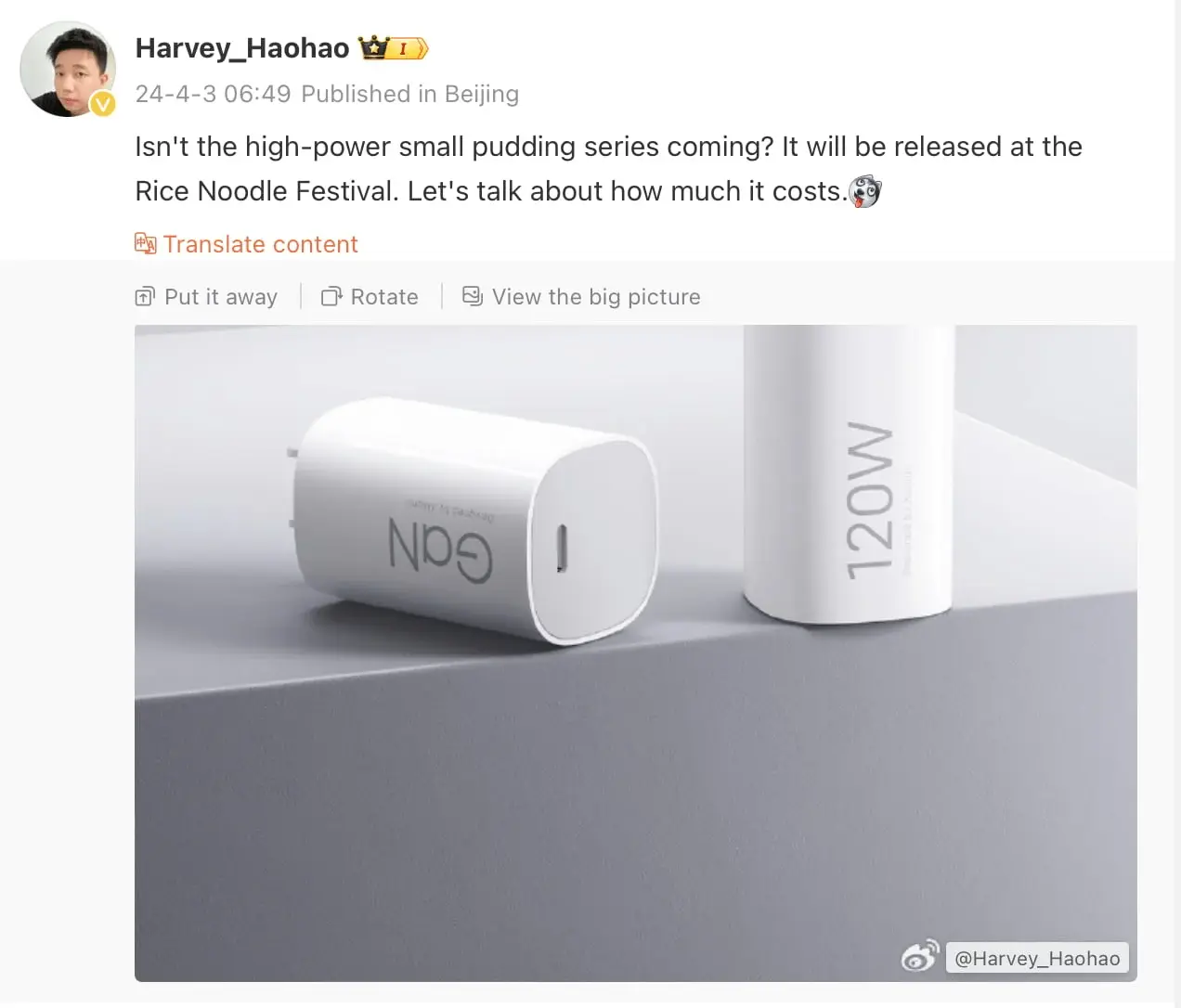
Xiaomi recently unveiled a compact 67W charging brick that caters to all Xiaomi phones compatible with 67W charging. Now, the company is gearing up to launch a compact 120W charging adapter, leveraging Gallium Nitride (GaN) technology to deliver 120W power in a remarkably small package.
Sneak Peek at the 120W Charging Adapter
Although Xiaomi has not officially introduced the 120W compact charger, a preliminary image was shared by a Weibo account named “Harvey_浩浩.” While there hasn’t been an official announcement from Xiaomi regarding the new 120W GaN charging adapter, Harvey suggests that it will be unveiled at a special event in China.
Evolution of Xiaomi’s Chargers
Xiaomi had earlier introduced a 67W GaN charger, significantly reducing the adapter’s size. By comparing both the 67W standard adapter and the 67W GaN charging adapter, users can appreciate the difference in design and efficiency. If the image shared by Harvey accurately reflects Xiaomi’s final design for the 120W GaN charger, consumers can anticipate a similarly impressive size reduction. It is indeed remarkable to witness a power brick capable of delivering 120W in such a compact form factor. Initially, Xiaomi plans to launch this adapter in China.
Xiaomi’s MIUI, a well-loved Android skin, is gradually making way for HyperOS, the company’s latest custom skin. How does HyperOS stack up against MIUI in terms of performance and features? This comparison aims to shed light on the differences between the two Android skins to help users decide if upgrading to the new OS is worthwhile.
HyperOS: An Overview
HyperOS isn’t merely a flashy term coined by Xiaomi to replace MIUI; it has been in development since 2017, featuring significant core system modifications. Essentially, HyperOS is a new operating system from Xiaomi that builds upon Android, similar to MIUI, while incorporating elements of Linux. The latest OS incorporates Xiaomi’s Vela system for deeper system-level enhancements.
HyperOS vs MIUI: A Comparison
While Xiaomi has tweaked the core system in HyperOS, it doesn’t introduce groundbreaking features unseen on smartphones. Some changes in HyperOS draw inspiration from iOS, a move not uncommon in the tech industry. Despite this, there are intriguing aspects to explore within HyperOS.
Subtle Design Changes
When transitioning to HyperOS, users may initially struggle to distinguish between MIUI and HyperOS due to their nearly identical icons and layouts. However, upon closer inspection, differences become apparent. HyperOS features slightly subdued app icons compared to MIUI, with minor adjustments like icon placements and menu restructuring for a cleaner look.
Enhanced Control Center
HyperOS introduces significant changes to the Control Center, removing icon labels to achieve a minimalist appearance. While this design choice may confuse some users initially, the larger icons and streamlined layout enhance usability. Additionally, a music player widget has been integrated into the Control Center for added functionality.
Revamped Lock Screens
One standout feature of HyperOS is the introduction of new lock screen designs, dubbed "Artistic Lock Screens." These customizable lock screens offer various styles like Classic, Rhombus, and Magazine, providing users with personalized options for an enhanced unlocking experience.
Bloatware Elimination
HyperOS addresses the long-standing issue of bloatware on Xiaomi devices by allowing users to easily remove unwanted apps. This not only frees up storage space but also improves system performance by reducing resource usage.
Lightweight OS and Battery Improvements
HyperOS boasts a smaller storage footprint compared to MIUI, offering users more space for multimedia content. Moreover, Xiaomi has optimized the core system of HyperOS to deliver improved battery life, with users likely to notice an additional hour of screen time.
Conclusion
HyperOS surpasses MIUI in various aspects, offering users unique features such as innovative lock screens, a refined control center, and enhanced system performance. If your device is eligible for the HyperOS upgrade, consider installing the update to explore its new functionalities. Keep in mind that as a new OS, HyperOS may have minor bugs, so stay updated for optimal performance.
Before you leave, remember to report any encountered bugs to Xiaomi and regularly update your device to ensure a smooth user experience.
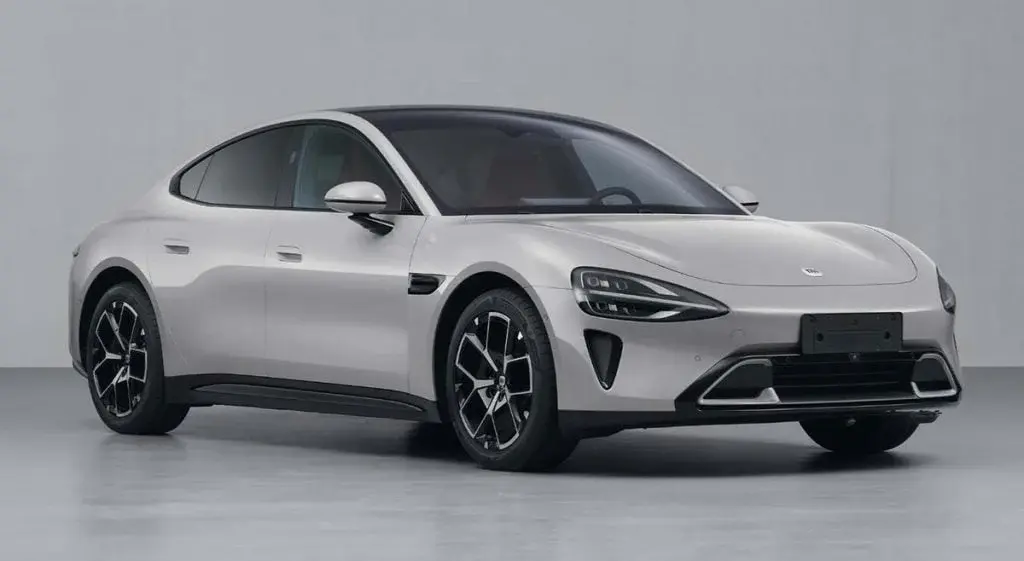
Xiaomi is broadening its product range beyond just smartphones and smart home devices available exclusively in China. A significant move was made by the company as it entered the electric vehicle market with its SU7 EV. The response to this new venture has been overwhelming, with reports of 3 AM test drives and a high demand for the vehicle.
Xiaomi’s Foray into Electric Vehicles
The recent buzz surrounding Xiaomi’s entry into the electric vehicle market has sparked curiosity among consumers familiar with the brand’s product strategy. The question on many minds is, "Will there be a Redmi electric vehicle?" Wang Teng, the general manager of Xiaomi’s Redmi brand, has shed light on the matter, providing insights into the company’s future plans in this sector.
Undoubtedly, the idea of an affordable Redmi car has been a long-standing wish for Xiaomi fans. Speculations about a Redmi EV have circulated for some time, fueling anticipation. Wang Teng has clarified that while there are no immediate plans for a Redmi car, Xiaomi is gearing up for the launch of new models under its own brand.
Wang Teng emphasized the importance of supporting and promoting the Xiaomi SU7 before envisioning a potential Redmi car. He highlighted that Xiaomi’s focus is currently on establishing a strong foundation with its core models. While the idea of a Redmi car remains uncertain, Xiaomi has ambitious plans for expanding its vehicle lineup in the future.
In a recent statement issued by Xiaomi Auto, the company reiterated its commitment to prioritizing the development of the SU7 EV over an affordable Redmi Car. The report emphasized the challenges in significantly reducing costs to create a competitive electric vehicle under a subsidiary brand like Redmi. Xiaomi’s primary goal is to solidify its position in the electric vehicle market before considering ventures into additional sub-brands.
Xiaomi’s venture into the electric vehicle sector seems to be yielding significant results. The debut of their first model, the SU7 EV, has been a remarkable success in China, leading to a substantial increase in production capacity by the tech giant.
Production Capacity Boost
Reports indicate that Xiaomi has urged its suppliers to elevate production levels to an impressive 10,000 units per month, particularly focusing on the higher-end versions of the SU7. This decision follows the unexpected surge in initial sales figures for the EV.
Production Challenges and Response
Initially, the production plan aimed for 3,000 vehicles monthly by March, gradually scaling up to a consistent 6,000 monthly by the close of 2024. However, the overwhelming demand for the SU7 has necessitated a reevaluation of these targets to prevent potential delays in deliveries.
Market Response and Stock Performance
Acknowledging the production challenges, Xiaomi Motors has committed to enhancing production capacity and expediting deliveries. Presently, delivery times for various SU7 models span from 19 to 32 weeks, a period of up to 7 months. This surge in demand has also translated into a notable uptick in Xiaomi’s shares on the Hong Kong stock market, initially surging by nearly 15% and finally settling at a 10.17% increase.
Strong Market Debut
The launch of the SU7 witnessed an impressive 88,898 units sold within the first 24 hours. Reports from a reputable Chinese car blogger on Weibo suggest that each store received an average of 1,800 to 2,000 orders, with a reservation rate of 35-40%.
This successful introduction of the Xiaomi SU7 hints at a bright future for the company in the automotive industry. While the sustainability of this momentum and Xiaomi’s potential as a key player in the global EV market remain uncertain, these initial accomplishments serve as a promising indicator of things to come.
Xiaomi has recently announced the upcoming launch of the Redmi Turbo 3 in China, introducing the new Redmi Turbo smartphone series. Before its official release, purported specifications for the Redmi Turbo 3 have emerged on the Geekbench benchmarking platform.
Redmi Turbo 3 Specifications
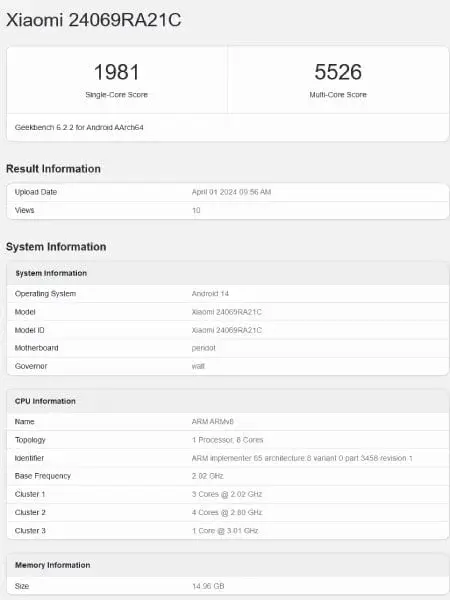
The Redmi Turbo 3 was listed on Geekbench (version 6.2.2) with the model number 24069RA21C, achieving 1981 points in single-core testing and 5526 points in multi-core tests.
The listing discloses that the device is powered by a Qualcomm Snapdragon 8s Gen 3 processor and boasts a significant 16GB of memory. Additionally, the phone will come equipped with the latest Android 14 operating system.
Xiaomi’s announcement positions the Redmi Turbo 3 as a mid-range offering within its new ‘performance series’ lineup. This marks a shift from the previous inclusion of Turbo series smartphones under the Redmi Note lineup, the last of which was the Note 12 Turbo.
Lineup Restructuring
As part of the lineup restructuring, Turbo-branded phones will now form a distinct series, while the Note series will maintain its focus on delivering mid-range phones with flagship features aimed at a broader audience.
Last month, an alleged Redmi Turbo phone, likely the Turbo 3, was identified on the 3C certification with support for 90W charging speed.
Expected Features
Rumors circulating suggest that the upcoming Redmi Turbo smartphone may feature a 5000mAh battery and a 1.5K OLED display.
While Xiaomi has not officially confirmed these details, the Redmi Turbo 3 is anticipated to launch in China later this month. There are speculations that the device may also be introduced globally as the rebranded Poco F6.
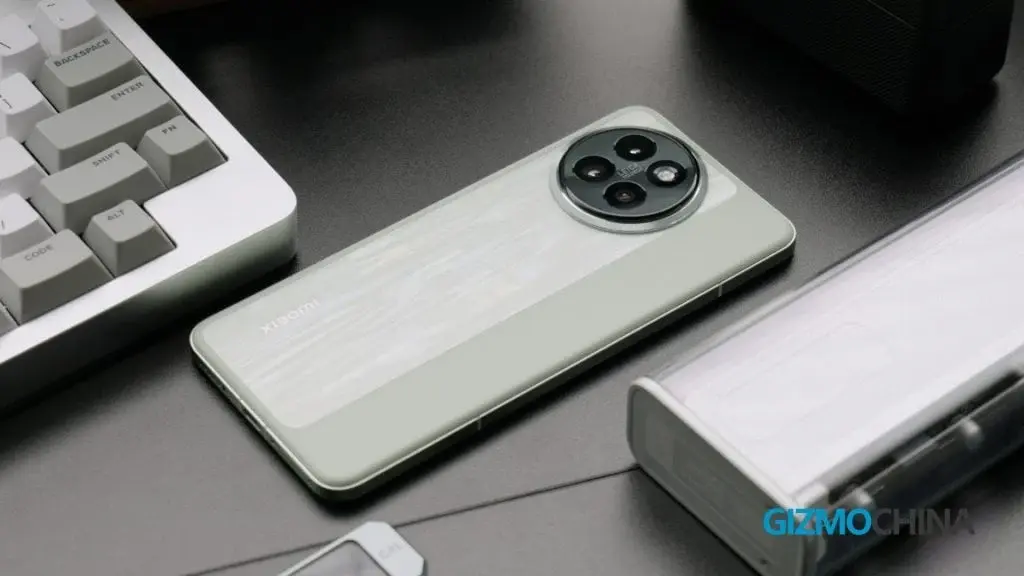
The Xiaomi Civi 4 Pro made its debut recently, boasting a blend of sophisticated design and state-of-the-art components. Despite its impressive features, this new smartphone was introduced exclusively in Xiaomi's native market of China, leaving consumers elsewhere wondering about its potential global availability. With an air of anticipation, many are curious about whether the Civi 4 Pro will be launched in India and if it will retain the same specifications as its Chinese counterpart. Let's delve into these key inquiries to shed light on the future of this device.
Xiaomi Civi 4 Pro Details
As of now, the Xiaomi Civi 4 Pro is captivating tech enthusiasts with its premium design and cutting-edge hardware. However, its limited release in China has sparked speculation regarding its potential expansion to other markets like India. The question remains – will this high-end device make its way to international audiences, and if so, will it offer the same impressive specifications seen in China?
Global Release Speculations
Despite its initial launch being confined to China, there is a buzz of excitement among global consumers who are eager to witness the Xiaomi Civi 4 Pro's official release in their regions. The mystery surrounding its international availability and whether it will mirror the features of the Chinese variant continues to intrigue smartphone enthusiasts worldwide.
Anticipating the Future
With its sleek design and advanced hardware, the Xiaomi Civi 4 Pro has already made waves in the tech industry. As enthusiasts await news of a potential global release, the prospect of experiencing this cutting-edge smartphone outside of China lingers in the minds of many. Will this device transcend borders and reach markets beyond its country of origin? Only time will reveal the answers to these pressing questions, leaving consumers on the edge of their seats in anticipation of what the future holds for the Xiaomi Civi 4 Pro.
Poco India has recently revealed its upcoming launch of the HyperOS update for a range of Poco devices in the second quarter of 2024. This announcement follows the initial introduction of the HyperOS user interface in India in February this year.
Eligible Poco Devices for HyperOS Update
Poco has confirmed that the following Poco phones will receive the HyperOS update within Q2:
Poco F4
Poco M4 Pro
Poco C65
Poco M6
Poco X6 Neo
These models will be added to the existing list of devices that have already received the update, such as the Poco C55, Poco M5, Poco X5, and others.
One noteworthy addition in the Q2 rollout plan is the Poco X6 Neo 5G, which was unveiled in March 2024 with Android 13-based MIUI 14.
Enhancements with HyperOS Update
The HyperOS update is expected to enhance the user experience on these devices, equipped with features like a MediaTek Dimensity 6080 processor, a dynamic 120Hz AMOLED display, and a capable 108-megapixel camera system.
If you own one of these devices and have not yet received the update notification, it is recommended to navigate to Settings>About Phone and select 'System updates'.
Introduction of HyperOS by Xiaomi
Earlier this year, Xiaomi introduced HyperOS in India as a refined iteration of its renowned MIUI interface. HyperOS aims to provide users with a smoother, more efficient experience by focusing on performance optimization and convenient features.
For further insights into HyperOS and how it differs from MIUI, explore our detailed coverage on this topic.
In recent developments, Xiaomi has also outlined its rollout strategy for HyperOS on several Xiaomi and Redmi devices for the second quarter of 2024, including the Mi 10, originally launched in 2020.
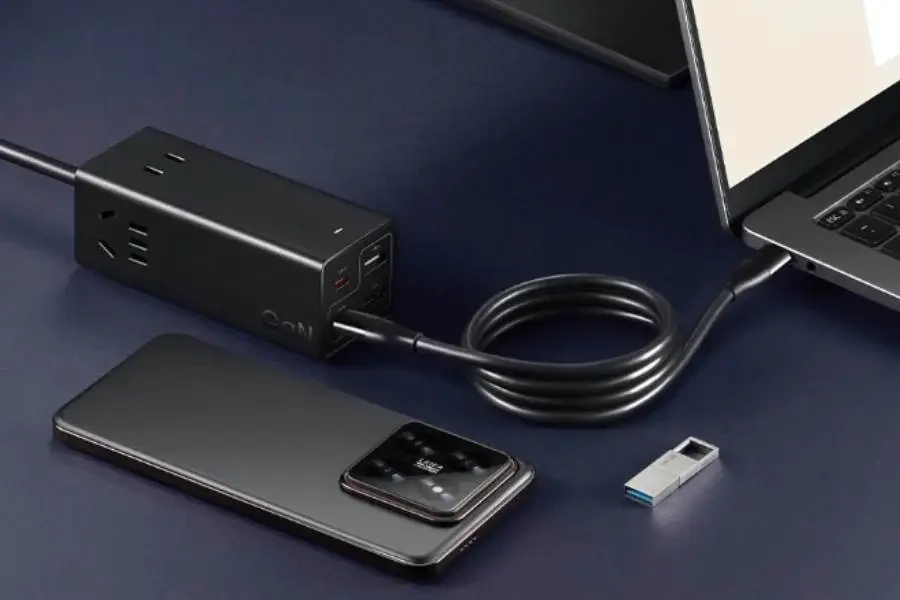
Xiaomi has introduced a new gadget, the Xiaomi 67W Desktop Fast Charging Socket Pro, aiming to simplify desktop charging and connectivity processes. This innovative device, now live on the Youpin platform, offers users the convenience of fast charging, multiple ports, and efficient data transmission all packaged into a compact solution. Let’s delve into the key specifications and features of this advanced product.
Xiaomi 67W Desktop Fast Charging Socket Pro Specifications
The Xiaomi 67W Desktop Fast Charging Socket Pro is designed with a versatile seven-in-one interface layout. It includes a USB-C1 fast charging port suitable for a range of devices such as phones, tablets, and laptops. The device also features three AC power supply interfaces, collectively supporting up to 2500W of power. Additionally, users can benefit from a full-function USB-C2 port for charging, data transfers, audio, and video, an HDMI port, and a USB-A port catering to low-power gadgets.
The product comes equipped with a 0.9-meter full-function data cable and is compatible with various fast-charging protocols, including Xiaomi 67W flash charging, PD3.0/2.0, QC3.0/2.0, FCP, AFC, Apple 2.4A, and BC1.2. With dual USB-C interfaces that offer front and rear access, the Xiaomi 67W Desktop Fast Charging Socket Pro ensures versatile usability.
Specification Details
Interfaces: 1 x USB-C1 (fast charging), 3 x AC power interfaces (2500W), 1 x USB-C2 (full-function), 1 x HDMI, 1 x USB-A
Fast Charging Protocols: Xiaomi 67W, PD3.0/2.0, QC3.0/2.0, FCP, AFC, Apple 2.4A, BC1.2
Transmission: 4K@60Hz, USB 3.0
Included Cable: 0.9-meter full-function data cable
A smart chip embedded within the Xiaomi 67W Desktop Fast Charging Socket Pro dynamically allocates power, ensuring safe charging practices across devices with varying power demands. For data transmission needs, the device supports high-definition 4K@60Hz resolution and employs the USB 3.0 high-speed transmission protocol.
Pricing and Availability
Interested customers can access the Xiaomi 67W Desktop Fast Charging Socket Pro through a crowdfunding campaign on Xiaomi Youpin, priced at 185 yuan (~$25). The crowdfunding initiative is set to commence on April 3rd.
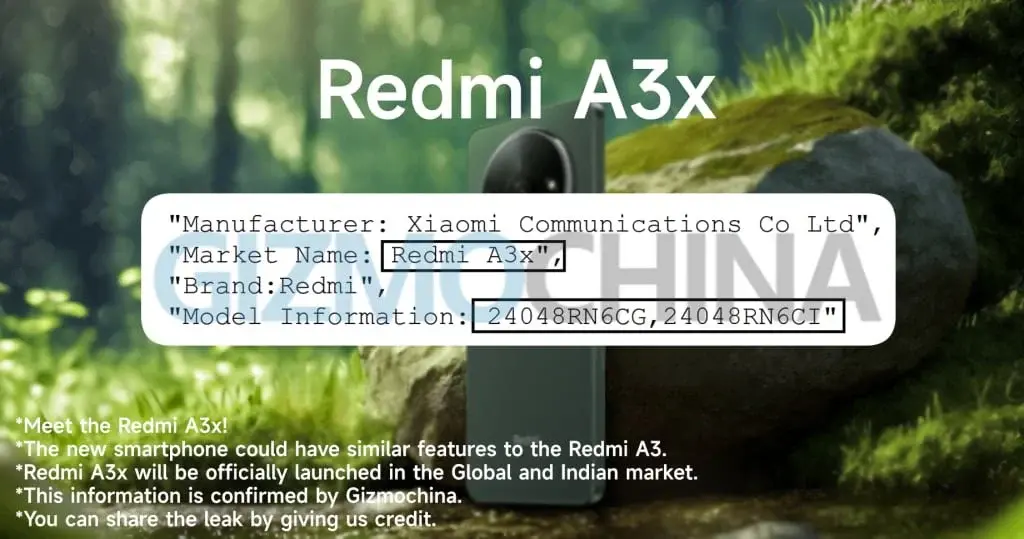
Xiaomi is currently in the process of developing its latest smartphone, the Redmi A3x. Recently, Gizmochina was able to catch a glimpse of the upcoming Redmi A3x, confirming its imminent release in India. While specific details regarding the smartphone's specifications remain undisclosed, it is anticipated that the Redmi A3x will offer comparable features to its predecessor, the Redmi A3.
Anticipated Arrival of Redmi A3x in April
Building on the legacy of the Redmi A3, known for its resemblance to the Redmi A2 in terms of specifications, the Redmi A3x is designed to cater to users primarily seeking basic communication functionalities such as calls, text messages, and standard internet usage. Unlike high-end smartphones, the Redmi A series prioritizes practical everyday utility. With the impending launch of the Redmi A3x, consumers are eager to discover what this latest model will bring to the table.
Exploring Redmi A3x
The Redmi A3x bears the model numbers "24048RN6CG" and "24048RN6CI," with the initial digits "2404" hinting at an expected unveiling in April 2024. Furthermore, the suffixes "G" and "I" in the model numbers indicate the intended regions for the device's sale, including the Global and Indian markets. While specific features of the Redmi A3x remain shrouded in mystery, it is anticipated that this new addition will maintain the familiar attributes found in the Redmi A3. Stay tuned for further updates on the Redmi A3x!
The competition for the next generation of mobile connectivity is intensifying as Xiaomi joins OPPO and Vivo in embracing 5.5G technology. As per a recent leak from Digital Chat Station, Xiaomi is gearing up to introduce 5.5G enhancements through Over-the-Air (OTA) updates, potentially targeting devices running on the Snapdragon 8 Gen 3 chipset. China Mobile recently conducted tests on the Xiaomi 14 Ultra, achieving impressive speeds of up to 5132 Mbps.
Embracing 5.5G Technology
5.5G, also referred to as 5G-A, serves as a link between current 5G networks and the upcoming 6G era. It brings about substantial enhancements such as a tenfold increase in download speeds exceeding tens of gigabits per second, reduced latency, enhanced positioning, and improved network reliability compared to its predecessor.
Most smartphones featuring the latest Snapdragon 8 Gen 3 and Dimensity 9300 processors have the capability to support 5.5G. This news follows OPPO’s announcement of complete 5.5G support for its Find X7 series and Vivo unveiling their initial range of compatible devices.
A Glimpse into Xiaomi’s Future Plans
Apart from smartphones, Xiaomi appears to be eyeing the future of connected cars. A recent patent application uncovered by Tianyancha indicates Xiaomi’s interest in vehicle-to-satellite communication. This technology could potentially enhance satellite communication quality and reliability in Xiaomi vehicles, offering benefits like improved navigation and emergency response features. However, further clarification is required on whether this functionality will be integrated into upcoming Xiaomi models or offered as an upgrade for the recently launched Xiaomi SU7.
While the notion of satellite-connected cars is not entirely new, Chinese automaker Geely Holding recently deployed 11 low-earth orbit satellites through its subsidiary Geespace. These satellites form part of the "Geely Future Mobility Constellation" network, aimed at integrating communication, navigation, and remote sensing for autonomous vehicles.
Geely’s car models like the Zeekr 001 FR and Zeekr 007 come equipped with built-in satellite communication capabilities, enabling precise positioning and connectivity with consumer electronics. The satellites also provide AI remote sensing functions, delivering high-resolution imaging data. Geely’s ambitious goal is to have 72 satellites in orbit by 2025, with a vision to expand the constellation to a total of 240 satellites.