
Tag: VR

  • Steam Frame Launching Soon: More Units Reach US Warehouses

    Steam Frame Launching Soon: More Units Reach US Warehouses

    Key Takeaway

    – Valve hardware shipments (Steam Frame and Steam Machine) have arrived in US warehouses.
    – Launch timeline has shifted from 2026 to “this summer,” with a possible June 29 release.
    – Steam Frame may launch earlier than Steam Machine, possibly by end of June.
    – Pricing remains undecided due to high component and DRAM costs affecting strategy.
    – Steam Controller released on time at an acceptable price since it doesn’t require RAM.


    Reports has emerged that shipments of the Steam Frame have reportedly made its way to the country as well, following earlier reports of Steam Machine shipments reaching the US. The same leaker who has been watching these developments closely provided this information, giving another hint at a imminent launch.

    Leaker Reveals Shipment Details

    Leaker Brad Lynch posted a screenshot showing shipments of “Virtual Reality Devices” that have reached Valve’s USA warehouses, according to the source. These shipments follow similar patterns to past ones and is dated June 10 for the “Virtual Reality Devices” and June 3 for the “Game Console.” This comes right after Valve updated its release timeline for the Steam Machine and Steam Frame, changing it from ‘2026’ to ‘this summer.’

    Imminent Launch Speculation

    Everything is pointing towards a imminent launch, with the newest speculation hinting at June 29 as the date. Valve has until August or September to release the new hardware given the summer 2026 timeline though. It could be that Valve releases the Steam Frame sooner, maybe by the end of this month, and then waits a bit longer for the Steam Machine to follow.

    Pricing Uncertainties and Market Conditions

    The devices still have unclear pricing, and Valve is having to think long and hard before making the call due to this issue. Because of the current market condition, with component prices going through the roof especially for DRAM, Valve was forced to change its original strategy. This explains why the Steam Controller, which doesn’t require any RAM, was launched on time at a price point people could accept.

    Source Details

    According to Brad Lynch on X, the information has been confirmed through these shipment records. The leaker continues to provide updates as the situation develops further. Valve appears to be moving forward with their plans despite the challenging market environment, though final pricing remains a big question mark.

    Sources
  • Steam Frame Leak: First Look at Valve VR Headset Tutorial

    Key Takeaway

    – Steam Frame “Welcome Tour” footage appears authentic and matches backend files, though unconfirmed.
    – Software interface is based on SteamOS, resembling Big Picture Mode.
    – Prompt about PC connection suggests Steam Frame will support standalone mode.
    – Headset still uses old codename “Deckard” in software, indicating active development.
    – Community reaction is positive despite placeholder text and unfinished UI elements.


    New Steam Frame Footage Surfaces

    Shortly after Valve confirmed that both the Steam Machine and Steam Frame are still planned for a summer launch, the first footage of the “Steam Frame Welcome Tour” appeared on Reddit. The video appears to show the initial setup tutorial users will see when setting up the headset for the first time. The authenticity of the footage has not been officially confirmed. According to thread creator u/Goggodboss, the video was captured using a Valve Index. However, since the material appears authentic and matches previously discovered Steam backend files, much of the community considers it genuine.

    A Detailed Look At The Software

    The footage provides the most detailed look yet at the headset’s software. The interface is clearly based on SteamOS and the Steam Deck experience, closely resembling Steam’s familiar Big Picture Mode. Part of the controller setup can be seen, followed by an explanation of how to open and dismiss the interface. One particularly notable detail is a prompt asking whether the VR headset should be connected to a PC. This supports the previous assumption that the Steam Frame will also work in standalone mode and will not require a computer at all times.

    Placeholder Details And Community Reaction

    It is also worth noting that the Steam Frame still appears in parts of the Welcome Tour under its old codename, “Deckard”, which has been circulating in leaks and datamines for years. Placeholder text and unfinished UI elements are visible as well, suggesting that the software is still in development. Even so, the community has reacted largely positively and seems pleased by the renewed interest surrounding the Steam Frame. The video does not reveal any major new information, but it does provide the clearest visual preview yet of Valve’s VR headset software.


    Sources

  • Nanoscale OLEDs: Scientists Shrink OLED Pixels to 300 nm

    Nanoscale OLEDs: Scientists Shrink OLED Pixels to 300 nm

    Key Takeaways

    1. The smallest commercially available pixels are currently about 5 x 5 micrometers, but researchers have created OLED pixels as small as 300 nanometers².
    2. Smaller pixels could eliminate the screen-door effect (SDE) in VR and augmented reality glasses, potentially leading to displays with billions of pixels.
    3. The new 300 nm² pixels produce orange light and shine as brightly as larger OLEDs, but additional technology is needed for efficiency and to prevent short circuits.
    4. The lifespan of the new pixels has only been tested for 2 weeks, compared to traditional OLEDs that last 8 to 13 years, and the color range is currently limited to orange.
    5. Future developments aim to expand the color range to full RGB and improve efficiency, with potential applications in projectors and ultra-high-resolution displays integrated into eyewear by the end of the decade.


    As of now, the smallest pixels in displays that can be bought commercially are about 5 x 5 micrometers. This size might seem tiny, but when used in VR or augmented reality glasses, some people might still see the annoying screen-door effect (SDE). Reducing the pixel size could help, but how much smaller do we need to go? Would pixels measuring 300 x 300 nanometers be sufficient to eliminate SDE? VR headsets with such tiny pixels could be on the market soon, as a group of researchers at Julius-Maximilians-Universität Würzburg in Germany have successfully reduced the size of OLED pixels to just 300 nanometer². Such a minuscule size could mean that 1080p displays would only be 1 x 1 millimeters, suggesting that future VR/AR glasses might have billions of pixels.

    Research Findings

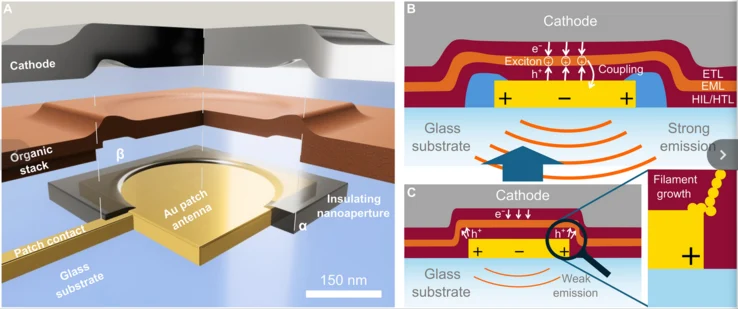
    The German scientists shared their results in the Science Advances journal, highlighting that the 300 nm² pixel produces orange light and shines as brightly as a standard 5 nm² OLED. However, making the light-emitting diode smaller alone wouldn’t ensure good efficiency. The researchers had to add a gold cuboid antenna that measures 300 x 300 x 50 nm and also ensure that the electric field currents wouldn’t push the gold atoms into the optically active materials, which could cause short circuits in the pixel. To achieve this, they created an insulation layer on top of the antenna, featuring a round opening with a 200 nm diameter right in the center.

    Future Developments

    The pixels have been evaluated for only 2 weeks without any problems, which is just a small part of the lifespan of traditional OLEDs that can last between 8 to 13 years. Additionally, the color range is still limited, since the only color produced is orange. The team aims to broaden the color range to include the full RGB spectrum. Another goal is to improve efficiency, which is currently at a lowly 1%.

    It appears that the German team still has a lot of work ahead, and displays with such minuscule pixels may still be several years away. Projectors could also gain from this new tech, and by the end of this decade, we might witness nearly invisible displays with ultra high resolution that could be integrated into eyeglasses or even contact lenses.

    Source:
    Link