
Key Takeaways
1. The smallest commercially available pixels are currently about 5 x 5 micrometers, but researchers have created OLED pixels as small as 300 nanometers².
2. Smaller pixels could eliminate the screen-door effect (SDE) in VR and augmented reality glasses, potentially leading to displays with billions of pixels.
3. The new 300 nm² pixels produce orange light and shine as brightly as larger OLEDs, but additional technology is needed for efficiency and to prevent short circuits.
4. The lifespan of the new pixels has only been tested for 2 weeks, compared to traditional OLEDs that last 8 to 13 years, and the color range is currently limited to orange.
5. Future developments aim to expand the color range to full RGB and improve efficiency, with potential applications in projectors and ultra-high-resolution displays integrated into eyewear by the end of the decade.
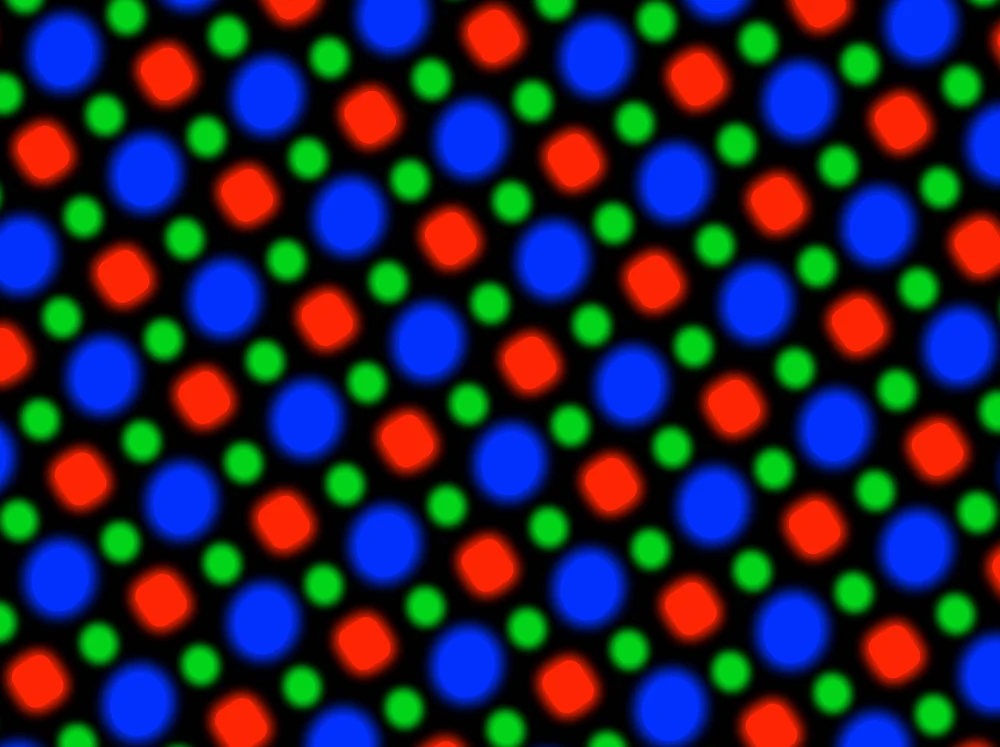
As of now, the smallest pixels in displays that can be bought commercially are about 5 x 5 micrometers. This size might seem tiny, but when used in VR or augmented reality glasses, some people might still see the annoying screen-door effect (SDE). Reducing the pixel size could help, but how much smaller do we need to go? Would pixels measuring 300 x 300 nanometers be sufficient to eliminate SDE? VR headsets with such tiny pixels could be on the market soon, as a group of researchers at Julius-Maximilians-Universität Würzburg in Germany have successfully reduced the size of OLED pixels to just 300 nanometer². Such a minuscule size could mean that 1080p displays would only be 1 x 1 millimeters, suggesting that future VR/AR glasses might have billions of pixels.
Research Findings
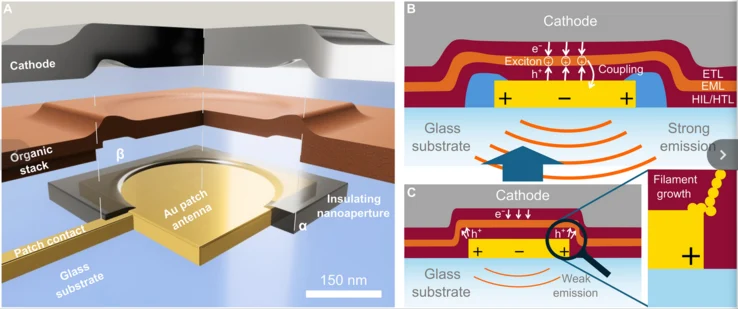
The German scientists shared their results in the Science Advances journal, highlighting that the 300 nm² pixel produces orange light and shines as brightly as a standard 5 nm² OLED. However, making the light-emitting diode smaller alone wouldn’t ensure good efficiency. The researchers had to add a gold cuboid antenna that measures 300 x 300 x 50 nm and also ensure that the electric field currents wouldn’t push the gold atoms into the optically active materials, which could cause short circuits in the pixel. To achieve this, they created an insulation layer on top of the antenna, featuring a round opening with a 200 nm diameter right in the center.
Future Developments
The pixels have been evaluated for only 2 weeks without any problems, which is just a small part of the lifespan of traditional OLEDs that can last between 8 to 13 years. Additionally, the color range is still limited, since the only color produced is orange. The team aims to broaden the color range to include the full RGB spectrum. Another goal is to improve efficiency, which is currently at a lowly 1%.
It appears that the German team still has a lot of work ahead, and displays with such minuscule pixels may still be several years away. Projectors could also gain from this new tech, and by the end of this decade, we might witness nearly invisible displays with ultra high resolution that could be integrated into eyeglasses or even contact lenses.
Source:
Link
Leave a Reply