Tag: Ryzen 5 9600X

  • Intel’s Core Ultra 5 250K Plus and 7 270K Plus Challenge AMD Ryzen

    Intel’s Core Ultra 5 250K Plus and 7 270K Plus Challenge AMD Ryzen

    Key Takeaways

    1. The Intel Core Ultra 200S Plus Arrow Lake Refresh CPUs, specifically the Core Ultra 5 250K Plus and Core Ultra 7 270K Plus, show significant performance improvements over previous models and AMD competitors.

    2. The Core Ultra 5 250K Plus offers excellent productivity performance, outperforming the Ryzen 5 9600X in multi-core tasks by 85% in Cinebench 2026.

    3. Gaming performance varies, with the Ryzen 5 9600X leading by 18% in some games, highlighting the importance of checking multiple reviews before purchasing.

    4. The Core Ultra 7 270K Plus competes closely with the Ryzen 9 9950X in application performance while being priced at $299 compared to the Ryzen’s $649.

    5. Both the Core Ultra 5 250K Plus and Core Ultra 7 270K Plus are recommended as budget-friendly options for users seeking versatile CPUs.


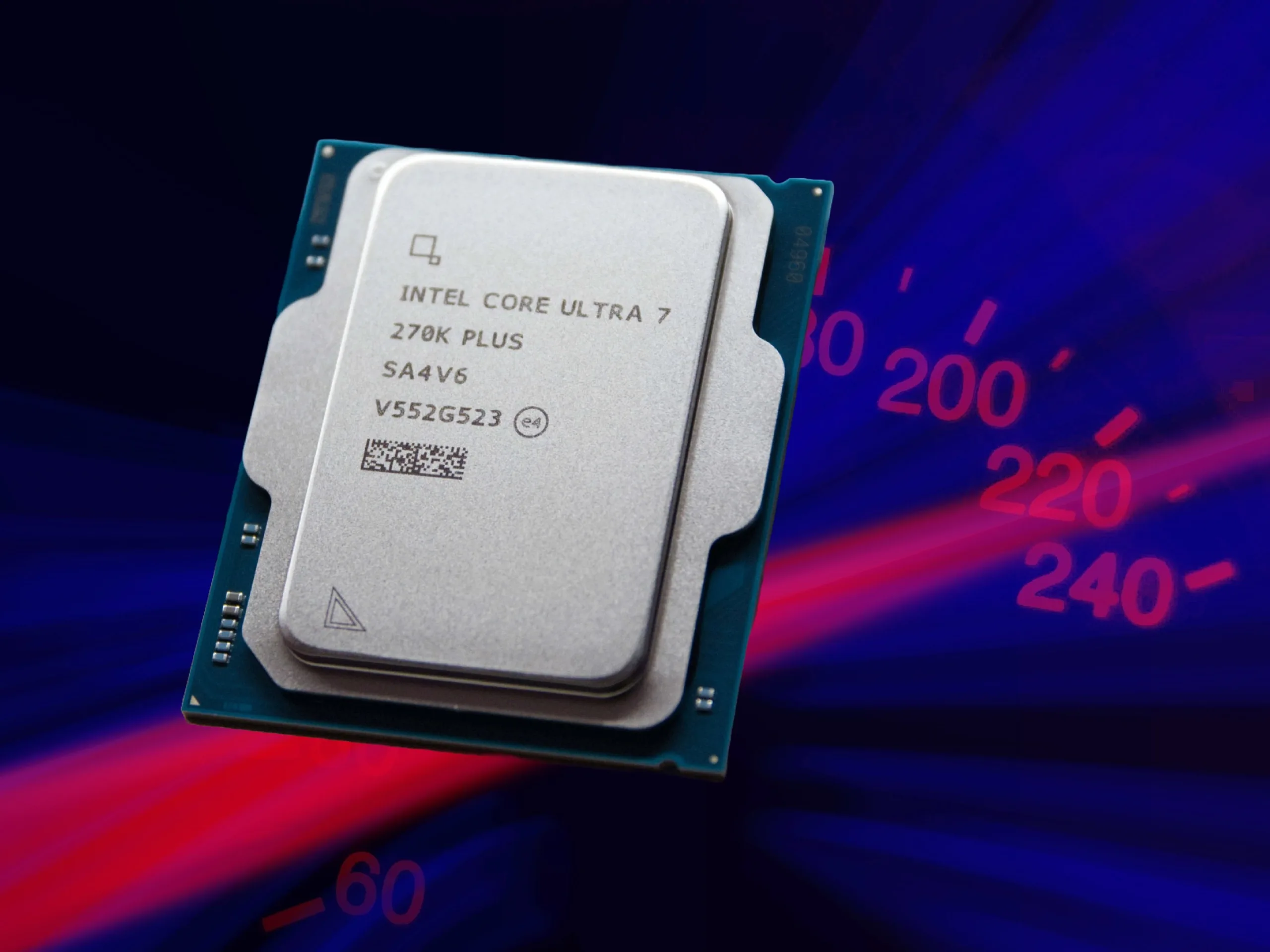
    Pre-launch leaks regarding the Intel Arrow Lake Refresh Core Ultra 200S Plus CPUs were not very thrilling. Nevertheless, Intel has seemingly excelled with the introduction of the new Core Ultra 200S Plus Arrow Lake Refresh CPUs. Both the Core Ultra 5 250K Plus and the Core Ultra 7 270K Plus show significant enhancements compared to the standard Core Ultra 5 and Core Ultra 7 Arrow Lake CPUs, proving to be better options than their AMD Ryzen rivals.

    Performance Highlights

    In our evaluation of the Core Ultra 5 250K Plus and the Core Ultra 7 270K Plus, we observed that these new Intel processors excel in productivity tasks, deliver improved gaming performance over the standard Core Ultra 200 CPUs, and are incredibly efficient in terms of power consumption. We commended the CPUs for their excellent price/performance ratio, as the Core Ultra 5 250K Plus and the Core Ultra 7 270K Plus are priced at $199 and $299, respectively.

    Various tech outlets, such as TechPowerUp and Hardware Unboxed, echo our views. For example, TechPowerUp indicates that the Core Ultra 5 250K Plus has effectively bridged the gaming performance gap that separated the Core Ultra 5 245K from the Ryzen 5 9600X. Now, the Ryzen 5 9600X and the Core Ultra 5 250K Plus perform similarly.

    Application Performance Gains

    Moreover, the Core Ultra 5 250K Plus outpaces the Ryzen 5 9600X in application performance. Tests conducted by Hardware Unboxed reveal an impressive 85% increase in multi-core performance for the Core Ultra 5 250K Plus compared to the Ryzen 5 9600X in Cinebench 2026, along with smaller yet significant performance improvements in other cases. It’s worth noting that the Cinebench 2026 result represents an optimal scenario where the software efficiently utilizes all available cores and threads.

    Thus, with the Intel Core Ultra 5 250K Plus, you’re acquiring a CPU that is competitively priced and comparable in gaming performance to the Ryzen 5 9600X, but it significantly outshines it in productivity tasks.

    Gaming Performance Variability

    However, in the games we tested using the Core Ultra 5 250K Plus, the Ryzen 5 9600X held a 18% performance lead. This highlights that CPU performance can vary greatly depending on the game. Therefore, it’s crucial to check multiple reviews before making a final buying decision.

    Similarly, the Core Ultra 7 270K Plus has also exhibited substantial improvements in gaming and application performance over the Core Ultra 7 265K. According to TechPowerUp, the Core Ultra 7 270K Plus now reportedly rivals the Ryzen 7 9700X in gaming scenarios.

    Competitive Pricing

    In terms of application performance, the Core Ultra 7 270K Plus is almost on the same level as the far pricier Ryzen 9 9950X. For instance, during our tests in Blender, both the Core Ultra 7 270K Plus and Ryzen 9 9950X delivered identical performance.

    In simpler terms, the $299 Core Ultra 7 270K Plus matches the performance of the Ryzen 9 9950X, which debuted at $649. Given these findings, it’s disappointing that Intel is supposedly not launching the flagship Core Ultra 9 290K Plus. Recent leaks suggest that this CPU significantly surpasses the Ryzen 9 9950X in both single-core and multi-core performance.

    To sum it up, if you’re working within a limited budget and searching for a versatile CPU, both the Core Ultra 5 250K Plus and the Core Ultra 7 270K Plus seem to be ideal choices.

    Buy the Intel Core Ultra 5 245K | Ryzen 5 9600X on Amazon

    Notebookcheck, TechPowerUp (1,2), Hardware Unboxed on YouTube, Teaser image source: Sebastian Bade for Notebookcheck, geralt on Pixabay, edited

    Source:
    Link


  • AMD Zen 6 IPC Leak: Exciting 3D V-Cache Boosts Performance

    AMD Zen 6 IPC Leak: Exciting 3D V-Cache Boosts Performance

    Key Takeaways

    1. Upcoming CPU Releases: AMD Zen 6 and Intel Nova Lake are set to be the leading desktop CPU designs, expected around 2026.

    2. Performance Improvements: Intel’s Nova Lake may achieve a 10% boost in single-core performance and up to 60% in multi-core performance compared to Arrow Lake-S CPUs, while Zen 6 is expected to have a 7 to 9% uplift in Floating Point IPC.

    3. Enhanced Cache Features: Zen 6 is rumored to support increased 3D V-Cache, potentially reaching 96 MB or more, with configurations that could allow up to 240 MB of L3 cache.

    4. Gaming Focus: Zen 6 is particularly aimed at gamers, with features like boost clocks exceeding 6 GHz and improved 3D V-Cache for better gaming performance.

    5. Current Options: AMD’s existing Zen 5 processors, like the Ryzen 5 9600X, are available at good prices for those who need upgrades before Zen 6 is released.


    AMD Zen 6 and Intel Nova Lake are likely going to be the leading new desktop CPU designs set to release around 2026. Intel’s Nova Lake is said to feature as much as 56 cores, new P/E cores, a low-power core island, and additional enhancements. On the other hand, AMD is gearing up for Zen 6, which promises significant upgrades, such as possibly astonishing boost clocks, increased core counts, and a state-of-the-art TSMC fabrication process.

    Performance Expectations

    Leaked information suggests that Intel’s Nova Lake might deliver a 10% boost in single-core performance and as much as 60% improvement in multi-core performance compared to Arrow Lake-S CPUs. Unfortunately, we don’t have similar details for Zen 6 yet, as leaks on its performance have been limited.

    Early IPC Insights

    Moore’s Law Is Dead has filled this void by disclosing initial IPC (Instructions Per Cycle) figures for Zen 6. According to a source within AMD, retail Zen 6 CPUs are expected to provide a 7 to 9% uplift in Floating Point (FP) IPC compared to Zen 5.

    However, the source warned MLID that this number is “NOT the final claimed IPC that will consider gaming and other PPC uplift”. Therefore, the leaker suggests that the ultimate IPC enhancement, which includes gains from gaming and other tasks, might reach or surpass 10%.

    Cache and Gaming Focus

    We have previously noted that Zen 6 could support more than just 12-core CCDs; it is also expected to feature increased 3D V-Cache. An AMD source for MLID has confirmed that Zen 6 will include 96 MB of 3D V-Cache. The source also indicated that Zen 6 CPUs could utilize multiple layers of 3D V-Cache, allowing for configurations like 240 MB of L3 cache if AMD opts for two layers of 3D V-Cache.

    Zen 6 is said to be particularly aimed at gaming. Features like boost clocks exceeding 6 GHz and enhanced 3D V-Cache align well with AMD’s supposed strategy. Consequently, those looking to upgrade next year can anticipate notable improvements in gaming performance from generation to generation.

    Current Options

    If the wait is too long, many of AMD’s current-generation Zen 5 processors are available at attractive prices. For example, the 6-core Ryzen 5 9600X, which has shown impressive performance in our evaluations, is currently a great deal on Amazon.

    In conclusion, please keep in consideration that the information shared by MLID remains unverified until AMD officially announces Zen 6. Since Zen 6 is at least a year away, it’s unlikely that AMD will provide any definitive information in the near future.

    Source:
    Link


  • Zen 6 CPU Cores Outperform Intel E-Cores in Power Efficiency

    Zen 6 CPU Cores Outperform Intel E-Cores in Power Efficiency

    Key Takeaways

    1. AMD’s Zen 6 “Olympic Ridge” processors may feature a maximum core count of 24, utilizing new 12-core CCDs.
    2. Each CCD will have an increased L3 cache of 48 MB and could reach clock speeds up to 6 GHz with TSMC’s N2X process.
    3. The addition of two Zen 5 LP cores in the Olympic Ridge CPUs promises energy-efficient performance, achieving 65-75% IPC and 50-60% clock speeds compared to full Zen 5 cores.
    4. Zen 5 LP cores are expected to have clock speeds between 2.5-3.5 GHz and consume 1 W or less, making them more efficient than Intel’s E-cores.
    5. The launch of Zen 6 processors is anticipated in the second half of 2026, so current leaks should be viewed with skepticism.


    It’s apparent to those keeping an eye on the latest Zen 6 leaks that AMD is gearing up for some major enhancements in their Zen 6 lineup. In particular, the “Olympic Ridge” desktop processors are rumored to see a maximum core count boost to 24, thanks to the introduction of 12-core CCDs. Additionally, there’s an increase in L3 cache, now totaling 48 MB for each CCD. The new Zen 6 CCDs will utilize TSMC’s advanced N2X process, which might enable the boost clock to hit a remarkable 6 GHz. The IOD chiplet is expected to use either the N3P or N6 process.

    Noteworthy Changes

    One intriguing detail that might be missed is the anticipated addition of two Zen 5 LP cores in the Olympic Ridge desktop CPUs. According to Moore’s Law Is Dead, these low-power cores are more than just a gimmick. The leak suggests that these Zen LP cores perform well while also being energy-efficient.

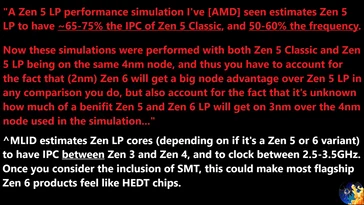
    In conversations with Tom, a source from AMD indicated that the Zen 5 LP cores can achieve approximately 65-75% of the IPC and 50-60% of the clock speeds compared to the full Zen 5 “Classic” cores. These performance assessments were reportedly done using the 4 nm process. Therefore, if AMD opts for N3P for the IOD die, the performance of the Zen 5 LP cores in Olympic Ridge CPUs could vary.

    Impressive Performance

    Based on these findings, MLID predicts that Zen 5 LP cores could reach clock speeds between 2.5-3.5 GHz with an IPC that falls “between Zen 3 and Zen 4.” What’s even more remarkable is that achieving this level of performance demands minimal energy.

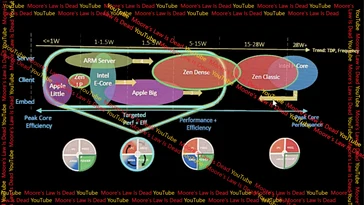
    According to one of AMD’s internal presentations shared by MLID, the Zen LP cores are categorized as “Client” products aiming for “Peak Core Efficiency.” The presentation shows that each Zen 5 LP core consumes 1 W or less, making them more efficient than Intel’s E-cores.

    In simpler terms, the Zen 5 LP cores not only provide solid performance to enhance multi-core tasks but also do so while being economical with power usage.

    Caution Ahead

    Even with these exciting updates, it’s crucial to remain cautious, as the Zen 6 processors won’t launch until the second half of 2026. Therefore, it’s wise to view MLID’s insights with some skepticism.

    Source:
    Link