Tag: Qualcomm

  • Qualcomm Snapdragon 8 Elite Gen 6 Pro Launch Date and Xiaomi 18 Update

    Qualcomm Snapdragon 8 Elite Gen 6 Pro Launch Date and Xiaomi 18 Update

    Key Takeaways

    1. Qualcomm plans to launch two versions of the Snapdragon 8 Elite Gen 6 platform to address rising component costs.
    2. The new chipsets are expected to be announced in September, similar to previous years.
    3. Qualcomm will introduce two ‘Elite’ chipsets: Snapdragon 8 Elite Gen 6 and Snapdragon 8 Elite Gen 6 Pro.
    4. The Snapdragon 8 Elite Gen 6 Pro will feature LPDDR6 RAM, enhanced cache, and a full-power GPU.
    5. Xiaomi 18 smartphones are expected to be the first devices to use these new chipsets.


    According to recent sources, Qualcomm is planning to divide its top-tier chipsets this year due to increasing costs of components. Specifically, several Chinese informants have suggested that Qualcomm is working on launching two versions of the Snapdragon 8 Elite Gen 6 platform later this year to replace devices like the Poco F8 Ultra and OnePlus 15 (current price: $899.99 on Amazon).

    New Chipset Announcements Expected

    In a post on Weibo, Digital Chat Station has indicated that Qualcomm is set to reveal its new flagship chipsets in September, similar to the announcements of Snapdragon 8 Gen 5 and Snapdragon 8 Elite Gen 5 back in September 2025. Unlike the previous year, Qualcomm is expected to introduce two ‘Elite’ branded chipsets, with the SM8950 and SM8975 reportedly being developed as the Snapdragon 8 Elite Gen 6 and Snapdragon 8 Elite Gen 6 Pro, respectively.

    Specifications of the New Variants

    Additionally, the leaker has suggested that the Snapdragon 8 Elite Gen 6 Pro will be the sole variant boasting LPDDR6 RAM, an ‘maxed-out cache’, and a ‘full-power GPU’. They also anticipate that Xiaomi 18 smartphones will be the first to feature both Snapdragon 8 Elite Gen 6 and Snapdragon 8 Elite Gen 6 Pro chipsets. Currently, Digital Chat Station believes that the standard Xiaomi 18 will be the only model using the regular Snapdragon 8 Elite Gen 6, however.

    Source:
    Link


  • Snapdragon 8 Elite Gen 6 Pro Expected to Reach 5GHz Clock Speed

    Snapdragon 8 Elite Gen 6 Pro Expected to Reach 5GHz Clock Speed

    Key Takeaways

    1. The Snapdragon 8 Elite Gen 6 may reach clock speeds of up to 6GHz, with a realistic target of 5.5GHz and a minimum of 5GHz.
    2. Qualcomm might use Heat Path Block (HPB) technology to manage heat generated by higher clock speeds, similar to Samsung’s implementation in the Exynos 2600.
    3. Two versions of the next-gen processor are expected: Snapdragon 8 Elite Gen 6 and Snapdragon 8 Elite Gen 6 Pro, with the Pro version likely reaching higher speeds.
    4. Both variants are anticipated to be manufactured using the TSMC N2P process, with the Pro model featuring a more powerful GPU and supporting LPDDR6 memory.
    5. Information is based on leaks and rumors, with no official confirmation from Qualcomm; a similar release schedule to the 8 Elite Gen 5, launched in September, may be expected.


    The Snapdragon 8 Elite Gen 5 is the newest top-tier processor from Qualcomm, and it powers devices like the Xiaomi 17 Ultra, OnePlus 15, and Realme GT 8 Pro. A recent leak from Fixed Focus Digital on Weibo hints that the upcoming processor generation will bring a significant increase in clock speed.

    Potential Clock Speeds

    According to the leak, speeds could potentially hit 6GHz, although the source suggests that 5.5GHz is a more realistic goal, with a minimum target of 5GHz. This marks a substantial improvement over the current Snapdragon 8 Elite Gen 5, which operates at 4.61GHz for its performance cores. However, the ‘for Galaxy’ version found in the upcoming Galaxy S26 series is projected to reach a maximum of 4.74GHz.

    Managing Heat

    Higher clock speeds come with the challenge of managing heat. To tackle this issue, the leak proposes that Qualcomm might implement Heat Path Block (HPB) technology. Samsung has utilized this technology in the Exynos 2600, which optimizes heat-transfer paths to disperse internal heat more efficiently. Samsung claims that HPB technology on the Exynos 2600 reduced thermal resistance by as much as 16%.

    Chipset Variants

    Earlier leaks have mentioned two versions of Qualcomm’s next-gen processor: a standard Snapdragon 8 Elite Gen 6 and a more advanced Snapdragon 8 Elite Gen 6 Pro. The leak does not clarify which version will reach the 5.5GHz speed, but it is likely that this capability will be exclusive to the Pro model.

    Both variants are expected to be based on the TSMC N2P manufacturing process. However, the Pro version is rumored to have a more powerful GPU and will support LPDDR6 memory.

    Keep in mind that this information is derived from leaks and rumors, lacking official confirmation from Qualcomm, so it should be taken with a grain of salt. Since the 8 Elite Gen 5 launched in September, a similar release schedule for the next series might be anticipated.

    Source:
    Link


  • Qualcomm Snapdragon 8 Elite Gen 6 May Use Samsung 2nm Process

    Qualcomm Snapdragon 8 Elite Gen 6 May Use Samsung 2nm Process

    Key Takeaways

    1. Qualcomm’s new flagship mobile chipset may be revealed in September or October, succeeding the Snapdragon 8 Gen 5 and Snapdragon 8 Elite Gen 5.
    2. The upcoming chipsets, codenamed SM8950 and SM8975, are expected to utilize TSMC’s N2P nodes, offering an 18% performance boost and over a third reduction in power consumption compared to the N3E node.
    3. There may be a collaboration with Samsung Foundry for the Snapdragon 8 Elite Gen 6 chipsets, introducing a potential Samsung 2 nm variant.
    4. The SM8950 and SM8975 are likely to be identified as Snapdragon 8 Elite Gen 6 and Gen 6 Pro, with support from N2P nodes.
    5. This Qualcomm and Samsung partnership could also result in a new Snapdragon 8 Elite Gen 5 variant for upcoming Samsung foldable devices.


    Qualcomm is still some time away from revealing its new flagship mobile chipset. Based on previous trends, the company might hold off until September or October to replace the Snapdragon 8 Gen 5 and Snapdragon 8 Elite Gen 5. However, Digital Chat Station has claimed to have acquired early information regarding two chipsets with codenames SM8950 and SM8975.

    Chipset Production Insights

    The leaker had previously anticipated that Qualcomm would produce these chipsets using TSMC’s N2P nodes. Internal analysis suggests that these N2P nodes could offer approximately an 18% performance improvement compared to TSMC’s N3E node, which is currently used in chipsets like the Snapdragon 8 Elite for Galaxy found in the Galaxy S25 Ultra (currently priced at $1,045 on Amazon). Additionally, this new node is expected to decrease power consumption by more than a third.

    Potential Foundry Collaboration

    Digital Chat Station also hints that TSMC might not be the sole foundry Qualcomm is using for its upcoming Snapdragon 8 Elite Gen 6 chipsets. According to the leaker’s Weibo post, this generation could include a Samsung 2 nm variant as well.

    The SM8950 and SM8975 variants are reportedly on track to be the Snapdragon 8 Elite Gen 6 and Snapdragon 8 Elite Gen 6 Pro, which will be supported by N2P nodes. Therefore, specific information about this unknown Samsung Foundry variant is likely to emerge later under a completely different codename. Interestingly, there is a possibility that this collaboration between Qualcomm and Samsung Foundry could lead to the introduction of a new Snapdragon 8 Elite Gen 5 variant for Samsung’s forthcoming foldable devices.

    Conclusion

    Digital Chat Station has provided some intriguing insights into Qualcomm’s future plans. With the potential for enhanced performance and new manufacturing partnerships, the upcoming Snapdragon chipsets could bring significant advancements to mobile technology.

    Source:
    Link


  • Qualcomm Snapdragon X2 Plus SoCs for Windows Laptops: 10 Cores, 35% Boost

    Qualcomm Snapdragon X2 Plus SoCs for Windows Laptops: 10 Cores, 35% Boost

    Key Takeaways

    1. Qualcomm introduced the Snapdragon X2 Elite and X2 Elite Extreme ARM SoCs for Windows laptops in September 2025, featuring third-generation Oryon CPUs and a powerful Adreno X2-85/90 iGPU.

    2. The Snapdragon X2 Plus series, revealed at CES 2026, includes 6-core and 10-core variants with varying CPU and iGPU performance while maintaining the same architecture as the X2 Elite models.

    3. Both Snapdragon X2 Plus models support up to 128 GB of LPDDR5x memory, Wi-Fi 7, Bluetooth 5.4, and can drive three 4K/144 Hz displays simultaneously.

    4. Qualcomm claims significant performance improvements for the Snapdragon X2 Plus, including 35% better single-core and 17% better multi-core performance compared to its predecessor.

    5. The Snapdragon X2 Plus is positioned to compete strongly against AMD and Intel CPUs, offering greater performance and power efficiency, with laptops expected to launch in the first half of 2026.


    Qualcomm recently unveiled the new Snapdragon X2 Elite and X2 Elite Extreme ARM SoCs designed for Windows laptops in September 2025. These advanced systems-on-chip (SoCs) include third-generation Oryon CPUs, an impressive Adreno X2-85/90 integrated GPU (iGPU), and a new Hexagon NPU that delivers 80 TOPS of performance. As anticipated, Qualcomm also plans to release several Snapdragon X2 variants suitable for lightweight Windows laptops that require less power.

    New Snapdragon X2 Plus SoCs at CES 2026

    During CES 2026, Qualcomm revealed the 6-core Snapdragon X2 Plus X2P-42-100 and the 10-core Snapdragon X2 Plus X2P-64-100 SoCs. While these chips share the same architecture as the Snapdragon X2 Elite and X2 Elite Extreme, they feature less powerful CPUs and less robust iGPUs.

    CPU Specifications

    In terms of CPU, the Snapdragon X2 Plus X2P-42-100 comes with 6 Nuvia cores, while the X2P-64-100 has 10 cores. The stronger 10-core Snapdragon X2 Plus includes 6 Prime Cores and 6 Performance cores, whereas the 6-core variant only has 6 Prime Cores. Both models offer a maximum single-core clock speed of 4.04 GHz for the Prime Cores, with a reported maximum multi-core frequency of 4 GHz. The total cache sizes are 34 MB for the 10-core and 22 MB for the 6-core Snapdragon X2 Plus.

    iGPU Performance

    Regarding the iGPU, both Snapdragon X2 Plus models are equipped with the X2-45 Adreno iGPU. The 10-core X2P-64-100 is clocked at a higher 1.7 GHz, while the 6-core X2P-42-100 operates at 0.9 GHz. Similar to its larger counterpart, the Adreno X2-45 supports DirectX 12.2 Ultimate, Vulkan 1.4, and OpenCL 3.0.

    Memory and Connectivity

    In terms of memory, both Snapdragon X2 Plus variants can support up to 128 GB of LPDDR5x-9523, featuring a 128-bit wide bus and 152 GB/s memory bandwidth. Additional specifications include connectivity options such as Wi-Fi 7 and Bluetooth 5.4, support for up to three Type-C ports, and the capability to drive three 4K/144 Hz displays at the same time.

    Qualcomm emphasized the performance of the Snapdragon X2 Elite and X2 Elite Extreme back in September 2025, and they are doing the same for the Snapdragon X2 Plus SoCs. If the first-party performance metrics are correct, the Snapdragon X2 Plus could pose a significant challenge to the Intel Panther Lake CPUs.

    Performance Claims

    According to Qualcomm, the 10-core Snapdragon X2 Plus X2P-64-100 achieves a 35% improvement in single-core performance and a 17% increase in multi-core performance compared to the 10-core Snapdragon X Plus, based on Geekbench 6.5 results. The Adreno X2-45 iGPU is said to be 29% faster than its predecessor in the 3DMark Steel Nomad Light benchmark. For the NPU, Qualcomm claims a remarkable 78% generational performance boost.

    The 6-core Snapdragon X2 Plus reportedly has the same single-core performance gains as its 10-core counterpart, while it enjoys a 10% improvement in multi-core performance and a significant 39% enhancement in GPU performance over the Snapdragon X Plus.

    Competitive Edge Over AMD and Intel

    Qualcomm is also highlighting considerable advantages over similarly positioned AMD and Intel CPUs. For example, the company asserts that the 10-core Snapdragon X2 Plus is approximately 3.5 times faster than the Core Ultra 7 265U in Geekbench 6.5 at “ISO power” and offers 28% superior peak single-core performance. Additionally, the Snapdragon X2 Plus X2P-64-100 is more power-efficient, requiring 4.6 times less power than the Core Ultra 7 265U to reach its peak performance.

    In terms of multi-core performance, Qualcomm boasts an astonishing 50% greater multi-core peak performance compared to the Intel Core Ultra 7 265U.

    Upcoming Availability

    Laptops equipped with the latest Qualcomm Snapdragon X2 Plus SoCs are anticipated to appear in stores in the first half of 2026. Therefore, we expect to see a variety of Snapdragon-based Windows laptops showcased at CES 2026.

    Source:
    Link



  • Qualcomm Launches Snapdragon 8 Gen 5 SoC with Oryon Cores

    Qualcomm Launches Snapdragon 8 Gen 5 SoC with Oryon Cores

    Key Takeaways

    1. High-Performance Design: The Snapdragon 8 Gen 5 is built on TSMC’s advanced 3 nm technology and features a 2P + 6E core configuration for improved performance and efficiency.

    2. Gaming and Display Capabilities: It supports a QHD+ display at 240 Hz and offers advanced gaming features like real-time ray tracing and compatibility with Unreal Engine 5.

    3. 5G and Connectivity: The chip includes the Snapdragon X80 5G modem, supporting Wi-Fi 7 and Bluetooth 6.0, along with the FastConnect 7900 module for enhanced connectivity.

    4. Camera and Video Features: It can handle a single 320 MP camera and record video at 4K 120 FPS, supporting multiple HDR formats and various video codecs.

    5. Audio Technologies: The Snapdragon 8 Gen 5 supports advanced audio features including aptX Adaptive, aptX Lossless, and Snapdragon Sound technologies for enhanced audio quality.


    Qualcomm has introduced its latest high-performance smartphone system-on-chip (SoC), known as the Snapdragon 8 Gen 5. This chip is a simplified version of the Snapdragon 8 Elite Gen 5 and is mainly designed for premium smartphones like the OnePlus 15R and Vivo X Fold 6. Similar to its Elite variant, it is built using TSMC’s advanced 3 nm technology.

    Core Specifications

    The Snapdragon 8 Gen 5 (SM8845) features a configuration of Oryon cores arranged in a 2P + 6E setup. The performance cores can reach speeds of up to 3.8 GHz, while the efficiency cores can go as high as 3.3 GHz. Although Qualcomm has not revealed the exact GPU, a previous Geekbench report indicated it is equipped with an Adreno 840. Additionally, it supports LPDDR5X-9600 RAM and UFS 4.1 storage solutions.

    Display and Gaming Capabilities

    The GPU is capable of driving a QHD+ display at 240 Hz or powering an external 8K display at 30 Hz. For gaming enthusiasts, it offers features like Real-time Hardware-Accelerated Ray Tracing with Global Illumination, compatibility with Unreal Engine 5, Snapdragon Game Super Resolution, and the Adreno Frame Motion Engine 2.1.

    Connectivity and Camera Features

    In terms of 5G capabilities, the Snapdragon 8 Gen 5 incorporates the Snapdragon X80 5G modem, which is a step down from the X85 found in the Snapdragon 8 Elite Gen 5. However, both chips utilize the FastConnect 7900 module, providing support for Wi-Fi 7, Bluetooth 6.0, and Bluetooth LE. The chip also includes the Spectra ISP, which can handle a single 320 MP camera and allows video recording at 4K 120 FPS and 1080p at 480 FPS.

    For recording, it supports various formats like Dolby Vision, Google Ultra HDR, HDR10, HDR10+, and HLG. The Snapdragon 8 Gen 5 is compatible with multiple video codecs, including AV1, Dolby Vision, H.264, H.265, HDR10, HDR10+, Hybrid Log Gamma (HLG), VP8, and VP9. On the audio front, it works with Qualcomm’s aptX Adaptive, aptX Lossless, aptX Voice, and Snapdragon Sound technologies.

    Qualcomm’s new SoC brings together powerful features and advanced technology, aiming to enhance the overall smartphone experience.

    Source:
    Link


  • Adreno X2: Snapdragon X2 Elite GPU Performance Benchmarks

    Adreno X2: Snapdragon X2 Elite GPU Performance Benchmarks

    Key Takeaways

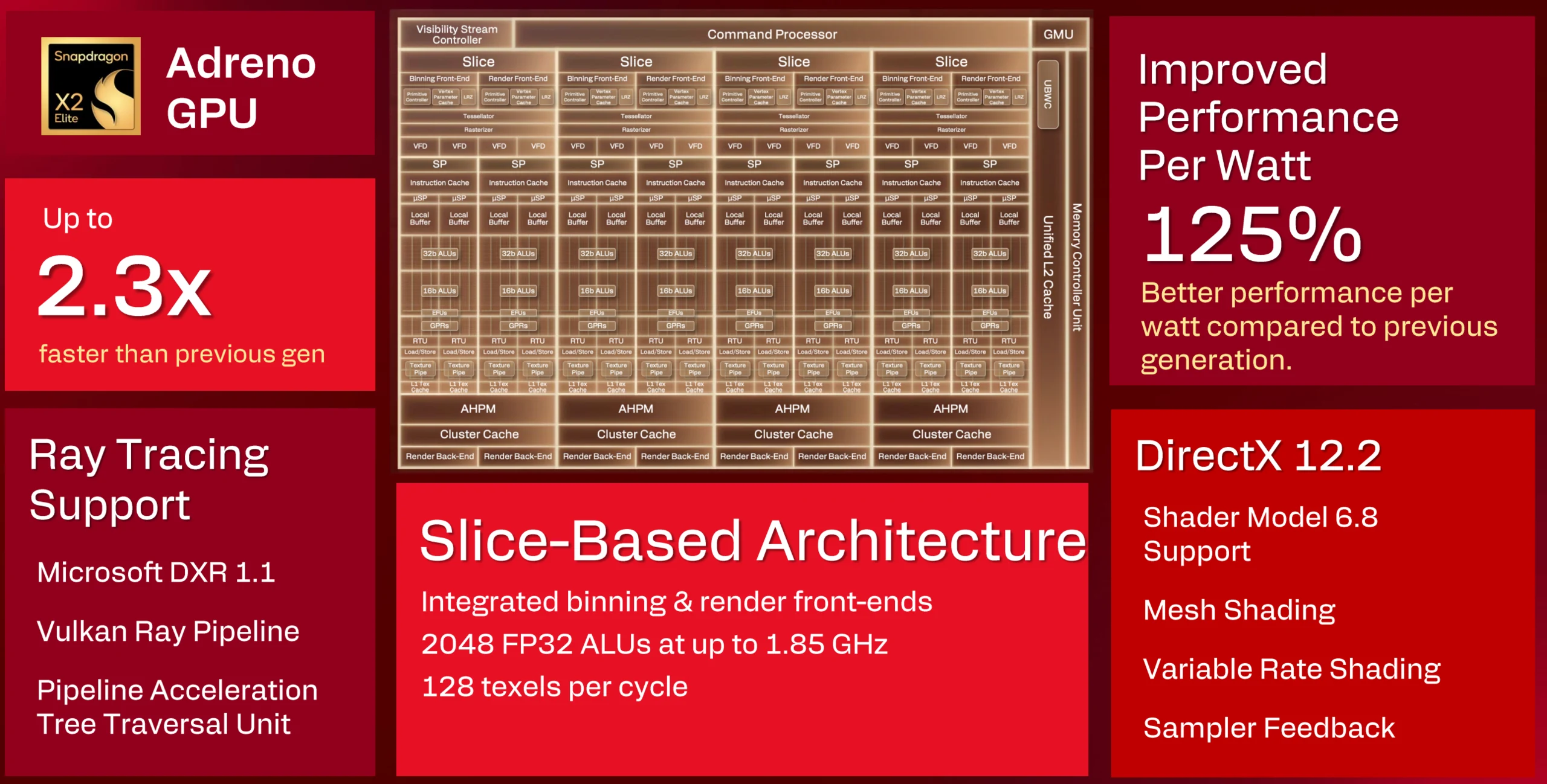
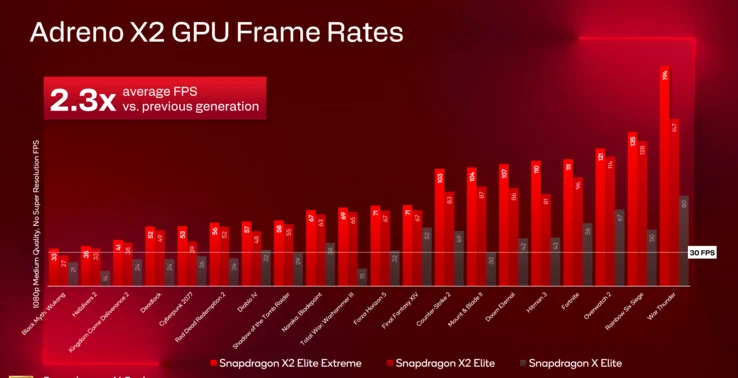
    1. The Adreno X2 GPU features four render slices, 2,048 ALUs, and is up to 2.3 times faster and 125% more efficient than its predecessor.

    2. It supports kernel-level anti-cheat software, allowing compatibility with a wider range of games secured by various security systems, except Riot’s Vanguard.

    3. The GPU has 21 MB of high-performance on-chip memory, enabling shader processors to access memory at speeds up to 4 TB/s.

    4. Initial benchmarks show the Adreno X2 performs well in lighter games, running Cyberpunk 2077 at nearly 60 FPS and outperforming its predecessor in various titles.

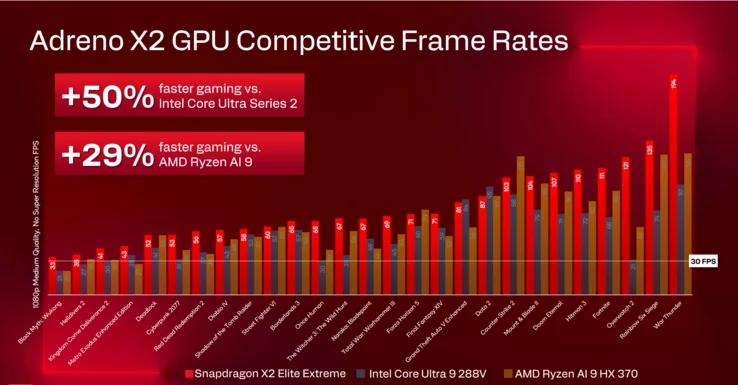
    5. The Adreno X2 competes favorably against Intel and AMD offerings, but its driver support remains a concern for future performance.


    Qualcomm has revealed new details about the Adreno X2 GPU that powers its Snapdragon X2 Elite CPUs. This GPU features four render slices and includes 2,048 ALUs, which is roughly comparable to 16 AMD WGPs. The company boasts that the Adreno X2 is up to 2.3 times quicker than the previous version while being 125% more efficient in terms of power usage. Additionally, it now has the capability to support kernel-level anti-cheat software, meaning that future laptops running on Snapdragon X2 Elite can handle a broader selection of games secured by Denuvo, Tencent ACE, GameGuard, BattleEye, and Uncheater. Notably, Riot’s Vanguard is absent from this list.

    High-Performance Memory

    The Adreno X2 achieves its performance with 21 MB of what Qualcomm refers to as ‘high-performance on-chip memory’. This memory acts like a block of L3 cache that all render slices can access (5.25 MB per slice). Qualcomm states that shader processors can reach this memory at speeds up to 4 TB/s. In other aspects, the GPU can tap into the SoC’s LPDDR5X-9523 RAM at speeds of up to 228 GB/s. Each render slice of the Adreno X2 contains two texture pipelines, four raytracing units, two render backends, and two shader processors.

    Benchmarking Performance

    Qualcomm has shared some initial benchmarks for the Adreno X2. While it may face challenges with graphically intensive games like Black Myth: Wukong, it performs exceptionally well in lighter games, like War Thunder, where it significantly outperforms its predecessor. The benchmarks also suggest that the Snapdragon X2 Elite Extreme X2E-96-100 will feature a noticeably stronger GPU compared to the Snapdragon X2 Elite Extreme X2E-86-100 and X2E-80-100. It can even run Cyberpunk 2077 at nearly 60 FPS, marking a significant improvement over the last generation.

    Competitive Edge

    When lined up against similar offerings from Intel and AMD, the Adreno X2 shows surprising strength. It competes closely with the Radeon 890M and Arc 140v across a variety of games such as Diablo IV, Metro Exodus, The Witcher 3: Wild Hunt, and again, War Thunder. These benchmarks are from first-party tests conducted on a Qualcomm reference device, not on a ready-to-market laptop. The real differences will be clearer when Snapdragon X2 Elite laptops are released in early 2026.

    To sum up, the Adreno X2 is looking to be a strong rival to the integrated GPUs from Intel and AMD. Despite the impressive performance figures on paper, the ongoing issue with Adreno GPUs has been their inadequate driver support, and it’ll be intriguing to see how Qualcomm addresses this challenge.


  • Qualcomm Announces Snapdragon 8 Gen 5 Launch Date Confirmed

    Qualcomm Announces Snapdragon 8 Gen 5 Launch Date Confirmed

    Key Takeaways

    1. The Snapdragon 8 Gen 5 launch has been delayed and is now set for November 26, 2025.
    2. It will initially launch in China before expanding to other regions, with devices like the OnePlus Ace 6T expected to use it.
    3. The Snapdragon 8 Gen 5 features a 2+6 CPU core configuration, with performance cores clocked at 3.8 GHz and efficiency cores at 3.36 GHz.
    4. It is equipped with the Adreno 840 GPU, which may operate at a lower frequency than the Elite version.
    5. The Snapdragon 8 Gen 5 is the first non-flagship chipset to use Qualcomm’s Orion cores, differing from previous models that used standard Arm Cortex IP.


    Initially planned to release at the same time as the Snapdragon 8 Elite Gen 5, the Snapdragon 8 Gen 5 has had its launch delayed by several weeks. It earlier appeared on Geekbench, showing performance that is on par with its Elite version for multi-core tasks, though it falls behind in single-core performance. It now has a confirmed date for its official release.

    Launch Date Announcement

    Qualcomm is set to unveil the Snapdragon 8 Gen 5 on November 26, 2025. Similar to the Snapdragon 8 Elite Gen 5, it will first launch in China before becoming available in other regions. One of the first devices expected to incorporate this chip is the OnePlus Ace 6T. Other upcoming models include the Vivo S50 and Vivo X Fold 6.

    Specifications Overview

    In terms of specifications, the Snapdragon 8 Gen 5 will closely resemble its Elite variant, featuring a 2+6 CPU core configuration. The performance cores (P cores) will be clocked at 3.8 GHz, while the efficiency cores (E cores) will run at 3.36 GHz. For graphics, it will be equipped with the same Adreno 840 GPU as the Snapdragon 8 Elite Gen 5, though it may operate at a lower frequency.

    New Core Architecture

    The Snapdragon 8 Gen 5 is notable as the first non-flagship chipset to utilize Qualcomm’s proprietary Orion cores. It is yet to be determined if these are the same cores found in the 8 Elite Gen 5. Previous models, like the Snapdragon 8s Gen 4, utilized standard Arm Cortex IP instead.


  • Qualcomm Snapdragon X Series to Support Android 16 Soon

    Qualcomm Snapdragon X Series to Support Android 16 Soon

    Key Takeaways

    1. Qualcomm is advancing support for Android 16 on its Snapdragon X Elite and X series processors.
    2. Internal updates reveal active development of firmware components essential for Android 16, including camera, Bluetooth, and audio subsystems.
    3. This development aligns with Google’s strategy to merge Chrome OS and Android, aiming for desktop-like features in Android 16.
    4. Upcoming devices like laptops, tablets, and mini PCs may run on Snapdragon X series processors with Android in the near future.
    5. Qualcomm is also working to support Android 16 on previous generation Snapdragon X series processors, but next-gen processors are not yet compatible.


    Qualcomm is reportedly making strides to support the upcoming Android 16 on its Snapdragon X Elite and X series processors. According to a tip shared by @Jukanlosreve on X, the company has updated its internal source repository for “Purwa,” which is the codename for the X series.

    Firmware Components Indicate Progress

    The screenshot that was shared highlights manifests for various firmware components crucial for the Android build environment. This includes sections for the camera subsystem, Bluetooth, and audio subsystem. Such details point towards Qualcomm’s active development efforts for Android 16 compatibility.

    Expectations Align with Google’s Vision

    This news aligns well with prior expectations following Google’s announcement about merging Chrome OS and Android. Google has rolled out desktop-oriented features in Android 16, yet the basic version of the mobile operating system still lacks a true desktop interface.

    If this information proves accurate, we could see laptops, tablets, and mini PCs running on Snapdragon X series processors and Android in the near future. This would present an intriguing alternative in the Arm64 development space that Qualcomm has been part of since launching the Snapdragon X CPUs (HP OmniBook 5 with X1P-42-100 curr. $549.99 on Amazon).

    Support for Older Generations

    Additionally, it’s worth noting that the screenshot indicates Qualcomm is working to add Android 16 support to the previous generation of Snapdragon X series processors. However, the next-gen processors are reportedly not compatible with Android just yet.


    Source:
    Link


  • Snapdragon 8 Elite Gen 6 Leak: Standard & Pro Variants with N2P GPU

    Snapdragon 8 Elite Gen 6 Leak: Standard & Pro Variants with N2P GPU

    Key Takeaways

    1. Qualcomm’s upcoming Snapdragon 8 Elite Gen 6 series will have two versions: Standard and Pro.
    2. Both versions will use third-generation architecture and TSMC’s N2P fabrication technique, but the Pro variant will have better GPU performance and support for LPDDR6 memory.
    3. Qualcomm’s naming system for chips is confusing, with potential for non-flagship chips to carry the “Gen 5” tag and the introduction of a “Pro” label for Gen 6.
    4. The new Snapdragon 8 series is expected to feature a 2+3+3 CPU configuration for improved efficiency and performance.
    5. The advanced N2P manufacturing process is likely to reduce energy consumption in upcoming flagship smartphones.


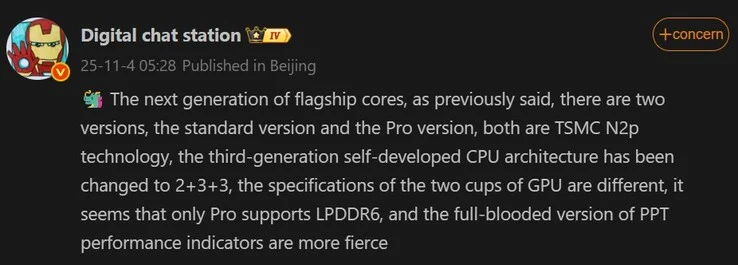
    New insights from the well-known leaker Digital Chat Station (DCS) hint that Qualcomm’s next high-end chip could be available in two different versions. The source shared this information on Weibo, indicating that the Snapdragon 8 Elite Gen 6 series might come in both Standard and Pro configurations.

    Processor Specifications

    According to DCS, both of the upcoming mobile processors will utilize the same third-generation architecture. They will also be built using TSMC’s N2P fabrication technique. The Pro variant, however, will boast stronger specifications, including enhanced GPU performance and compatibility with LPDDR6 memory.

    Naming Confusion

    Qualcomm has a history of creating a rather perplexing naming system for its chips. The company transitioned from the Snapdragon 8 Gen 3 to the Snapdragon 8 Elite Gen 5, and there’s speculation that it will apply the “Gen 5” tag to a non-flagship chip this year. This could leave smartphone consumers bewildered, especially with the introduction of a “Pro” label for Gen 6.

    Future Expectations

    Despite the confusing naming conventions, the next-generation Snapdragon appears to be quite promising. Qualcomm’s forthcoming 2+3+3 CPU configuration is anticipated to enhance both efficiency and performance. Moreover, employing TSMC’s advanced N2P manufacturing process is likely to lower energy usage in the next series of flagship smartphones.

    Source:
    Link


  • Qualcomm Unveils Snapdragon 6s Gen 4 Chipset with Performance Boosts

    Qualcomm Unveils Snapdragon 6s Gen 4 Chipset with Performance Boosts

    Key Takeaways

    1. Qualcomm introduced the Snapdragon 6s Gen 4, an update to its mid-range chipset lineup.
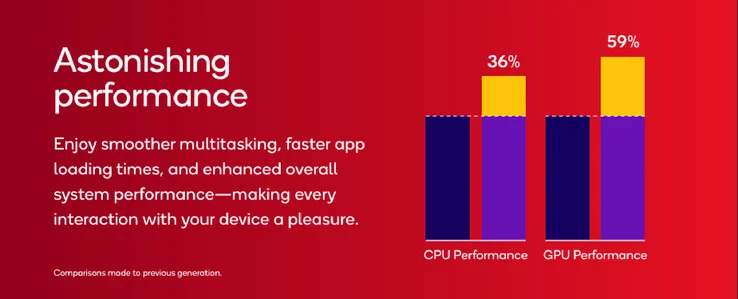
    2. The Snapdragon 6s Gen 4 features a CPU that is 36% faster and offers a 59% boost in GPU performance.
    3. This new model is designed to replace the Snapdragon 6s Gen 3, with similarities in CPU configuration and clock speeds.
    4. The Snapdragon 6s Gen 4 supports 144 Hz display at 1080p and includes Bluetooth 5.4 connectivity.
    5. The launch follows the recent rollout of the Snapdragon 8 Gen 5 and Snapdragon 8 Elite Gen 5.


    Qualcomm has made some updates to its mid-range chipset lineup by introducing a new model in the Snapdragon 6 series. This announcement comes after the rollout of the Snapdragon 8 Gen 5 and Snapdragon 8 Elite Gen 5 last month. The latest addition is the Snapdragon 6s Gen 4, which arrives more than eight months after the initial launch of the Snapdragon 6 Gen 4.

    Enhanced Performance

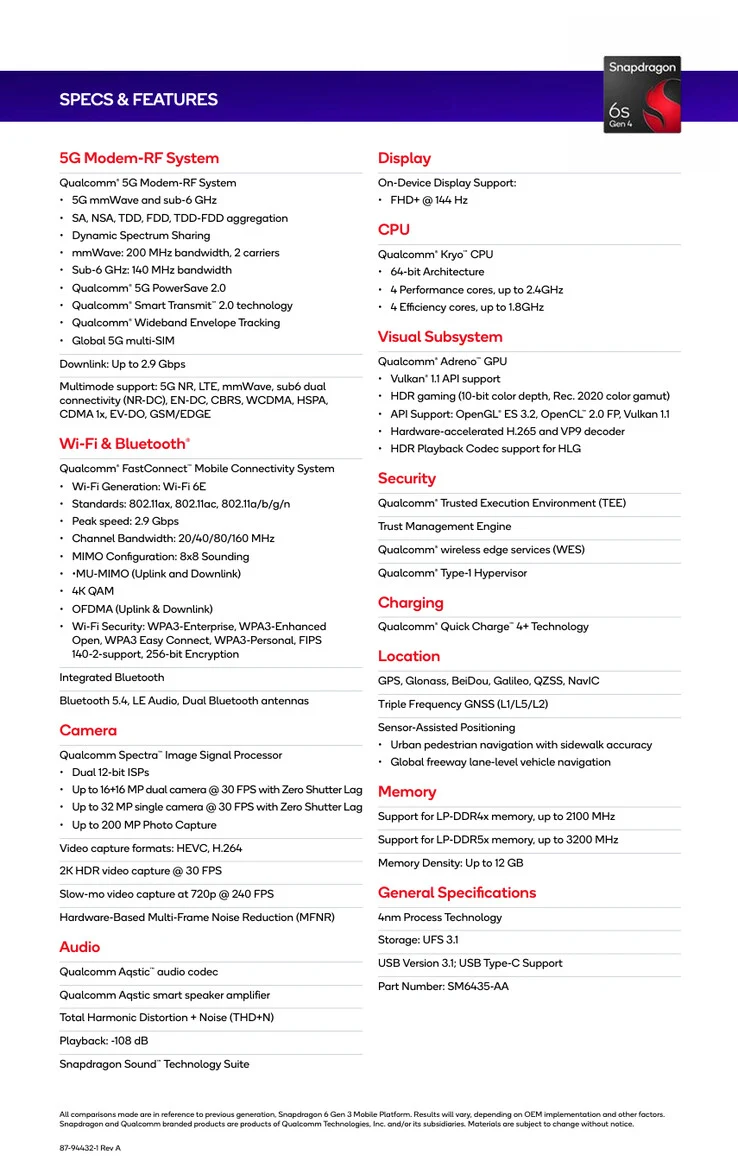
    As per Qualcomm, the new 4 nm chipset boasts a CPU that is 36% quicker, featuring four performance cores operating at 2.4 GHz and four efficiency cores functioning at 1.8 GHz. Even better, the Snapdragon 6s Gen 4 is claimed to offer a significant 59% boost in GPU performance compared to the “previous generation.” However, Qualcomm has not provided specific details about this improvement.

    Comparison with Previous Models

    It seems logical to compare this new model with the Snapdragon 6s Gen 3, which the Snapdragon 6s Gen 4 is designed to replace. Interestingly, the part number ‘SM6435-AA’ suggests that the Snapdragon 6s Gen 4 is related to the Snapdragon 6 Gen 1 (SM6450), which is used in several smartphones like the Honor Magic 7 Lite and Moto G Stylus 5G 2024, currently priced at $199 on Amazon.

    Similarities and Upgrades

    In fact, the Snapdragon 6s Gen 4 retains the same CPU configuration and clock speeds as its predecessor, the Snapdragon 6 Gen 3. However, it does offer a jump to 144 Hz display support at 1080p and includes Bluetooth 5.4 connectivity as well. For further information, check out Qualcomm’s product brief below.