Tag: Adreno 840

  • Qualcomm Launches Snapdragon 8 Gen 5 SoC with Oryon Cores

    Qualcomm Launches Snapdragon 8 Gen 5 SoC with Oryon Cores

    Key Takeaways

    1. High-Performance Design: The Snapdragon 8 Gen 5 is built on TSMC’s advanced 3 nm technology and features a 2P + 6E core configuration for improved performance and efficiency.

    2. Gaming and Display Capabilities: It supports a QHD+ display at 240 Hz and offers advanced gaming features like real-time ray tracing and compatibility with Unreal Engine 5.

    3. 5G and Connectivity: The chip includes the Snapdragon X80 5G modem, supporting Wi-Fi 7 and Bluetooth 6.0, along with the FastConnect 7900 module for enhanced connectivity.

    4. Camera and Video Features: It can handle a single 320 MP camera and record video at 4K 120 FPS, supporting multiple HDR formats and various video codecs.

    5. Audio Technologies: The Snapdragon 8 Gen 5 supports advanced audio features including aptX Adaptive, aptX Lossless, and Snapdragon Sound technologies for enhanced audio quality.


    Qualcomm has introduced its latest high-performance smartphone system-on-chip (SoC), known as the Snapdragon 8 Gen 5. This chip is a simplified version of the Snapdragon 8 Elite Gen 5 and is mainly designed for premium smartphones like the OnePlus 15R and Vivo X Fold 6. Similar to its Elite variant, it is built using TSMC’s advanced 3 nm technology.

    Core Specifications

    The Snapdragon 8 Gen 5 (SM8845) features a configuration of Oryon cores arranged in a 2P + 6E setup. The performance cores can reach speeds of up to 3.8 GHz, while the efficiency cores can go as high as 3.3 GHz. Although Qualcomm has not revealed the exact GPU, a previous Geekbench report indicated it is equipped with an Adreno 840. Additionally, it supports LPDDR5X-9600 RAM and UFS 4.1 storage solutions.

    Display and Gaming Capabilities

    The GPU is capable of driving a QHD+ display at 240 Hz or powering an external 8K display at 30 Hz. For gaming enthusiasts, it offers features like Real-time Hardware-Accelerated Ray Tracing with Global Illumination, compatibility with Unreal Engine 5, Snapdragon Game Super Resolution, and the Adreno Frame Motion Engine 2.1.

    Connectivity and Camera Features

    In terms of 5G capabilities, the Snapdragon 8 Gen 5 incorporates the Snapdragon X80 5G modem, which is a step down from the X85 found in the Snapdragon 8 Elite Gen 5. However, both chips utilize the FastConnect 7900 module, providing support for Wi-Fi 7, Bluetooth 6.0, and Bluetooth LE. The chip also includes the Spectra ISP, which can handle a single 320 MP camera and allows video recording at 4K 120 FPS and 1080p at 480 FPS.

    For recording, it supports various formats like Dolby Vision, Google Ultra HDR, HDR10, HDR10+, and HLG. The Snapdragon 8 Gen 5 is compatible with multiple video codecs, including AV1, Dolby Vision, H.264, H.265, HDR10, HDR10+, Hybrid Log Gamma (HLG), VP8, and VP9. On the audio front, it works with Qualcomm’s aptX Adaptive, aptX Lossless, aptX Voice, and Snapdragon Sound technologies.

    Qualcomm’s new SoC brings together powerful features and advanced technology, aiming to enhance the overall smartphone experience.

    Source:
    Link


  • Dimensity 9500 GPU Promises Major Ray Tracing Performance Boost

    Dimensity 9500 GPU Promises Major Ray Tracing Performance Boost

    Key Takeaways

    1. The Dimensity 9500 features a new Arm Cortex-X930 core, promising a 49% boost in single-core performance.
    2. The Drage GPU is 40% more power-efficient than the Immortalis-G925 and shows a 40% improvement in ray tracing performance.
    3. The Dimensity 9500 will include an Arm Mali-G1-Ultra MC12 GPU with 12 cores, maintaining the same core count as its predecessor.
    4. It competes with Qualcomm’s Adreno 840 and Samsung’s Xclipse 960, with early benchmarks indicating potential challenges for the latter.
    5. Current game titles utilizing the GPU’s ray tracing technology include Diablo Immortal, War Thunder, Honour of Kings, and Arena Blackout.


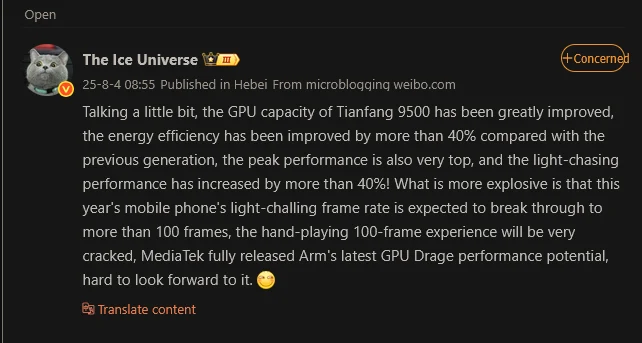
    Previous leaks have thoroughly examined the CPU capabilities of the Dimensity 9500, which features a new Arm Cortex-X930 core, suggesting a remarkable 49% boost in single-core performance. If we believe a recent leak by Ice Universe, the GPU, known as Drage, is also expected to perform well. Although its past Geekbench results were not impressive, this is typical for hardware still in the production phase.

    Improved Efficiency and Performance

    According to Ice, this GPU is 40% more power-efficient than the Immortalis-G925. Furthermore, it boasts a 40% enhancement in ray tracing performance and is said to achieve over 100 FPS in certain unspecified games. Currently, only a few titles such as Diablo Immortal, War Thunder, Honour of Kings, and Arena Blackout utilize this technology.

    GPU Specifications

    The previously mentioned Geekbench report revealed that the Dimensity 9500 will come equipped with an Arm Mali-G1-Ultra MC12 GPU. This is part of Arm’s wider effort to rebrand its mobile intellectual properties, which includes changing the names of Cortex CPU cores to Lumex. This GPU maintains 12 cores or 24 pipelines, similar to its predecessor.

    Competitive Landscape

    The Dimensity 9500 is up against tough rivals like Qualcomm’s Adreno 840 and Samsung’s Xclipse 960. While we don’t have much information on the Adreno 840, the Xclipse 960 has shown promising results in early benchmark leaks. However, as we often see with Xclipse GPUs, it may face limitations from a CPU that struggles to keep pace, as well as thermal issues due to the Samsung Foundry’s SF2 node.

    Source:
    Link


  • Snapdragon 8 Elite 2 Rumored to Outperform Snapdragon 8 Elite

    Snapdragon 8 Elite 2 Rumored to Outperform Snapdragon 8 Elite

    Key Takeaways

    1. Qualcomm’s Snapdragon 8 Elite 2 may be delayed until October, with ongoing updates shared by leaker Digital Chat Station.
    2. The chipset is expected to use TSMC’s N3P nodes for improved efficiency and will feature an Adreno 840 GPU, along with two prime and six performance CPU cores based on Oryon architecture.
    3. It will support ARM’s Scalable Matrix Extension 1 (SME 1) and Scalable Vector Extension 2 (SVE2), indicating a shift to ArmV9 architecture for enhanced machine learning capabilities.
    4. Performance expectations suggest the Snapdragon 8 Elite 2 could reach over 3.8 million points on AnTuTu V10, compared to 2.6 million for the Snapdragon 8 Elite.
    5. A 26% performance boost is anticipated between the Snapdragon 8 Elite and the Snapdragon 8 Elite 2, marking significant advancements in capability.


    The expected release of Qualcomm’s next-generation flagship chipset seems to be a bit delayed. Recent whispers suggest that the Snapdragon 8 Elite 2, also known as Snapdragon 8 Elite Gen 2, may not launch until autumn, with October being pointed out as the likely month. However, Digital Chat Station is continuing to share bits of info regarding the chipset on Chinese social media platforms.

    Specifications and Features

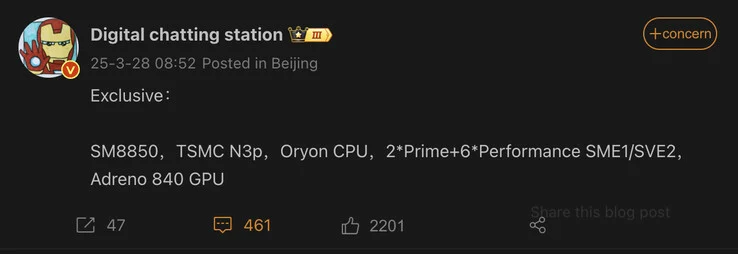
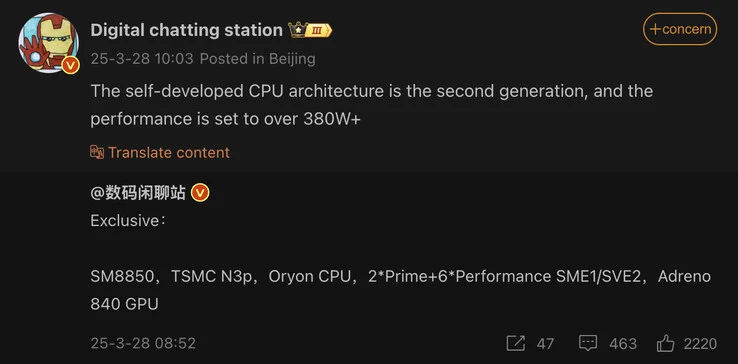
    To summarize, the leaker has previously indicated that Qualcomm is using TSMC’s N3P nodes for the Snapdragon 8 Elite 2, which is expected to be more efficient than the N3E node powering the Snapdragon 8 Elite. Additionally, this same source claims to have discovered that the chipset will come equipped with an Adreno 840 GPU, along with two prime and six performance CPU cores which are likely based on Qualcomm’s upcoming Oryon architecture.

    Machine Learning Enhancements

    Digital Chat Station also mentions that the Snapdragon 8 Elite 2 will incorporate support for ARM’s Scalable Matrix Extension 1 (SME 1) and Scalable Vector Extension 2 (SVE2), enhancing its machine learning capabilities. If this is accurate, it indicates that the Snapdragon 8 Elite 2 will utilize the ArmV9 architecture, while the Snapdragon 8 Elite relies on the earlier Armv8 architecture.

    Performance Expectations

    These advancements are expected to push the Snapdragon 8 Elite 2 beyond 3.8 million points on AnTuTu V10. For comparison, the Snapdragon 8 Elite has recorded a median score of 2.6 million in tests conducted so far using devices like the ROG Phone 9 Pro, OnePlus 13, and Nubia Z70 Ultra (currently priced at $769 on Amazon), among others. On the other hand, Qualcomm’s Snapdragon 8 Elite Reference Device achieved a score of 3 million in AnTuTu V10. Even if Digital Chat Station is talking about a reference device, reaching 3.8 million would signify a 26% performance boost between generations.

    Source:
    Link