Tag: Qualcomm

  • Qualcomm Snapdragon X Series Processor to Launch on April 24

    Qualcomm Snapdragon X Series Processor to Launch on April 24

    Qualcomm has unveiled its latest addition to the Snapdragon X line of processors, the Snapdragon X Elite, with further details gradually emerging about this new chipset. Additionally, there are discussions surrounding a Snapdragon X Plus variant, primarily aimed at more budget-friendly ARM-based Windows laptops.

    Teaser Video Teases Major Announcement

    Qualcomm has released a brief teaser video teasing a significant announcement related to its Snapdragon X processor line. The video, shared on the official Snapdragon X account, showcases a CPU chipset transforming into a 3D “X” with the caption "Stay tuned for 4/24."

    Speculations and Leaks

    While Qualcomm did not explicitly confirm the launch of Snapdragon X Elite and X Plus in the teaser, rumors suggest that the official unveiling might occur on the 24th of April. Recent leaks surrounding the Lenovo Yoga Slim 7 indicate that it could potentially house the Snapdragon X Elite chip, making it the first device to utilize Qualcomm’s new System on a Chip (SoC).

    Impressive Performance Metrics

    The Snapdragon X Elite chip is lauded for its dedicated AI functionalities for PCs, boasting an impressive 45 TOPS of NPU performance. Benchmarks indicate that it outperforms Apple’s M3 chip significantly on Geekbench, even matching the performance of Intel’s Core i7-13700HX, Core i9-13900H, and AMD’s latest Ryzen 9 8945HS mobile flagship in certain metrics.

    If these benchmark numbers translate into real-world performance, Qualcomm’s latest SoC could pose a substantial challenge to established players in the industry. Furthermore, Qualcomm has recently demonstrated its video editing capabilities in Davinci Resolve, hinting at potential exclusive AI features for Windows 11 on Snapdragon X Elite-powered devices.

    As the announcement date draws near, the tech community eagerly anticipates further insights into Qualcomm’s strategy for the Snapdragon X line in the upcoming days.

  • Latest Update: Qualcomm Developing New Mid-Range Mobile Processors

    Latest Update: Qualcomm Developing New Mid-Range Mobile Processors

    Qualcomm is reported by Android Headlines as currently developing three mid-range mobile processors under model numbers: SM4635, SM6650 and SM7635 – likely belonging to their Snapdragon 4, 6 or 7 series series depending on which conventions Qualcomm adheres to for their namesakes.

    Xiaomi Redmi Note 14 Pro will be the inaugural phone to feature Qualcomm’s mid-range chipset SM7635 chipset, known by its code name of "pitti." Meanwhile both SM6650 and SM7635 share this moniker; Roland Quandt had suggested in February that this may be Snapdragon 4 Gen 3, as details surfaced regarding "Kalpeni," an early test project with 6GB LPDDR4X RAM and 256GB UFS 3.1 storage for this particular chip compared with earlier iterations being identified by model numbers SM4375 or 4450 respectively

    Rumors And Predictions

    Rumors surrounding Qualcomm’s "volcano" processors SM6650 and SM7635 suggest they could take an approach similar to its Snapdragon 6 Gen 1 (SM6450) and 7s Gen 2 (SM7435) models (codenamed parrot), with similar specifications; Android Headlines predicted the latter may surpass Snapdragon 7+ Gen 3, thus solidifying Qualcomm’s position in mid-range SoC market; Xiaomi Redmi Note 14 Pro could feature these processors; though details surrounding these processors remain scarce at present – more information should soon become apparent as their release approaches.

  • Understanding the Snapdragon 8s Gen 3: Is the “s” for Small?

    Understanding the Snapdragon 8s Gen 3: Is the “s” for Small?

    Qualcomm unveiled the Snapdragon 8s Gen 3 (SM8635), positioning it as an affordable yet capable alternative to its flagship counterpart – the Snapdragon 8 Gen 3. The "s" variant offers simplified feature set intended to appeal to budget-minded buyers.

    Size and Configuration

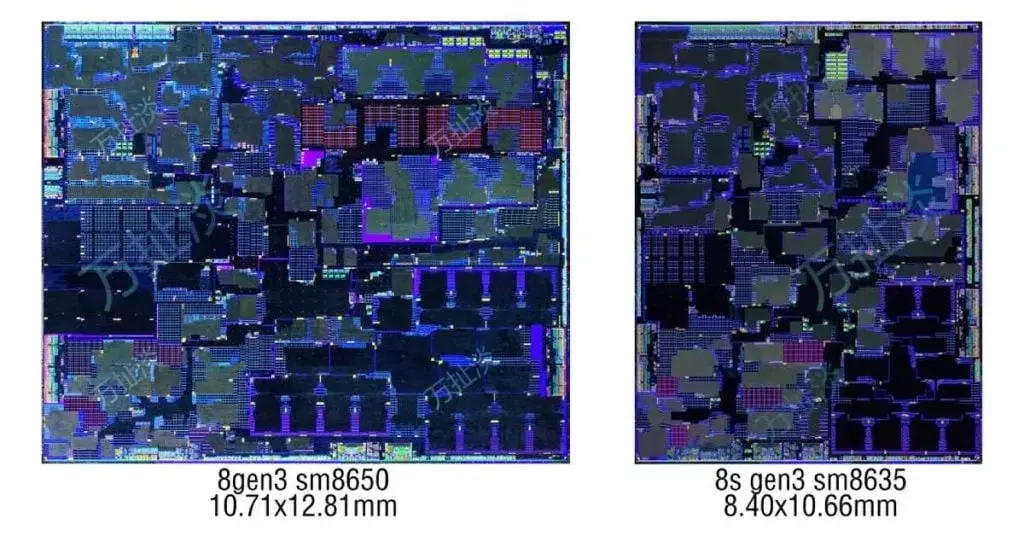
    A recent set of images published by ITHome show the dimensions of SoCs such as Snapdragon 8s Gen 3. Interestingly, its footprint measures 8.40×10.66mm which represents 34.73% less area compared to 10.71×12.81mm footprint of Snapdragon 8 Gen 3 SoC.

    Cache and Processing

    Alongside its physical size reductions, the Snapdragon 8s Gen 3 features a more modest cache configuration. Notably, L2 cache for its ultra-large X4 core has been cut back from 2MB to 1MB; similar changes were seen across L2, L3, and SLC sizes.

    Compare Specifications and Comparisons.

    While TSMC’s 4nm process enables Snapdragon 8 Gen 3, featuring multiple CPU cores with specific clock speeds, and various core configurations with different clock rates; Snapdragon 8s Gen 3 uses similar hardware but features different core configurations as well as less powerful Adreno 735 GPU. Furthermore, there may also be limitations with memory support, video capabilities and network speeds when compared with its premium counterpart.

    The Snapdragon 8s Gen 3 stands as a solid processor, likely providing sufficient performance for daily tasks. Its specs appear tailored towards making this an economical option for mid-range flagship smartphones.

  • Qualcomm Snapdragon X Plus: Windows laptops get what feature MacBooks lack

    Qualcomm Snapdragon X Plus: Windows laptops get what feature MacBooks lack

    As we prepare for the launch of laptops equipped with Snapdragon X Elite chips by mid-2024, Qualcomm is also contemplating offering more cost-efficient ARM-based Windows chip options such as Snapdragon X Plus.

    There Are Two Snapdragon X Plus SoC Variants

    According to recent leaks, Qualcomm appears to be creating two different variations of their Snapdragon X Plus System-on-Chip (SoC), which may offer advantages over Apple’s current MacBook series. These chips reportedly bear model numbers X1P44100 and X1P46100; “X Plus” chips can be distinguished from Snapdragon X Elite ones by using “X1E” instead of ‘X1P” when listing model numbers.

    Potential Features of Snapdragon X Plus

    Although exact details remain sparse, its nomenclature suggests that the Snapdragon X Plus may be a lesser version of its more robust sibling; possibly with reduced core counts similar to what Apple uses with their M series chips as a differentiating factor. Although not reaching the raw power of its more expensive sibling, the Snapdragon X Plus could prove ideal for affordable Windows laptops running ARM technology.

    Integration of Qualcomm Snapdragon X65 5G Modem.

    Qualcomm appears to be testing an important feature that would make Snapdragon X Plus laptops even more appealing: an integrated Snapdragon X65 5G modem. If successful implementation occurs, this would bring 5G-enabled Windows laptops onto the market – something Apple cannot compete with due to Apple’s absence in this particular segment of 5G laptops.

    Though an official release date for the Snapdragon X Plus smartphone hasn’t been set, considering its predecessor is anticipated for later 2024, we might expect its arrival later in 2019 or early in 2025 based on similar patterns as with its Snapdragon X Elite counterparts. At present, however, any predictions remain uncertain and timeline estimates should only be used as estimates at best.

  • Qualcomm S5 Gen 3 & S3 Gen 3 Sound Platforms Revealed for Next-Gen Audio

    Qualcomm S5 Gen 3 & S3 Gen 3 Sound Platforms Revealed for Next-Gen Audio

    Qualcomm has recently unveiled the S5 Gen 3 and S3 Gen 3 sound platforms, designed to elevate the audio experience on a variety of devices such as earbuds, headphones, and speakers. These platforms are set to bring cutting-edge sound quality to premium and mid-range audio products, incorporating state-of-the-art technologies and AI-driven improvements.

    S5 Gen 3 Platform: Enhancing Premium Audio

    The S5 Gen 3 platform, tailored for premium audio devices, delivers a notable enhancement in performance, boasting triple the computational power and fifty times the AI capacity compared to its predecessor. This platform introduces features like Adaptive Active Noise Cancellation and the Snapdragon Sound Technology Suite, ensuring top-notch listening experiences. With support for Snapdragon Sound featuring aptX Lossless and Bluetooth 5.4, users can expect seamless music streaming and connectivity.

    S3 Gen 3 Platform: Elevating Mid-Range Audio

    On the other hand, the S3 Gen 3 platform caters to mid-range devices, enriching audio experiences with functionalities such as hearing enhancement and spatial audio. It also supports Snapdragon Sound with aptX Lossless 24-bit 48kHz music streaming and Bluetooth 5.4 connectivity for a well-rounded audio experience.

    Both platforms come equipped with advanced features like enhanced ANC, high-quality DAC for crystal-clear sound reproduction, and LE Audio for innovative audio-sharing capabilities. These new sound platforms are slated to make their way into upcoming mid-range and premium audio devices, promising users an audio experience like never before. Stay tuned for further updates on these exciting developments.


    Qualcomm S5 Gen 3 & S3 Gen 3 Sound Platforms Revealed for Next-Gen Audio
  • Qualcomm’s Latest Innovation: Snapdragon X Elite Chip

    Qualcomm’s Latest Innovation: Snapdragon X Elite Chip

    For more than fifteen years, Qualcomm has been in pursuit of a successful Arm-based Windows laptop that excels in performance and battery life. Despite encountering a few victories along the journey, devices powered by Qualcomm have often fallen short of meeting mainstream expectations, leaving Intel and AMD as the primary contenders in the market.

    Qualcomm’s Latest Innovation: Snapdragon X Elite Chip

    Qualcomm’s newest offering, the Snapdragon X Elite chip, introduces a compelling feature: the capability to run existing x86/64 games without necessitating developers to adapt them for Arm architecture. This innovation has the potential to revolutionize the landscape of Windows on Arm devices.

    Rising to Meet Industry Standards

    Apple’s transition to M-series silicon chips has raised the industry benchmark significantly. The exceptional performance and efficiency gains of Apple’s chips, even when running legacy x86 software via Rosetta 2 emulation, have set a high standard. In response, Windows on Arm endeavors to bridge the gap, with Qualcomm’s Snapdragon X Elite poised to transform the user experience.

    Advancements in Emulation and Support

    Qualcomm emphasizes its collaboration with game developers to ensure smooth compatibility of their titles on forthcoming Snapdragon-powered laptops. Leveraging advanced emulation techniques, the Snapdragon X Elite chip enables x86/64 games to operate at near-optimal speeds. Qualcomm asserts that its Adreno GPU drivers fully endorse contemporary graphics standards, minimizing performance compromises during emulation.

    If Qualcomm’s assertions hold true, the Snapdragon X Elite chip could herald a new era for Arm-based laptops. Despite potential uncertainties associated with unreleased hardware, Qualcomm’s confidence in its product instills a sense of assurance. However, challenges may arise with games utilizing kernel-level anti-cheat software or relying heavily on AVX instruction sets. Nonetheless, the successful implementation of Qualcomm’s vision could mark a significant milestone for Windows on Arm.


    Qualcomm's Latest Innovation: Snapdragon X Elite Chip
  • Introducing Snapdragon 7+ Gen 3 SoC: On-Device GenAI Capabilities

    Introducing Snapdragon 7+ Gen 3 SoC: On-Device GenAI Capabilities

    Qualcomm recently unveiled the Snapdragon 8s Gen 3 processor, a streamlined version of the flagship Snapdragon 8 Gen 3. Now, the American chipmaker has introduced a new mid-range System on Chip (SoC) that joins the Snapdragon 7 Gen 3 lineup. The latest addition is the Snapdragon 7+ Gen 3, serving as the successor to last year's Snapdragon 7+ Gen 2. This new chipset brings various enhancements, particularly in the realm of artificial intelligence (AI), indicating that devices powered by this SoC will boast advanced AI features.

    Snapdragon 7+ Gen 3 Unveiled

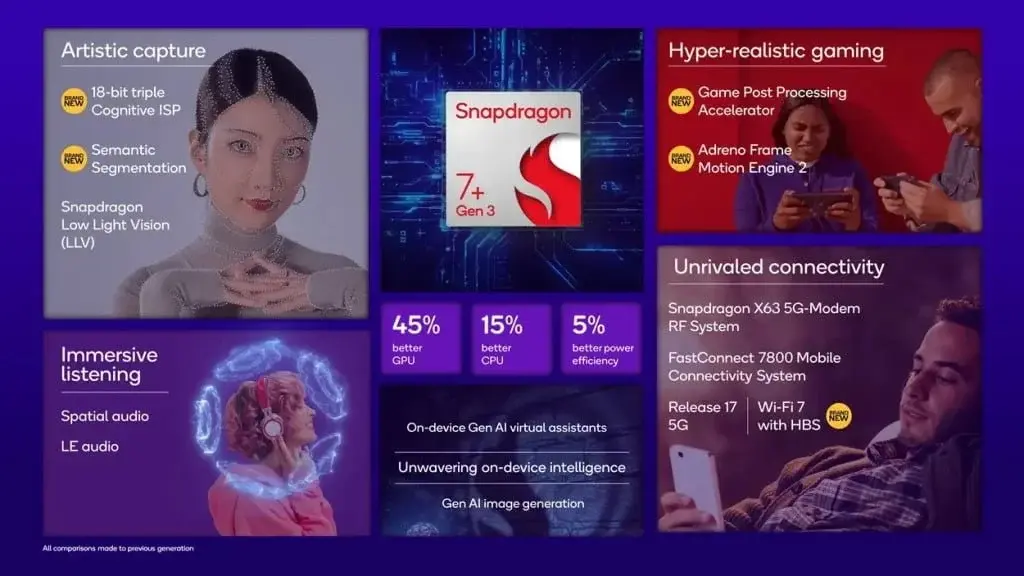
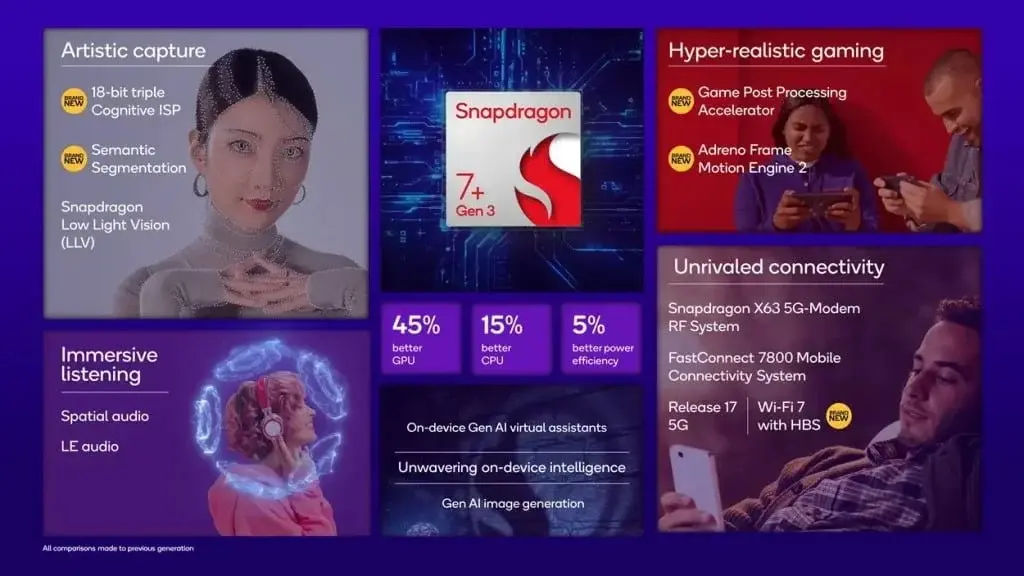
    The Snapdragon 7+ Gen 3 retains TSMC's 4nm process, similar to its predecessor. It shares the same CPU architecture as the flagship Snapdragon 8 Gen 3, comprising a prime core, four performance cores, and three efficiency cores. Notably, the prime core reaches a maximum speed of 2.8GHz. Qualcomm claims that this chipset offers a 15% improvement in CPU performance, a 45% boost in GPU performance, and a 15% enhancement in power efficiency.

    Enhanced Connectivity and AI Capabilities

    Equipped with an integrated X63 5G modem and FastConnect 7800 mobile connectivity system, the Snapdragon 7+ Gen 3 can achieve peak download speeds of up to 4.2 Gbps and supports WiFi-7 connectivity. One of its standout features is the support for on-device generative AI capabilities, enabling a wide array of large language models (LLM) like Baichuan-7B, Llama 2, and Gemini Nano. This empowers devices using this chipset to enhance virtual assistant functionalities and offer additional AI-powered features, including multi-language translation and transcription.

    Impressive Features and Specifications

    The Snapdragon 7+ Gen 3 boasts an 18-bit triple cognitive Image Signal Processor (ISP) and can capture images up to 200MP. Notable features include Snapdragon Low Light Vision and advanced audio capabilities such as Spatial Audio with head tracking, Snapdragon Sound technology, aptX Lossless, and LE audio support. This chipset can accommodate up to QHD+ display resolution at a 120Hz refresh rate, along with supporting up to 24GB LPDDR5x RAM and a UFS 4.0 storage system.

    The OnePlus Ace 3V has already been introduced in China, featuring the Snapdragon 7+ Gen 3 processor, showcasing the capabilities of this new mid-range SoC.

  • Next-Gen Snapdragon “Pakala” Chip and Reference Device Unveiled in New Qualcomm Video

    Next-Gen Snapdragon “Pakala” Chip and Reference Device Unveiled in New Qualcomm Video

    Qualcomm had previously declared its intention to unveil the Snapdragon 8 Gen 4 later this year. In a recent YouTube video released by the company, keen observers were able to identify the codename of the upcoming chipset as well as the reference device. Let’s delve into the details.

    Snapdragon 8 Gen 4 Details Unveiled
    In a video titled “Behind the Silicon: Snapdragon X”, Qualcomm inadvertently revealed the moniker of the upcoming Snapdragon 8 Gen 4, which goes by the name “Pakala”. Just before the codename was spotted, viewers caught a glimpse of the reference device being utilized in the video. However, the video primarily focuses on the Snapdragon X Elite rather than the Snapdragon 8 Gen 4.

    Exciting Updates on Snapdragon 8 Gen 4
    It was previously speculated that the Snapdragon 8 Gen 4 would be identified as “Sun” on benchmarking platforms and as “Pakala” for the hardware, a speculation that has now been confirmed. This upcoming chipset from Qualcomm is highly awaited and signifies a significant chip redesign for the brand, not just a routine annual release of its top-of-the-line mobile Application Processor (AP). The Snapdragon 8 Gen 4 is reportedly transitioning from ARM cores to Qualcomm’s proprietary Oryon cores.

    Anticipated Performance and Features
    There are rumors circulating that suggest the Snapdragon 8 Gen 4 could potentially outperform the Apple A18 Pro chipset, although this remains unverified at the present time. Initial information indicates that the Snapdragon 8 Gen 4 might also offer support for LPDDR6 memory. The official unveiling of the chipset is scheduled for October 2024, so stay tuned for further developments.


    Next-Gen Snapdragon “Pakala” Chip and Reference Device Unveiled in New Qualcomm Video
  • Introducing Snapdragon 7+ Gen 3 SoC: On-Device GenAI Features

    Introducing Snapdragon 7+ Gen 3 SoC: On-Device GenAI Features

    Qualcomm has recently unveiled the Snapdragon 8s Gen 3 processor, a streamlined variant of the flagship Snapdragon 8 Gen 3. In addition to this, the American chipmaker has introduced a new mid-range System on Chip (SoC) that joins the Snapdragon 7 Gen 3 family. This latest addition is known as the Snapdragon 7+ Gen 3, serving as the successor to the Snapdragon 7+ Gen 2 from the previous year. The Snapdragon 7+ Gen 3 brings forth a variety of enhancements, particularly in the realm of Artificial Intelligence (AI), indicating that devices powered by this chipset will incorporate advanced AI functionalities.

    Snapdragon 7+ Gen 3 Unveiled

    The Snapdragon 7+ Gen 3 retains the 4nm process technology from TSMC, similar to its predecessor. Its CPU architecture mirrors that of the flagship Snapdragon 8 Gen 3, comprising of a prime core, four performance cores, and three efficiency cores. Notably, the prime core reaches a maximum clock speed of 2.8GHz. Qualcomm asserts that this chipset offers a 15% improvement in CPU performance, 45% in GPU performance, and a 15% boost in power efficiency.

    Enhanced Features and Connectivity

    Equipped with an integrated X63 5G modem and the FastConnect 7800 mobile connectivity system, the Snapdragon 7+ Gen 3 can achieve peak download speeds of up to 4.2 Gbps while also supporting WiFi-7 technology.

    On-Device AI Capabilities

    One of the standout features of the Snapdragon 7+ Gen 3 is its on-device generative AI capabilities. This platform supports a diverse array of large language models (LLM) like Baichuan-7B, Llama 2, and Gemini Nano, enhancing virtual assistant functionalities, multi-language translation, and transcription capabilities for smartphones powered by this chipset.

    Photography and Audio Capabilities

    Featuring an 18-bit triple cognitive Image Signal Processor (ISP) that can capture images up to 200MP, the Snapdragon 7+ Gen 3 boasts additional features such as Snapdragon Low Light Vision. On the audio front, it supports Spatial Audio with head tracking, Snapdragon Sound technology, aptX Lossless, LE audio, and more. The chipset is capable of accommodating up to QHD+ display resolution at a refresh rate of 120Hz, and it supports up to 24GB of LPDDR5x RAM and a UFS 4.0 storage system.

    OnePlus Ace 3V Debut

    The OnePlus Ace 3V has already made its entrance in the Chinese market, featuring the Snapdragon 7+ Gen 3 processor.

  • Snapdragon 8s Gen 3 SoC Launch: Supports 1080p 240FPS Video Recording

    Snapdragon 8s Gen 3 SoC Launch: Supports 1080p 240FPS Video Recording

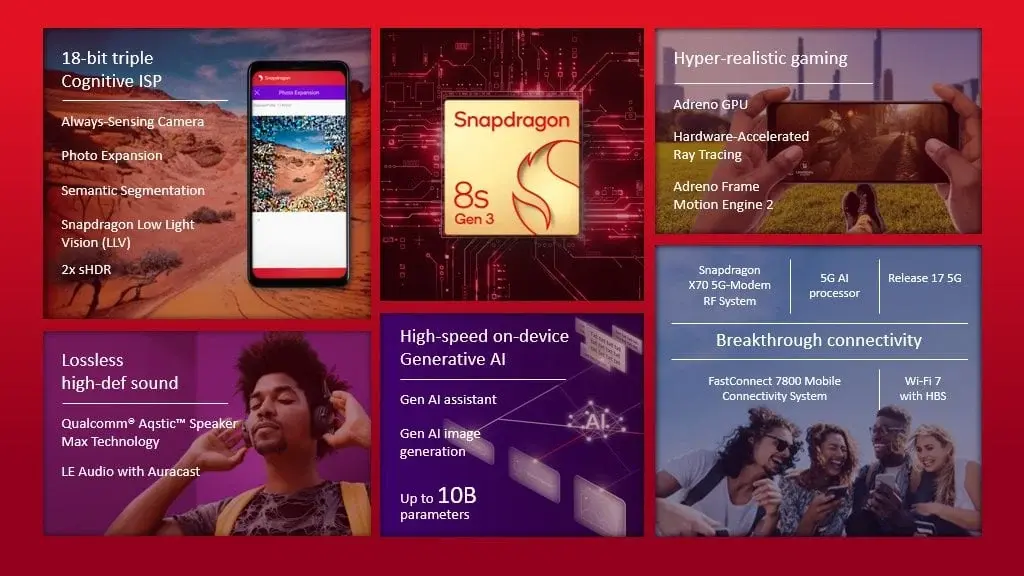
    Qualcomm recently held a media event to unveil the latest Snapdragon 8s Gen 3 SoCs, a variant of the flagship Snapdragon 8 Gen 3 chip. This new chip retains key features like hardware-accelerated ray tracing, enhancing visual quality in games and apps by improving lighting, shadows, and reflections. Additionally, it incorporates the Adreno Frame Motion Engine 2.0 to potentially double game frame rates from 60fps to 120fps.

    Enhanced Features and Performance

    The CPU configuration comprises a Cortex-X4 prime core, four Cortex A720 cores, and three Cortex-A520 cores running at speeds of 3.0GHz, 2.8GHz, and 2.0GHz, respectively. Supporting up to 24GB LPDDR5x RAM clocked at 4,200MHz, it boasts an 18-bit triple cognitive ISP for image and video processing tasks. The chip offers various capabilities like always-on camera, photo enhancement, and 4K HDR video recording at 60FPS.

    Advanced Connectivity and AI Capabilities

    The Snapdragon 8s Gen 3 integrates the FastConnect 7800 Mobile Connectivity System, Wi-Fi 7 with HBS, Snapdragon X70 5G-Modem RF System, and 5G AI processor. It supports Release 17 5G, promising improved performance and broader coverage. On-device generative AI features include AI image generation and support for up to 10 billion parameters, catering to diverse AI applications.

    Adoption by Global Brands

    Qualcomm has announced partnerships with leading global OEMs and brands like HONOR, iQOO, realme, Redmi, and Xiaomi, who will incorporate the Snapdragon 8s Gen 3 platform into their upcoming devices. The first product launch utilizing this platform is anticipated in March.