Tag: open-source hardware

  • $30 Tiny DIY E-Ink Reader Smaller Than AirPods Case with 2-Week Battery

    $30 Tiny DIY E-Ink Reader Smaller Than AirPods Case with 2-Week Battery

    Key Takeaway

    1. The new iteration of the world’s smallest e-reader addresses assembly and durability issues by switching to a screw-down case with threaded inserts, making it more robust.
    2. Software improvements include increased storage capacity, automated text compression, and new navigation features like jumping to specific pages.
    3. The project remains open-source and affordable, with parts costing around $30 and additional case designs and firmware available for €4.90.

    Smallest E-Reader Gets a Major Upgrade

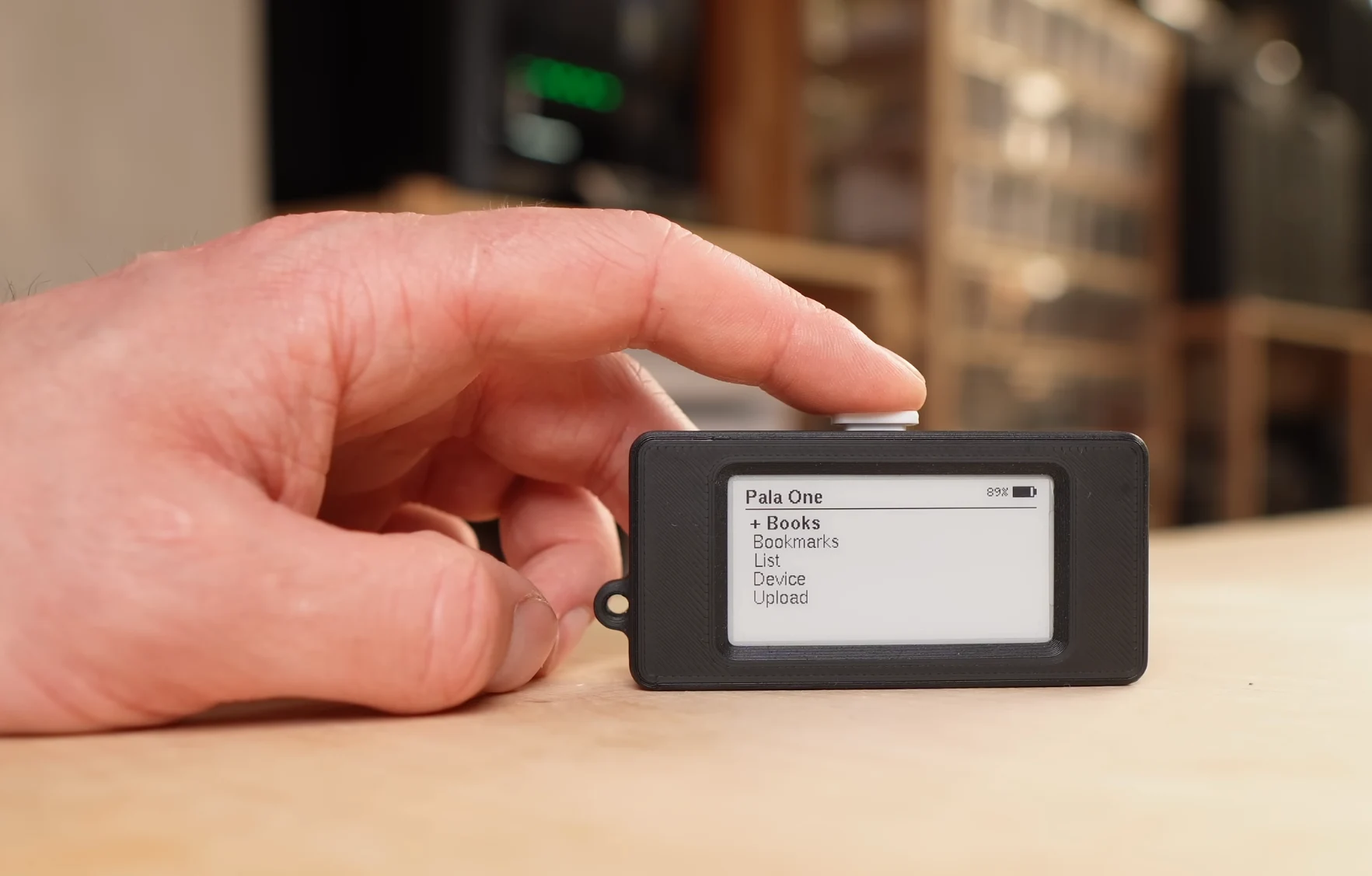
    Paul Lagier recently released a new version of his most tiny e-reader project, moving away from the rough prototype into a more robust and durable device. This second version is a response to the original build, which first launched just over a month ago as a minimalist tool for reclaiming time spent on mobile gaming. Its focus was on creating a simple, compact e-reader that fits conveniently into your pocket or bag.

    Hardware and Design Changes

    The first version used an ESP32 microcontroller (which costs around $16.79) and a small 2.9-inch monochrome e-ink display. However, it faced several assembly challenges; the 3D-printed case depended on tiny plastic pins that many hobbyists found hard to produce reliably. It also had inefficient memory use, with most of its 8 MB flash storage wasted, leaving so little as 1.5 MB for books, equaling maybe two books max. The new version eliminates these issues by switching to a sturdy screw-down case design, incorporating M2 threaded inserts, making the entire device, which is the size of an AirPods case, much stronger and more solid. An added small patch of self-adhesive foam inside helps to dampen the mechanical “click” noise from the navigation button, a common complaint among early users. The design now feels more reliable and user-friendly than its predecessor.

    Software Improvements and Features

    On the software part, the second iteration brings a significant partitioning fix that frees up 5.5 MB of storage for books. Automated text compression has also been introduced, allowing the device to now accommodate between six and ten full-length books at once. Users can manage their library more easily thanks to folder-based systems, a storage indicator visible on the web interface, and the capability to jump directly to specific pages—features that the single-button UI couldn’t support in the original version. These upgrades make reading and navigation much more efficient, enhancing overall user experience.

    Open-Source and Parts Cost

    • The project remains open-source, with available case designs and firmware versions listed for €4.90.
    • Parts for the build typically cost around $30, making it an affordable DIY project for technology enthusiasts. The affordable parts combined with the open-source nature makes this device a fun and functional alternative to just reading on a smartphone, providing a dedicated space for digital reading in a small, portable form factor.

    Overall, Paul Lagier’s e-reader project continues to impress by balancing minimalism, functionality, and affordability, now with a much more refined design that is both practical and fun to build.

    Sources
  • ESP32-P4 SBC with HDMI, Ethernet, 4 USB Ports, and More

    ESP32-P4 SBC with HDMI, Ethernet, 4 USB Ports, and More

    Key Takeaways

    1. New Development Board: Olimex has launched the ESP32-P4-PC, a compact development board (90 × 60 mm) featuring HDMI output, Ethernet, and multiple USB ports.

    2. Enhanced Features: The board includes a MIPI DSI/CSI interface, 10/100Mbit Ethernet with optional PoE, four USB 2.0 ports, JTAG for debugging, and a UEXT port for expansion.

    3. Integrated HDMI: It is the first development board with an integrated HDMI port using the LT8912B converter chip, eliminating the need for external graphics support.

    4. Power Supply and UPS: Powered via USB-C with a built-in battery charging circuit, it can operate from a battery and switch to it seamlessly if USB power fails.

    5. Open Source and Availability: The board is open-source with design resources on GitHub, available for pre-order at €24.95, shipping starting on February 23, 2026.


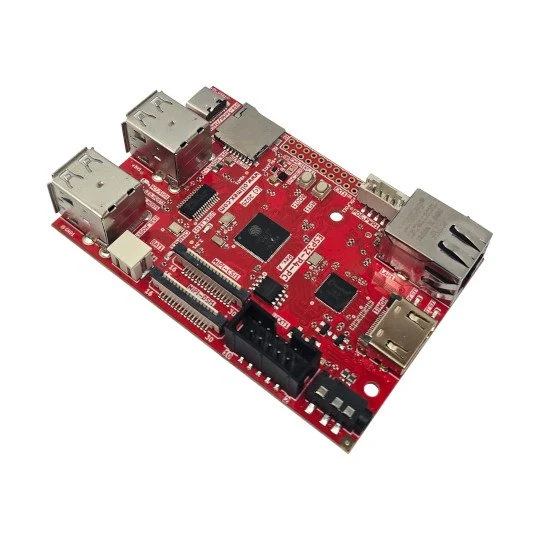
    Olimex, a company from Bulgaria, has introduced the Olimex ESP32-P4-PC, a fresh development board that utilizes the ESP32-P4 SoC. True to its “PC” designation, it comes equipped with HDMI output, Ethernet access, and various USB ports, all packaged in a compact size of 90 × 60 mm.

    Upgrade from Previous Models

    This new board appears to be a step up from the earlier ESP32-SBC-FabGL, which was intended to run the FabGL library for VGA display and simulate older systems using Intel’s 8080 and 8086 processors. However, the latest board is centered around the ESP32-P4 MCU and offers native HDMI output through an LT8912B MIPI-to-HDMI converter chip. This makes it the first development board to feature an integrated HDMI port without needing any external graphics support.

    Rich Features Included

    Notable specifications of this board consist of a MIPI DSI/CSI interface for displays and cameras, a 3.5mm audio jack, 10/100Mbit Ethernet with optional PoE, four USB 2.0 ports, and a 20-pin GPIO header. It also features JTAG for debugging and a UEXT port for further expansion, along with programming buttons for boot and reset. Power is supplied through the USB-C port, which also includes a built-in battery charging circuit, allowing it to operate from a battery. Furthermore, the battery circuit has external power sensing, enabling the board to function as an uninterruptible power supply (UPS) right out of the box. If the USB-C power fails, it can seamlessly switch to a LiPo cell without rebooting the MCU.

    Connectivity and Availability

    One aspect that’s lacking is wireless connectivity, which can be easily integrated via the UEXT port. The board is open-source, and all design resources, including schematics and the user manual, are accessible on GitHub.

    The company positions this as a “PC-like” board, but it’s not intended to replace Linux-based Single Board Computers (SBCs) such as Raspberry Pi, Orange Pi, or Banana Pi. With a 400MHz dual-core RISC-V processor, it can handle basic real-time tasks like 1080p H.264 video processing and showing 2D GUIs, but it isn’t capable of running desktop-level applications. This board should be seen as a high-end embedded platform, suitable for industrial HMIs, smart displays, or media-focused IoT gateways where HDMI and reliable wired connections are prioritized over full PC capabilities.

    The Olimex ESP32-P4-PC is now available for pre-order for €24.95 on the company’s website, with shipping expected to start on February 23, 2026.

    Source:
    Link