
Key Takeaways
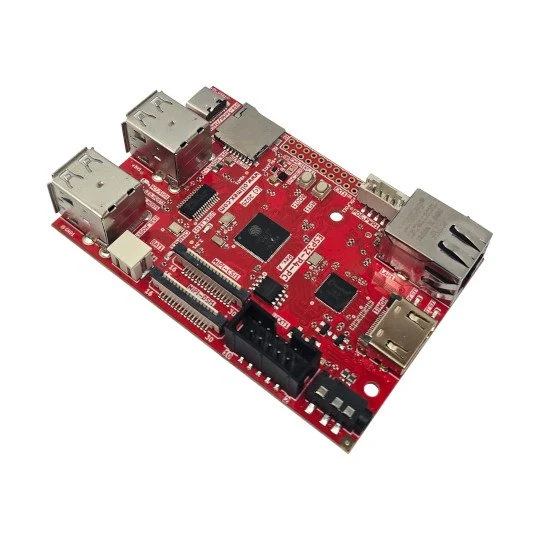
1. New Development Board: Olimex has launched the ESP32-P4-PC, a compact development board (90 × 60 mm) featuring HDMI output, Ethernet, and multiple USB ports.
2. Enhanced Features: The board includes a MIPI DSI/CSI interface, 10/100Mbit Ethernet with optional PoE, four USB 2.0 ports, JTAG for debugging, and a UEXT port for expansion.
3. Integrated HDMI: It is the first development board with an integrated HDMI port using the LT8912B converter chip, eliminating the need for external graphics support.
4. Power Supply and UPS: Powered via USB-C with a built-in battery charging circuit, it can operate from a battery and switch to it seamlessly if USB power fails.
5. Open Source and Availability: The board is open-source with design resources on GitHub, available for pre-order at €24.95, shipping starting on February 23, 2026.
Olimex, a company from Bulgaria, has introduced the Olimex ESP32-P4-PC, a fresh development board that utilizes the ESP32-P4 SoC. True to its “PC” designation, it comes equipped with HDMI output, Ethernet access, and various USB ports, all packaged in a compact size of 90 × 60 mm.
Upgrade from Previous Models
This new board appears to be a step up from the earlier ESP32-SBC-FabGL, which was intended to run the FabGL library for VGA display and simulate older systems using Intel’s 8080 and 8086 processors. However, the latest board is centered around the ESP32-P4 MCU and offers native HDMI output through an LT8912B MIPI-to-HDMI converter chip. This makes it the first development board to feature an integrated HDMI port without needing any external graphics support.
Rich Features Included
Notable specifications of this board consist of a MIPI DSI/CSI interface for displays and cameras, a 3.5mm audio jack, 10/100Mbit Ethernet with optional PoE, four USB 2.0 ports, and a 20-pin GPIO header. It also features JTAG for debugging and a UEXT port for further expansion, along with programming buttons for boot and reset. Power is supplied through the USB-C port, which also includes a built-in battery charging circuit, allowing it to operate from a battery. Furthermore, the battery circuit has external power sensing, enabling the board to function as an uninterruptible power supply (UPS) right out of the box. If the USB-C power fails, it can seamlessly switch to a LiPo cell without rebooting the MCU.
Connectivity and Availability
One aspect that’s lacking is wireless connectivity, which can be easily integrated via the UEXT port. The board is open-source, and all design resources, including schematics and the user manual, are accessible on GitHub.
The company positions this as a “PC-like” board, but it’s not intended to replace Linux-based Single Board Computers (SBCs) such as Raspberry Pi, Orange Pi, or Banana Pi. With a 400MHz dual-core RISC-V processor, it can handle basic real-time tasks like 1080p H.264 video processing and showing 2D GUIs, but it isn’t capable of running desktop-level applications. This board should be seen as a high-end embedded platform, suitable for industrial HMIs, smart displays, or media-focused IoT gateways where HDMI and reliable wired connections are prioritized over full PC capabilities.
The Olimex ESP32-P4-PC is now available for pre-order for €24.95 on the company’s website, with shipping expected to start on February 23, 2026.
Source:
Link