Tag: Nvidia GeForce RTX 5050

  • Lenovo Launches 16-Inch Laptop with Intel Panther Lake & 105W GPU

    Lenovo Launches 16-Inch Laptop with Intel Panther Lake & 105W GPU

    Key Takeaways

    1. Lenovo has launched the IdeaPad Pro 5i Gen 11 series in North America, featuring a 16-inch model with Nvidia GeForce RTX 5050 GPU.
    2. The North American version differs from the European and Australian models, which include a 14-inch version without discrete graphics.
    3. The 16-inch model in the US starts at $2,449.99, while prices in Canada and Australia are CAD 3,399.99 and AUD 4,399, respectively.
    4. The standard configuration includes a Core Ultra 7 356H processor, 32 GB of RAM, 1 TB storage, and a 2.8K OLED display.
    5. Future options will include the Core Ultra 9 386H processor and a 99 Wh battery setup.


    Lenovo has begun to distribute its new IdeaPad Pro 5i generation throughout North America. However, there are noticeable differences between the version available in Canada and the United States and the one recently introduced in Europe and Australia. To summarize, the company launched the IdeaPad Pro 5i Gen 11 series in those regions with a 14-inch model that does not include discrete graphics.

    Distinct Features for North America

    In contrast, North American consumers can now get a 16-inch model featuring an Nvidia GeForce RTX 5050 GPU with a Total Graphics Power (TGP) of 105 W, similar to last year’s version (curr. $1,299 on Amazon). Interestingly, the GeForce RTX 5060, which was talked about during CES 2026 in January, is exclusively available in Australia, where Lenovo has placed a price of AUD 10,098.90 (~$6,945) on it.

    Specifications and Pricing

    Currently, Lenovo is marketing the IdeaPad Pro 5i (16IPH11) with options between the Core Ultra 7 356H and Core Ultra 9 386H processors. The standard version comes with a Core Ultra 7 356H chip, 32 GB of LPDDR5X-8533 RAM, 1 TB of M.2 2242 storage, and an 84 Wh battery that allows for 170 W charging. This setup also includes a 2.8K OLED non-touch display that can reach up to 120 Hz, with 500 nits for SDR and 1,000 nits for HDR brightness.

    Costs and Future Options

    In the US, the starting price for the IdeaPad Pro 5i 16-inch is $2,449.99; in Canada, it’s CAD 3,399.99, and in Australia, it’s AUD 4,399. Alternatively, customers can opt for a configuration featuring the Core Ultra 9 386H and a touchscreen display. Eventually, Lenovo plans to introduce options for the Core Ultra X9 388H and a 99 Wh battery setup as well.

    Source:
    Link
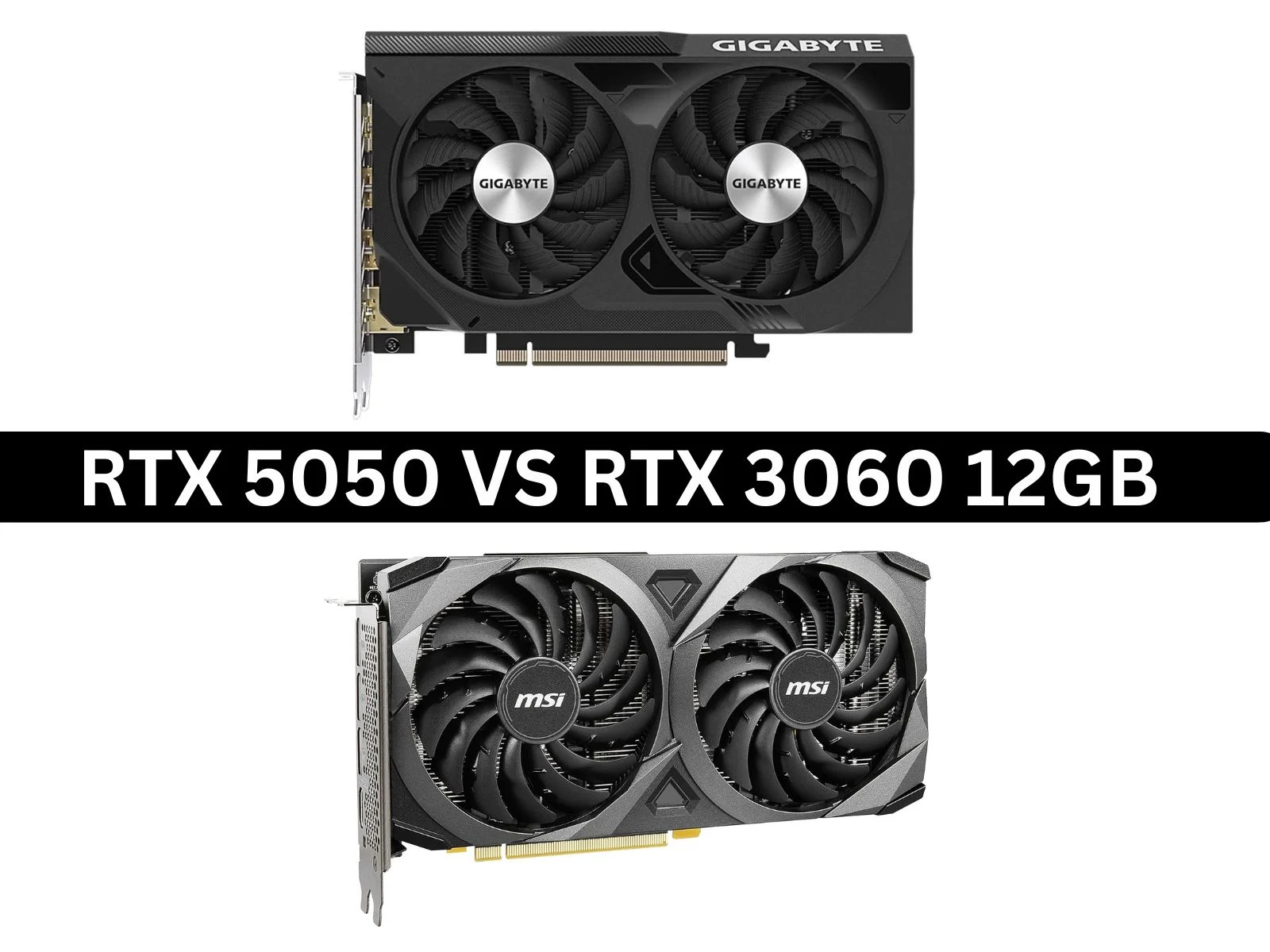


  • RTX 5050 vs RTX 3060 12GB: $250 GPU Battle in 50+ Games

    RTX 5050 vs RTX 3060 12GB: $250 GPU Battle in 50+ Games

    Key Takeaways

    1. Testing Methodology: Daniel Owen tested over 50 games at 1440p and 1080p with medium and maximum graphics settings, including native resolution and DLSS activation.

    2. System Specifications: The testing setup featured an AMD Ryzen 9 9800X3D and 32 GB of DDR5-6000 memory, aimed at evaluating the 8 GB VRAM of the RTX 5050 against the 12 GB VRAM of the RTX 3060.

    3. Performance Insights: The RTX 3060 performs better in games that exceed 8 GB of VRAM usage, while the RTX 5050 achieves higher raw FPS in scenarios where VRAM is not a limitation.

    4. Game-Specific Benchmarks: In titles like Oblivion Remastered and Kingdom Come: Deliverance 2, the RTX 5050 shows advantages at medium settings, while the RTX 3060 struggles at maximum settings due to VRAM constraints.

    5. Conclusion: Both GPUs are not ideal for maxed-out 1440p gaming, but the RTX 5050 often has a slight edge at 1080p on medium settings with DLSS, making it a better choice for certain configurations.


    Famous hardware-focused YouTuber Daniel Owen has conducted a thorough comparison of the Nvidia GeForce RTX 5050 and the RTX 3060 12 GB model.

    Testing Methodology

    In his experiments, the YouTuber evaluated over 50 games at both 1440p and 1080p resolutions, using medium and maximum graphics settings. He also examined the games at their native resolution and with DLSS activated to ensure all scenarios where the RTX 5050 and RTX 3060 12 GB could be deployed were covered.

    System Specifications

    For this testing, the system included an AMD Ryzen 9 9800X3D (priced at $652 on Amazon US) and 32 GB of quick DDR5-6000 memory from G.SKILL’s Trident series. Daniel set out with a clear goal: to determine if the 8 GB of VRAM on newer GPUs like the RTX 5050 is sufficient for gaming in 2025 or if it is wiser to opt for an older model like the RTX 3060 with 12 GB of VRAM.

    Performance Insights

    Daniel discovered that when games exceed 8 GB of VRAM usage, the RTX 3060 tends to perform better, showing fewer stutters, improved 1% lows, and more consistent frame times, especially at maximum settings. However, in situations where VRAM isn’t an issue, the RTX 5050 consistently achieves higher raw FPS, leading by as much as 10-13% in current AAA titles.

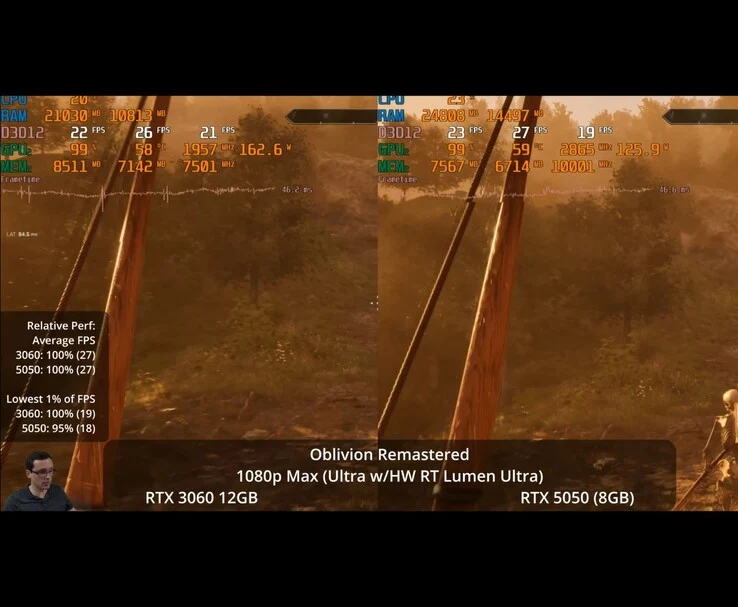
    In Oblivion Remastered, both cards are tested rigorously. At 1080p with maximum settings, they are tied at 27 FPS, but with DLSS, the RTX 3060 rises to 37 FPS, while the RTX 5050 cannot increase due to its tighter VRAM constraints. When switching to medium settings, the performance levels out, but with DLSS active, the RTX 5050 suddenly takes the lead, reaching 71 FPS compared to the RTX 3060’s 61 FPS.

    Game-Specific Benchmarks

    Kingdom Come: Deliverance 2 proves challenging for both GPUs at maximum settings. At 1440p, the RTX 3060 manages 20 FPS, while the RTX 5050 struggles significantly at 7 FPS due to VRAM limitations. DLSS provides some assistance, but not significantly. The situation improves at medium settings; at 1080p, the RTX 5050 leads with 91 FPS against the RTX 3060’s 80. Even at 1440p, the RTX 5050 maintains a slight advantage, stretching to 85 FPS with DLSS Balanced compared to 75 FPS on the RTX 3060. Both cards ensure smooth gameplay, but the RTX 5050 has the upper hand.

    In Assassin’s Creed Shadows, both GPUs are pushed beyond their VRAM limits, resulting in poor performance at maximum settings. At native 1080p, the RTX 3060 slightly edges out with 22 FPS versus 20 FPS on the RTX 5050. Even with DLSS Quality turned on, frame rates barely improve, showing 26 FPS on the RTX 3060 and 24 FPS on the RTX 5050. The situation doesn’t get much better at 1440p, with both GPUs achieving only 18 FPS. DLSS Balanced offers a minor increase, raising the RTX 3060 to 25 FPS and the RTX 5050 to 24 FPS, still rendering the game unplayable. When settings are lowered to 1080p medium, the RTX 5050 rises to 58 FPS, compared to 47 FPS on the RTX 3060, although lighting differences during testing might have slightly impacted the results, as noted by the YouTuber.

    Conclusion

    Neither GPU is truly designed for maxed-out 1440p gaming, but both perform adequately at 1080p on medium settings with DLSS, often with the RTX 5050 showing a slight edge. Daniel provides a detailed breakdown of which card performs better under various settings, depending on the game’s demands. If you are deciding which GPU suits your configuration best, the complete video is rich with valuable insights and is certainly worth watching.

    Source:
    Link


  • Nvidia GeForce RTX 5050 vs Intel Arc B580 and Radeon RX 7600 Review

    Nvidia GeForce RTX 5050 vs Intel Arc B580 and Radeon RX 7600 Review

    Key Takeaways

    1. The Nvidia GeForce RTX 5050 is set to launch in July at a starting price of $249, but lacks pre-release reviews from the press.
    2. The RTX 5050 features 2,560 CUDA cores, 8 GB of GDDR6 VRAM, and a 320 GB/s memory bus, while the RTX 5060 has 3,840 CUDA cores and a 448 GB/s memory bus for a higher performance.
    3. The RTX 5060 outperforms the RTX 5050 by about 30% in tests, making it a better value despite its higher price of $299.
    4. The RTX 5050 performs slightly worse than the Intel Arc B580, priced around $320, and is outperformed by the older RTX 4060 by 7% without DLSS 4 enabled.
    5. While the RTX 5050 is a budget option for gamers, it may not be the best choice compared to the RTX 5060 and other competitive GPUs.


    The Nvidia GeForce RTX 5050 is expected to launch in the second half of July, with a starting price of $249. Similar to the GeForce RTX 5060, Nvidia has decided not to send out review units to the press before the official release. Yet, Quasar Zone was able to get their hands on an RTX 5050 and tested its performance against some well-known competitors.

    Performance Specifications

    The GeForce RTX 5050 comes equipped with 2,560 CUDA cores and can boost up to 2,572 MHz. It also includes 8 GB of GDDR6 VRAM along with a 320 GB/s memory bus. In contrast, the RTX 5060 boasts 3,840 CUDA cores, 8 GB of quicker GDDR7 VRAM, and a broader 448 GB/s memory bus. This means it has 50% more shaders and a memory bandwidth that is 40% higher, while only costing around 20% more, starting at $299. The enhanced hardware leads to improved real-world results: testing done by Quasar Zone indicates that the RTX 5060 outpaces the RTX 5050 by about 30%, making the more expensive model a better deal.

    Competitive Comparison

    Interestingly, the GeForce RTX 5050 performed slightly worse than the Intel Arc B580, which is priced at around $320 on Amazon. Additionally, the much older AMD Radeon RX 7600 is nearly 2% slower than the RTX 5050. Moreover, the previous generation’s RTX 4060 managed to outperform the upcoming entry-level Nvidia card by an average of 7%, under the condition that DLSS 4 Multi-Frame Generation is turned off. This technology enables the RTX 50 series GPUs to produce three-quarters of all frames using AI instead of traditional rendering, which can potentially lead to higher frame rates but may come with increased latency and reduced visual quality.

    Conclusion

    In conclusion, while the RTX 5050 presents a decent option for gamers on a budget, it seems to lag behind its competitors, especially the RTX 5060. With significant performance gains seen in the higher-tier model, buyers might want to think twice before opting for the 5050, especially with other solid alternatives available in the market. Quasar Zone’s findings provide valuable insights into the performance landscape of these GPUs, highlighting the importance of considering both specifications and real-world performance.

    Source:
    Link


  • Nvidia Confirms Pricey GeForce RTX 5050 for EU Market

    Nvidia Confirms Pricey GeForce RTX 5050 for EU Market

    Key Takeaways

    1. The Nvidia GeForce RTX 5050 will be priced at $249 in the US and €259 in Germany, launching in late July.
    2. The RTX 5050 is more expensive compared to the RTX 5060, which is only 23% to 12% pricier but offers significantly better performance with 50% more CUDA cores and 40% faster memory bandwidth.
    3. The RTX 5050 features 8 GB of VRAM with older GDDR6 technology, while the RTX 5060 uses newer technology.
    4. Competing options include the AMD Radeon RX 9060 XT starting at €299 and the Intel Arc B580 with 12 GB of graphics memory at €259.
    5. To match the price-performance ratio of the RTX 5060, the RTX 5050 would theoretically need to be priced around €200.


    The Nvidia GeForce RTX 5050 was just revealed on Tuesday and is expected to hit the market in the latter part of July. This graphics card will be priced at $249 in the United States. Nvidia has confirmed to ComputerBase that the recommended retail price in Germany will be €259. This puts the GPU about €7 higher than what a straightforward conversion of the US price (including VAT) would indicate.

    Price Comparison

    While the difference might seem minor, the listed price appears rather steep when compared to the GeForce RTX 5060. The next upgraded model in Nvidia’s desktop GPU lineup has an official price of €319, or €292 at some retailers. This means the GeForce RTX 5060 is only 23% and 12% pricier than the GeForce RTX 5050, respectively. However, it packs 50% more CUDA cores and has a memory bandwidth that is 40% faster. The RTX 5050 is fitted with 8 GB of VRAM, but it uses the older GDDR6 technology instead of the newer GDDR7.

    Competing Options

    On the other hand, the AMD Radeon RX 9060 XT starts at €299. If your budget is capped at €259, you also have the option of the Intel Arc B580, which comes with 12 GB of graphics memory at the same price point. Comprehensive tests are on the way that will determine if Intel’s mid-range GPU can outperform the GeForce RTX 5050. Additionally, some customers might find that purchasing used graphics cards could be a more advantageous choice. For the GeForce RTX 5050 to match the price-performance ratio of the GeForce RTX 5060, its price would need to drop to around €200, at least in theory.

    Source:
    Link


  • GeForce RTX 5050 Laptop Launches with DLSS 4 and Nvidia Drivers

    GeForce RTX 5050 Laptop Launches with DLSS 4 and Nvidia Drivers

    Key Takeaways

    1. Nvidia has launched the GeForce RTX 5050 for laptops, available for pre-order in some regions, while the desktop version will be released next month.
    2. Asus is the first manufacturer to officially launch a laptop with the RTX 5050, previously listing the ROG Strix G16 with the GPU.
    3. The Vivobook Pro 16 is available for pre-order in China, featuring an Intel Core 5 210H processor, but expected to have lower CPU performance than earlier models.
    4. The GeForce RTX 5050 may perform similarly to the RTX 4060, despite having 20% fewer CUDA cores and a maximum power output of 115 W.
    5. The Vivobook Pro 16 with RTX 5050 includes options for 1 TB PCIe 4.0 storage, 16 GB DDR5-5200 RAM, and a 144 Hz display, priced at approximately $836.


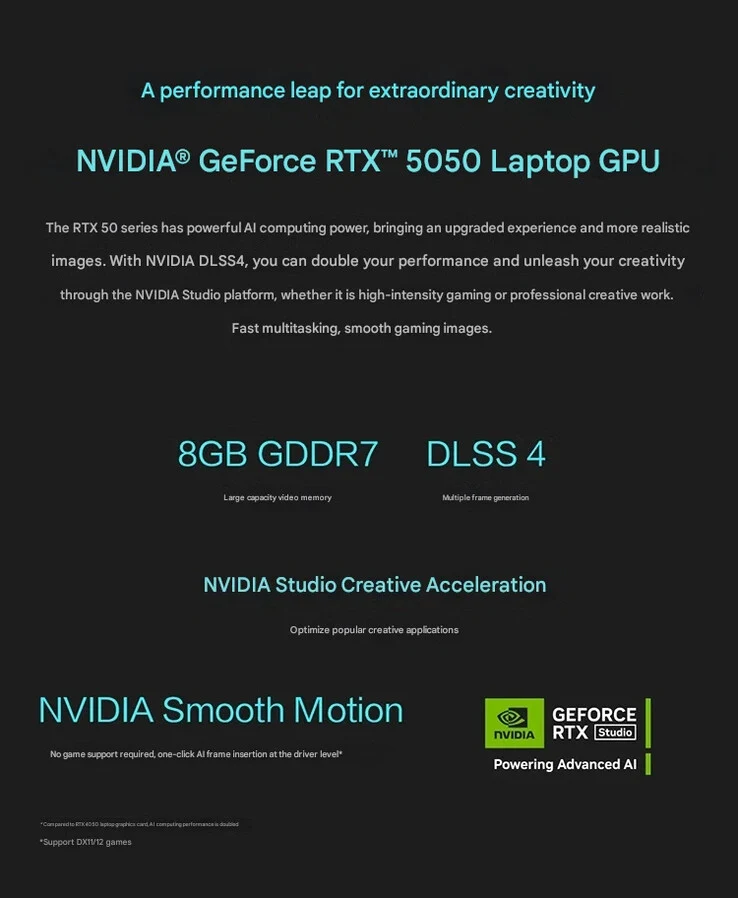
    Nvidia has just revealed the GeForce RTX 5050 designed for laptops. To give some background, the company also launched a desktop variant, which comes with just 8 GB of GDDR6 VRAM. While the desktop version won’t be available until next month, the laptop model is already available for pre-order in some regions.

    Asus Takes the Lead

    Asus appears to be the first laptop manufacturer to officially launch a laptop featuring the RTX 5050. Interestingly, this same company had previously been seen listing the ROG Strix G16 equipped with Nvidia’s newest laptop GPU almost two weeks ago. However, that listing has since been removed from the website.

    Vivobook Pro 16 Availability

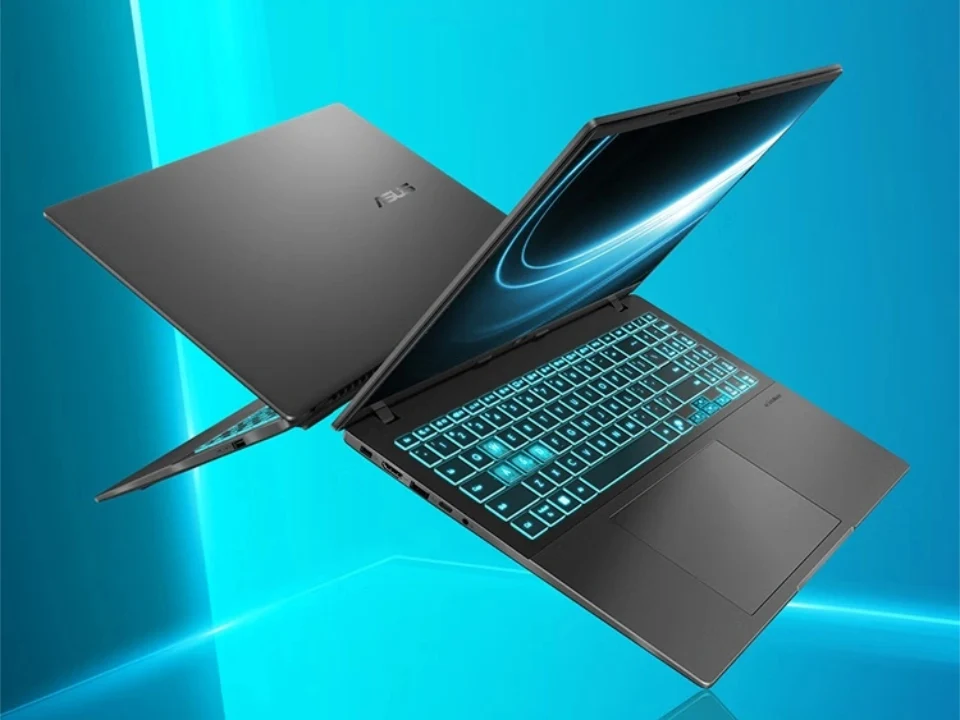
    On the other hand, the Vivobook Pro 16 is available for pre-order starting today in China, and it comes with an Intel Core 5 210H processor from the Raptor Lake-H family. In real-world usage, this processor is expected to provide lower CPU performance compared to the options available in the Vivobook Pro 16 that we reviewed a year and a half ago (currently priced at $1,199.99 on Amazon).

    Surprisingly, the GeForce RTX 5050 might match the performance of the GeForce RTX 4060, even though it has 20% fewer CUDA cores. For comparison, the GeForce RTX 5050 has a maximum power output of 115 W; however, Asus has not disclosed the Total Graphics Power (TGP) for the Vivobook Pro 16 yet. Currently, you can get the GeForce RTX 5050 with up to 1 TB of PCIe 4.0 storage, 16 GB of DDR5-5200 RAM, and a 144 Hz display for CNY 5,999 (approximately $836). There’s still no information on when it will be released internationally.

    Source:
    Link