Tag: Nvidia GeForce RTX 3060

  • Nvidia GeForce RTX 3060 Relaunch Set for This Month, Report Says

    Nvidia GeForce RTX 3060 Relaunch Set for This Month, Report Says

    Key Takeaways

    1. The Nvidia GeForce RTX 3060 may return in March 2026, despite being five years old.
    2. The RTX 3060 will likely be produced using Samsung’s 8 nm node, similar to its original release.
    3. The RTX 3060 is expected to deliver around 70% of the performance of the RTX 5060, making it suitable for low-end desktop users.
    4. The RTX 5060 offers additional features like multi-frame generation and native FP8 acceleration in DLSS 4.5, enhancing its overall capabilities.
    5. Approach rumors about the RTX 3060’s return with caution, as verification is still pending.


    Amid global shortages, Nvidia seems to have a strategy to satisfy gamers craving more GPUs. The Nvidia GeForce RTX 3060, which is already five years old, might be making an unexpected return as soon as March 2026.

    Specifications of the RTX 3060

    The GeForce RTX 3060 was offered in 8 or 12 GB GDDR6 VRAM options, but it’s still uncertain which version will be released again. The GeForce RTX 5060, currently priced at $339.99 on Amazon, features only 8 GB of VRAM, which is something to consider. It’s also unclear why Nvidia opted for an older model like the RTX 3060 instead of going with a newer GPU like the RTX 4060. However, a recent report has revealed that the RTX 3060 will be produced using Samsung’s 8 nm node, just like before.

    Performance Expectations

    In terms of performance, the RTX 3060 is expected to deliver around 70% of the RTX 5060’s performance, making it a reasonable option for low-end desktop users, potentially at a competitive price. However, the RTX 5060 offers many extra features, such as multi-frame generation and native FP8 acceleration in DLSS 4.5, which enhances its capabilities beyond just raw performance metrics. As with most recent GPU launches, the final market price will largely depend on supply and demand dynamics.

    Caution with Rumors

    It’s important to approach unverified reports and rumors with skepticism. If the GeForce RTX 3060 gaming GPU is indeed scheduled for a comeback later this month, we should learn more about it soon enough.

    This was noted by Hankyung, as seen by TechPowerUp.

    Source:
    Link


  • Intel GPU Hits 150 FPS in Cyberpunk 2077 and 120 FPS in Borderlands 4

    Intel GPU Hits 150 FPS in Cyberpunk 2077 and 120 FPS in Borderlands 4

    Key Takeaways

    1. Dual-GPU setups are making a comeback, leveraging new frame generation technologies like Lossless Scaling to enhance gaming performance.
    2. The YouTuber ETA PRIME demonstrated improved performance in games by using an Intel Arc A380 for frame generation alongside an Nvidia GeForce RTX 3060.
    3. In tests, frame rates significantly increased from below 60 FPS to over 120 FPS with Lossless Scaling enabled, especially at 2x scaling.
    4. The Arc A380 proved to be efficient, utilizing only 34 watts while achieving 70-80% utilization, compared to the higher utilization of the RTX 3060.
    5. This approach allows gamers with mid-range hardware to boost performance without needing to upgrade to high-end GPUs.


    Combining two GPUs to enhance gaming performance is an old technique that seems to be making a return thanks to new frame generation technologies. One notable application is Lossless Scaling, available on Steam, which uses machine learning to boost performance. The great thing about it is its compatibility with games lacking built-in frame generation features. YouTuber ETA PRIME recently demonstrated a dual-GPU configuration in a gaming PC, assigning one GPU specifically for the frame generation work.

    Components Used in the Setup

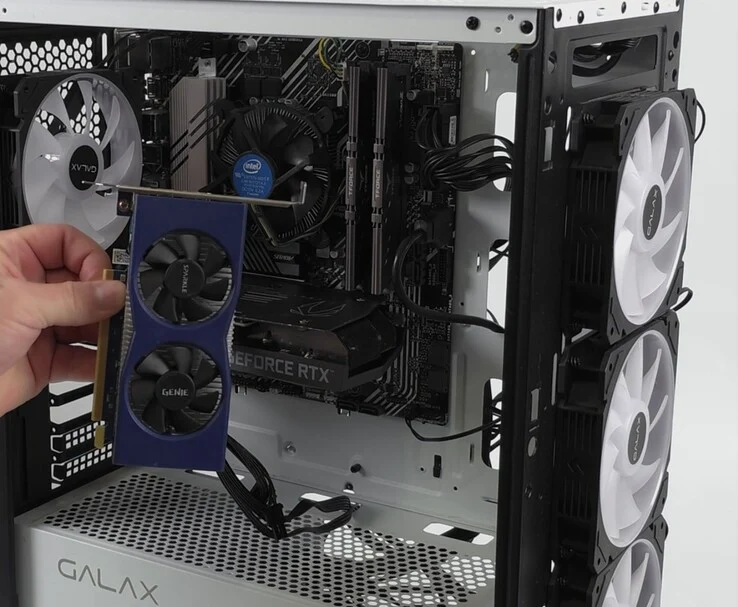
    In their gaming PC, the YouTuber included an Intel Core i5-11400F CPU, an Nvidia GeForce RTX 3060 GPU with 12GB of VRAM, and an Intel Arc A380, which has 6GB of VRAM. Additionally, the system was equipped with 16GB of RAM.

    Testing Performance

    After a quick setup, where the RTX 3060 was set as the primary GPU and the Lossless Scaling app was launched, the YouTuber began testing various games. The first game was Borderlands 4, played at 1440p with medium settings and DLSS set to balanced. The RTX 3060 alone struggled to keep a high frame rate, often dropping below 60 FPS. However, once the Arc A380 took on the frame generation task via Lossless Scaling, the performance significantly improved.

    With a fixed 2x multiplier, the system exceeded 120 FPS without any noticeable input lag, according to the YouTuber. Even when trying 3x scaling, the playability was stable, though 2x was identified as the ideal setting.

    Further Tests on Cyberpunk and Oblivion

    The next game tested was Cyberpunk 2077, at 1440p ultra settings with DLSS configured to quality. The RTX 3060, operating independently, averaged around 48 FPS. After enabling Lossless Scaling on the Arc A380, the generated frames boosted performance up to around 150 FPS.

    Notably, issues with HUD elements and crosshairs that were common in prior app versions were mostly resolved, leading to a smoother and more consistent gaming experience, as stated by the YouTuber.

    ETA PRIME also looked at Oblivion Remastered. At 1440p high settings, the RTX 3060 alone struggled to maintain 60 FPS. However, with Lossless Scaling set to 2x, the average performance comfortably surpassed 100 FPS, showcasing the secondary GPU’s capability for frame generation.

    Noteworthy Efficiency of the Arc A380

    One of the impressive aspects of this setup is the efficiency of the Arc A380. Even though it’s a budget-friendly card that doesn’t need external power, it managed frame generation with about 70–80% utilization and consumed only around 34 watts. In contrast, the RTX 3060’s utilization ranged from 90 to 100%.

    While this dual-GPU approach isn’t a substitute for upgrading to a high-end GPU, it presents a creative method to extract more performance from mid-range hardware, and many viewers seemed to echo this sentiment in the comments.

    One user mentioned their “1050 Ti has a new life”, while another stated they own an RTX 1660 Ti and plan to combine it with an RTX 2070 Super.

    Source:
    Link


  • RTX 5050 vs RTX 3060 12GB: $250 GPU Battle in 50+ Games

    RTX 5050 vs RTX 3060 12GB: $250 GPU Battle in 50+ Games

    Key Takeaways

    1. Testing Methodology: Daniel Owen tested over 50 games at 1440p and 1080p with medium and maximum graphics settings, including native resolution and DLSS activation.

    2. System Specifications: The testing setup featured an AMD Ryzen 9 9800X3D and 32 GB of DDR5-6000 memory, aimed at evaluating the 8 GB VRAM of the RTX 5050 against the 12 GB VRAM of the RTX 3060.

    3. Performance Insights: The RTX 3060 performs better in games that exceed 8 GB of VRAM usage, while the RTX 5050 achieves higher raw FPS in scenarios where VRAM is not a limitation.

    4. Game-Specific Benchmarks: In titles like Oblivion Remastered and Kingdom Come: Deliverance 2, the RTX 5050 shows advantages at medium settings, while the RTX 3060 struggles at maximum settings due to VRAM constraints.

    5. Conclusion: Both GPUs are not ideal for maxed-out 1440p gaming, but the RTX 5050 often has a slight edge at 1080p on medium settings with DLSS, making it a better choice for certain configurations.


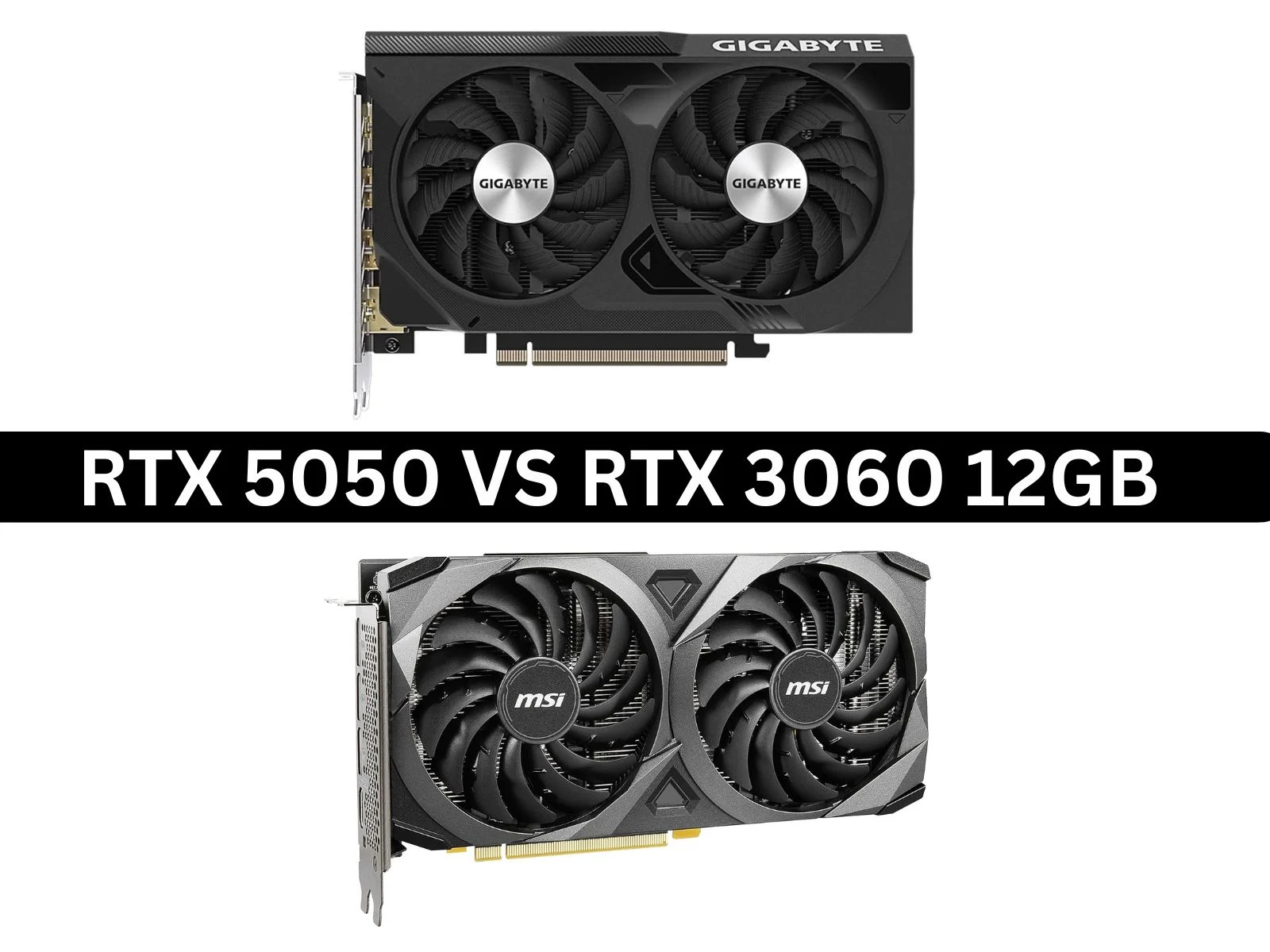
    Famous hardware-focused YouTuber Daniel Owen has conducted a thorough comparison of the Nvidia GeForce RTX 5050 and the RTX 3060 12 GB model.

    Testing Methodology

    In his experiments, the YouTuber evaluated over 50 games at both 1440p and 1080p resolutions, using medium and maximum graphics settings. He also examined the games at their native resolution and with DLSS activated to ensure all scenarios where the RTX 5050 and RTX 3060 12 GB could be deployed were covered.

    System Specifications

    For this testing, the system included an AMD Ryzen 9 9800X3D (priced at $652 on Amazon US) and 32 GB of quick DDR5-6000 memory from G.SKILL’s Trident series. Daniel set out with a clear goal: to determine if the 8 GB of VRAM on newer GPUs like the RTX 5050 is sufficient for gaming in 2025 or if it is wiser to opt for an older model like the RTX 3060 with 12 GB of VRAM.

    Performance Insights

    Daniel discovered that when games exceed 8 GB of VRAM usage, the RTX 3060 tends to perform better, showing fewer stutters, improved 1% lows, and more consistent frame times, especially at maximum settings. However, in situations where VRAM isn’t an issue, the RTX 5050 consistently achieves higher raw FPS, leading by as much as 10-13% in current AAA titles.

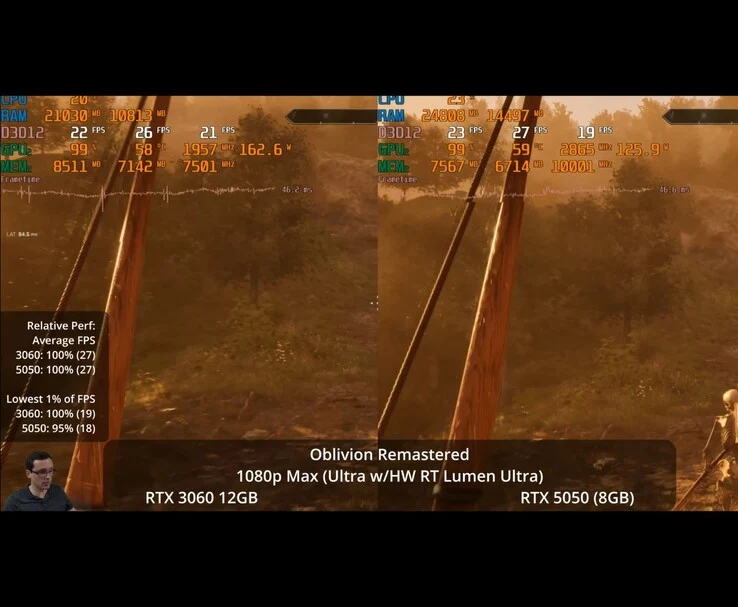
    In Oblivion Remastered, both cards are tested rigorously. At 1080p with maximum settings, they are tied at 27 FPS, but with DLSS, the RTX 3060 rises to 37 FPS, while the RTX 5050 cannot increase due to its tighter VRAM constraints. When switching to medium settings, the performance levels out, but with DLSS active, the RTX 5050 suddenly takes the lead, reaching 71 FPS compared to the RTX 3060’s 61 FPS.

    Game-Specific Benchmarks

    Kingdom Come: Deliverance 2 proves challenging for both GPUs at maximum settings. At 1440p, the RTX 3060 manages 20 FPS, while the RTX 5050 struggles significantly at 7 FPS due to VRAM limitations. DLSS provides some assistance, but not significantly. The situation improves at medium settings; at 1080p, the RTX 5050 leads with 91 FPS against the RTX 3060’s 80. Even at 1440p, the RTX 5050 maintains a slight advantage, stretching to 85 FPS with DLSS Balanced compared to 75 FPS on the RTX 3060. Both cards ensure smooth gameplay, but the RTX 5050 has the upper hand.

    In Assassin’s Creed Shadows, both GPUs are pushed beyond their VRAM limits, resulting in poor performance at maximum settings. At native 1080p, the RTX 3060 slightly edges out with 22 FPS versus 20 FPS on the RTX 5050. Even with DLSS Quality turned on, frame rates barely improve, showing 26 FPS on the RTX 3060 and 24 FPS on the RTX 5050. The situation doesn’t get much better at 1440p, with both GPUs achieving only 18 FPS. DLSS Balanced offers a minor increase, raising the RTX 3060 to 25 FPS and the RTX 5050 to 24 FPS, still rendering the game unplayable. When settings are lowered to 1080p medium, the RTX 5050 rises to 58 FPS, compared to 47 FPS on the RTX 3060, although lighting differences during testing might have slightly impacted the results, as noted by the YouTuber.

    Conclusion

    Neither GPU is truly designed for maxed-out 1440p gaming, but both perform adequately at 1080p on medium settings with DLSS, often with the RTX 5050 showing a slight edge. Daniel provides a detailed breakdown of which card performs better under various settings, depending on the game’s demands. If you are deciding which GPU suits your configuration best, the complete video is rich with valuable insights and is certainly worth watching.

    Source:
    Link