Tag: Meta

  • WhatsApp Encryption Lawsuit: Employees Can Access User Data Easily

    WhatsApp Encryption Lawsuit: Employees Can Access User Data Easily

    Key Takeaways

    1. Meta’s reputation regarding privacy is questionable, despite WhatsApp’s claims of end-to-end encryption.
    2. Whistleblowers allege that WhatsApp’s messaging data is not fully encrypted and that Meta engineers can easily access it.
    3. Access to encrypted communications is reportedly granted to Meta employees with minimal scrutiny through a simple internal request system.
    4. The lawsuit lacks technical evidence but raises serious concerns about WhatsApp’s privacy practices.
    5. Meta has dismissed the lawsuit as “absurd” and “categorically false,” while WhatsApp’s security has faced criticism in the past.


    When discussing privacy, it’s fair to say that Meta isn’t viewed as one of the most reliable companies. WhatsApp, which is a part of Meta, promotes itself as a secure messaging platform due to its end-to-end encryption policy. This feature is supposed to prevent any unauthorized access to user data, even by Meta itself. However, a new lawsuit suggests otherwise.

    Whistleblower Claims

    The lawsuit references allegations made by a group of “whistleblowers.” It suggests that WhatsApp’s messaging data isn’t actually encrypted end-to-end as claimed. Moreover, it alleges that Meta engineers can access this data quite easily with just a simple request. Even more concerning, the lawsuit states that these engineers frequently access customer data “without any scrutiny.”

    “As explained by the whistleblowers, WhatsApp and Meta retain and have unlimited access to WhatsApp’s encrypted communications. The process for Meta employees to obtain this access is remarkably straightforward. An employee just needs to submit a “task” (which is essentially a request through Meta’s internal system) to a Meta engineer, explaining that they require access to WhatsApp messages for their job. In response, the Meta engineering team often grants this access without any serious review.”

    Lack of Evidence

    Interestingly, the lawsuit does not provide any technical proof to support its assertions. However, the fact that the whistleblowers have chosen to file a lawsuit suggests there may be some truth to these alarming claims. If this is accurate, it could be a significant setback for WhatsApp, especially as privacy is increasingly a top concern for consumers today.

    Meta has responded to the lawsuit, labeling it as “absurd” and “categorically false” in a statement to PCMag.

    Ongoing Concerns

    WhatsApp’s privacy and security measures have been criticized several times in the past. Telegram’s founder, Pavel Durov, claimed that various vulnerabilities in WhatsApp’s security were uncovered during an investigation, but he did not provide any further evidence to substantiate his allegations.

    Source:
    Link



  • WhatsApp Could Introduce Paid Subscription for Ad-Free Experience

    WhatsApp Could Introduce Paid Subscription for Ad-Free Experience

    Key Takeaways

    1. WhatsApp is preparing to launch a paid subscription service to eliminate ads, found in the latest beta version.
    2. The platform has been funded mainly by its parent company, Meta, and is currently showing ads in status updates and channels.
    3. Users may have the option to pay a monthly fee of €4 to access an ad-free experience while keeping essential features free.
    4. The subscription service targets users who want a seamless experience without distractions from ads or channel suggestions.
    5. The timeline for the public release of this paid service is currently unclear.


    The messaging platform WhatsApp seems to be getting ready to launch a paid subscription service that will eliminate ads. A recent report from WABetaInfo revealed that code hints related to this feature have been found in the latest WhatsApp beta for Android, version 2.26.3.9. This indicates that users might soon have the choice between a free version with ads and a paid, ad-free alternative.

    Financing Model Changes

    Up to now, WhatsApp has mainly been funded through its connection with its parent company, Meta. Recently, some users have started seeing advertisements; however, these ads currently do not show up in private conversations and are restricted to status updates and channels located in the updates section. Meta claims these ads are not personalized or targeted, meaning that a user discussing their pet cat won’t receive ads for cat food. On their business site, Meta is already advertising the potential to reach over 1.5 billion people with these ads.

    Subscription Details

    For those who prefer not to see ads, there may be an option to pay a monthly fee of €4. The essential features of WhatsApp, including messaging and calling, will likely remain free for all users. As it stands, ads will still appear in status updates, and users may still encounter channel suggestions occasionally. This could prove to be quite distracting for many individuals.

    Target Audience

    The subscription service appears to target users who appreciate a seamless experience while checking status updates or navigating their channels. It is also anticipated that the paid service will remove the previously mentioned channel suggestions. A screenshot indicates a monthly cost of €4, although it’s possible this is just a temporary figure. It remains uncertain when or if this new WhatsApp update will be available to the general public.

    Source:
    Link


  • Meta Closes Studio Behind Deadpool VR Video Game

    Meta Closes Studio Behind Deadpool VR Video Game

    Key Takeaways

    1. Meta is cutting over 1,000 jobs in its Reality Labs division and closing three game studios, including Twisted Pixel.
    2. The layoffs are part of a strategic shift to redirect funding from the metaverse to wearables, with plans to reinvest savings in 2026.
    3. Along with Twisted Pixel, other studios closed include Armature and Sanzaru, impacting notable VR titles.
    4. Despite studio closures, Meta remains committed to gaming, focusing future investments on third-party developers and partners.
    5. Meta still has five operational gaming studios, including Beat Games and BigBox, which are expected to continue creating games for Meta Quest headsets.


    Meta has recently made the decision to cut several jobs within its Reality Labs division. This move has also resulted in the closure of three game studios, with Twisted Pixel being one of them. Twisted Pixel is known for developing the video game Deadpool VR, which was launched on November 18, 2025.

    Job Cuts and Shifts in Focus

    According to a report from Bloomberg, over 1,000 jobs are affected by this layoff. The changes stem from Meta’s strategic choice to redirect its funding from the metaverse towards wearables. This information comes from an internal memo and statements from a company spokesperson. The report indicates that the savings from these layoffs will be reinvested to foster the growth of wearables in 2026.

    Studio Closures

    Besides Twisted Pixel Games, the layoffs have also resulted in the closure of Armature, the studio that created the VR version of Resident Evil 4, and Sanzaru, known for Asgard’s Wrath and Marvel Powers United. Deadpool VR is priced at $49.99 and is exclusive to Meta’s Quest 3 and Quest 3S headsets. It has earned a rating of 4.6 out of 5 stars on the Meta Store.

    Future of Gaming at Meta

    Even with the shutdown of these studios, Meta insists that it remains committed to video games, calling gaming a crucial part of its ecosystem. However, the company’s future investments will now primarily target third-party developers and partners.

    The closure leaves Meta with five gaming studios still operational, which are Beat Games, BigBox, Camouflaj, Glassworks, and Ouro. It is hoped that these studios will keep on creating games for the Meta Quest 3 and Meta Quest 3S (with the 256GB version listing for $359.99 on Amazon).

    Source:
    Link


  • WhatsApp Phone Book: All 3.5 Billion Users Listed by Researchers

    WhatsApp Phone Book: All 3.5 Billion Users Listed by Researchers

    Key Takeaways

    1. Data Collection Vulnerability: Researchers exploited a security flaw in WhatsApp’s contact discovery feature, revealing the identities of 3.5 billion users.

    2. Massive Query Capability: The flaw allowed for the potential lookup of 100 million phone numbers every hour due to a lack of proper rate limits for queries.

    3. Database Creation: The research resulted in a vast database of active WhatsApp accounts, showing publicly accessible metadata like profile photos and last seen details.

    4. Meta’s Response: Meta has implemented strict rate limits to prevent mass queries, although they claim no evidence of prior exploitation exists.

    5. Implications of Shared Keys: Researchers discovered groups of phone numbers sharing the same public key, indicating the use of unofficial software that compromises WhatsApp’s security.


    Security researchers from the University of Vienna and SBA Research have shown a worrying example of how data can be collected on WhatsApp. The team was able to reveal the identities of all 3.5 billion users by utilizing the messenger’s contact discovery feature. This feature is supposed to help users check the contacts in their own address book.

    Exploiting Security Flaws

    The researchers took advantage of a significant security flaw, which has now been patched. They found that the interface lacked proper rate limits for queries. This allowed them to potentially look up a staggering 100 million phone numbers every hour. They simply scanned complete phone number ranges. The study has been shared on GitHub, and the scientists will showcase additional findings and analyses at the Network and Distributed System Security (NDSS) Symposium happening in San Diego from February 23 to 27, 2026.

    A Massive Database of User Accounts

    The results of this research created a vast database containing around 3.5 billion active WhatsApp accounts across the globe. Once a number was verified as registered, WhatsApp’s API (application programming interface) revealed publicly accessible metadata. This included profile photos, status updates, and details about the last time a user was seen online. Technical insights were also available, such as the types of operating systems used. For instance, the data indicates that about 81% of users globally are on Android, while iOS represents about 19%.

    The researchers also looked at this data in relation to the significant Facebook data breach from 2021. Of the numbers leaked during that incident, 58% remain active today. This highlights how valuable large datasets can be, even after a long period. In places with strict internet censorship and bans on WhatsApp, millions of active users were still identified. Specifically, 2,333,519 accounts with Chinese phone numbers were found. Even in North Korea, at least five phone numbers were linked to WhatsApp accounts.

    Meta’s Response to the Issue

    Meta was alerted about the security vulnerability and has since taken steps to enforce strict rate limits, thus preventing mass queries at such speeds. Although the company claims there is no proof that third parties exploited the vulnerability, a thorough review of past attempts is nearly impossible from a technical standpoint. The method used is known among security experts, raising the possibility that it might have been previously used undetected by other parties.

    Additionally, a technical aspect sheds light on the obscure workings of WhatsApp. Typically, each app installation generates a distinct cryptographic key pair necessary for end-to-end encryption and to authenticate the device’s identity. However, the researchers found groups of phone numbers sharing the same public key, which should not be possible with the official app on real devices. This shared key strongly indicates the use of unofficial software. Such tools are often employed in “click farms” or for marketing bots, where operators replicate identical security identities across numerous accounts for efficiency or due to poor implementation. This not only reveals fake accounts but also shows that these unofficial applications can significantly compromise the messenger’s security framework.

    Source:
    Link


  • Meta to Invest $1B in AI Data Center Amid Climate Concerns

    Meta to Invest $1B in AI Data Center Amid Climate Concerns

    Key Takeaways

    1. Meta is building its 30th data center in Beaver Dam, Wisconsin, with an investment exceeding $1 billion, focusing on AI workloads rather than traditional cloud storage.
    2. The construction will require over 1,000 skilled trade workers at peak, and the facility will create more than 100 operational jobs once completed.
    3. The center will feature AI-optimized server racks and a dry-cooling system, allowing it to operate without water for cooling, a significant innovation in data center design.
    4. Meta plans to restore 570 acres of wetlands and prairie land, ensuring the data center runs on 100% clean and renewable energy while aiming for LEED Gold Certification.
    5. Despite its environmental efforts, Meta has been criticized for its climate responsibility, with concerns about the integrity of its net-zero by 2030 commitment and the carbon impact of its data centers.


    Meta is gearing up to construct its 30th data center in Beaver Dam, Wisconsin, with an investment that will surpass $1 billion. The company has stated that more than 1,000 skilled trade workers will be needed at the peak of construction, and over 100 operational jobs will be available once the facility is up and running. This data center is designed especially for AI workloads instead of regular cloud storage, highlighting the increasing computational needs of modern large language models and ranking systems utilized by Facebook, Instagram, and WhatsApp.

    Advanced Infrastructure for AI

    Meta has indicated that the center will incorporate AI-optimized server racks, more powerful energy delivery systems, and improved thermal management designed for high-load operations. The engineering modifications are crucial for managing current training and inference tasks at scale. Additionally, the company plans to invest approximately $200 million in enhancements to local energy transmission lines and substations, as AI-focused centers require a lot more continuous power compared to typical server farms.

    Innovative Cooling Solutions

    One significant technical advancement highlighted by Meta is the implementation of a dry-cooling system. This approach means that the data center will function without water for cooling once it is operational. The company emphasizes that many large data centers depend on water for heat management, particularly those utilizing GPUs and accelerators, making the adoption of dry-cooling a remarkable engineering decision.

    Meta goes on to explain that dry-cooling necessitates careful airflow design, heat-exchange planning, and thermal control at the rack level to effectively handle heat produced by high-performance AI hardware. The company also assures that it will return all the water used during construction to local watersheds.

    Environmental Restoration Efforts

    Meta is collaborating with Ducks Unlimited and other organizations to restore 570 acres of damaged wetlands and prairie land around the campus. Of this area, about 175 acres will be directly transferred to Ducks Unlimited for ecological restoration.

    Moreover, the data center’s energy usage will be supported by 100% clean and renewable energy. Meta notes that large facilities like this typically depend on long-term agreements for solar, wind, and clean energy.

    The company aims for the building to achieve LEED Gold Certification, which includes high-efficiency standards, advanced air handling systems, and low-carbon construction materials that are aimed at maintaining stable thermal and power conditions for dense AI compute clusters.

    Complex Climate Impact

    Despite Meta’s focus on efficiency and environmental improvements for the Beaver Dam project, the overall climate situation is more complicated. The Corporate Climate Responsibility Monitor 2025 flags Meta as one of the lowest performers in the tech industry regarding climate responsibility, giving its net-zero-by-2030 commitment a “very poor” integrity rating.

    This report points out that the pledge does not have a clear emissions-reduction target and heavily relies on market-based accounting. It also highlights that roughly 37% of Meta’s emissions are generated by its own data centers and that the claim of 100% carbon-free energy is based on annual matching rather than real-time clean power, which does not guarantee carbon-free electricity when AI systems are actively using it.

    Furthermore, the monitor mentions that Meta does not release emissions data from third-party data centers and has co-founded a lobbying group that advocates for more lenient carbon-accounting rules. These factors contribute to an increased climate-risk profile for Meta as its energy-intensive AI operations continue to grow.

    Source:
    Link


  • Meta Launches AI Video Feed Vibes, Users Call It Infinite Slop

    Meta Launches AI Video Feed Vibes, Users Call It Infinite Slop

    Key Takeaways

    1. Meta introduced Vibes, a new short-form AI video feed available via the Meta AI app and website, allowing users to create clips from text prompts or remix existing videos.

    2. User reactions on Reddit were largely critical, with concerns about the quality of content and the potential for the feature to be addictive.

    3. Meta has partnered with Black Forest Labs, committing over $140 million to enhance its generative AI technology for Vibes.

    4. The launch reflects Meta’s shifting strategy in AI, including the consolidation of research groups and hiring key personnel to drive innovation.

    5. Privacy and moderation issues remain a significant concern, raising questions about how synthetic videos will be regulated and the authenticity of content.


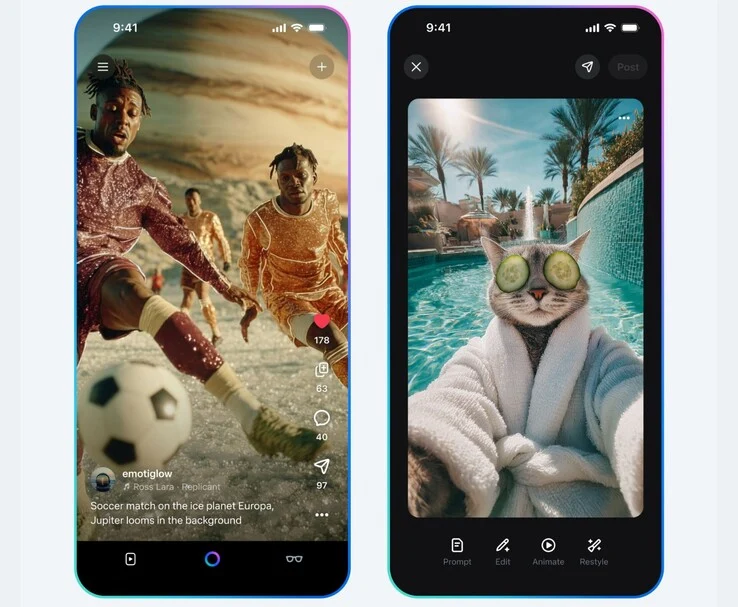
    Meta introduced Vibes on Thursday, September 25, 2025, a new short-form AI video feed. This feature is available through the Meta AI app and website, allowing users to make clips from text prompts or remix existing videos. CEO Mark Zuckerberg showcased the launch on Instagram by sharing several AI-generated clips.

    User Reactions

    However, the response from users on Reddit was mostly critical. One user, u/NowaVision, remarked, “I love how this would have been such a breakthrough a few years ago and now it just gets called out for the slop it is.” Another user, u/garden_speech, mentioned, “for every person calling it out as slop, I’m guessing there’s gonna be five of them addicted to scrolling through it within a few years.”

    Concerns and Optimism

    User u/Main-Company-5946 expressed doubts, stating, “They are going to design this thing to be as addictive as possible and it will destroy people’s minds.” On the other hand, some users saw a glimmer of potential in the feature, with u/VismoSofie commenting, “Someone is bound to use it in a cool way I suppose.”

    Meta has teamed up with the German startup Black Forest Labs to support Vibes. As reported by Bloomberg, financial documents indicate that Meta has signed a contract exceeding $140 million, which includes $35 million this year and $105 million for the following year. Sifted also covered this deal, which underscores how Meta is depending on outside providers for certain parts of its generative AI technology.

    Shifting Strategy

    The launch timing highlights Meta’s changing strategy in AI. In June, the company merged its research groups into Meta Superintelligence Labs after several senior staff left. Later in July, Reuters mentioned that Meta hired a co-creator of ChatGPT as chief scientist to guide long-term research in this area. With nearly $165 billion in revenue last year, Meta is focusing on products like Vibes, image-to-video ad tools, and smart glasses to drive new growth.

    Privacy and moderation issues are still a major concern. TechCrunch and others have previously highlighted how Meta’s AI-driven Discover feed has exposed private interactions, sparking questions about how synthetic videos will be regulated. Critics argue that with blurred lines of ownership and authenticity, it may become even more difficult to filter misleading or harmful content.

    By launching Vibes as both a creative venture and part of its larger AI initiative, Meta is betting on synthetic content becoming a key element of its ecosystem. Whether users will accept it or persist in dismissing it as “infinite slop” could impact how fast the company can integrate Vibes into its strategic plan.

    Source:
    Link


  • Mark Zuckerberg Sued Over Facebook Bans: Legal Battle Explained

    Mark Zuckerberg Sued Over Facebook Bans: Legal Battle Explained

    Key Takeaways

    1. Mark Zuckerberg, an Indianapolis bankruptcy attorney, is suing Meta over account suspensions that have affected his business.
    2. He claims negligence and breach of contract due to repeated automated flagging of his account, despite complaints.
    3. The account suspensions have disrupted his legal practice and caused financial losses, including $11,000 on advertising.
    4. Zuckerberg doubts the effectiveness of Meta’s moderation systems and feels insulted by their inability to prevent account issues.
    5. Meta acknowledged the mistake in disabling his account and stated they are working to prevent future occurrences.


    Mark Zuckerberg, a bankruptcy attorney based in Indianapolis, is taking legal action against Meta, the company behind Facebook. He has faced account suspensions five times over the past eight years due to allegations of impersonating a public figure.

    “It’s not a joke,” Zuckerberg expressed to WTHR. “It becomes serious when they start messing with my finances. This really makes me angry.”

    Legal Claims Against Meta

    Zuckerberg’s lawsuit against Meta includes accusations of negligence and breach of contract. He argues that automated systems are repeatedly flagging his account, even after he has lodged numerous complaints. These ongoing suspensions have disrupted his legal practice, halted communication with clients, and resulted in a loss of $11,000 spent on advertising for his professional profiles.

    Doubts About Account Safety

    Although Meta has restored his account, Zuckerberg remains skeptical about the effectiveness of their moderation systems.

    “It’s quite insulting that a company known for its technological expertise can’t seem to manage flagging my accounts to prevent this from reoccurring,” he told The New York Post. “It feels like they might be doing it intentionally, although I know that’s probably not the case.”

    Zuckerberg acknowledges that Meta has “greater financial power, more attorneys, and a wealth of resources” compared to him. He prefers to avoid confrontation but is at a loss for what else to do to get them to cease these issues.

    Meta’s Response

    In a response provided to WTHR, a representative from Meta stated that Zuckerberg’s account had been restored “after it was determined that it had been disabled mistakenly.”

    “We are grateful for Mr. Zuckerberg’s understanding regarding this matter and are actively working to ensure this does not occur again,” the spokesperson said.

    Source:
    Link


  • OpenAI Urges Court to Uncover Musk and xAI Talks in Meta Dispute

    OpenAI Urges Court to Uncover Musk and xAI Talks in Meta Dispute

    Key Takeaways

    1. OpenAI is seeking court action to compel Meta to provide documents related to Elon Musk and xAI’s unsolicited proposal to purchase OpenAI.
    2. Musk and Zuckerberg reportedly discussed funding plans connected to xAI, but no formal agreement exists between Meta and the investor group.
    3. The legal conflict raises questions about OpenAI’s shift to a for-profit model and its alignment with its original mission.
    4. Meta has been actively trying to enhance its AI capabilities but has faced challenges, including a recent pause on hiring.
    5. The court’s decision will impact the discovery process in an ongoing legal battle between major competitors in the AI industry.


    OpenAI has requested a court to compel Meta to provide documents regarding any collaboration with Elon Musk and xAI related to an unsolicited proposal to purchase the ChatGPT developer. This request comes after a subpoena sent to Meta in June that aimed to gather evidence of Musk’s involvement; Meta objected in July, leading to OpenAI’s recent filing.

    Musk and Zuckerberg’s Communication

    According to OpenAI’s legal team, they found out that Musk had discussions with Mark Zuckerberg concerning potential funding plans or investments linked to xAI’s initiatives. The filing also mentions that neither Meta nor Zuckerberg has signed any letter of intent to be part of the investor group making the offer. Meta contends that the information OpenAI seeks is either accessible through Musk and xAI directly or is not relevant to the ongoing case.

    Legal Implications on OpenAI’s Structure

    The conflict revolves around OpenAI’s restructuring. Musk’s lawsuit questions OpenAI’s transition to a for-profit model and its shift towards a public benefit corporation, claiming it deviates from the organization’s original mission. OpenAI argues that the nonprofit still maintains control after the changes aimed at securing funding, now seeking Meta’s documents regarding any discussions about “restructuring or recapitalization.”

    Meta’s Efforts and Industry Rivalry

    Court documents and reports indicate Meta’s ambition to exceed GPT-4’s capabilities, followed by frustration due to the underwhelming performance of their models. The company has been aggressively hiring, including the recruitment of ChatGPT co-creator Shengjia Zhao to lead the Meta Superintelligence Labs, along with a significant investment of $14 billion in Scale AI. Recently, however, Meta has reportedly put a pause on hiring and divided its superintelligence team.

    If the court approves OpenAI’s motion, Meta will be required to provide communication records regarding its discussions, if any, with Musk and xAI, as well as internal documents about OpenAI’s potential restructuring. Should the court favor Meta, OpenAI will need to obtain those records solely from Musk and xAI. The result of this case will influence discovery in a highly publicized legal battle involving key competitors and their changing partnerships.

    Source:
    Link


  • Meta Reorganizes Superintelligence Labs into Four Units

    Meta Reorganizes Superintelligence Labs into Four Units

    Key Takeaways

    1. Meta is reorganizing its Superintelligence Labs into four groups: research, superintelligence, products, and infrastructure to improve development speed and accountability.
    2. The company has made significant investments, including $14.3 billion in Scale AI and plans for $72 billion in capital spending for 2023, focusing on data centers and recruitment.
    3. Leadership is rethinking strategies, including potentially moving toward a closed model for their flagship AI, diverging from their traditional open-source approach.
    4. Key personnel changes include hiring Nat Friedman and Daniel Gross for new product features, while some former researchers have left for other companies.
    5. The restructuring aims to expedite decision-making and product delivery, marking a final major change as the company focuses on advancing superintelligence despite significant costs.


    Meta is reorganizing its Superintelligence Labs into four distinct groups: research, superintelligence, products, and infrastructure. This change aims to boost development speed and enhance accountability within its AI framework. According to leadership, this restructuring is designed to simplify operations and refocus efforts after a period of uncertainty regarding the company’s strategy for advanced models. Some executives might depart, and the division could experience additional downsizing or role changes.

    Major Investments and Plans

    In June, Meta poured billions into Scale AI and brought in its CEO, Alexandr Wang, to spearhead the superintelligence initiative. Reports indicate that this investment was around $14.3 billion, with a potential of $72 billion allocated for capital spending in 2023, primarily for data centers and recruitment.

    Rethinking Strategies

    The company’s leaders are reconsidering their model strategies. They have been looking into licensing external systems and discussing whether the upcoming flagship model should be “closed,” which diverges from Meta’s traditional open-source approach. The firm has discontinued the previously planned frontier model, Behemoth, due to lackluster results and has begun anew under Wang’s direction. Hiring has surged, with offers exceeding $100 million, creating some tensions between new hires and established researchers.

    Nat Friedman, who previously served as GitHub’s CEO, alongside Daniel Gross, ex-leader at Safe Superintelligence, will guide new product features and applied research. Rob Fergus, a co-founder of FAIR, will keep overseeing core research initiatives. Joelle Pineau and Angela Fan, both former Meta researchers, have moved on to roles at Cohere and OpenAI, respectively. Loredana Crisan, who was the vice president of generative AI, is now the chief design officer at Figma. Ahmad Al-Dahle and Amir Frenkel are now under Wang’s leadership for strategic AI efforts.

    Future Direction

    This restructuring comes after stalled advancements and reflects a renewed focus on superintelligence. Leadership describes it as the final major structural change for the time being, aimed at expediting decision-making, reducing excess, and delivering products more quickly, despite ongoing high expenditures.

    Source:
    Link


  • Meta to Showcase Two New VR Headsets with High-Res Display

    Meta to Showcase Two New VR Headsets with High-Res Display

    Key Takeaways

    1. Meta is developing two new VR headsets, set to be unveiled at SIGGRAPH 2025.
    2. The Tiramisu headset offers above retinal resolution with enhanced brightness, contrast, and resolution, but has a limited field of view.
    3. The Boba 3 headset features a wider field of view and improved resolution, making it lighter and more consumer-friendly than the Quest 3.
    4. Meta uses DLSS 3 to enhance the performance of the Tiramisu headset’s high-resolution experience.
    5. The release timeline for both headsets is uncertain, with Boba 3 appearing closer to production than Tiramisu.


    Meta is making strides towards its vision of a virtual reality (VR) experience that harmoniously merges the real world with the virtual realm. The company is currently working on two new VR headsets, and their prototypes are set to be unveiled soon. One of these headsets offers an impressive above retinal resolution, boasting improved brightness, resolution, and contrast when compared to the Meta Quest 3. The other headset emphasizes a broader field of view (FOV), aiming to mimic the natural vision of the human eye.

    Upcoming Showcase at SIGGRAPH 2025

    According to a post on the Meta blog titled “Windows on the Future,” the company plans to showcase these two prototype VR headsets at SIGGRAPH 2025, which will take place from August 10 to August 14. The first headset is named ‘Tiramisu: Hyperrealistic VR,’ featuring about 3x contrast, 3.6x pixels per degree (PPD), and brightness that can reach up to 14x compared to the Quest 3 (available on Amazon). This results in what Meta describes as an above retinal resolution, providing an incredibly lifelike VR experience, thanks to its dual high-resolution µOLED displays. However, this hyperrealistic experience does come with limitations, as the FOV is restricted to 33 inches by 33 inches. Additionally, the Tiramisu is heavier and bulkier than other commercial VR headsets on the market.

    Powering the Hyperrealistic Experience

    It’s worth noting that this high resolution is challenging to achieve, leading Meta to utilize DLSS 3 (Deep Learning Super Sampling) to power the Unreal Engine 5-based demo, which will be featured at SIGGRAPH 2025.

    The second headset, known as the Boba 3, prioritizes an expansive FOV. It offers a horizontal FOV of 180 degrees and a vertical FOV of 120 degrees, which is a significant upgrade over the Quest 3’s 110 degrees and 96 degrees, respectively. The resolution has also been improved to 30 PPD, compared to the Quest 3’s 25 PPD. The Boba 3 incorporates similar lens technology as the Quest 3 while being lighter than the Quest 3 combined with the Elite strap, making it a more viable option for consumers.

    Future Availability Remains Uncertain

    As for the release timeline of these two headsets, it’s still unclear. The Boba 3 appears to be closer to mass production, while the Tiramisu feels more like a concept at this stage.

    Source:
    Link