– LoRa emphasizes energy efficiency and long-range over high data rate, making it suitable for small data payloads (Kbit/s) and use cases like text messages or location data without relying on traditional networks.
– Meshtastic creates a mesh network (and MeshCore as an alternative) to extend effective range via multi-hop relays, with devices acting as routers and clients.
– ThinkNode M1 exemplifies typical Meshtastic hardware (LoRa + GNSS, e-ink display, Bluetooth phone pairing) and supports easy message sending and position sharing through the Meshtastic app.
We have already covered LoRa several times. It is a rather special wireless standard. In principle, LoRa is a transmission method similar to IEEE 802.11 (WiFi), but LoRa has a very different focus: instead of enabling the fastest possible transmissions with low latency, LoRa is much more about energy efficiency and range. However, LoRa is only useful when relatively small amounts of data are being transmitted, meaning more in the KBit/s range. Sending and receiving images, for example, is not realistically practical, but sending longer texts is supported. Location data can also be transmitted. Such systems can be useful on factory sites or hikes, for example, or for communication independent of state network infrastructure in repressive countries.
LoRa products, or in this specific case Meshtastic products, create a mesh network
This means the message can be transmitted indirectly, increasing the effective range far beyond the range of a direct connection. MeshCore is also available as an alternative technology or implementation that effectively runs on the same hardware, although it does have some differences in detail. For example, MeshCore works with more clearly defined roles, such as router and client, which tends to make MeshCore better suited for more or less professional, permanent mesh networks.
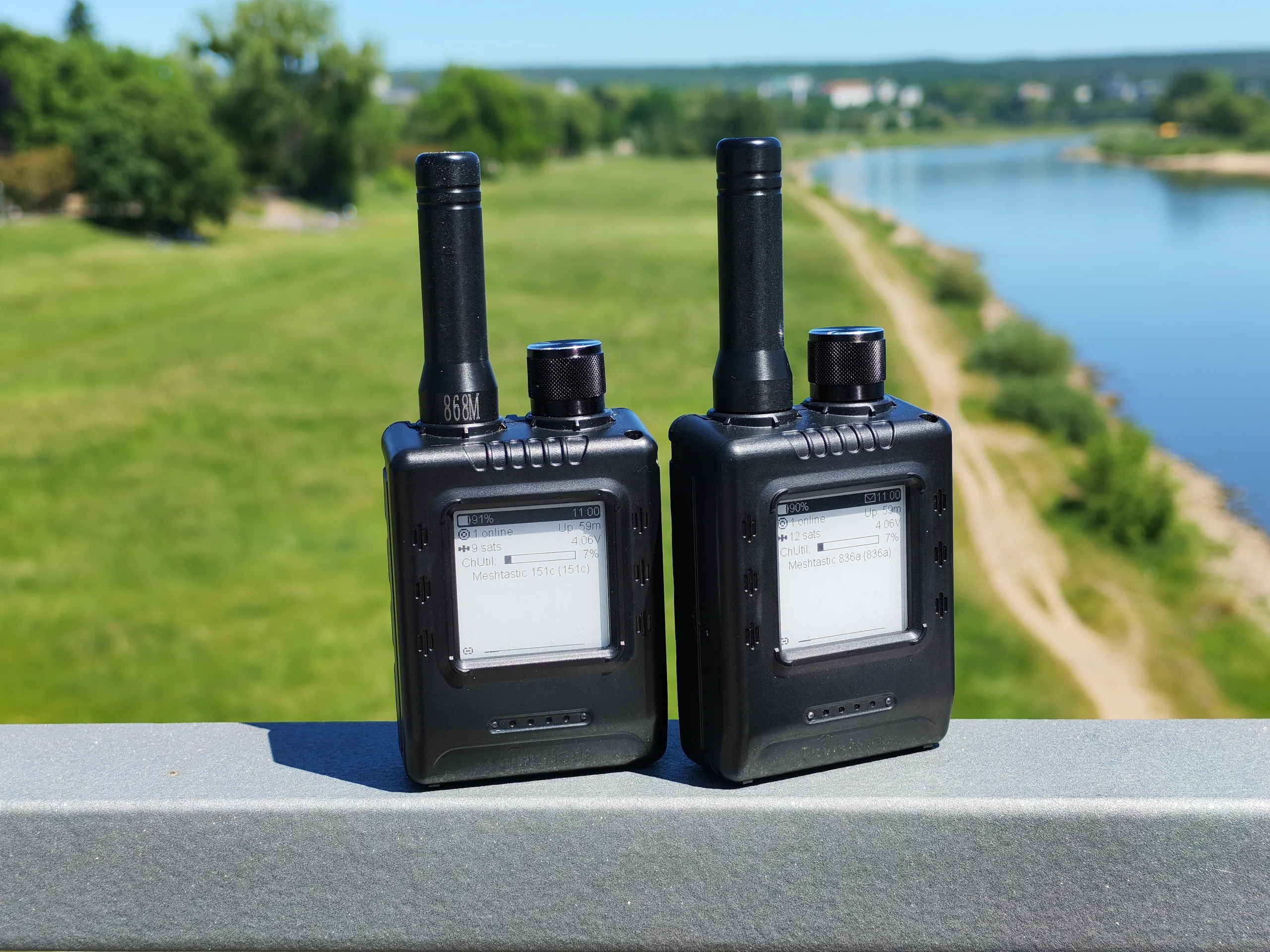
But how exactly does Meshtastic work? The answer is fairly simple. We took a look at the ThinkNode M1, a LoRa- and Meshtastic-compatible system. There is a wide selection of such systems, including on Amazon. The ThinkNode M1 comes with an e-ink display, a GNSS module, a rotary dial for powering it on and controlling brightness, two buttons, and a switch for the GNSS connection. The battery-powered system can communicate directly with other Meshtastic devices. A smartphone can be connected via Bluetooth, with the ThinkNode M1 then also acting as an external “LoRa modem.” The Meshtastic app supports setup and configuration of Meshtastic devices and also works as a messenger. This makes it easy to send messages from a smartphone.
Operation and practical notes
Operation via the two buttons is not entirely intuitive. The e-ink display remains easy to read even in direct sunlight, though overlapping image content can occasionally appear, which is partly due to the technology. This can happen with a partial refresh, although the ThinkNode M1 eventually performs a full refresh again. The e-ink display is relatively sluggish. Overall, we have little to criticize about the ThinkNode M1, although we simply lack the comparison base for a fully detailed assessment. Recording the user’s own position works without issues. This position can also be sent to the mesh network, and the location history of a device can be displayed. Users can receive notifications on their smartphone for incoming messages.
At this point, however, one thing should be pointed out directly: ranges of hundreds of miles are unlikely to be achievable with two ThinkNode M1 handhelds and a network established only between those two devices. For that, several mobile devices or repeaters have to be integrated as relay stations. With 868MHz and the LONG-SLOW modem preset, around 1,600 feet was achievable near a river, while in inner-city areas the range was more like a few hundred yards, in both cases without line of sight.