Tag: Dimensity 9400

  • Snapdragon 8 Elite Tops A18 Pro in GPU Performance vs. Dimensity 9400

    Snapdragon 8 Elite Tops A18 Pro in GPU Performance vs. Dimensity 9400

    Qualcomm has introduced the Snapdragon 8 Elite SoC, which is the new successor to the Snapdragon 8 Gen 3 flagship SoC designed for smartphones and tablets. Early benchmarks indicate that the Snapdragon 8 Elite is a strong contender against MediaTek’s Dimensity 9400 and Apple’s A18 Pro.

    CPU Performance Insights

    When it comes to CPU performance, the Snapdragon 8 Elite seems to have surpassed Apple’s A18 Pro in multi-core tests. Geekerwan’s review shows that the Snapdragon 8 Elite achieved an impressive score of 10,521 points in Geekbench 6, breaking the 10,000-point mark. However, in single-core performance, the 8 Elite still trails behind Apple’s latest chip, even though it has seen a significant generational improvement.

    GPU Capabilities

    On the GPU front, the Snapdragon 8 Elite’s Adreno GPU shows strong performance. It scored an impressive 18,007 points in Geekbench 6’s OpenCL test, which is notably higher than the approximately 16,000 points achieved by the Dimensity 9400. It’s worth noting that the GPU’s performance can vary based on the thermal characteristics of the smartphone it’s in, so that should be considered.

    Geekerwan’s analysis indicates that the Adreno GPU of the Snapdragon 8 Elite is very close in performance to the Immortalis-G925 found in the Dimensity 9400, with both exhibiting a similar efficiency curve. The Snapdragon’s GPU scored around 2,600 points, putting it well ahead of the A18 Pro, which managed only about 2,100 points while using slightly more power.

    Real-World Gaming Tests

    In practical gaming tests using Honkai Impact 3, the results were consistent. Both the Snapdragon 8 Elite and Dimensity 9400 maintained around 60 FPS at ‘very high’ settings during a 30-minute session, with power use of 6.2 and 6.0 watts respectively. Meanwhile, the A18 Pro achieved only 51.2 FPS while using about 5.5 watts.

    Clearly, Qualcomm’s choice to customize the Snapdragon 8 Elite has proven to be a smart move. The SoC is now not only more powerful but also more efficient than before, having outperformed Apple’s A18 Pro in both GPU and multi-core CPU benchmarks. Nevertheless, Apple still leads in single-core performance and overall CPU efficiency, though the gap has narrowed significantly.

    Geekerwan’s analysis showcases the advancements in mobile processing power.


    Image 1
  • Snapdragon 8 Elite vs Dimensity 9400: Qualcomm vs MediaTek Comparison

    Snapdragon 8 Elite vs Dimensity 9400: Qualcomm vs MediaTek Comparison

    Qualcomm has just revealed the Snapdragon 8 Elite, the high-end processor set to drive the next wave of flagship smartphones. This announcement comes just weeks after MediaTek showcased its own premium Dimensity 9400 SoC. We previously put together a preliminary comparison based on rumors and leaks regarding these two processors. Now, let’s take a closer look at how the Snapdragon 8 Elite stacks up against the Dimensity 9400.

    Snapdragon 8 Elite vs Dimensity 9400: Specs Overview

    The new Dimensity 9400 from MediaTek is built around their 2nd Gen All Big Core architecture, which features the robust ARM Cortex-X925 core. These cores operate at speeds exceeding 3.62GHz, and the chip integrates three Cortex X4 cores along with four Cortex A720 cores. This setup allows the Dimensity 9400 to deliver a 35% enhancement in single-core performance and a 28% increase in multi-core performance when compared to its predecessor, the Dimensity 9300.

    It is manufactured using TSMC’s 2nd Gen 3nm technology, which provides up to 40% better power efficiency. The new chip also comes with an advanced NPU that enhances AI capabilities and includes a 12-core ARM Immortalis-G925 GPU, which boasts 40% faster ray tracing capabilities.

    Snapdragon 8 Elite’s Features

    Qualcomm’s Snapdragon 8 Elite follows a similar path with its All Big Core architecture. It features eight cores, consisting of 2 prime cores that run at a remarkable 4.32GHz, along with 6 performance cores clocked at 3.53GHz. This new chip is also built on TSMC’s 3nm process, indicating a 45% boost in CPU performance and a 44% enhancement in power efficiency.

    Thanks to its upgraded Adreno 830 GPU, it also sees a 40% improvement in performance and power efficiency, alongside a 35% increase in ray tracing speed. Notably, the Snapdragon 8 Elite supports Unreal Engine 5.3 and its Nanite virtualized geometry system, which is a big plus for gaming enthusiasts.


    Image 1
    Image 1
  • Snapdragon 8 Elite CPU Benchmarks Reveal New Performance Leader

    Snapdragon 8 Elite CPU Benchmarks Reveal New Performance Leader

    Qualcomm has introduced its top-of-the-line chipset for this year, named the Snapdragon 8 Elite. This chipset is promoted as having the fastest mobile CPU in the world. Unlike previous models that used ARM’s Cortex cores, the Snapdragon 8 Elite utilizes Oryon cores, leading to significant improvements in performance. QRD benchmark tests have demonstrated that this chipset excels in CPU capabilities.

    Performance Highlights

    According to Geekerwan, the Snapdragon 8 Elite achieves a score of 3,242 in Geekbench 6’s single-core CPU test. This figure surpasses the Dimensity 9400, which scored 3,010, but falls short of the Apple A18 Pro’s impressive 3,509 score. However, in the multi-core test, the Snapdragon 8 Elite truly lives up to its title of the fastest mobile CPU, scoring 10,521 and outpacing the A18 Pro (9,376) and Dimensity 9400 (9,317).

    Comparison With Competitors

    In AnTuTu benchmarks, the Snapdragon 8 Elite received a CPU score of 679,852. The Dimensity 9400, found on the Vivo X200 Pro, is close behind with a score of 652,381. Nevertheless, the Snapdragon 8 Elite does not match the efficiency of the A18 Pro, which consumes about 11.9 W in the multi-core test on Geekbench, compared to the Snapdragon 8 Elite’s 16.8 W. Unfortunately, the Dimensity 9400 is the least efficient this year, drawing around 18.6 W.

    Conclusion

    Clearly, the Snapdragon 8 Elite presents a compelling argument for having the fastest mobile CPU to date. It outshines MediaTek’s Dimensity 9400 in all significant CPU tests and is only narrowly surpassed by the Apple A18 Pro in peak performance circumstances. It’s worth mentioning that these benchmarks were conducted on an engineering unit rather than retail devices. However, the Xiaomi 15, OnePlus 13, and iQOO 13 are expected to launch soon, and we will provide updates on their real-world performance once they are available.

    From Geekerwan,
    Kingmi Mobile


    Image 1
    Image 1
    Image 1
    Image 1
  • Vivo X200 Ultra Teased with Snapdragon 8 Elite Chip Features

    Vivo X200 Ultra Teased with Snapdragon 8 Elite Chip Features

    Vivo has recently introduced the Vivo X200, X200 Pro Min, and X200 Pro in China. Each of these smartphones is powered by the Dimensity 9400 chipset. There’s also anticipation for an Ultra version, which is expected to launch in the first half of 2025. Rumors suggest that this model could feature the Snapdragon 8 Elite chipset.

    Upcoming Snapdragon 8 Elite Device

    The Vivo X200 Ultra is rumored to utilize the Snapdragon 8 Elite. For context, the earlier Vivo X100 and X100 Pro used the Dimensity 9300 chipset, while the X100 Ultra had the Snapdragon 8 Gen 3 chip. It’s likely that Vivo will follow a similar approach with the Ultra model. This was hinted at when they announced on their Weibo account that a Snapdragon 8 Elite smartphone is in the works. The upcoming Vivo X200 Ultra is probably going to include this chip.

    Features and Specifications

    As we look forward to the Vivo X200 Ultra’s launch next year, leaks have started providing insights. Recently, tipster Digital Chat Station shared that the X200 Ultra will come with a 50-megapixel main camera, a 50-megapixel ultra-wide lens, a 50-megapixel telephoto camera, and an impressive 200-megapixel periscope telephoto lens. There are also speculations that it will support satellite communication.

    Currently, not much else is known about the Vivo X200 Ultra. This device is expected to compete with the Samsung Galaxy S25 Ultra, Oppo Find X8 Ultra, and Xiaomi 15 Ultra within the Chinese marketplace. The anticipated price for the X200 Ultra is around 5,500 Yuan (approximately $770) in China.

    Global Release Uncertainty

    Both the X100 and X100 Pro were made available globally, but the X100 Ultra was exclusively sold in China. Hence, it remains unclear whether the X200 Ultra will be introduced to the international market.

  • Redmi Flagship to Feature Snapdragon 8 Elite and Dimensity 9400

    Redmi Flagship to Feature Snapdragon 8 Elite and Dimensity 9400

    A report from earlier this week has suggested that Redmi might be developing a small sub-flagship smartphone. This upcoming device is anticipated to sport a 6.3-inch display and come equipped with an impressive 6000mAh battery, which is noteworthy considering its compact size.

    Processor Insights

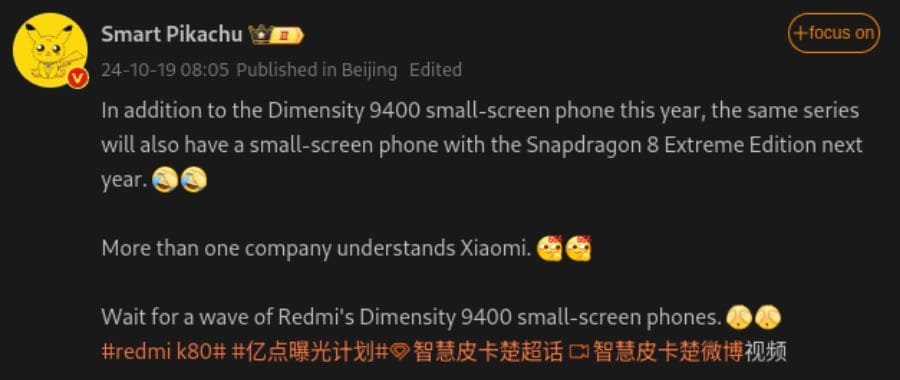
    Recently, a leak has emerged providing insights into the phone’s processor, and the information, if accurate, is quite compelling. As per a Weibo source known as Smart Pikachu, this mini flagship from Redmi could run on the Dimensity 9400 chip and may belong to the Redmi K80 series, indicated by the hashtag #redmik80 in their post. Interestingly, the tipster also mentioned that the K80 series could include a variant with the Snapdragon 8 Elite (Extreme Edition or Gen 4) chip next year.

    Speculative Nature

    While we can’t verify the truthfulness of these claims, if they are correct, it would be fascinating for Redmi to incorporate both Snapdragon and MediaTek flagship SoCs within the same series. Besides this, not much information is available regarding this compact smartphone from Redmi. Given the scant details, it’s reasonable to assume that the development is probably at an early stage.

    Launch Expectations

    Currently, Xiaomi appears to be concentrating on the upcoming launch of the standard Redmi K80 series, which is expected to debut next month with at least two models – the K80 and K80 Pro. Speculations indicate that the K80 Pro will utilize the Snapdragon 8 Elite, while the K80 may feature the Snapdragon 8 Gen 3. Should the compact phone indeed be part of the K80 lineup, it could potentially be unveiled alongside its larger counterparts in November.

    The concept of a compact Redmi phone featuring a flagship processor and a robust battery is thrilling, but it’s important to temper expectations until Xiaomi makes an official announcement. In the coming weeks, it’s possible that additional leaks and information will emerge. For now, though, the reality and specifications of this mini flagship remain uncertain.

  • Snapdragon 8 Gen 4 Tops Multi-Core, A18 Pro Leads Single-Core

    Snapdragon 8 Gen 4 Tops Multi-Core, A18 Pro Leads Single-Core

    If the latest happenings in the smartphone chip scene are any indication, a major chip competition is on the horizon. Apple took the lead with its A18 Pro SoC, followed closely by MediaTek’s Dimensity 9400 which was introduced this month. Now, everyone is looking forward to Qualcomm, which is set to officially announce its Snapdragon 8 Gen 4 SoC during the Snapdragon Summit event.

    Benchmarks Surface Online

    Benchmarks for all these SoCs have surfaced online, including the unreleased Snapdragon 8 Gen 4, or whatever name Qualcomm decides to give it. As predicted, Apple dominates in single-core performance by a significant margin. In Geekbench 6, the A18 Pro achieves an impressive score of 3,400 points, whereas the Dimensity 9400 scores around 2,800—an improvement over last year’s 9300+, but still far behind Apple. Leaked benchmarks for the Snapdragon 8 Gen 4 indicate it surpasses the Dimensity 9400 in single-core performance with 3,100 points, yet it still falls short compared to the A18 Pro.

    Multi-Core Scores Flip the Script

    When it comes to multi-core performance, the situation changes quickly. Despite having the fewest cores, the A18 Pro ranks at the bottom with a score of approximately 8,700 points in Geekbench 6. Meanwhile, the Snapdragon 8 Gen 4 impressively crosses the 10,000-point mark in early leaks, hitting 10,052. The Dimensity 9400 finds its place between Apple’s and Qualcomm’s solutions, scoring just above 9,000 according to a recent assessment by Geekerwan.

    Efficiency Matters Too

    Of course, it wouldn’t be right to evaluate smartphone SoCs without looking at efficiency. According to Geekerwan’s data, Apple’s A18 Pro clearly outperforms the Dimensity 9400 in this area. Given the remarkably high multi-core scores of the Snapdragon 8 Gen 4, it might not be the most efficient chip, especially since previous Snapdragon models have struggled against Apple concerning CPU efficiency. Nevertheless, this time could be different, but I’m not ready to make any assumptions just yet.

    Geekerwan, Geekbench.


    Image 1
  • Vivo X200 Pro Mini: Flagship Specs, Zeiss Cameras, Big Battery

    Vivo X200 Pro Mini: Flagship Specs, Zeiss Cameras, Big Battery

    Vivo has unveiled the X200 series in China, which features three new smartphones that are the first to use the advanced Dimensity 9400 chipset. Among these, the X200 Pro Mini stands out as it offers premium flagship specifications in a compact design.

    Compact Design and Impressive Battery

    The Vivo X200 Pro Mini comes equipped with a 6.31-inch display, making it the smallest option in the lineup. Despite its petite size, it boasts a robust 5,700 mAh battery. In comparison, both the Pixel 9 Pro and iPhone 16 Pro have 6.3-inch screens but are equipped with smaller batteries of 4,700 mAh and 3,582 mAh, respectively.

    Camera Capabilities

    This model doesn’t skimp on camera features, either. It shares the same camera setup as the larger Pro version. The flagship mini is loaded with a Sony LYT-818 main camera, a 200 MP Zeiss APO telephoto sensor, and a 50 MP ultrawide lens. Notably, the 200 MP Zeiss APO telephoto camera is the same one found in the X100 Ultra. For selfies, it has a 32 MP front camera. All of these camera systems are enhanced by Vivo’s V3+ imaging chip, which is also utilized in the X100 Ultra.

    Display and Charging Features

    On the display front, the Vivo X200 Pro Mini features a 6.31-inch LTPO OLED screen. This display supports an adaptive refresh rate of 120 Hz, reaches a peak brightness of 4,500 nits, and has a resolution of 2,640 x 1,260 pixels. Additional features of the X200 Pro Mini include 30W wireless charging and 90W wired charging (the 100W Anker Prime charger is currently priced at $64.23 on Amazon), alongside IP68 and IP69 ratings, and it runs on Android 15-based OriginOS.

    Pricing and Availability

    The starting price for the Vivo X200 Pro Mini with 12 GB of RAM and 256 GB of UFS 4.0 storage is CNY 4,699, roughly translating to $663. The mid-tier model, which includes 16 GB of RAM and 512 GB of storage, is priced at CNY 5,299, about $748. The high-end version, featuring 16 GB of RAM and 1 TB of storage, costs CNY 5,799, around $818.

    Color Options

    In terms of colors, the X200 Pro Mini can be found in Simple Black, Plain White, Light Pink, and Titanium Green. Vivo has not yet announced when or if these devices will be available globally or provided pricing details for those markets.


    Image 1
  • Vivo X200 Series: Enhanced Display for Color Accuracy and Comfort

    Vivo X200 Series: Enhanced Display for Color Accuracy and Comfort

    Vivo has disclosed many details about their flagship X200 series devices, which are set to launch today in China. Han Boxiao, the product manager at Vivo, has provided more insights into the display technology used in these devices. Confirming what was previously leaked, he mentioned that the X200 series features the ‘Master Zeiss color screen’ for the first time, enhancing color accuracy. The devices also support 2160Hz high-frequency PWM dimming, which helps to lessen eye fatigue.

    Enhanced Color Accuracy and Comfort

    As per the official statement, these devices can uniformly map the color gamut in various scenarios, whether it’s a UI element or an image. They can also adjust the color temperature according to the surrounding light, similar to the upcoming Oppo Find X8 series. Regarding eye protection, the X200 series maintains a consistent 2160Hz PWM regardless of brightness levels, which should be gentler on the eyes, especially in dim settings. Han Boxiao adds that many competitor brands implement a two-stage dimming approach, causing the display to only achieve the higher PWM frequency in low-light situations.

    Seamless Viewing Experience

    This switching between PWM levels due to changing light conditions can lead to less-than-ideal viewing experiences. In contrast, the Vivo X200 series is said to provide a more fluid visual experience in varying lighting. Additionally, the display panels and their components are designed to be more power-efficient this time, which is expected to extend battery life. The full brightness 2160Hz PWM dimming supposedly doesn’t affect the benefits and features of the LTPO panel, requiring only slightly higher power use.

    Advanced Eye Protection Features

    Moreover, the display panels include low blue light solutions to enhance eye comfort during dark environments. The “Night Eye Protection 2.0” software solution can adjust the visual effects based on what’s displayed. Besides the eye protection features, the Vivo X200 series provides smoother visuals with the Android 15-based OriginOS 5, thanks to its refined animations. Every device in this series is powered by the newly launched Dimensity 9400 chipset, which supports on-device LLMs and brings significant enhancements in both CPU and GPU performance.


    Image 1
  • Samsung Galaxy S25 Expected to Feature MediaTek Dimensity 9400

    Samsung Galaxy S25 Expected to Feature MediaTek Dimensity 9400

    Plenty has been discussed about Samsung’s potential use of MediaTek chipsets lately, but nothing has been confirmed yet. The initial speculation seems to have started with the launch of the Galaxy Tab S10 Plus and Galaxy Tab S10 Ultra, which come equipped with Dimensity 9300 Plus chipsets—this is a first for this series.

    Google DeepMind’s Implication

    A post from Google DeepMind suggested this chip adoption might also apply to Samsung’s smartphones, although this claim has since been denied. In a similar vein, market analysts from Morgan Stanley have purportedly released findings rejecting the idea that a Samsung phone powered by the Dimensity 9400 could be launched next year. This rumor also supposedly involves Honor, but we have yet to discover any concrete proof, nor has our source shared a link to the report.

    Ongoing Speculations

    Despite this, there are still ongoing rumors about Samsung potentially incorporating Dimensity chipsets in the Galaxy S25 series. Reports say that initial discussions between Samsung and MediaTek focused on including a yet-to-be-named Dimensity chipset in the standard Galaxy S25. However, it seems that Samsung has opted for Snapdragon exclusivity for its upcoming compact flagship, which may also apply to the bigger Galaxy S25 Plus.

    Future of the Galaxy S25 FE

    MediaTek, on the other hand, is now hoping that Samsung will use its Dimensity platform in the Galaxy S25 FE, moving away from this year’s dual Exynos and Snapdragon approach seen in the Galaxy S24 FE (currently priced at $649.99 on Amazon). It’s likely that the chipset involved will be the Dimensity 9400, not something newer or older. While the launch date for the Galaxy S25 FE remains uncertain, the idea that it may feature a Dimensity chipset suggests it could be released alongside new flagship Galaxy Tab S tablets.

  • Galaxy S25 FE Expected to Feature Slim Design and Build

    Galaxy S25 FE Expected to Feature Slim Design and Build

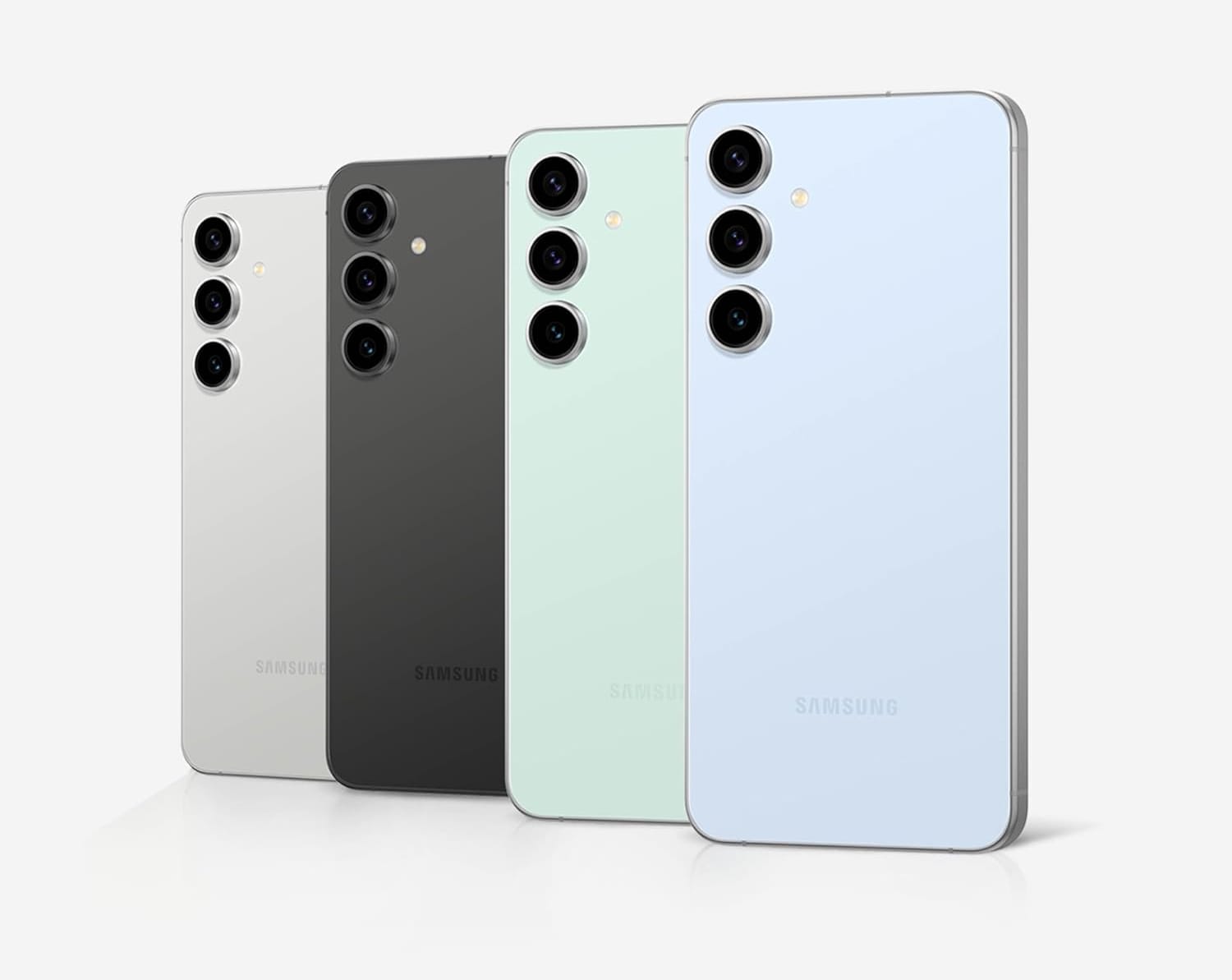
    According to earlier information, the Galaxy S25 FE will feature the Dimensity 9400 chip instead of the Exynos 2500 or a tweaked version of it, suggesting that a significant boost in performance is on the horizon. Moreover, a report from South Korea indicates that this new model will be much thinner compared to the previous version.

    A Need for Redesign

    The report highlights that Samsung has managed to make the phone thinner by incorporating a larger yet slimmer battery. The company aims to position the S25 FE as a "slim" variant. To accommodate the bigger battery, Samsung will likely have to rework the internal components.

    For reference, the Galaxy S24 FE has a thickness of 8mm, weighs 213g, and features a 6.7″ display with a 19.5:9 aspect ratio. Inside it holds a 4700 mAh battery, upgraded from the 4000 mAh capacity of the Galaxy S24.

    Battery Technology Insights

    High-density silicon-carbon anode batteries are currently available in the market and provide a much thinner profile than traditional graphite anode batteries with equivalent capacity. However, the report did not specify if this technology will be utilized.

    That being said, the Galaxy S25 FE is anticipated to maintain the 6.7″ display, just like its predecessor, the Galaxy S24 FE. The official launch of the new phone is expected to take place in the latter half of next year.

    Expectations Based on the S24 FE

    Though information on the forthcoming FE model is limited at this time, we can look at the S24 FE for some clues about what might be in store. The design of the phone closely resembles that of the Galaxy S24 and keeps the IP68 rating for dust and water resistance.

    In terms of camera features, the latest FE version has a camera arrangement that is quite similar to the standard model, with only a minor reduction in resolution for the 3x telephoto lens (8MP instead of 10MP).

    On the other hand, the Galaxy S24 is a tad slimmer at 7.6mm, and it’s noticeably lighter and more compact. Samsung has increased the display size of its FE devices from 6.4″ to 6.7″ this year, and the effort to reduce thickness may be aimed at aligning it more closely with the flagship model in that respect.