Tag: Android 15

  • Google Pixel 9a Specs and Pricing Leaked Before Launch

    Google Pixel 9a Specs and Pricing Leaked Before Launch

    Google’s upcoming mid-range smartphone has been in the spotlight due to numerous leaks recently. Just two weeks after Google unveiled the Pixel 9 (currently priced at $622 on Amazon) along with its other flagship models, the first images of the Pixel 9a emerged. Since that time, the Pixel 9a has made several appearances, with the latest leaks surfacing earlier this month.

    New Specifications Revealed

    Android Headlines has released what it claims to be the ‘complete technical specifications’ of the device. Based on the information provided, the Pixel 9a will feature several updates compared to this year’s Pixel 8a, such as a larger chassis and a battery that is 13.5% bigger. Additionally, the smartphone will sport a 6.28-inch display, which is 0.18 inches wider diagonally than the display found on this year’s mid-range Pixel.

    Camera and Brightness Enhancements

    In terms of brightness, the HDR peak has been raised from 2,000 nits to 2,700 nits, although the maximum full panel brightness is capped at 1,800 nits. Google is reportedly replacing the main camera with a Samsung ISOCELL GN8 sensor, which offers a resolution of 48 MP with a 1/1.95-inch optical format. This means the Pixel 9a will have a smaller main camera compared to its predecessor. However, the 13 MP front-facing and ultra-wide-angle cameras will be retained from the Pixel 8a.

    Performance and Storage Options

    As anticipated, the upcoming Pixel A series smartphone will be equipped with a Tensor G4 chipset and come with 8 GB of RAM. The device is expected to be offered with storage options of 128 GB and 256 GB at the same prices as before, at least in the United States. Interestingly, the Pixel 9a might be the only smartphone launched by Google that runs on Android 15. For more technical details, please check the image below.

    Source: Link


    Image 1
  • OnePlus 13 Appears on GeekBench Before January Launch with Snapdragon 8

    OnePlus 13 Appears on GeekBench Before January Launch with Snapdragon 8

    The OnePlus 13 made its debut in China in October 2024, and now the company is preparing for a broader international launch. Before the official announcement for other regions, the OnePlus 13 has been seen showcasing its performance on a well-known benchmarking site. Let’s take a closer look.

    OnePlus 13 Shines on GeekBench with Snapdragon 8 Elite

    The flagship device appeared in the GeekBench database under the model number CPH2655 (Via 91Mobiles). According to the benchmarking results, it achieved a score of 2998 points in the single-core test and an impressive 9170 points in the multi-core test. The OnePlus 13 is powered by Qualcomm’s top-of-the-line Snapdragon 8 Elite processor. It comes equipped with 16GB of RAM, though it’s possible there will be additional RAM options available.

    Specs and Features of OnePlus 13

    This device operates on Android 15 right out of the box, likely featuring the OxygenOS 15 custom interface. OnePlus has recently teased some important specifications and shared initial sale information in India through Amazon. However, the global version has also been noted on the Wireless Power Consortium, revealing some unsatisfactory wireless charging capabilities. From the details we have so far, the OnePlus 13 boasts a tall 6.82-inch LTPO AMOLED display with a 2K resolution, a 120Hz refresh rate, and a peak brightness of 4500 nits.

    Camera and Battery Performance

    For photography enthusiasts, the OnePlus 13 comes with three 50MP cameras on the back and a 32MP front-facing camera for selfies. A large 6,000mAh battery powers the device, which is compatible with 100W wired fast charging and 50W wireless fast charging. All these features are housed within a sleek body that combines glass and metal. The global introduction of the OnePlus 13 is expected in January 2025, so stay tuned for more information.

    Source: Gizmochina


    Image 1
  • Galaxy S25 Series: Noise Removal & Voice Enhancement in Videos

    Galaxy S25 Series: Noise Removal & Voice Enhancement in Videos

    Samsung has revealed the One UI 7 Beta on December 5, initially rolling out to Galaxy S24 series devices in countries like Germany, India, South Korea, Poland, the United Kingdom, and the United States. The stable version, based on Android 15, is expected to launch with the Galaxy S25 series in January 2025.

    New Features on the Horizon

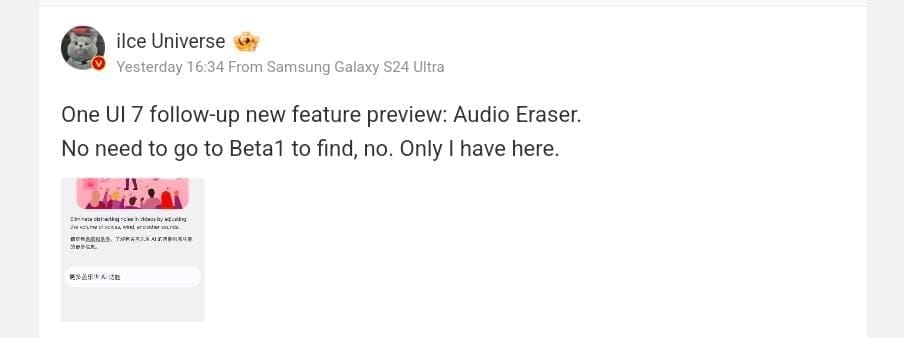
    According to tipster ICE Universe, the next iteration of One UI 7 will introduce a feature called “audio eraser,” which is absent in the current Beta 1 version. This audio eraser will allow users to fine-tune the volume of particular sounds in videos, enabling them to diminish or eliminate background noises such as wind, traffic, and other distractions while keeping voices crystal clear. This enhancement aims to enrich the user experience without requiring any third-party tools.

    Exciting Updates in One UI 7 Beta

    The One UI 7 Beta brings forth numerous thrilling improvements, especially emphasizing AI features to boost productivity and device performance.

    Notable Features and Enhancements

    Advanced Writing Assistance: One UI 7 incorporates sophisticated writing aids within its AI functionalities. These tools assist users in summarizing texts, verifying spelling and grammar, and automatically transforming notes into bullet points. This integration facilitates smooth multitasking, allowing users to highlight text without the hassle of switching apps.

    Automatic Call Transcription: A significant improvement in One UI 7’s calling functionality is the automatic transcription of call recordings once enabled. This innovation eliminates the requirement for manual note-taking during conversations, making it perfect for individuals who must document essential information while on the move.

    NowBar: The newly redesigned notification feature, known as Now Bar, streamlines communication and eases access to vital notifications from the lock screen. This development minimizes the need to unlock the device frequently, allowing users to manage crucial information more effectively. The Now Bar is set to be supported on upcoming Galaxy S series devices and will continue to evolve for a smarter experience in future updates.

    Revamped Camera Experience: One UI 7 also revamps the camera interface, providing users with more intuitive access to advanced settings. The redesigned camera buttons, modes, and controls ensure smoother navigation and a clearer view of photos and videos prior to capturing them.

    Source: Link


    Image 1
  • OnePlus 13R Shows Up on Geekbench and FCC with Key Specs

    OnePlus 13R Shows Up on Geekbench and FCC with Key Specs

    OnePlus seems to be preparing to launch its newest sub-flagship smartphone, the OnePlus 13R. Recent leaks and certifications have provided insights into the key specs and features of this eagerly awaited device.

    Geekbench Insights

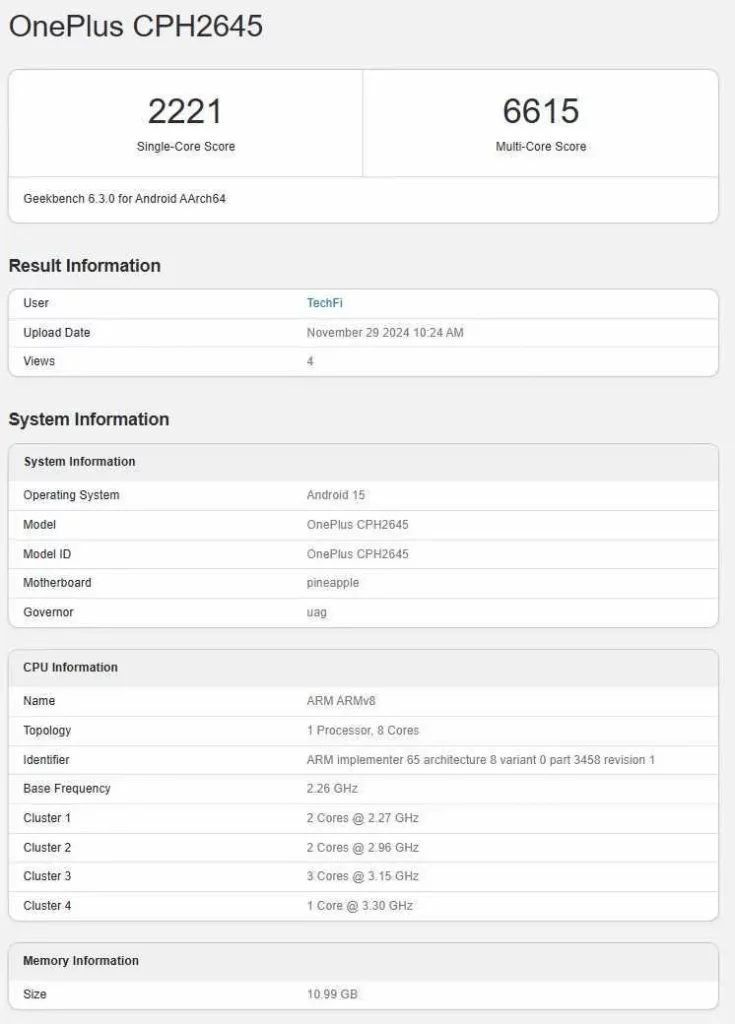
    The OnePlus 13R has been identified on Geekbench, under the model number CPH2645. The listing shows that the phone will be driven by the Qualcomm Snapdragon 8 Gen 3 SoC, a robust chipset recognized for its remarkable performance. To support the powerful processor, the smartphone is set to come with up to 12GB of RAM, which would guarantee smooth multitasking and efficient app performance.

    Software and Battery Features

    As for the software front, the OnePlus 13R will operate on Android 15, likely featuring OxygenOS 15. Other notable specifications revealed through an FCC listing include a 5,860mAh battery that supports 80W fast charging. Furthermore, the OnePlus 13R will be equipped with Wi-Fi 7, Bluetooth 5.4, and NFC functionalities.

    Launch Speculations

    While the precise launch date and pricing for the OnePlus 13R haven’t been officially confirmed, the leaks and certifications indicate that the device’s official unveiling is imminent. Previous reports hint that the device could be a rebranded variant of the OnePlus Ace 5, which is anticipated to be launched in China shortly.

    Regarding specifications, the OnePlus Ace 5 is rumored to include the Snapdragon 8 Gen 3 processor, paired with as much as 16GB LPDDR5X RAM and 512GB UFS 4.0 storage, along with a 1.5K resolution OLED flat display from BOE. The camera configuration is expected to showcase a triple sensor setup of 50MP + 8MP + 2MP, along with a 16MP front-facing camera.

    It’s important to note that the OnePlus Ace 5 is believed to sport a battery capacity between 6,300 and 6,500mAh, along with support for 100W fast charging. Therefore, it’s possible that the OnePlus 13R, which will be available in the global market, may come with a lesser battery and charging capabilities. More information about the device is likely to surface in the upcoming days, so keep an eye out!


    Image 1
  • All You Need to Know About Samsung One UI 7.0 Update

    All You Need to Know About Samsung One UI 7.0 Update

    Over time, One UI has developed into one of the most refined and robust Android interfaces. Each new version seems to enhance the user experience further. In recent years, Samsung has excelled with its software updates, often delivering them ahead of schedule. Yet, this year has not met expectations.

    Samsung vs. Competitors

    While Samsung has often been a leader in launching new Android versions, this year Vivo has surged ahead by launching Android 15 even before Google. It marks the first time since One UI 3.0 that Samsung won’t introduce a new One UI version publicly. Although Samsung hasn’t provided specific reasons for the delay in One UI 7.0, reports suggest that it may be the most significant update from the company in a long time, necessitating more development time.

    What’s on the Horizon?

    Samsung has kept most information about One UI 7.0 under wraps, but some leaks have revealed crucial details, including its rollout schedule and new features. At its Developer Conference on October 3, Samsung hinted that the new interface will emphasize a simple, impactful, and emotional Galaxy experience, introducing a new blur engine designed to enhance user interaction with the software.

    Recently, OnePlus and Oppo have teased One UI’s slower app performance while showcasing their Android 15-based skins. However, One UI 7 could change that narrative, promising to be the largest enhancement in Samsung’s software history. Users can expect a smoother experience with improved animations and transitions.

    Exciting New Features

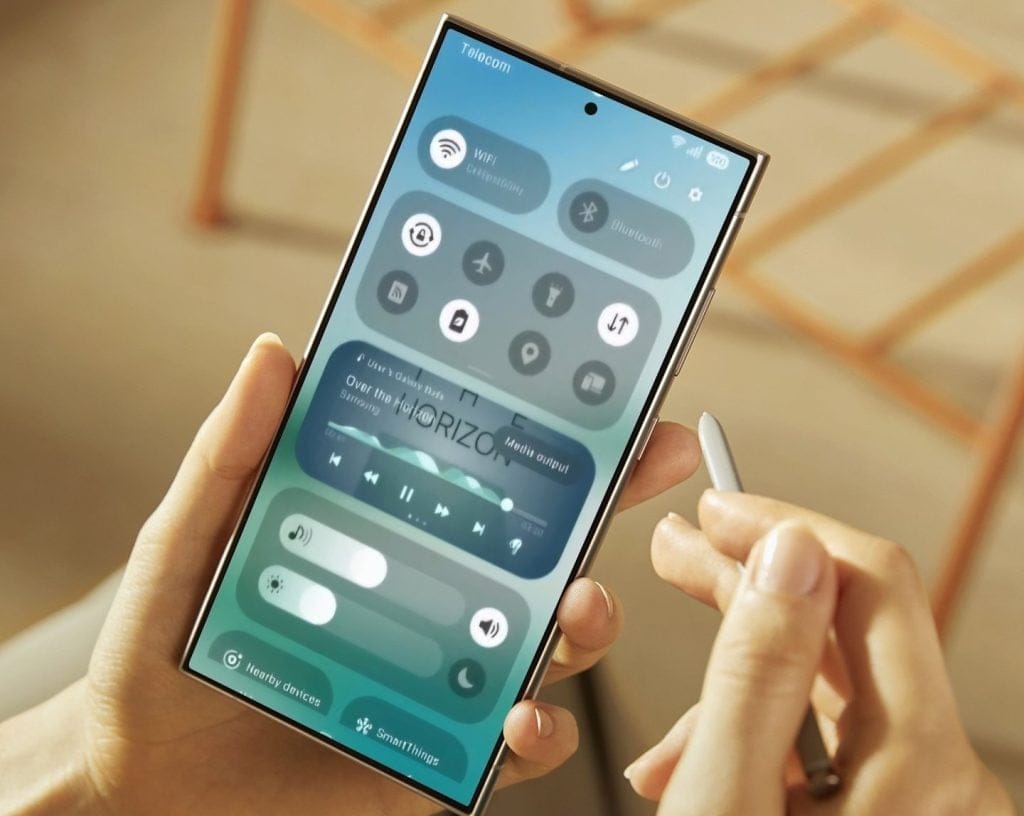
    One UI 7.0 is rumored to come with a revamped Quick Settings panel, offering more customization options than ever. Users may be able to rearrange various quick settings toggles and sliders. The update might also introduce a two-page Quick Panel layout—one for notifications and the other for quick settings toggles—depending on which side of the status bar you swipe down from. Still, there will be an option to combine them as it was done previously.

    Most Samsung apps are expected to receive new icons, with some undergoing a UI redesign. The Camera app is one of those slated for updates, potentially grouping various settings for a more streamlined appearance. The AR Emoji feature is now called Galaxy Avatar and will be integrated within the Settings app. It’s also anticipated that the AI Portrait Studio will have a fresh design, providing improved previews at the bottom of the display. Additionally, One UI 7.0 is likely to enhance Parental Controls and may incorporate more Good Lock features.

    Samsung is reportedly developing a new “Cloud” app that might be part of One UI 7.0, with unclear functionalities—but it could serve as a new backup solution. The Auto Blocker feature could introduce a new Maximum Restriction mode for heightened security. Users might even have the option to fully disable thermal throttling, a feature spotted in an early software version, but its presence in the final iteration remains uncertain. Furthermore, Galaxy AI may take a lesser role in One UI 7.0, likely offering fewer features than its predecessors.

    Release Timeline for One UI 7.0

    Samsung has not been vocal about the release date for One UI 7.0. However, it has confirmed that the beta testing phase will begin this year, with the stable version launching alongside the Galaxy S25 series, expected in early 2025.

    A recent leak suggests that the Galaxy S25 series will receive the beta in the first week of December, with the Galaxy S24 series following in 2-3 weeks. It remains uncertain whether the Galaxy S22 series will access the One UI 7.0 beta this year, and the Galaxy S21 series may be excluded from the beta program altogether.

    The beta program will extend to more Galaxy devices (check for the full list here). If you are interested in the eligible devices for One UI 7.0, please visit this page.

  • Over 50 Galaxy Devices Eligible for One UI 7 Update List

    Over 50 Galaxy Devices Eligible for One UI 7 Update List

    Samsung is preparing to launch its One UI 7 update, which is based on Android 15, and there’s a lot of talk about which devices will get it. Although the company hasn’t shared an official list or specific dates yet, tipster @TheGalox_ has identified over 50 devices that are expected to get the update.

    List of Eligible Devices

    The list from @TheGalox_ features a diverse selection of Galaxy smartphones and tablets, covering high-end, mid-tier, and budget options. Key models include Galaxy S devices dating back to the S21 series, which also includes the S21 FE. Samsung’s foldable devices—from the Z Fold 6 to the Z Flip3—are anticipated to be part of this rollout. While the new Galaxy W25 and W25 Flip that are exclusive to China are not mentioned, they are still thought to likely get the Android 15 update.

    Galaxy smartphones anticipated to receive One UI 7 update:

    • Galaxy Z Fold Special Edition
    • Galaxy Z Fold6
    • Galaxy Z Fold5
    • Galaxy Z Fold4
    • Galaxy Z Fold3
    • Galaxy Z Flip6
    • Galaxy Z Flip5
    • Galaxy Z Flip4
    • Galaxy Z Flip3
    • Galaxy S24 series
    • Galaxy S23 series
    • Galaxy S22 series
    • Galaxy S21 series
    • Galaxy A73
    • Galaxy A55
    • Galaxy A54
    • Galaxy A53
    • Galaxy A35
    • Galaxy A34
    • Galaxy A33
    • Galaxy A25
    • Galaxy A24
    • Galaxy A23
    • Galaxy A16
    • Galaxy A15
    • Galaxy A14

    Galaxy Tablets Expected to Receive the Update

    Galaxy Tablets likely to get the update:

    What’s in the One UI 7 update?

    The One UI 7 update is set to be the most significant upgrade in One UI’s history. It promises a new design along with various functional improvements. Leaked images hint at new icons, widgets, and wallpapers, plus the ability to use large folders for better content organization.

    User Experience Enhancements

    The software is also rumored to introduce a redesigned camera interface, making it easier for users to navigate. Visual enhancements include a fresh unlock animation as well as updated battery and charging icons.

    Furthermore, a major redesign seems to be in store for the control center, featuring larger toggles for brightness and volume adjustments, which could lead to a more user-friendly experience overall.

  • Vivo S20 Processor Benchmark Results Unveiled

    Vivo S20 Processor Benchmark Results Unveiled

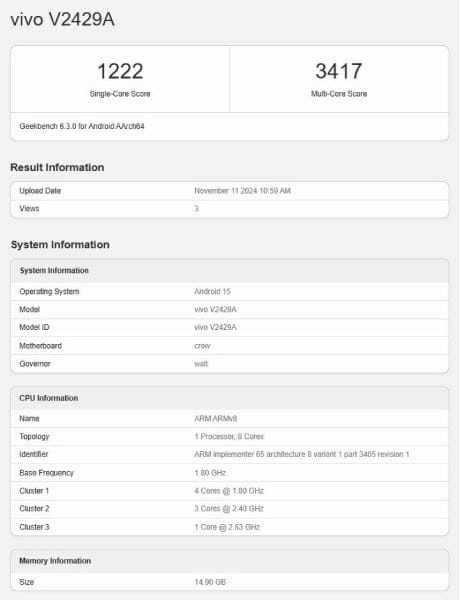
    After the release of the X200 line of flagship phones, Vivo is preparing to introduce its mid-tier S20 series smartphones in China. The expected launch includes two models: the Vivo S20 and S20 Pro, which are anticipated to arrive by the end of this month. Prior to the official launch, the standard model underwent performance testing on the Geekbench benchmarking platform.

    Performance Testing Results

    The device identified by the model number V2429A scored 1222 in single-core and 3417 in multi-core evaluations. It is equipped with a processor that has one prime core operating at 2.63 GHz, three mid-cores running at 2.40 GHz, and four efficiency cores clocked at 1.8 GHz.

    Specifications and Features

    From these specifications, it seems likely that the device is running on the Qualcomm Snapdragon 7 Gen 3, along with 16GB of RAM. Additionally, it is said to operate on the newest Android 15 OS. The model number corresponds with prior leaks found in China’s 3C and TENAA certification databases, which also hinted at various configurations for the S20. These configurations may include 8GB, 12GB, and a robust 16GB of RAM, as well as storage choices ranging from 128GB to an impressive 1TB.

    Furthermore, the smartphone is expected to sport a large 6.67-inch 1.5K AMOLED display. In terms of photography, the S20 is likely to come with a 50MP primary sensor and an 8MP secondary sensor on the rear. The front-facing camera will reportedly be a 50MP selfie shooter.

    Battery and Charging Capabilities

    According to the 3C certification, the battery is set to have a substantial capacity of 6365mAh, which Vivo may market as a 6500mAh battery. This will support 90W wired fast charging. While there appears to be no support for wireless charging, there might be an under-display fingerprint scanner for enhanced security.

    Vivo has yet to confirm the launch date for the S20 series, but speculation points toward a possible release on November 28, 2024. In the meantime, Oppo’s Reno 13 series is scheduled to launch on November 25, creating a competitive landscape that could see Vivo follow closely behind.


    Image 1
  • One UI 7 Beta: More Bugs Than Anticipated

    Samsung’s updates are known for being regular and reliable in the Android landscape. With consistent releases and an effective beta program, the company has found a successful strategy. However, the upcoming One UI 7, which is based on Android 15, may not go as smoothly as expected.

    Potential Issues Ahead

    Renowned leaker Ice Universe has indicated that the first public beta of One UI 7 might be quite glitchy, as recent internal test versions have shown new animation bugs. This suggests that Samsung is struggling with the new animations planned for One UI 7.

    ONE UI 7 BETA MAY ENCOUNTER SEVERAL PROBLEMS, AS THERE ARE MANY BUGS PRESENT. EVEN IN THE LATEST XKB VERSION, NEW ANIMATION ISSUES HAVE BEEN SPOTTED. SAMSUNG HAS FALLEN BEHIND ON A NUMBER OF FRONTS IN RECENT TIMES, AND IT’S CHALLENGING FOR THEM TO CATCH UP…

    — ICE UNIVERSE (@UniverseIce) November 15, 2024

    Major Redesign Ahead

    For those who don’t know, One UI 7 is not just a minor update like the previous versions; it’s a total overhaul of Samsung’s Android interface. It includes a new animation system, a fresh look for notifications and quick settings, and updated app icons, among other things. This is a significant project.

    The sheer scale of the changes in One UI 7 likely creates a heavier workload for developers. Users who are eager to experience these fresh features may encounter an unstable beta. But that’s what beta testing is about.

    Importance of Beta Testing

    Beta testing plays a vital role for Samsung to collect insights from developers and experienced users to enhance the overall experience before the final version is released to everyone. Early access is not just for showcasing features; it’s an essential phase for spotting and correcting bugs before a wider launch.

    Ice Universe also points out that Samsung’s software progress may have “lagged” in recent times. Nevertheless, he expresses hope regarding the company’s capability to tackle these challenges.

    Rumors suggest that the first public beta of One UI 7 could be available as early as next week. This will allow users to try out the new features and give important feedback to Samsung, aiding them in fixing these bugs before the final stable release is expected alongside the Galaxy S25 in 2025.

  • Motorola Android 15 Update: Complete List of Supported Devices

    Motorola Android 15 Update: Complete List of Supported Devices

    Motorola has yet to make an official announcement regarding which devices will get upgraded to Android 15. Nonetheless, it is consistently refreshing the support pages for its devices, providing insights about the upcoming major software update.

    Updated Device List

    Last month, when we shared a similar update, 22 devices were verified to receive the Android 15 upgrade. Since then, Motorola has revised the support pages for a number of devices, affirming their eligibility for Android 15. Here’s the latest compilation of Motorola devices confirmed to receive the Android 15 update:

    Motorola Razr Phones:

    • Motorola Razr+ (2024) / Razr 50 Ultra
    • Motorola Razr (2024) / Razr 50
    • Motorola Razr 50s
    • Motorola Razr+ (2023) / Razr 40 Ultra
    • Motorola Razr (2023) / Razr 40
    • Motorola Razr 40s

    Motorola Edge Phones:

    • Motorola Edge (2024)
    • Motorola Edge (2023)
    • Motorola Edge+ (2023)
    • Motorola Edge 50 Ultra
    • Motorola Edge 50 Pro
    • Motorola Edge 50 Neo
    • Motorola Edge 50 Fusion
    • Motorola Edge 50
    • Motorola Edge 40
    • Motorola Edge 40 Neo
    • Motorola Edge 40 Pro
    • Motorola Edge 30 Ultra

    Motorola Moto G Series Phones:

    Other Motorola Phones:

    • ThinkPhone by Motorola
    • ThinkPhone 25

    Notable Omissions

    You might notice that some Motorola devices that many expected to be included are not on this list. The most significant absences are the Moto G64 and Moto G (2024), both of which were launched this year and were anticipated to receive the Android 15 update. This list is not definitive; it’s made based on information from the support pages. More devices are likely to be added, so if your Motorola phone is absent, hold tight for the official list.

    Motorola is already rolling out the beta version to several devices, including the Edge 50 Fusion. By joining Motorola’s beta program, you could gain early access to the latest software.

    New Features in Android 15

    1. Private Space
      Android 15 introduces a feature called private space, which provides a secure area for important apps. This space is concealed from recent apps, settings, and the rest of the device, making it the ideal spot for sensitive finance or dating applications.
    2. App Archiving
      Currently, Android phones have an app archiving feature that allows users to uninstall apps while retaining user data, but this was limited to apps from the Google Play Store. The new Android 15 version includes this feature for apps installed from other sources as well. It helps save storage by archiving apps you might not want to use temporarily. When you decide to reinstall the app, there’s no need to log in again or adjust the settings.
    3. Enhanced Multitasking
      Android 15 boosts multitasking capabilities, especially for larger devices like foldables and tablets. It enables users to create app pairs for easier access to favorite apps in split-screen mode. To set up an app pair, simply open apps in split-screen, tap the app icons on top, and select Save app pair. A new shortcut icon for this split-screen app pair will appear on your home screen. Additionally, there’s a foldable-specific feature that allows users to keep using an app on the cover display after closing the main screen without needing to unlock the device. You can also pin or unpin the taskbar on foldables and tablets for quick access to commonly used apps.

    The latest Android version also introduces real-time widget preview, theft detection, and support for satellite connectivity, among other improvements. The animations and overall software experience have seen significant enhancements.

  • Android 15 Delivers True VRR Support for Smartphones

    Android 15 Delivers True VRR Support for Smartphones

    With the launch of Android 15, Google has made a significant improvement for Android screens: real variable refresh rate (VRR) support. This new feature, known as adaptive refresh rate (ARR), allows screens to change their refresh rates on the fly based on the content being shown, which aims to decrease power usage and enhance the user experience.

    Current Limitations of LTPO and VRR on Android Devices

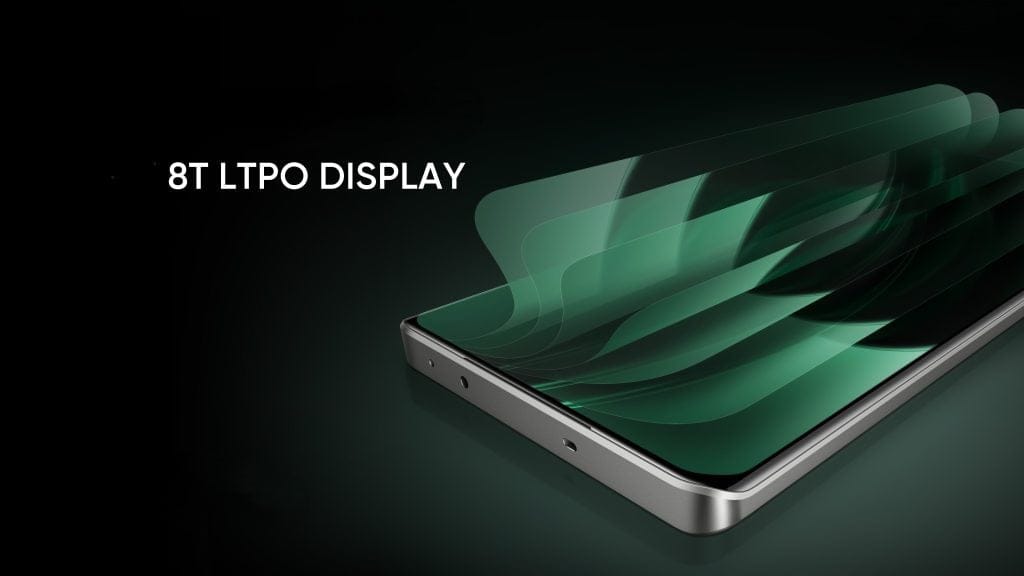
    For those curious about the VRR capabilities of 8T LTPO (Low-Temperature Polycrystalline Oxide) displays, it’s important to understand that these screens still switch between a set of fixed refresh rates instead of providing a true continuous range from 1Hz to 120Hz. Manufacturers set these displays to alternate among specific refresh rates like 1Hz, 10Hz, 30Hz, 60Hz, and up to 120Hz, depending on the content. For instance, I’ve never observed the 8T LTPO screen on the iQOO Neo9 Pro refresh at any rate other than those fixed options. This limitation is a result of Android’s software framework, which, until Android 15, has only allowed for discrete display modes.

    Google’s Adaptive Refresh Rate Implementation in Android 15

    With the introduction of Android 15, Google has revamped the display framework by adding genuine ARR (Adaptive Refresh Rate) support, allowing screens to modify their refresh rates within a single mode. This enhancement is made possible by updates to the Hardware Composer (HWC) hardware abstraction layer (HAL). Version 3 of the HWC HAL enables the system to optimize refresh rates by evaluating the type of content and adjusting the rates as needed, eliminating the need to switch modes. This change reduces occurrences of “jank,” or visual hiccups, that often came from switching display modes in older Android versions.

    Does Hardware Support Exist?

    However, to enable ARR, there is a need for compatible hardware. Devices must support HWC HAL version 3, which is found on select recent models like smartphones using Qualcomm’s Snapdragon 8 Elite processor. Older devices that receive Android 15 may not gain ARR due to the lack of hardware or kernel support. Unfortunately, Google’s ARR method won’t provide the same real-time sync for gaming found on PCs, as it only allows refresh rates that match “divisors of the panel’s tearing effect (TE).” While this ARR enhancement is exciting, its widespread use will rely on hardware compatibility and manufacturers’ readiness to implement HWC HAL v3, potentially limiting the feature to newer flagship devices. Nevertheless, the addition of true VRR capability by Google marks a notable advancement towards a more flexible and energy-efficient display experience on Android.


    Image 1