Tag: A19 Pro chip

  • iPhone 17 Pro GPU Ray Tracing Stability vs iPhone 17 Test Results

    iPhone 17 Pro GPU Ray Tracing Stability vs iPhone 17 Test Results

    Key Takeaways

    1. The iPhone 17 Pro features a new vapour chamber cooling system, enhancing thermal management for better performance.
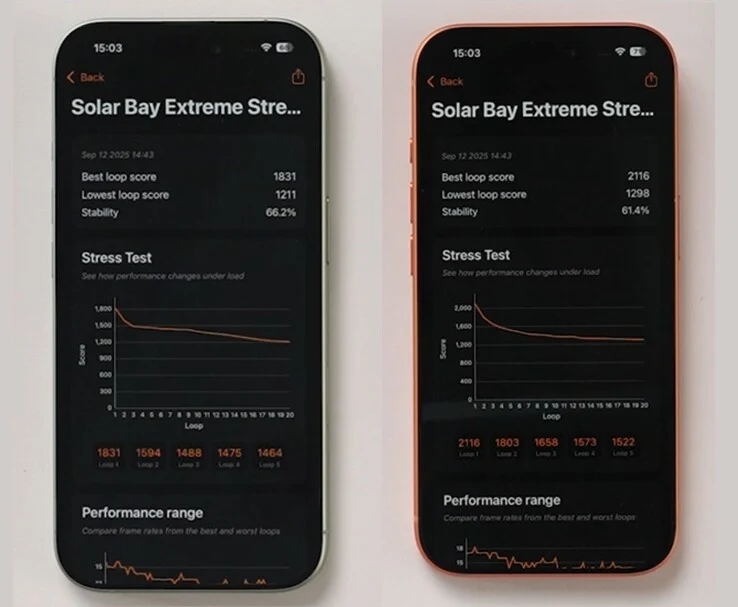
    2. In a stress test, the iPhone 17 Pro scored a stability rating of 61.4%, while the iPhone 17 with the standard A19 chip scored 66.2%.
    3. The iPhone 17 Pro outperformed the iPhone 17 in Best loop scores (2,116 vs. 1,831), but the iPhone 17 Pro Max achieved the highest scores overall.
    4. The stability of the iPhone 16 Pro Max and iPhone 17 Pro Max was nearly identical, indicating effective performance balancing by Apple.
    5. The iPhone 17 Air, with its less powerful A19 chip, performed worse than the base iPhone 17 model in benchmark tests.


    The iPhone 17 Pro has been introduced with various updates in terms of design, camera, and battery. One of the most significant enhancements is the new vapour chamber cooling system. This upgraded cooling technology is logical, especially since the A19 Pro chip is said to perform well, especially in graphics processing.

    Performance Review

    When popular YouTuber The Tech Chap reviewed the Apple iPhone 17 Air, it gave us a chance to see how the iPhone 17 Pro compares to other models from this year and the previous iPhone 16 Pro Max. During the 3DMark Solar Bay Extreme stress test, which lasts around 20 minutes and tests ray tracing performance over time, the iPhone 17 Pro with the advanced A19 Pro chip scored a stability rating of 61.4%. In contrast, the more budget-friendly iPhone 17 with the standard A19 chip achieved a stability score of 66.2%, which is clearly better.

    Score Comparisons

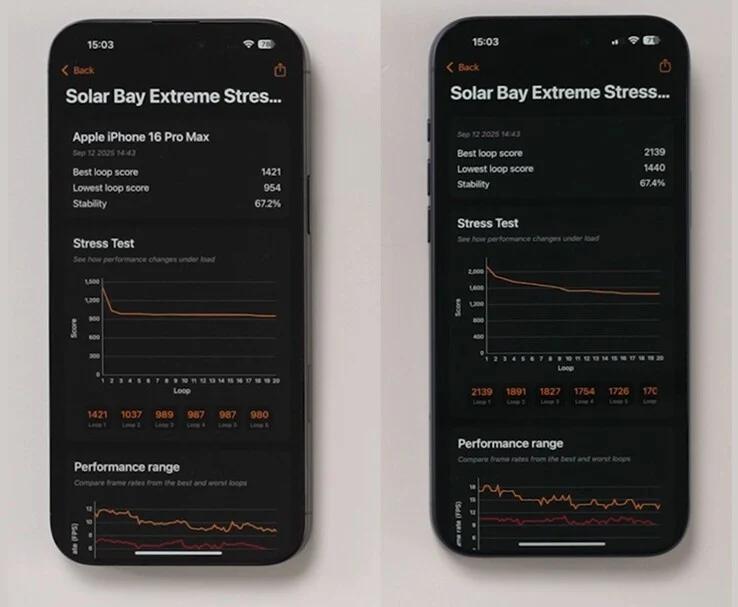
    The iPhone 17 and iPhone 17 Pro had similar Lowest loop scores, with figures of 1,211 and 1,298, respectively. However, when assessing the Best loop scores, there was a notable difference: the iPhone 17 scored 1,831 while the iPhone 17 Pro reached 2,116. This indicates that, although the A19 Pro chip is quite potent, users seeking top performance should consider the iPhone 17 Pro Max. This model recorded the highest Best and Lowest loop scores of 2,139 and 1,440, respectively, with an overall stability of 67.4%.

    Insights on Stability

    A fascinating finding from the benchmark tests is that the iPhone 16 Pro Max and the iPhone 17 Pro Max displayed nearly the same stability throughout the stress test. This implies that Apple has effectively balanced increased performance with better thermal management, as the differences are quite notable. The Best loop score for the iPhone 16 Pro Max at 1,421 is actually a tad lower than the Lowest loop score of the iPhone 17 Pro Max.

    If you’re curious about the performance of the iPhone 17 Air, the video primarily highlights it, and you can check it out through the link below. Analyzing the benchmark data from this test suggests that the slightly less powerful A19 Pro chip, which has one fewer GPU core in the iPhone 17 Air, performs even worse than the base model iPhone 17.

    Source:
    Link


  • iPhone 17 Pro to Feature Vapor Chamber Cooling System, Leak Reveals

    iPhone 17 Pro to Feature Vapor Chamber Cooling System, Leak Reveals

    Key Takeaways

    1. The iPhone 17 Pro and iPhone 17 Pro Max are expected to feature the new A19 Pro chip, enhancing performance but facing overheating concerns.
    2. Vapor chamber cooling may be implemented in the Pro models to manage heat, distinguishing them from the standard iPhone 17 and iPhone 17 Air.
    3. Vapor chamber cooling uses a liquid-filled copper pipe to efficiently dissipate heat from the processor, a system commonly found in Android devices.
    4. The A19 Pro chip will improve speed and efficiency, but performance gains may be limited without effective cooling solutions.
    5. Overheating is a significant issue for mobile gaming, making vapor chamber cooling a desirable feature for high-performance smartphones.


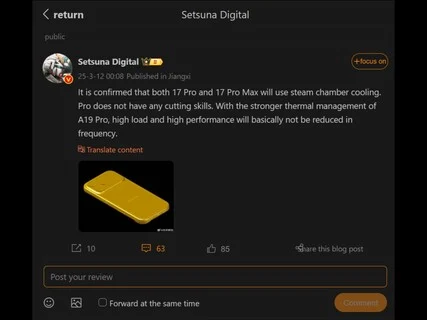
    The tech world is buzzing about the expected release of the iPhone 17 Pro and iPhone 17 Pro Max later this year. The new A19 Pro chip is set to enhance performance, yet concerns about overheating might restrict these improvements. There have been talks suggesting that Apple could implement vapor chamber cooling to compete with Samsung devices like the Galaxy S25 Ultra. Recently, a leaker named Instant Digital expressed strong confidence that some iPhone 17 models will feature this more advanced cooling system.

    Rumors on Cooling Systems

    In a post on Weibo, Instant Digital mentioned that vapor chamber cooling won’t be available for the iPhone 17 and iPhone 17 Air. Customers looking for this feature will have to choose Apple’s upcoming Pro models instead. Less advanced phones typically use conductive materials in heatsinks to draw heat away toward the casing. Unfortunately, this method might fall short during heavy activities like gaming or video editing.

    How Vapor Chamber Cooling Works

    Vapor chamber cooling generally consists of a thin copper pipe filled with liquid positioned over the processor. As the processor heats up, the liquid turns to vapor and spreads to a cooler area of the chamber. The vapor then cools down and reverts to liquid, and the cycle continues. This system has mainly been found in Android phones. The Galaxy S25 Ultra, for instance, expanded its cooling chamber size to keep the Qualcomm Snapdragon 8 Elite chip from throttling.

    Performance Expectations

    Both the iPhone 17 Pro and iPhone 17 Pro Max will incorporate the A19 Pro chip, which is expected to deliver increased speed and efficiency. Nevertheless, the enhancements might not be as significant when compared to earlier iPhone Pro versions. Vapor chamber cooling could enable these phones to fully utilize their capabilities.

    Overheating is a critical issue, especially in the thriving mobile gaming sector. With high-end graphics, AAA games can really test the limits of any smartphone. While companies like GameSir provide controllers equipped with fans, a vapor chamber represents a much sleeker and more effective solution.

    Source:
    Link