Tag: 1X Neo

  • 1X NEO Household Robot Launches by 2026 With Controversial Features

    1X NEO Household Robot Launches by 2026 With Controversial Features

    Key Takeaway

    1. 1X Technologies plans to deliver its humanoid household robot, NEO, to US customers by the end of 2026, priced at around $20,000 or available for rent.
    2. NEO is designed for household tasks like vacuuming and laundry but currently requires remote support and human assistance for some functions.
    3. The robot is seen as an experimental platform for learning and development, with ongoing efforts to enable full autonomy.
    4. The company aims to scale production significantly by 2027, producing over 100,000 units annually through increased automation and additional manufacturing facilities.

    Introduction to the NEO Household Robot

    Robotics company 1X Technologies has announced plans to launch its humanoid household robot called NEO, aiming to deliver it to the first private customers in the US by the end of 2026. The robot measures about 5 feet 5 inches tall, is just under 66 pounds in weight, and has impressive capabilities such as lifting up to 154 pounds and carrying roughly 55 pounds. Its pricing is set at a minimum of $20,000, but there’s also an option to rent it for approximately $500 monthly. But, for typical families, those prices might still be too high for everyday use.

    Capabilities and Tasks

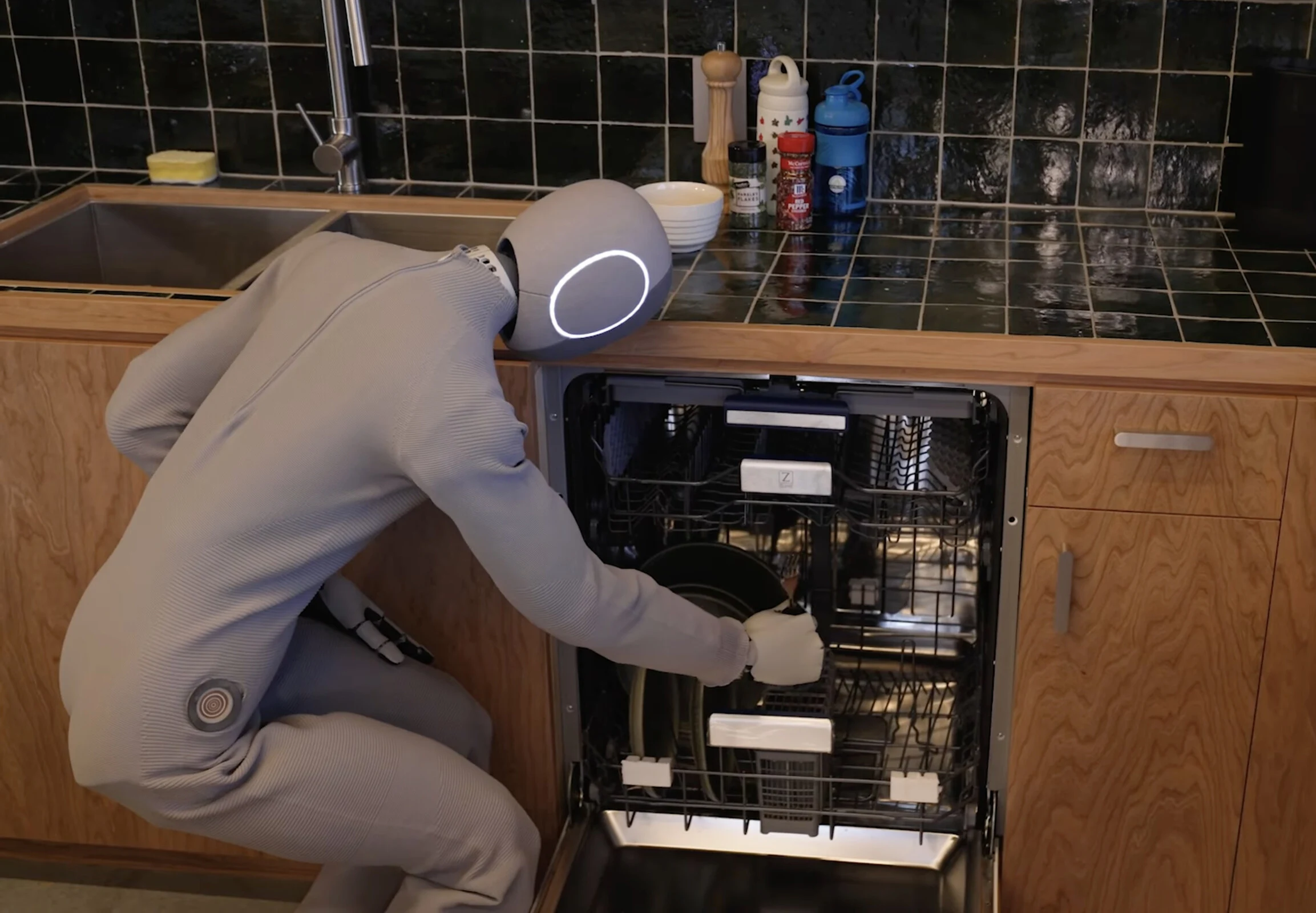
    On the company’s website, NEO is shown performing chores like vacuuming, folding laundry, and unloading the dishwasher—tasks that most people would prefer to delegate to a household robot. Nonetheless, in reality, some jobs may still be completed by humans, especially during its initial phase. 1X explains that NEO can be remotely supported by experts in scheduled sessions for tasks it hasn’t been programmed to do on its own yet. Still, the company has not specified which functions will work completely independently at launch or if some will continue to need human aid.

    Public Reception and Concerns

    Many Reddit users see the NEO as more of a experimental platform than a fully functional household robot. The physical robot is present but the main challenge lies in it completing daily tasks autonomously. Also, the idea that someone might observe their home through cameras makes quite a few people uneasy, raising privacy concerns among potential users.

    Future Prospects and Development

    Nevertheless, 1X holds a vision where someday, NEO could operate entirely without human help. Currently, the first batch of NEO robots is secretly working at the company’s factory in Hayward, California, doing simple logistics like moving items around. These activities assist in collecting valuable real-world data which will aid the development of the robot’s capabilities. The company hopes that by late 2027, they will be able to manufacture over 100,000 robots per year, facilitated by increased automation and a new plant planned in San Carlos.

    Sources
  • Train Robots Easily with New Tool – No Programming Needed

    Train Robots Easily with New Tool – No Programming Needed

    Key Takeaways

    1. MIT has developed a new method for training robots that allows anyone, not just programmers, to teach them.
    2. The technique used is called ‘Learning from Demonstration’ (LfD), where robots learn by watching humans perform tasks.
    3. The VDI tool, created by Mike Hagenow’s group, is a versatile handheld device that enhances the training process with sensors and cameras.
    4. The VDI tool has been tested for tasks like press-fitting and moulding, showing promise for industrial and household robots.
    5. Future applications for this teaching method include home care and household robots, with an aim to create intelligent partners for complex tasks.


    So far, training robots has needed experts with specific programming abilities. Recently, we shared news about a training center for humanoid robots in China, showing the role of a robot coach. However, engineers at MIT have created a new method for training robots. This method allows users to teach robots in three easy ways. The unique part is that training can be done not only by programmers but by anyone.

    Understanding Learning from Demonstration

    This technique, known as ‘Learning from Demonstration’ (LfD), is designed to let anyone train a robot. It utilizes a single tool with sensors that makes training more straightforward and adaptable. The core idea of this teaching technique is very old: The robot watches a human do something and then it has to do it itself. Older LfD methods usually fit into one of three types:

    Mike Hagenow’s group at MIT, under the leadership of Professor Julie Shah, has created a versatile tool called the VDI. This tool allows the use of any of the learning methods mentioned earlier, potentially increasing the number of users and ‘teachers’ who can work with robots. It’s a handheld control device equipped with sensors that can be attached to standard collaborative robot arms.

    Features of the VDI Tool

    This attachment includes a camera, position-tracking markers, and force sensors to detect pressure. Volunteers tested the new tool by completing tasks like press-fitting (pushing pegs into holes) and moulding (shaping a dough-like material around a rod). The researchers observed that those with manufacturing experience often favored the more natural teaching approach.

    The new tool is suitable for training industrial robots such as the Walker S2. A video of this robot went viral on social media recently, raising some concerns. However, the developers also see significant potential for the VDI in fields like home care and as household helpers.

    Future Applications of Robotics

    A prime example of this kind of household robot is the 1X Neo, which is currently available for pre-order in the USA and is set to be delivered in 2026. Mike Hagenow, a postdoctoral researcher in the Department of Aeronautics and Astronautics at MIT, shared insights on where the teaching method can be applied:

    “We aim to create highly intelligent and skilled partners that can efficiently collaborate with humans to accomplish complex tasks. We think flexible demonstration tools can expand far beyond the factory, into other areas where we expect to see more robot usage, like in homes or caregiving situations.”

    Source:
    Link


  • Become a Robot Coach at China’s Largest AI Training Center

    Become a Robot Coach at China’s Largest AI Training Center

    Key Takeaways

    1. China has opened the largest training facility for humanoid robots, focusing on everyday tasks and AI helpers for homes and industries.

    2. Humanoid robots struggle with simple household tasks like loading dishwashers and folding clothes due to their complex bionic hands.

    3. The 1X Neo home robot can perform tasks like vacuuming but faces challenges with delicate actions, such as folding a sweater.

    4. The training center in Beijing collects over 10,000 data points daily to help robots learn skills like towel folding and object handling.

    5. Robots are trained using meticulous movement documentation, allowing AI to analyze patterns and develop practical intelligence for autonomous task execution.


    China has recently gained attention with a viral clip showcasing an “army of humanoid robots.” This time, though, the spotlight is on a much calmer topic: the largest training facility for humanoid robots in the world, which includes AI helpers for homes and industrial use.

    Humanoid Robots and Everyday Tasks

    Loading a dishwasher might seem like a simple chore, but humanoid robots often find even the most basic household tasks difficult. For instance, while we humans can easily handle soft or delicate items, robots frequently struggle due to the complexity of their bionic hands.

    Challenging Household Activities

    Tasks like folding a shirt, making a bed, or arranging flowers in a vase can be quite demanding for these robots. Grasping fragile objects without damaging them or folding laundry without wrinkles is often a real test for current AI models. The new 1X Neo home robot is one such example; it can fold a sweater, but the sleeve tends to slip during the process. On the bright side, the 1X Neo excels at certain tasks like vacuuming. Those interested can pre-order this robot in the United States.

    Inside the Training Center

    In Beijing’s Shijingshan district, the largest humanoid robot training center in China is where these advanced machines acquire everyday skills like towel folding, picking up medicine boxes, and putting away brooms. Mi Sutong from CGTN Digital gives us a glimpse into the center, where she tries her luck as a ‘data collector’ and shows how the robots attend their “school” to learn essential life skills.

    Every day, the center collects over 10,000 trajectory data points from the robots to train AI models for practical use. With assistance from their human trainers, the robots practice tasks like folding towels. The trainers operate the robots with controllers and VR gear, allowing for precise movement control.

    Recording Movements for Learning

    Every finger and joint movement is meticulously documented as numerical codes. The AI analyzes this massive dataset to identify patterns and learn how to execute tasks effectively. Ultimately, the AI is trained to autonomously generate these movements. This accumulated data serves as the foundation for the robots’ practical intelligence. To see more about the training center, check out the video below:

    CGTN

    Source:
    Link


  • Humanoid Home Robot 1X Neo: Vacuums Well, Can’t Crack Walnuts

    Humanoid Home Robot 1X Neo: Vacuums Well, Can’t Crack Walnuts

    Key Takeaways

    1. The 1X Neo humanoid robot is now available for pre-order in the U.S., competing with other AI household assistants like Figure 03 and Tesla Optimus.
    2. Evaluations revealed performance limitations, such as struggling with tasks requiring strength and slow response times, highlighting the need for enhancements.
    3. Safety features include a fabric covering for visual appeal and lightweight design, reducing the risk of damage if the robot falls.
    4. The current model operates remotely via an AI controller, with plans for a more autonomous version set for release in 2026.
    5. Concerns about data privacy arise from the robot’s need to transmit visual and auditory data to improve its AI capabilities, with assurances made about user privacy.


    The 1X Neo humanoid home robot was introduced in 2024 and has now become available for pre-order in the United States. This innovative robot is in competition with other AI household assistants like Figure 03 and Tesla Optimus. Yet, there are lingering questions about the real abilities of this new product aimed at the general public. Given the recent visible failings of the first Russian humanoid robot demonstration, some skepticism is perhaps justified.

    Testing the Capabilities

    Joanna Stern from the Wall Street Journal evaluated the 1X Neo’s performance and found several areas needing enhancements. Bernt Børnich, the robot’s developer, also took part in the evaluation. The robot is advertised to be capable of tasks like washing dishes, cleaning the kitchen, and doing laundry, among others.

    Focus on Safety

    When discussing home robots, safety is as crucial as their functionality and intelligent features. Unlike industrial robots that operate on assembly lines, Neo is dressed in a fabric covering that looks like clothing. This design choice not only makes it visually appealing but also adds a layer of safety.

    Inside the Neo, there are several strong yet lightweight motors that use belts, akin to muscles, instead of gears. This design makes the robot quieter and allows for smoother movements. Its weight can be brought down to 30 kg (66 pounds). This is especially significant in case it falls, as lighter robots are less likely to cause damage. Despite being lightweight, it can handle loads of up to 68 kg (150 pounds).

    Performance Limitations

    At first glance, one might think this robot is exceptionally powerful, but that’s not entirely accurate. The 1X Neo struggled to crack a walnut manually. This appears to be a deliberate design choice, as the robot emphasizes finesse and delicacy rather than sheer strength. It’s also important to remember that this is just the initial version, and improvements are anticipated.

    The robot took a minute and seven seconds to fetch a water bottle from the fridge and deliver it to the tester standing a few steps away. The main obstacle was opening the refrigerator door. The assessment also tested various capabilities like loading a dishwasher and charging cycles, and Neo reportedly excelled at using a vacuum cleaner.

    Future Developments

    It is crucial to highlight that the tested model was still operated remotely by an AI controller. This version precedes the upcoming model set for release in 2026, which is expected to have increased dexterity, more autonomy, and better safety features. Initially, Neo won’t act as a true household helper but more like a child that requires guidance and is connected to human assistance through an app. The remote control mode is referred to as ‘expert mode’, where a human takes over tasks that the robot can’t manage independently yet.

    To enhance its AI, visual and auditory data from the user’s home must be transmitted to 1X’s servers through the robot’s cameras and microphones. The company promises that faces will be blurred and assures users they will know when an operator is engaged. However, this aspect raises significant concerns about data privacy for many. The developers aim for Neo to learn as much as possible in domestic environments, with hopes that within five years it can evolve into a fully capable assistant.

    In this way, Neo signifies the dawn of a new age of humanoid household robots. The developers claim that when fully realized, Neo will offer substantial help with numerous household chores, catering not just to standard situations but also assisting those with disabilities, the elderly, and other communities. Pre-orders are currently limited to the USA, requiring a $200 deposit. Interested buyers can opt for either a one-time payment of $20,000 or a monthly subscription of $499.

    Source:
    Link