
Key Takeaways
1. SK hynix has begun mass production of its 321-layer, 2-terabit QLC NAND, the first QLC device to exceed 300 layers.
2. The new design doubles the capacity per die and increases the number of planes from four to six, enhancing read and write performance.
3. The V9Q dies operate at 3,200 mega-transfers per second, providing significant performance improvements for QLC tasks despite being lower than TLC NAND speeds.
4. A 2-terabyte client SSD can be created with only eight 2-terabit dies, reducing package count and overall costs.
5. SK hynix is developing a 244-terabyte enterprise drive for AI servers, focusing on high capacity and efficient power use.
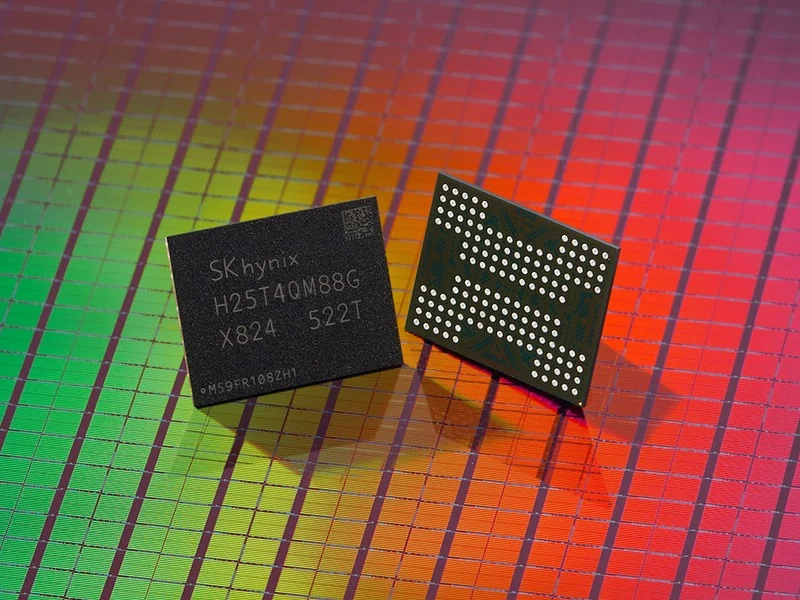
SK hynix has kicked off the mass production of its groundbreaking 321-layer, 2-terabit (256 gigabytes) QLC NAND, which is said to be the first QLC device to surpass the 300-layer threshold. The initial commercial products are expected to be available in the first half of next year, pending validation from customers.
Enhanced Chip Design
The company has managed to double the capacity per die when compared to earlier QLC versions and has upped the number of planes within each chip from four to six. This addition of more planes allows for increased parallel processing, which leads to a major boost in simultaneous read performance, all while keeping latency in check. According to SK hynix, this new QLC technology doubles the data transfer speed, improves write performance by as much as 56 percent, and enhances read performance by 18 percent. Additionally, write power efficiency has increased by over 23 percent, which is crucial for AI data centers with limited power resources.
Interface and Performance
On the interface front, the V9Q dies function at 3,200 mega-transfers per second. This is a bit lower than the top-tier TLC NAND, which operates at 3,600 mega-transfers per second; nevertheless, the structural advancements provide significant performance gains for QLC tasks. The six-plane design is the primary enhancement, and it plays a vital role in improving simultaneous read speeds.
Advantages of Density
The density of these chips brings further advantages. A 2-terabyte client SSD can be constructed using only eight of these 2-terabit dies, which reduces both the package count and overall bill of materials. SK hynix aims to start with PC SSDs before moving on to enterprise SSDs for data centers and UFS for smartphones once validation processes are wrapped up.
For extremely high capacities, the company’s 32DP packaging can stack up to 32 dies in a single package to maximize integration density. SK hynix is also working on an enterprise drive aimed at the 244-terabyte range, specifically designed for AI servers that demand vast storage capacity while ensuring efficient power use for data center applications.
Source:
Link
Leave a Reply