
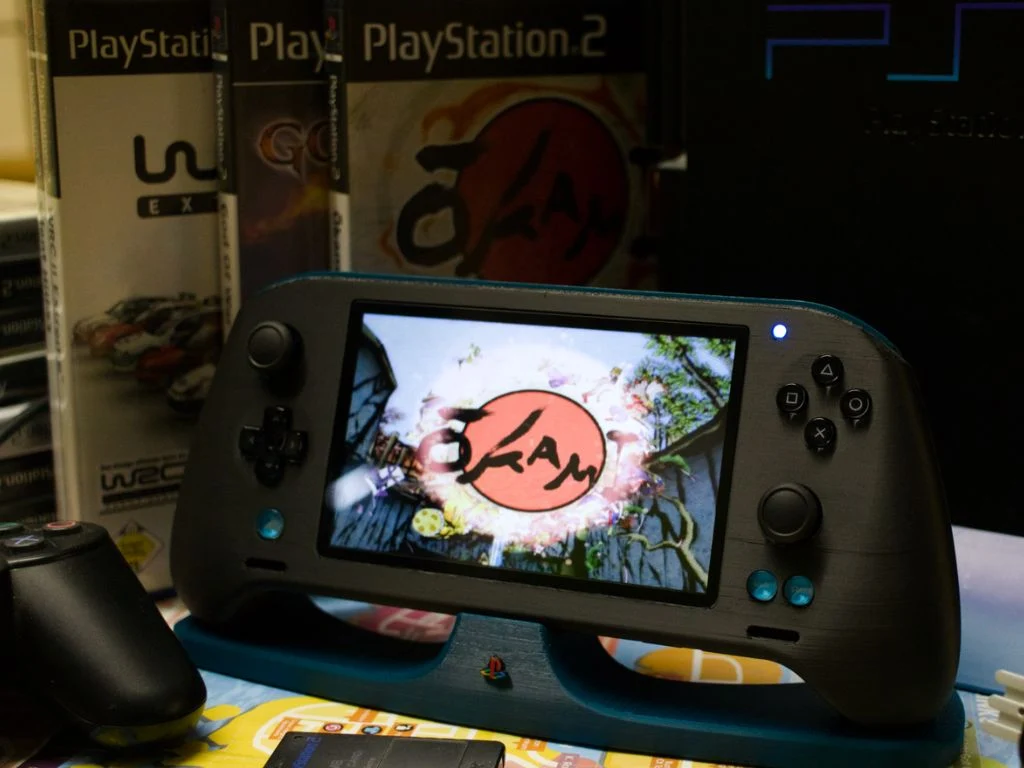
– It uses a custom reverse-engineered mainboard (not Sony) that reuses only six PS2 ICs, marking a first-of-its-kind hardware approach.
– A Trion T20 FPGA handles video output with integrated deinterlacing, line doubling, and scaling to deliver a crisp display from the PS2’s interlaced signal.
– Power and input emulation are handled by an RP2040, including USB-C charging and DualShock 2 rumble emulation; it runs on two 21700 batteries for about 4.5 hours.
– The design draws heavily on Windows handheld ergonomics (ROG Xbox Ally-inspired shell) with premium, PS Vita-like controls and Hall-effect sticks, but requires advanced soldering and DIY skills.
Overview of the PS2 Portable DIY
A solo builder and modder named Tschicki recently created what many retro enthusiasts would consider the ultimate DIY portable PlayStation 2 handheld. Designed, soldered, reverse-engineered, and crafted from scratch, it draws design inspiration from the Asus ROG Xbox Ally and incorporates that Windows gaming handheld’s ergonomics into the outer shell. The project began in early 2022 and went public last year, gaining attention again this week. The device stands out because it uses a reverse-engineered motherboard not sourced from a PS2 or Sony, with only six ICs recycled from SCPH-7900x or SCPH-9000x mainboards.
Technical Core and Display
Most internal components are brand new, and a Trion T20 FPGA handles the digital video output, featuring a motion-adaptive deinterlacer, line doubler, and bilinear scaler to convert the PS2’s interlaced signal into a crisp image on the handheld’s LCD. Power management is driven by an RP2040 microcontroller, which also manages charging and even emulates a DualShock 2 controller complete with traditional rumble. The device relies on two 21700 batteries to deliver about 4.5 hours of playtime, and charging is done via USB-C with an undervolting configuration to keep temperatures controlled and stable.
Design Aesthetics and Controls
The handheld’s controller section looks notably premium, featuring PS Vita-inspired face buttons and Hall-effect analog sticks. While the project is impressive, it is not for the faint of heart, and the GitHub project description makes that explicit. All PCB designs, FPGA code, 3D printing files, and firmware are freely available, yet successful assembly requires fine-pitch BGA soldering skills, a capable chip programmer, and substantial troubleshooting patience. The author even cautions that prospective builders should think twice before diving in.
Developer Notes and Accessibility
In the project notes, Tschicki emphasizes the high difficulty level and the specialized equipment needed. The repository details that the effort goes beyond a simple retrofit or emulator run, involving reverse-engineered hardware and carefully tuned software. Even so, the ambition and craftsmanship demonstrate what passionate hobbyists can achieve when pushing the boundaries of portable gaming hardware. The project remains a testament to hands-on innovation, not just nostalgia.
Conclusion and Status
Overall, this portable PS2 project showcases reverse-engineered hardware and a dedicated modding ethos, yielding a handheld that many retro fans would deem the ultimate DIY specimen. It’s a clear reminder that, with the right mix of hardware, software, and tenacity, enthusiasts can craft bespoke devices that blur the line between original consoles and modern portable gaming. The work is publicly documented, inviting others to study, learn, and perhaps attempt similar feats in the future.
Leave a Reply