
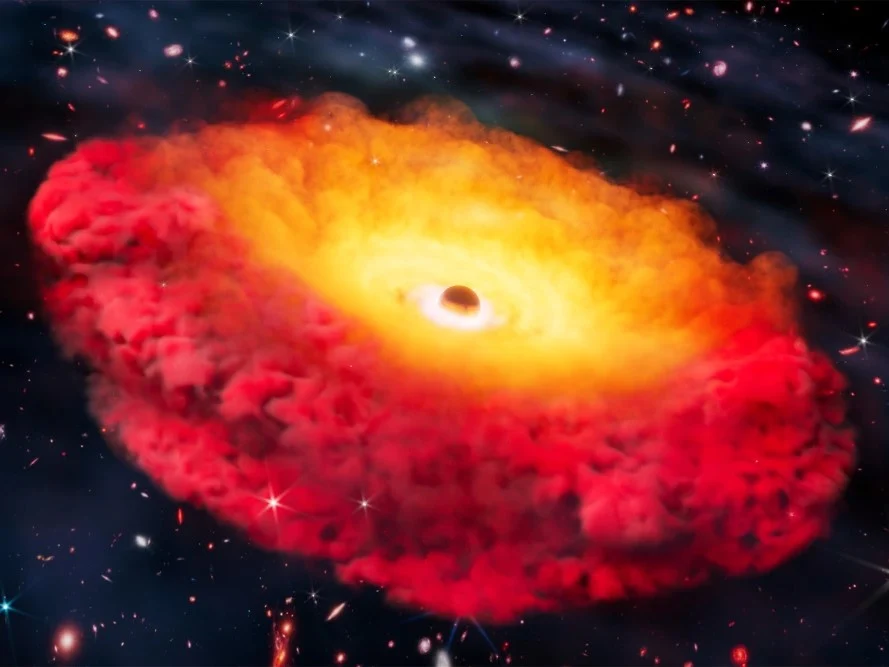
Key Takeaways
1. A research group confirmed the existence of a black hole in the galaxy CAPERS-LRD-z9 using spectroscopy.
2. CAPERS-LRD-z9 belongs to a group of ancient galaxies called “Little Red Dots” (LRDs) that are identified from the first 1.5 billion years of the universe.
3. The brightness of LRDs suggests the presence of black holes, which consume gas and dust, creating intense radiation.
4. The newly identified black hole is estimated to be 1.3 trillion times more massive than Earth and formed around 13.3 billion years ago.
5. Observations were made using NASA’s James Webb Space Telescope, which explores various stages of the universe.
A research group, guided by Anthony Taylor — a postdoctoral fellow at the Cosmic Frontier Center of the University of Texas at Austin — utilized spectroscopy to validate the existence of a black hole in the galaxy known as CAPERS-LRD-z9. This galaxy is part of a category of galaxies called “Little Red Dots” (LRDs).
Bright Red Galaxies
They got this name from their strikingly bright red look in telescope photographs. These ancient galaxies have only been identified within the first 1.5 billion years of the universe. Typically, the strong brightness characteristic of this galaxy type indicates the presence of many stars. However, due to the galaxy’s age, it seems unlikely that enough stars could have formed to create that level of brightness, leading to one reasonable conclusion — black holes. These black holes consume gas and dust, which spiral in at thousands of kilometers per second. This material gets compressed and heated to very high temperatures, resulting in intense radiation.
Size and Age of the Black Hole
What is particularly remarkable about the newly identified black hole in the CAPERS-LRD-Z9 galaxy is its immense size and ancient age. It is estimated to be up to 1.3 trillion times more massive than Earth, which is about half of CAPERS-LRD-Z9’s total stellar mass. Furthermore, it is an old giant, believed to have formed around 13.3 billion years ago, just 500 million years after the Universe was born.
Observations Made by NASA
The observation of CAPERS-LRD-Z9 and its giant black hole was accomplished using NASA’s James Webb Space Telescope, which has been examining every stage of our universe since its launch in December 2021.
Source:
Link
Leave a Reply