
Key Takeaways
1. Nvidia has expanded its Drive Hyperion platform, attracting major clients like Uber, BYD, Hyundai, and Kia, challenging Tesla’s dominance in the autonomous vehicle market.
2. The Alpamayo 1.5 system utilizes a Vision-Language-Action model to enhance autonomous driving capabilities, differing from Tesla’s fully integrated FSD stack.
3. Nvidia’s growing influence in the autonomous driving sector may impact Tesla’s market valuation, which heavily relies on its leadership in this area.
4. Nvidia plans to produce chips for orbital data centers, potentially competing with SpaceX’s ambitions in space-based AI infrastructure.
5. The Vera Rubin Space-1 chips by Nvidia aim to process data in orbit, addressing challenges like cooling systems in space, similar to hurdles SpaceX may face.
While Elon Musk has claimed he isn’t overly concerned about Nvidia’s plug-and-play self-driving system, Alpamayo, the tech behemoth has recently secured some of the biggest names in the EV and ride-sharing industries as clients.
Nvidia’s Bold Move
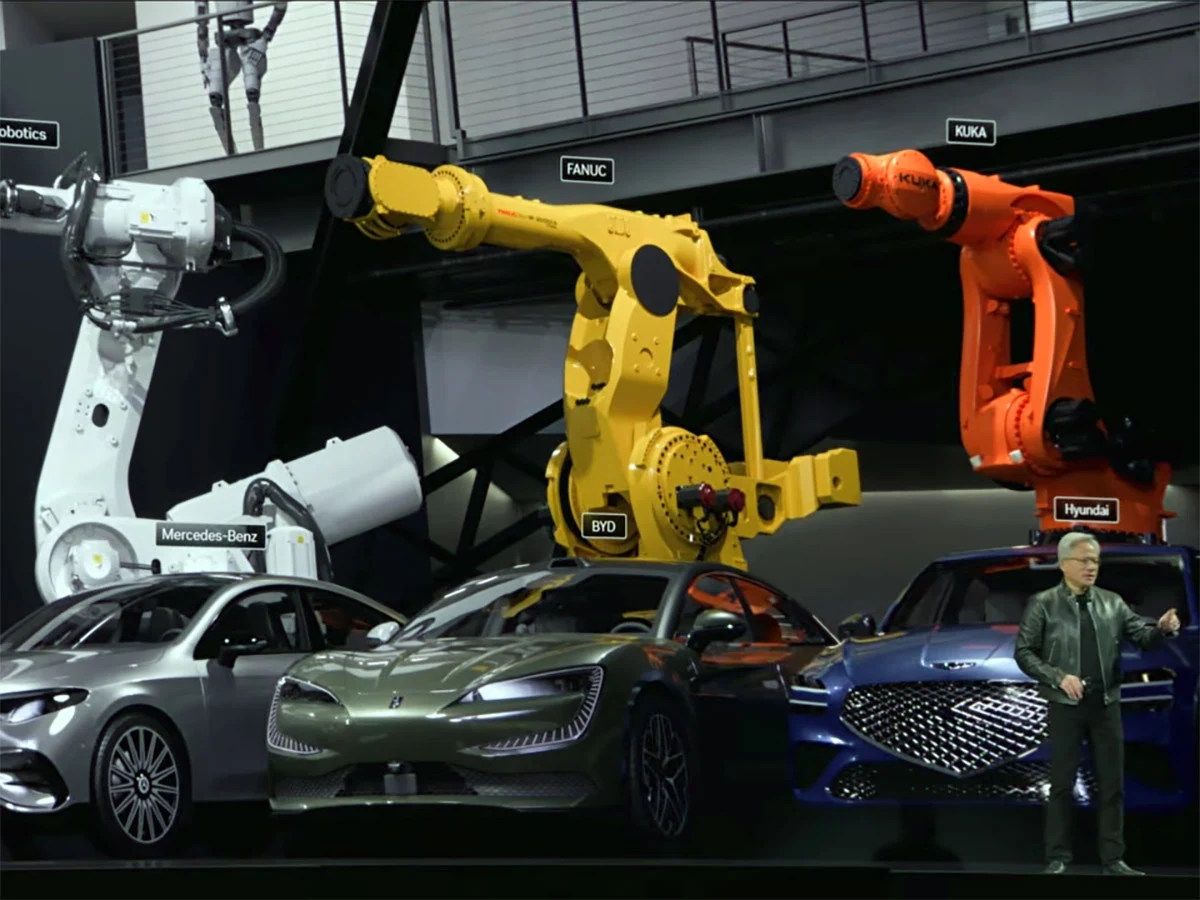
During GTC 2026, Nvidia’s CEO Jensen Huang revealed a broadened list of collaborators for the Drive Hyperion platform, indicating a clear challenge to Tesla’s supremacy in the robotaxi market. Leading this initiative is Uber, which plans to roll out 100,000 Level 4 autonomous vehicles across 28 global cities on four continents, kicking off with San Francisco and Los Angeles in early 2027.
A New Approach to Autonomous Driving
While Tesla depends on its fully integrated FSD stack, Nvidia is countering with Alpamayo 1.5, a public “Physical AI” ecosystem. Instead of directly linking sensors to commands, Alpamayo uses a Vision-Language-Action (VLA) model that Nvidia asserts has 10 billion parameters and can “think out loud.” At the event, Nvidia showcased Alpamayo 1.5, enhancing the system’s functionality “with an interactive, steerable reasoning model,” and announced it has attracted several clients for the Hyperion autonomous driving platform, including the largest EV manufacturer, BYD, along with Hyundai and Kia.
Impact on Tesla’s Market Position
A significant portion of Tesla’s lofty market capitalization depends on its ability to maintain leadership in autonomous driving and robotaxi sectors. Nvidia’s strategy to make these fields more accessible, especially with clients like Uber and BYD, could potentially influence Tesla’s market valuation.
Nvidia also declared plans to produce chips for orbital data centers, which may intrude on SpaceX’s territory. Just recently, Elon Musk’s company hinted at its intention to deploy AI data center infrastructure in space to harness solar energy without overtaxing Earth’s power grids.
Advancements in Space Technology
Nvidia’s “Vera Rubin Space-1” chips are designed to process data directly in orbit, cutting out the delay of transmitting raw data back to Earth. While Musk envisions vertical integration between Starlink and xAI, Nvidia is positioning itself as the “brains” for various other orbital startups, including Planet Labs and NASA.
“Of course, in space there’s no conduction, no convection; there’s just radiation, so we have to figure out how to cool these systems in space, but we’ve got loads of amazing engineers working on it,” joked Huang. These hurdles are the same ones SpaceX will encounter, so it will either need to compete with Nvidia in AI chip creation or become a client for its Vera Rubin Space-1 chips.
Source:
Link
Leave a Reply