
Key Takeaways
1. Webb Space Telescope has provided a unique image of NGC 6072, showcasing its chaotic and unusual structure compared to typical planetary nebulae.
2. NGC 6072 exhibits a multipolar structure with gas and dust moving in various directions, indicating complex dynamics at play.
3. The presence of a companion star may be influencing the nebula’s shape by interacting with an aging star and contributing to its intricate design.
4. Concentric rings observed in the nebula suggest pulsations that expelled gas or dust uniformly over time, likely due to the influence of a second star.
5. The central star of NGC 6072 will eventually enrich the interstellar medium with heavier elements, playing a role in the formation of new stars and planets.
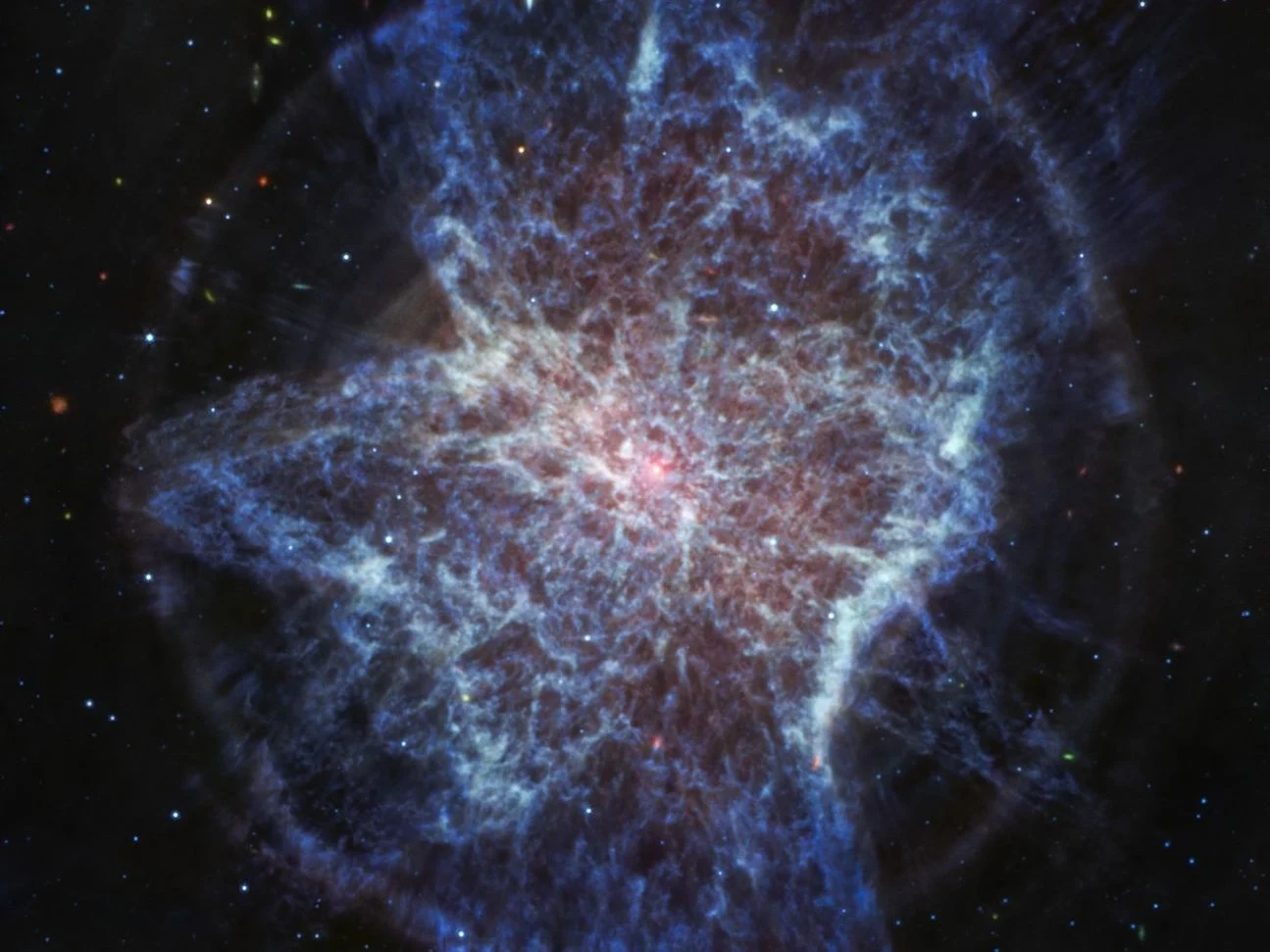
Since the launch of Webb on December 25, 2021, scientists have been using it to explore planetary nebulae and their intricate details. Recently, Webb took a glance at NGC 6072, returning an image that NASA describes as looking like paint splattered across a canvas.
Unusual Structures in Nebulae
Typically, planetary nebulae exhibit more standard shapes, such as circular, elliptical, or bipolar forms. However, NGC 6072’s uneven shape defies these expectations, displaying a chaotic mass of gas and dust moving in various directions.
A view from Webb’s NIRCam (Near-Infrared Camera) reveals that the nebula has a multipolar structure. Several elliptical flows are emerging from the center, heading in diverse directions. The disk that is positioned perpendicularly to the nebula implies that these outflows likely compress the surrounding materials as they progress.
The Role of Companion Stars
Researchers think this peculiar shape may indicate the existence of two stars at the heart of the nebula. A companion star is probably interacting with an aging star that has begun to lose its outer layers of gas and dust, contributing to the nebula’s remarkably intricate design.
The concentric rings that expand from the central area, as shown by Webb’s MIRI (Mid-Infrared Instrument), might provide additional proof of a second star influencing the scene. These rings imply that some sort of pulsation happened, causing gas or dust to be expelled uniformly in all directions, potentially thousands of years apart.
The Central Star’s Influence
Another captivating feature captured by Webb’s MIRI is a small pinkish-white dot at the center, thought to be the star that is sculpting this entire structure. Over time, as the central star cools and dims, the nebula will gradually spread into the interstellar medium, enriching it with heavier elements that might one day contribute to the formation of new stars and planets.
By providing such a clear image of NGC 6072, Webb opens doors for research into how complex planetary nebulae contribute to the environments where new stars and planets are birthed. The James Webb Space Telescope is known for its groundbreaking discoveries, having recently assisted NASA in correcting a previous misconception about Uranus.
NGC 6072 is situated roughly 3,000 light-years away, making it observable with a telescope. However, you will require a strong telescope, like the Celestron NexStar 8 SE (current price: $1,699.99 on Amazon), which features a 203-mm (8-inch) aperture. Remember, good viewing conditions are essential — a dark sky with little light pollution is necessary for the best experience.
Source:
Link

Leave a Reply