
Key Takeaways
1. A research team led by Yuqian Ma created soft contact lenses that allow users to see near-infrared (NIR) light by converting NIR photons into visible light.
2. The lenses are made with upconversion nanoparticles in a flexible poly-HEMA matrix, achieving over 85% transparency in the visible spectrum and showing no harm to corneal cells or retinal health in safety tests.
3. Electroretinography tests demonstrated normal visible light responses and distinct reactions to NIR in mice, indicating effective NIR detection even with eyelids sutured.
4. Human trials confirmed that participants could see NIR flashes in various lighting conditions and accurately interpret Morse code using the lenses, achieving a high spatial resolution for NIR images.
5. By using a trichromatic design in the nanoparticles, the lenses enabled users to perceive colors in NIR, allowing recreation of the complete NTSC color spectrum and differentiation of multi-colored objects.
Humans typically perceive light within the spectrum of 400 nm to 700 nm. However, a research group led by Yuqian Ma has broadened this spectrum by creating soft contact lenses that transform near-infrared (NIR) photons into visible light. This innovative development allows users to see in NIR without the need for surgical procedures.
Innovative Lens Design
The lenses incorporate upconversion nanoparticles embedded in a poly-HEMA matrix. By aligning the refractive index of the polymer with that of the nanoparticles and keeping the nanoparticle content at seven percent by mass, the researchers achieved over 85 percent transparency throughout the visible spectrum. Mechanical testing indicated that the lenses are as flexible and durable as standard commercial options, and six-hour safety assessments in mice showed no increase in corneal cell death or retinal inflammation.
Experimental Results
Electroretinography demonstrated normal responses to visible light, as well as distinct responses to NIR when the lenses were worn. Mice using these lenses had constricted pupils under 980 nm light, avoided areas illuminated by NIR, and successfully utilized NIR flicker to evade discomfort. These reactions remained consistent even with their eyelids sutured, indicating an eyelid transmittance of 23 percent at 980 nm compared to just 0.4 percent at 535 nm.
Human Trials
In trials with human participants, similar findings were observed. Those wearing the lenses were able to see NIR flashes in total darkness and under 300 lux of ambient light. Closing their eyes minimally affected their NIR sensitivity but significantly reduced their ability to detect visible light. Their flicker-fusion threshold for NIR matched the visible light standard, and they accurately interpreted Morse code sequences just as well as with visible light. An external module with three lenses projected NIR images through a flat up-conversion film, achieving a spatial resolution limit near 65 cycles per degree, which allowed for the identification of simple NIR patterns, letters, and shapes.
Enhanced Color Perception
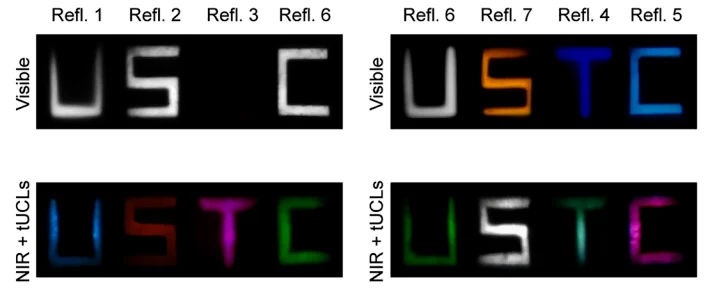
By substituting traditional nanoparticles with a trichromatic design that is excited orthogonally, the researchers introduced color capabilities. Distinct excitations at 808 nm, 980 nm, and 1532 nm generated separate green, blue, and red emissions. Color-matching tests revealed that users could combine these three “primary” NIR channels to recreate the complete NTSC-sized color spectrum and differentiate between multi-colored symbols, phrases encoded with combined color and temporal cues, as well as reflective objects whose colors in NIR differed from their visible counterparts.
Leave a Reply