
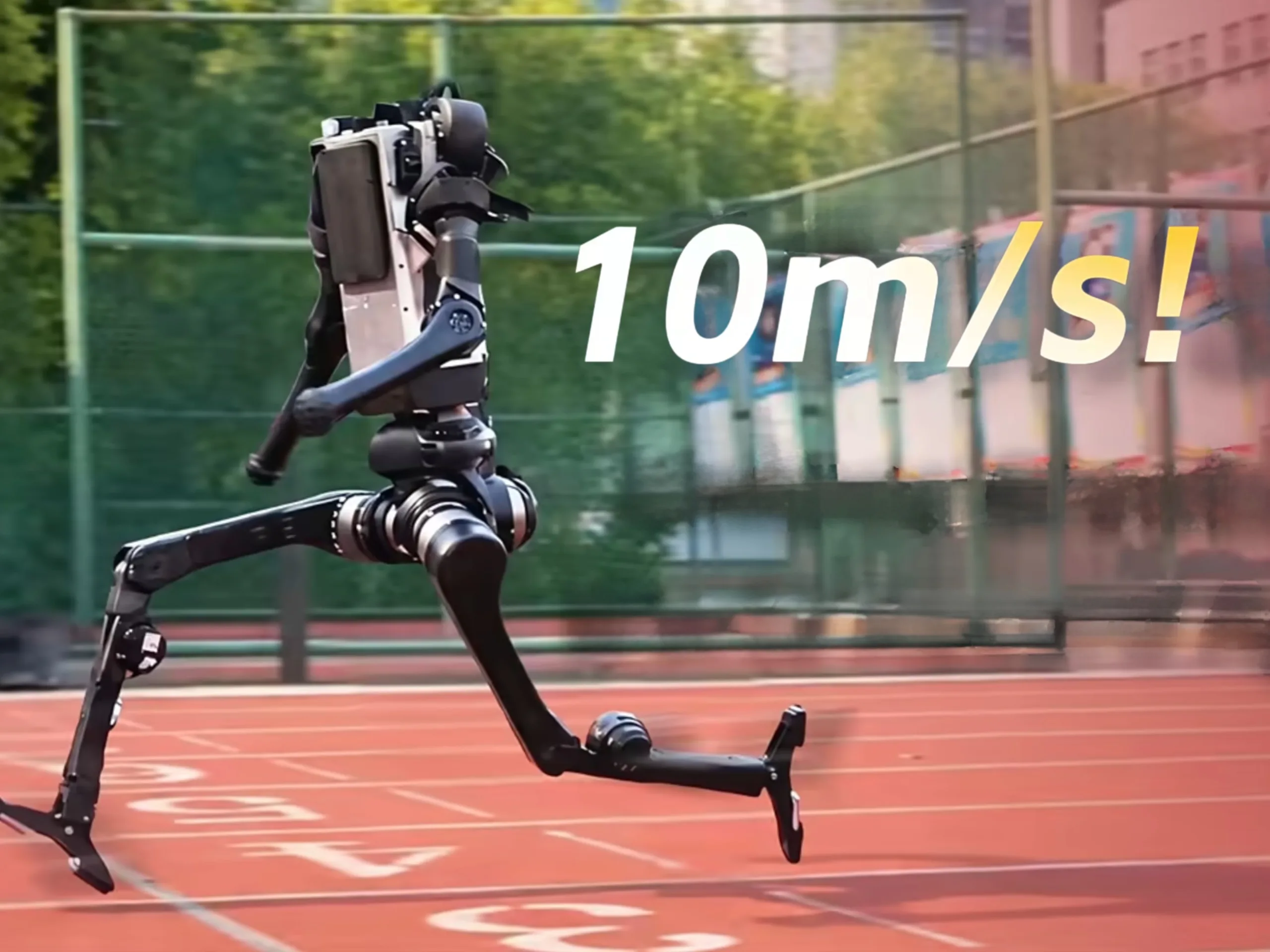
1. The Unitree H1 achieved a peak speed of 10.1 m/s during a 100-meter run, but did not break the world record time of 9.58 seconds set by Usain Bolt.
2. The robot’s design includes advanced gear systems, powerful motors, a depth camera, and 3D lidar to facilitate autonomous sprinting.
3. Currently, the H1’s movement and control systems still lag behind human athletes, requiring further development to reach competitive sprinting performance.
4. Achieving elite-level performance would require improvements in acceleration, sustained high speed, and precision within lane boundaries.
Speed Claims and Technical Aspects
Usain Bolt might laugh if he sees this: Unitree’s humanoid H1 clocked a top speed of 10.1 m/s on a 100-meter track. But, for now, he can breath a sigh of relief because no official record has been broken. The company is probably giving a bit of a boost to that number, the video title is a bit misleading. It only shows the robot’s maximum speed at some point during the run. When we’re talking about the actual race time, Bolt’s still way ahead with his record of 9.58 seconds. Still, the feat is pretty interesting to watch from a technological perspective. Unitree uploaded a video showing the robot sprinting on YouTube.
Design Specifications and Technology
The humanoid H1 from Unitree is designed similar to a human, standing about 1.78 meters tall, which is roughly 5 feet 10 inches. It tips the scales at 62 kilograms or about 137 pounds. Its legs, both upper and lower, are each around 40 centimeters long, giving it a total leg length of approximately 0.8 meters or 31.5 inches. The robot’s movement depends on custom gear systems, strong motors, and advanced sensors like a depth camera and 3D lidar, all meant to help it run independently. Compared to the basketball-playing G1 from Unitree, the H1 looks less athletic. While it can reach impressive speeds, it still has a long way to go before it can match Bolt’s speed or agility.
Challenges for Competitive Performance
If the H1 wanted to beat Bolt’s 9.58 seconds, it would need more than just a moment of high velocity. It requires rapid acceleration from a start, and to keep a high, consistent pace throughout the race. Bolt’s average speed in his record run was around 10.44 m/s. Moreover, the robot must stick to its designated lane without drifting off-course, something that the video shows it struggles with a bit. To actually compete at top-tier levels, the sensor tech would need to be refined for better stability and accuracy. However, the progress suggests it’s not out of reach for humanoid robots to race professionally someday soon.
Leave a Reply