
Key Takeaways
1. Android phones can act as earthquake early warning (EEW) systems by using their accelerometers to detect seismic activity.
2. The Android Earthquake Alerts system has warned millions of people in nearly 100 countries and has identified thousands of earthquakes.
3. Alerts are sent to users based on the detection of primary (P) waves before the more destructive secondary (S) waves arrive.
4. Approximately 2.5 billion Android users now have access to EEW information, significantly increasing the reach of earthquake notifications since 2019.
5. The accuracy of real-time magnitude estimation for earthquakes has improved, matching or exceeding traditional seismic networks, with successful alerts demonstrated in various countries.
Weather and pollution notifications on smartphones are quite common, but your Android device can do even more. Google researchers have demonstrated how Android phones can serve as earthquake early warning (EEW) systems that detect earthquakes around the world and notify users before the ground begins to shake.
Research Highlights
In a paper called “Global earthquake detection and warning using Android phones,” published in the journal Science, researchers found that the Android Earthquake Alerts system has identified thousands of quakes and warned millions of people across nearly 100 countries. The system is also capable of learning from user feedback to enhance important factors like magnitude estimation.
How It Works
To identify potential seismic activity, Android utilizes the phone’s accelerometer. This sensor detects linear acceleration and helps with orientation detection and pedometer functions. The accelerometer works alongside other parts of the inertial measurement unit (IMU) in a smartphone, which includes additional micro-electromechanical systems (MEMS), such as the gyroscope and compass.
Earthquakes consist of faster, non-destructive primary (P) waves and the slower, more harmful secondary (S) waves. For the earthquake alert system to function, an Android phone must be connected to Wi-Fi or a cellular network, with the Android Earthquake Alerts and location settings enabled. Users have the option to turn off this feature.
Alert Mechanism
When a stationary Android phone’s accelerometer first detects the P-wave, it sends a signal to Google’s earthquake detection server along with an approximate location. This location is identified in a rough manner to ensure user privacy is maintained.
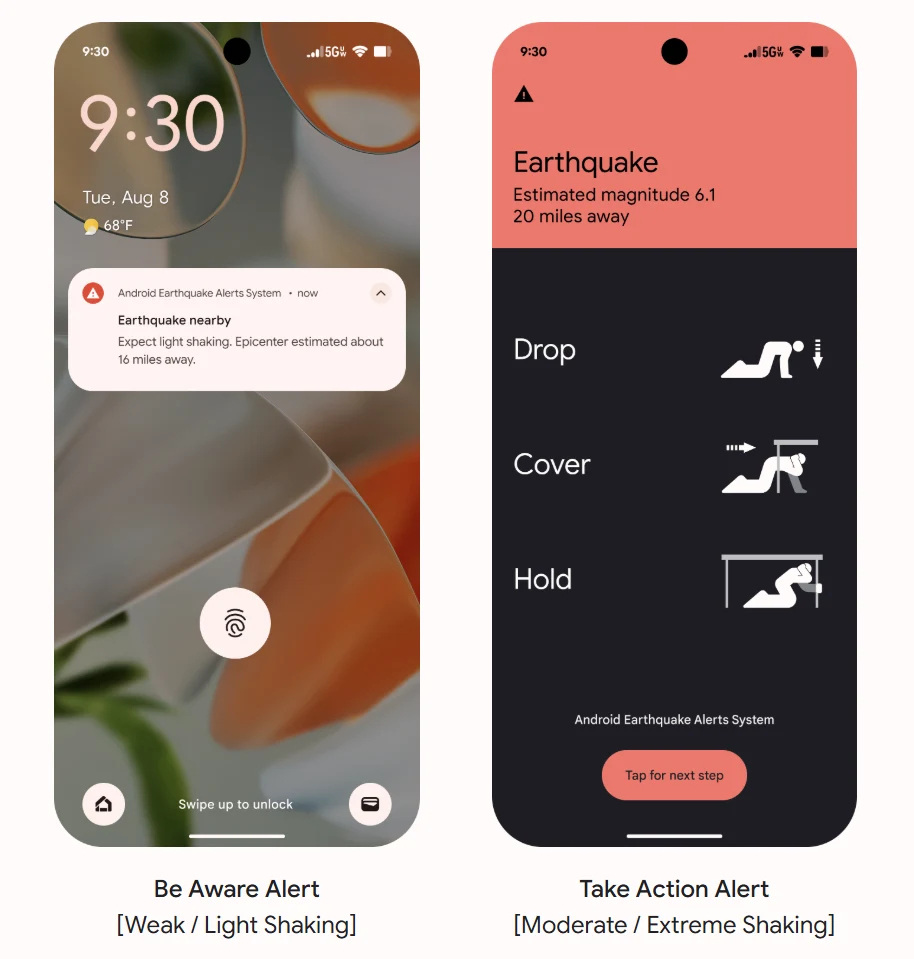
The server checks whether other phones in that area are sending similar signals and attempts to determine the quake’s location and magnitude. If confirmed, it sends alerts to all devices in the vicinity. The goal is to notify users before the more intense S wave hits. The system issues two types of alerts: Be Aware alerts for minor tremors and Take Action alerts that take over the phone’s screen and emit a loud sound.
A Global Network
Ultimately, each Android phone acts like a small seismometer, and collectively, they create a highly effective EEW system. Due to the widespread adoption of Android devices worldwide, around 2.5 billion people now have access to EEW information—a tenfold increase from 2019, when individuals relied solely on traditional EEWs.
This feature began to roll out in 2021 in countries like New Zealand and Greece and is now operational in 98 countries as of 2023. Google reports that the system has detected over 18,000 earthquakes, ranging from small M1.9 tremors to significant M7.8 ones. A total of 790 million alerts have been sent to phones globally for about 2,000 notable quakes.
Advancements in Accuracy
Google acknowledges that estimating an earthquake’s magnitude in real-time is a difficult task, but accuracy has improved over time, matching or even exceeding that of established major seismic networks.
The company also highlights recent successful examples in the Philippines, Nepal, and Turkey, where the system demonstrated its effectiveness. For instance, during the April 2025 Turkey earthquake, which registered a magnitude of 6.2, the system issued its first alert just 8 seconds after the quake started, sending over 16 million alerts and providing users with a warning time of a few to 20 seconds, depending on their distance from the epicenter.
Source:
Link

Leave a Reply