
Key Takeaways
1. The energy shift demands ongoing innovation for improved efficiency, leading to lower costs and better performance in renewable technologies.
2. Envision’s two-blade onshore wind turbine achieved a 99.3% availability rate and a mean time between trips of 2,444 hours after 500 days of testing.
3. The turbine features a modular design and high-speed DFIG technology, overcoming technical challenges like high system vibration and load imbalance.
4. Details on the turbine’s generation capacity remain undisclosed, but Envision is considering ramping up production for commercial deployment.
5. Two-blade turbine designs require less material, potentially reducing manufacturing and installation costs, with modular deployment being a key advantage.
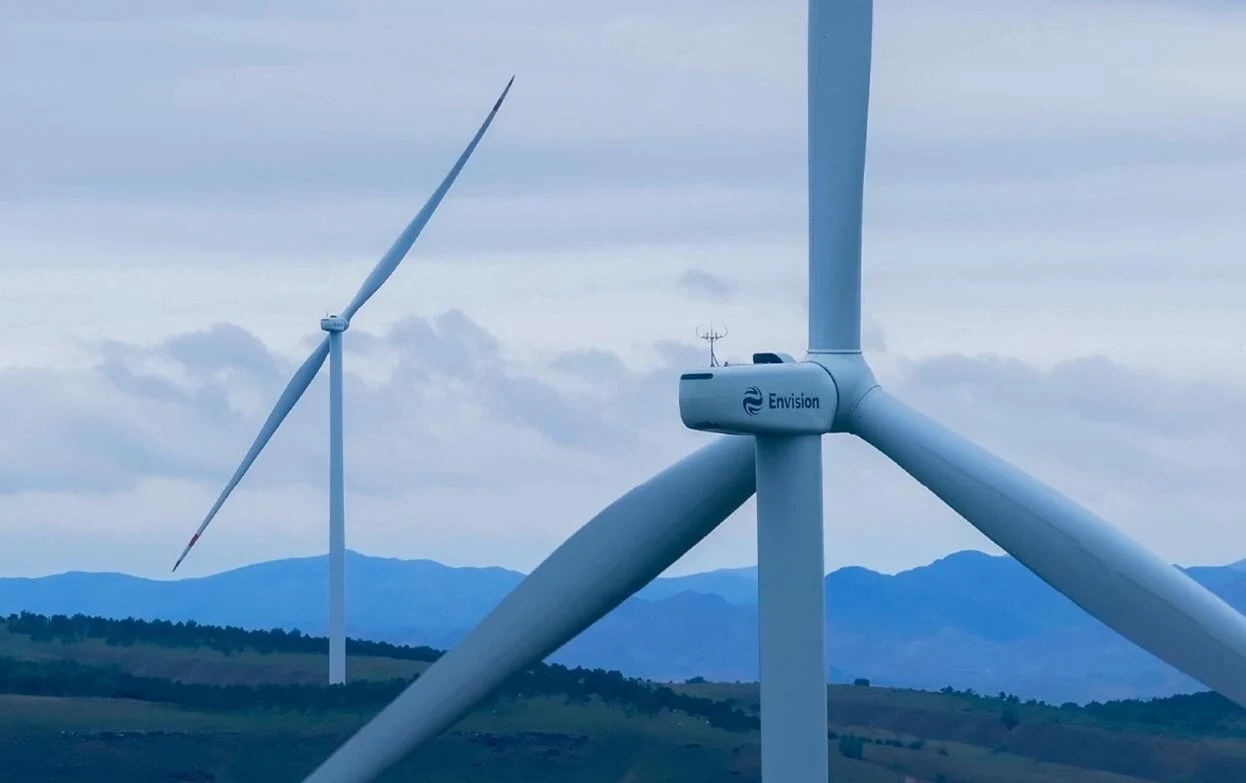
The energy shift has created a continuous need for innovation to improve efficiency. This has pushed technology boundaries, leading to lower costs and better performance, like increased energy density. Recently, the Chinese firm Envision has unveiled its two-blade onshore wind turbine, which has been under wraps for 500 days of testing.
Technical Challenges Overcome
According to Envision, reaching this milestone involved tackling several technical issues. After 500 days of reliable operation, the company reported impressive outcomes, such as a 99.3% availability rate, a mean time between trips (MTBT) of 2,444 hours, and 3,048 equivalent full-load hours each year. “Field performance shows that our two-blade turbine matches the performance of traditional three-blade ones at the same site,” the company stated in a press release.
Details About the Turbine Model
The turbine belongs to the Model X onshore series, boasting a modular design and high-speed DFIG (Doubly-Fed Induction Generator) technology that enhances stability. Lou Yimin, Senior Vice President and Chief Product Officer at Envision, noted that significant challenges for this model included high system vibration and load imbalance, which the team managed to resolve. The company has been developing a two-blade wind turbine since 2012, paving the way for this groundbreaking achievement.
Future Plans and Manufacturing Capacity
However, some specifics, like the turbine’s generation capacity, were not disclosed, and it remains uncertain whether the company intends to ramp up production for this model. Nevertheless, Envision hinted at this possibility, stating that “all parameters were systematically planned, tested, and validated to ensure technological maturity and readiness for commercial deployment.”
Many companies have attempted and some have experimented with two-blade turbines. The significance of this development lies in the fact that these designs require substantially less material, potentially lowering manufacturing and installation expenses due to having fewer parts to handle. Envision emphasized that modular deployment is one of its key advantages.
Source:
Link
Leave a Reply