
Category: Video / Photo

  • Vivo X200 Ultra: Transform Your Android into a Pro Camera with Zeiss

    Vivo X200 Ultra: Transform Your Android into a Pro Camera with Zeiss

    Key Takeaways

    1. The Zeiss teleconverter extends the focal length of the Vivo X200 Ultra to 200 mm, providing 8.7x optical zoom.
    2. Image quality is impressive, especially at higher zoom settings, with minimal distortion and commendable sharpness.
    3. Comparing images taken with and without the teleconverter shows clear improvements in detail and quality.
    4. The Vivo X200 Ultra performs well even without accessories, thanks to its built-in periscope camera reaching up to 800 mm.
    5. Overall, the Vivo X200 is a strong choice for photography enthusiasts, especially when used with quality accessories like the Zeiss teleconverter.


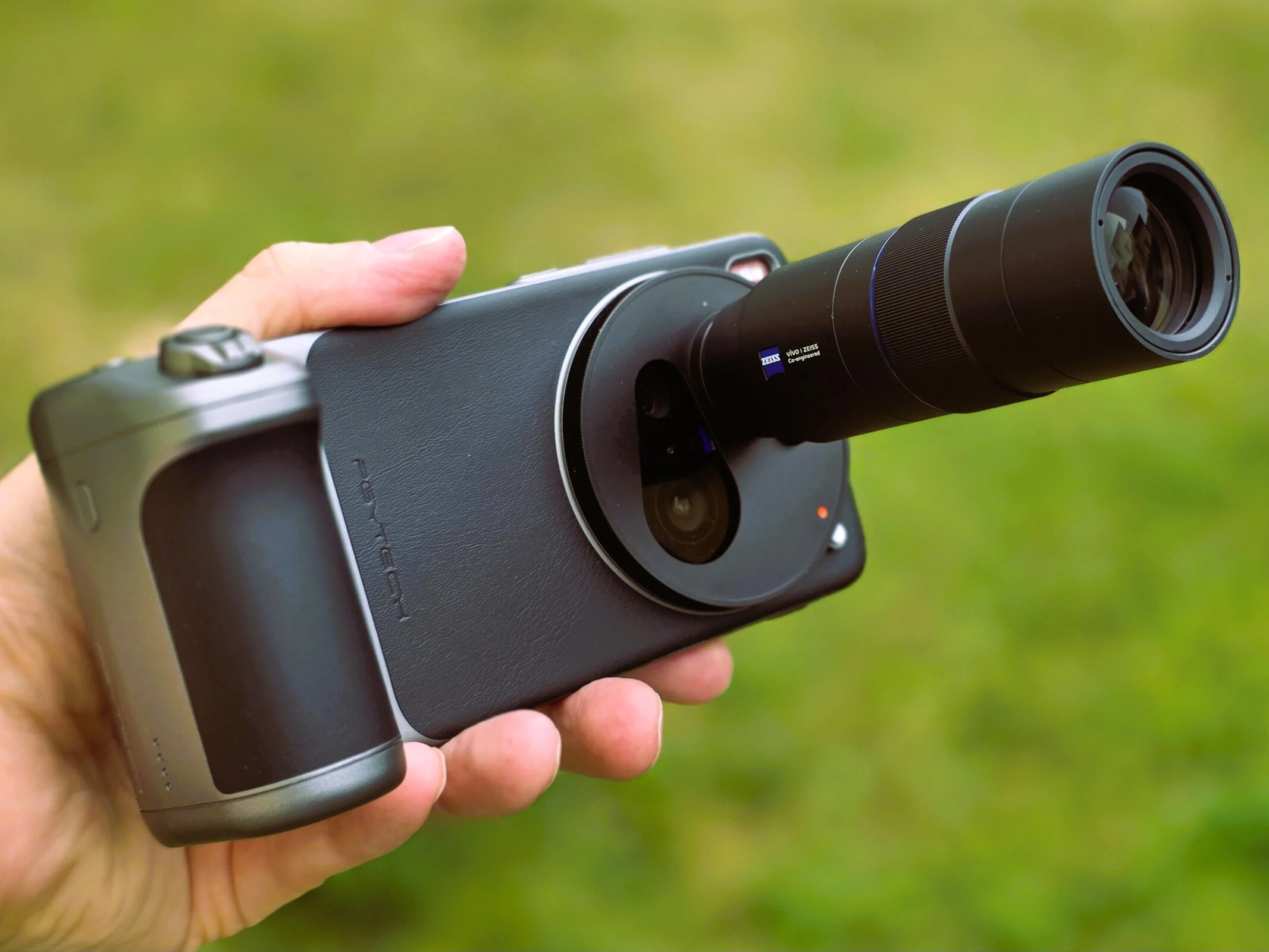
    In our latest review about the Photography Kit, we explored a wide range of camera accessories. We tested these with the Vivo X200 Ultra, which included the Zeiss teleconverter, while taking some pictures outdoors. The sample we used was supplied by Trading Shenzhen.

    Focal Length and Zoom Capabilities

    Using the Zeiss teleconverter, we could extend the focal length to 200 mm, which equals 8.7x optical zoom. By comparison, the smartphone has a maximum lossless zoom of 85 mm. Additionally, there are special modes in the camera app that allow for presets at 400 mm, 800 mm, and 1,600 mm.

    Image Quality Assessment

    The images taken with this setup are impressively good for a smartphone, particularly at higher zoom settings. Although there is some blurriness in the shots, this might be attributed to the camera software rather than the lens. The Zeiss teleconverter seems to be of excellent quality and yields solid image results. We noticed no significant distortion, and the sharpness of the pictures is commendable. The subjects also exhibit a lovely bokeh effect.

    Comparing Without Accessories

    When we compared the Vivo X200 Ultra with and without the accessories, the added quality from the Zeiss teleconverter was quite clear. There were more details and less sharpening, which highlights the benefits of the additional Zeiss optics. Nonetheless, the Vivo flagship performs beautifully even without the extended focal length, thanks to its periscope camera that reaches up to 800 mm.

    For all the pictures we captured, we used the default settings in the camera software. To help identify details in the images, we included all the image files alongside their respective photos. You can click on the individual photos to see them in full resolution.

    Conclusion on the Vivo X200

    In conclusion, the Vivo X200 offers a great photography experience, especially when paired with quality accessories like the Zeiss teleconverter. The camera’s capabilities stand out, making it a solid choice for photography enthusiasts.

    Source:
    Link

  • Tectonic Plate Movements Over 1.8 Billion Years Explained

    Tectonic Plate Movements Over 1.8 Billion Years Explained

    Key Takeaways

    1. Earth has undergone significant changes over its 1.8 billion-year history due to moving tectonic plates.
    2. Earth is the only planet in the solar system with plate tectonics, contributing to diverse ecosystems and climate shifts.
    3. A video from Geoscience Frontiers reveals the emergence of Pangaea and highlights unexpected tectonic activity during the “boring billion.”
    4. The video showcases Earth’s transformations and emphasizes ongoing geological changes that affect life and climate.
    5. Experts predict potential future formations of a new supercontinent in about 250 million years, with various theories on how this might occur.


    If you believe that Earth has remained unchanged since it was formed, you are wrong. Actually, during its long history, it has experienced many alterations, especially due to the ever-moving tectonic plates. A fascinating video helps us see the transformations that have occurred on the planet’s surface over the past 1.8 billion years.

    Unique Features of Earth

    It’s crucial to understand that Earth is the only planet in our solar system that has plate tectonics. This unique feature has undoubtedly contributed to the development of diverse ecosystems over time, as well as influencing shifts in climate.

    A Journey Through Time

    For those curious about the alterations on Earth’s surface over the last 1.8 billion years, there is a video first published in the journal Geoscience Frontiers. The video takes viewers on a journey starting from today and gradually moving backward in time.

    As you watch, you will notice the emergence of Pangaea, a massive supercontinent that formed around 200 million years ago, coinciding with the peak of the dinosaurs’ era. However, as the timeline stretches back even further, some surprising findings come to light.

    The “Boring Billion” Revisited

    Between 0.8 and 1.8 billion years ago, many researchers thought the continents remained relatively stationary, coining the term “boring billion” for this era. Yet, this video reveals numerous transformations, showcasing more vigorous tectonic activity than previously assumed, potentially leading to the creation of new mountain ranges and oceans.

    Utilizing cutting-edge technology, this video illustrates how Earth might have appeared during this era. Additionally, it highlights the constant shifts occurring beneath our feet, often unnoticed. It also sheds light on how life has evolved and how climate may change in the coming thousands of years.

    Speculations About the Future

    Looking ahead, significant changes are on the horizon. In fact, experts predict that the continents might come together again to form a supercontinent in about 250 million years. However, this is still uncertain, as various theories propose different possibilities, including a reunion of Asia and North America or the formation of New Pangaea or Next Pangaea.

    Source:
    Link

  • Jmgo Launches Discounted PicoPlay Portable Projectors Worldwide

    Key Takeaways

    1. The Jmgo PicoPlay and PicoPlay+ projectors are compact, portable mini projectors designed for easy use and transport.
    2. Both models support 1080p resolution, can project images up to 200 inches, and cover 90% of the DCI-P3 color spectrum; however, the PicoPlay+ has slightly higher brightness (450 ISO lumens) than the PicoPlay (400 ISO lumens).
    3. They run on Google TV, allowing streaming from popular services like YouTube and Netflix, and include smart features like voice commands and wireless casting.
    4. The projectors have a built-in 8W speaker with Dolby Audio support, multiple connectivity options (HDMI, USB-C, USB-A), and a robust 20,000 mAh battery for long playback times.
    5. The Jmgo PicoPlay is currently priced at $299/€349, while the PicoPlay+ is expected to launch at $449/€449.


    The Jmgo PicoPlay and PicoPlay+ projectors have been launched. They seem to be global versions of the Jmgo P5X projector that debuted in China in May 2025. Marketed as “coffee-cup-sized” mini projectors, their design enhances portability.

    Similarities and Differences

    The PicoPlay projectors are nearly the same in design and functionality, with just a slight difference in peak brightness. The PicoPlay has a brightness of up to 400 ISO lumens, while the PicoPlay+ boasts up to 450 ISO lumens. Both models can project images as large as 200 inches with a 1080p resolution, covering 90% of the DCI-P3 color spectrum. Additionally, they support HDR10 and can display 3D content. Setting up is a breeze with an 88° rotating gimbal, and users can fine-tune images using features like real-time autofocus, auto keystone, and screen alignment.

    Smart Features and Connectivity

    The PicoPlay series runs on Google TV, which allows users to stream content from services like YouTube and Netflix. This also includes support for voice commands via Google Assistant and wireless casting through Google Cast from mobile devices. It has a built-in 8W speaker that supports Dolby Audio, and includes ports such as HDMI (ARC), USB-C, and USB-A. This portable projector is equipped with a 20,000 mAh battery, providing up to three hours of video playback or seven hours of music. These small devices measure about 3.3 x 3.3 x 6.5 inches (approximately 8.5 x 8.5 x 16.6 cm) and weigh around 2.2 lbs (about 0.7 kg).

    Pricing Information

    Currently, the Jmgo PicoPlay projector is available for $299/€349, which is a significant discount of $200/€150 from the original price of $499/€499. These offers can be found at the brand’s official online store and on Amazon. The Jmgo PicoPlay+ is expected to be priced at $449/€449 when it launches.

    Source:
    Link

  • FlyCart 100: DJI’s Powerful Cargo Drone with 176 lb Capacity

    FlyCart 100: DJI’s Powerful Cargo Drone with 176 lb Capacity

    Key Takeaways

    1. Impressive Carrying Capacity: The FlyCart 100 can carry up to 80 kg (176 pounds) over distances of 6 km (3.7 miles), and up to 12 km (7.45 miles) with lighter loads.

    2. Adaptable for Various Environments: It operates in temperatures from -20 °C to 40 °C and can fly at altitudes up to 6,000 meters, with advanced sensors for obstacle avoidance and terrain detection.

    3. Versatile Delivery Options: Cargo can be loaded in a 70-liter container, or delivered using a winch and rope for challenging terrains.

    4. Safety Features: The drone includes a built-in parachute system for emergencies, deploying from heights over 100 meters and controlling descent speed.

    5. Rapid Charging and Durability: A single battery charges in 9 minutes, self-heats in cold conditions, and is rated for 1,500 cycles of use; priced at approximately $12,400 in China.


    We’ve had quite a few chances to try out DJI drones, like the DJI Neo and the DJI Flip. Besides the models aimed at casual users who want to capture aerial videos and photos, DJI also makes drones for professionals, including businesses and government agencies. One of these models is the FlyCart 100, which is a new professional drone designed mainly for transporting goods. The use of drones for deliveries is particularly appealing for those who need to send items quickly or to hard-to-access areas.

    Impressive Carrying Capacity

    The latest FlyCart 100 can carry a significant load, with a maximum capacity of up to 80 kg (176 pounds). DJI states that this maximum weight can be transported over a distance of 6 km (3.7 miles). This large capacity makes it possible to deliver fresh produce or medical supplies to challenging locations. If the drone is tasked with carrying 65 kilograms (143 pounds), using two batteries can extend its range to 12 kilometers (7.45 miles); with even lighter loads, it can go even farther.

    Adaptable for Various Environments

    DJI asserts that the drone can operate in temperatures ranging from -20 °C to 40 °C and can fly at altitudes up to 6,000 meters. However, flying at higher altitudes may lead to reduced efficiency and a drop in range due to lower air pressure. The drone is equipped with various sensors, including LiDAR, five-eye fisheye cameras, millimeter-wave radar, and night-time lighting. These features allow for smart obstacle avoidance, 360-degree awareness, and real-time terrain detection.

    Versatile Delivery Options

    Cargo can be loaded into a 70-liter container, but if the terrain is tricky, deliveries can also be made using a winch and rope. For this purpose, the drone features a 30-meter retractable rope and a dual-electric setup with a 10-meter fixed rope for easier handling. Additionally, it has a built-in parachute system that activates in emergencies to safeguard the drone and its cargo, deploying from heights of over 100 meters (326 feet) and controlling descent to under 6 m/s. Moreover, a single battery can be charged in just 9 minutes, can self-heat in chilly conditions, and is rated for 1,500 cycles of use.

    Currently, the drone is available in China for approximately $12,400. Details about a worldwide release are still unknown, but since the FlyCart 30 is already widely accessible, it’s likely that the FC100 will be available soon as well.

    Source:
    Link


  • PNG 3: Enhanced HDR and Animations Beat JPEG

    PNG 3: Enhanced HDR and Animations Beat JPEG

    Key Takeaways

    1. PNG format was introduced in 1995 and has undergone multiple updates, with Version 3 recognized as a W3C standard in June 2025.
    2. PNG offers lossless compression and supports transparent sections, making it superior to JPEG for quality, despite larger file sizes.
    3. Version 3 of PNG allows for the inclusion of EXIF data, similar to JPEGs, providing metadata about the image.
    4. Animated PNGs (APNGs) are now part of the W3C standard with Version 3, featuring new capabilities like HDR support.
    5. Collaboration with major companies like Adobe, Apple, and Google ensures wide compatibility of PNG Version 3 across various applications and platforms.


    The PNG file format made its debut in 1995 and was recommended by the World Wide Web Consortium (W3C) starting in October 1996. The W3C updated the standard to its second version in November 2003. A working group has been working on the third version since September 2021, which was officially recognized as a W3C standard on June 24, 2025.

    Advantages of PNG Over JPEG

    When you compare PNG to JPEG, there are two main benefits. Firstly, PNG allows for lossless compression of images and graphics, which means they maintain better quality, although the file sizes are larger. Secondly, PNG can hold an alpha channel, which enables it to show transparent sections. The new Version 3 brings significant changes that enhance PNG’s appeal for contemporary use. Most importantly, PNGs can now include EXIF data, like JPEGs do, allowing metadata to show which camera took the picture and its location through GPS coordinates.

    The Rise of Animated PNGs

    Animated PNGs, or APNGs, have been around for a while and were initially created by Mozilla. However, with the arrival of PNG Version 3, they are now officially part of the W3C standard, which means more software is likely to support them in the future. The most interesting new capability is HDR support. Thanks to cICP, HDR PNGs are only 16 bytes heavier than SDR PNGs. If an ICC profile is embedded, the file would increase by 9MB.

    Collaboration and Support

    Version 3 of PNG was created in partnership with Adobe, Apple, and Google, so it is already compatible with many applications. This includes all browsers based on Chromium, Firefox, macOS, iOS, Adobe Photoshop, and DaVinci Resolve. Since PNG is often used for subtitles and overlays in news broadcasts, we can expect HDR support for these elements soon.

    The World Wide Web Consortium is also focused on two additional enhancements for the PNG standard. First, they plan to modernize lossless compression to decrease PNG file sizes. Second, they aim to improve the compatibility of HDR images on SDR displays and vice versa.

    Source:
    Link

  • KF100 Max Drone: 4K Video, GPS, Touchscreen, Object Delivery

    KF100 Max Drone: 4K Video, GPS, Touchscreen, Object Delivery

    Key Takeaways

    1. The KF100 Max drone costs just below €300/£261, including import taxes but excluding shipping, and cannot be shipped to the US.
    2. Warranty and return options for the drone may be limited for customers.
    3. The drone weighs 745 grams, exceeding the 250-gram limit for recreational drones in many countries.
    4. It features a touchscreen controller with a 5.5-inch screen, a control range of 6,000 meters, and a flight duration of up to 50 minutes.
    5. The KF100 Max captures video at 3,840 x 2,160 resolution and photos at 7,680 x 4,320 pixels, and has GPS for autonomous return to the starting point.


    The KF100 Max is a new drone that can now be imported directly. Priced at just below €300/£261, this amount includes import taxes but excludes shipping costs. It’s important to note that this drone cannot be shipped to the US. Additionally, customers should be aware that their warranty and return options may be quite limited if they need to make a claim. A significant downside is that the drone weighs up to 745 grams, which is much higher than the legal 250-gram limit for recreational drones in numerous countries.

    Controller Features

    This drone comes with a touchscreen controller featuring a 5.5-inch diagonal screen. The specifications indicate a control range of 6,000 meters, although this range may decrease due to obstacles or hilly landscapes. The drone can fly at altitudes reaching up to 500 meters, with a maximum speed of 11 m/s and a flight duration of up to 50 minutes.

    Camera and GPS Capabilities

    Equipped with a 1/3.2-inch sensor, the KF100 Max captures videos at resolutions up to 3,840 x 2,160 and photos reaching 7,680 x 4,320 pixels. With GPS functionality, the drone can autonomously return to its original location when the battery is running low, if the signal is lost, or when the user presses the one-key-return button. Finally, it can carry and drop items weighing no more than 800 grams. More detailed specifications can be found on the product page at Banggood.

    Source:
    Link


  • GoPro Hero 13 Black: New Green Color vs. Sale on Original Model

    GoPro Hero 13 Black: New Green Color vs. Sale on Original Model

    Key Takeaways

    1. GoPro has released a new Forest Green color for the Hero 13 Black action camera, priced at $429.99.
    2. The white color variant is currently out of stock, but the black model is on sale for $329.99 (regular price $429.99).
    3. A complimentary 1-year GoPro Premium subscription is included with the purchase of the Forest Green model.
    4. The accessory bundle is discounted from $479.99 to $379.99, including extra items like an Enduro battery and a 64GB MicroSD card.
    5. The Polar White color is still available at a lower price on Amazon.


    Earlier this year, GoPro revealed a special edition Polar White color for the Hero 13 Black action camera. Currently, the white variant is out of stock on GoPro’s website, but the company has introduced another exclusive color that would be ideal for your adventures in the wild.

    New Color Release

    The latest color option is named Forest Green and resembles a deep military green shade. You can purchase it now on GoPro’s website for $429.99. Just like the regular black model, this version includes a complimentary 1-year GoPro Premium subscription with your purchase.

    Current Promotions

    While the new color is appealing, GoPro is also offering the standard black model at a discount. Instead of the usual $429.99, the Hero 13 Black can now be bought directly from GoPro for just $329.99. It’s also available at this lower price on Amazon, where you can still find the Polar White color in stock.

    Accessory Bundle Deal

    The limited-time discount extends to the accessories bundle, which has dropped in price from $479.99 to $379.99. This bundle features everything included in the standard package, plus an additional Enduro battery, a second curved adhesive mount, a hand grip, a camera case, and a 64GB SanDisk MicroSD card.

    Source:
    Link

  • HDMI 2.2 Specification Launches with 96Gb/s Bandwidth Support

    HDMI 2.2 Specification Launches with 96Gb/s Bandwidth Support

    Key Takeaways

    1. The new HDMI standard, Ultra96, supports bandwidth up to 96 Gb/s, doubling the 48 Gb/s of HDMI 2.1.
    2. Cables labeled as “Ultra96 HDMI Cable” must support all features of the HDMI 2.2 standard.
    3. Ultra96 allows for image playback at up to 16K at 60fps and 12K at 120fps, surpassing HDMI 2.1’s 8K at 60fps.
    4. It supports advanced video features like uncompressed 4:4:4 chroma subsampling and 4K at 240fps with high color depth.
    5. The new standard introduces the Latency Indication Protocol (LIP) to improve audio-video synchronization in home theater setups.


    Currently, some of the top-rated cables on Amazon, like this 6.6ft option from Anker, have the Ultra High Speed certification from the HDMI Forum. However, a new standard has emerged that you should keep an eye out for from the same independent organization.

    New Standard Unveiled

    The fresh term is Ultra96, which is now the official name related to HDMI 2.2. This name was chosen to show that the new standard allows for a bandwidth of up to 96 gigabits per second (Gb/s), compared to the 48Gb/s from HDMI 2.1.

    Understanding the Buzzword

    While the term may sound a bit misleading, it can still apply to cables that manage to achieve 64Gb/s or 80Gb/s. Still, the HDMI Forum insists that being able to label a new accessory with Ultra96 (or “Ultra96 HDMI Cable”) means it supports all the features of the new HDMI 2.2 standard.

    Enhanced Features

    These features include support for image playback at resolutions up to 16K at 60 frames per second (fps), as well as 12K at 120fps, 8K at 60fps, uncompressed 4:4:4 chroma subsampling, and 4K at 240fps at either 10-bit or 12-bit color. In contrast, HDMI 2.1 only supports up to 8K at 60fps.

    Additionally, the new standard also brings in the Latency Indication Protocol (LIP), which could enhance audio-video (AV) synchronization for home theater setups that may include devices like a soundbar or an AV receiver.

    Source:
    Link

  • DJI Osmo 360 Leak Reveals Camera Specs and Battery Life

    DJI Osmo 360 Leak Reveals Camera Specs and Battery Life

    Key Takeaways

    1. DJI is expected to release a new action camera, the Osmo 360, as a competitor to GoPro Max and Insta360 X5.
    2. Leaked images show that the Osmo 360 will feature 8K video recording at 30 frames per second.
    3. The camera is suggested to last more than 3 hours on a single charge while recording in 8K.
    4. Other specifications of the Osmo 360 are still unknown and await official confirmation.
    5. The official launch of the Osmo 360 is anticipated on July 15, with additional products expected by the end of the month.


    It seems DJI is getting closer to releasing its highly anticipated competitor to the GoPro Max and Insta360 X5 (currently priced at $549.99 on Amazon). Although DJI hasn’t officially confirmed any news about expanding its action camera lineup, a leaker named Igor Bogdanov has shared product images on X.

    New Insights on the Camera

    The images posted align with ones previously released by the Federal Communications Commission (FCC) showcasing a prototype from a few months back. However, these recent pictures provide more details about the camera’s features. For example, the label ‘8K30’ is prominently visible, indicating that the Osmo 360 will have the ability to record videos in stunning 8K resolution at 30 frames per second. Additionally, these photos suggest that the 360-degree camera may last for more than 3 hours on a single charge when recording at 8K and 30 FPS.

    Remaining Details Awaiting Confirmation

    At this point, other specifications for the Osmo 360 still remain a mystery. Usually, leaks like this surface late in a device’s development stage. It’s possible that a retailer accidentally uploaded these images to a public webpage earlier than intended. No matter where the images came from, DJI is anticipated to officially launch the Osmo 360 on July 15, followed by the Osmo Nano and Mic 3 release before the month wraps up.

    Source:
    Link


  • Insta360 Flow 2 Leaks: Competitive Pricing Revealed

    Insta360 Flow 2 Leaks: Competitive Pricing Revealed

    Key Takeaways

    1. Insta360 has launched the Mic Air, which is smaller than DJI’s Mic Mini and priced at $169 on Amazon.
    2. A new smartphone camera gimbal, the Flow 2, is set to be released, offering a more affordable option than the Flow 2 Pro.
    3. Insider Igor Bogdanov has revealed that the Flow 2 will feature impressive capabilities.
    4. Product images of the Flow 2 have been shared, showcasing its design and features.
    5. The Flow 2 is expected to be competitively priced and available for order starting today at 13:00 UTC.


    Insta360 has just unveiled the Mic Air, which is even tinier than DJI’s Mic Mini (currently priced at $169 on Amazon). But that’s not all; it appears that a new smartphone camera gimbal from the brand is also in the works.

    Sneak Peek of New Gimbal

    Officially, Insta360 has only given us a little glimpse of what they are planning. Nevertheless, Igor Bogdanov has shared that the company will soon introduce a more affordable version to the Flow 2 Pro. According to the insider, the Insta360 Flow 2 will come with some impressive features.

    Flow 2 Product Images

    Additionally, Igor Bogdanov has shared several images of the Flow 2, which we’ve included below. Sadly, the launch price is still a mystery. However, Bogdanov suggests that Insta360 is aiming to keep the Flow 2’s price competitive. The Flow 2 is expected to be available for order starting today at 13:00 UTC.

    Source:
    Link