Key Takeaways
1. The GPD Win 5 runs SteamOS 3.8 natively, allowing full support for controllers, Wi-Fi, and Bluetooth.
2. Power management in SteamOS on the GPD Win 5 requires additional tools, as TDP controls are not available in the native menu.
3. Gaming performance on SteamOS is competitive, with titles like Marvel’s Spider-Man 2 and Cyberpunk 2077 achieving 70-74 FPS at 1080p.
4. Windows 11 outperforms SteamOS in some games, such as Borderlands 4, suggesting better driver optimization for demanding titles.
5. Battery life for AAA games is similar on both operating systems, approximately two hours at 25 W.
The GPD Win 5 is said to perform nicely with Windows 11, which it comes pre-installed with, and it can run a range of indie and AAA games. This brings up the question of how well the new AMD Strix Halo-powered handheld would do with a lightweight, gaming-oriented Linux system like SteamOS.
Exploring SteamOS on GPD Win 5
This is what YouTuber ETA PRIME aimed to discover in their recent video. They started by loading the official SteamOS Hollow 3.8 main branch build onto the GPD Win 5, marking the first version that boots completely on AMD’s latest Strix Halo and Strix Point APUs.
ETA PRIME explained that this particular release was selected because it fixes the long-standing boot issue that had stopped SteamOS from working on these processors. With the improved boot chain in version 3.8, the GPD Win 5 now runs SteamOS natively, providing full controller support, Wi-Fi, Bluetooth, and system-level features similar to those of the Steam Deck.
Hardware Specifications
The test unit features AMD’s Ryzen AI Max 385 APU working alongside a 30-CU Radeon 8050S iGPU. It’s loaded with 32 GB of RAM, which ETA PRIME set up to divide 16 GB for system use and 16 GB for the iGPU. SteamOS correctly identifies the platform under System settings as “Hollow 3.8” and lists the APU as model 385.
Despite this progress, one limitation of SteamOS on non-Deck devices is the TDP control from the standard performance overlay. As shown by ETA PRIME, power limits do not show up in the native menu on the Win 5, leading them to install Decky Loader with the SimpleDeckyTDP plugin. With this configuration, the handheld can be adjusted anywhere from a low 4 W up to a reported 120 W slider range.
Gaming Performance
In practical terms, ETA PRIME keeps the power usage between 20 and 45 W for gaming on the go, noting that the Windows 11 “Performance” mode on the GPD Win 5 typically sits around 45 W and can peak to 65 W while on battery. For SteamOS, the YouTuber generally kept AAA games between 25 and 45 W.
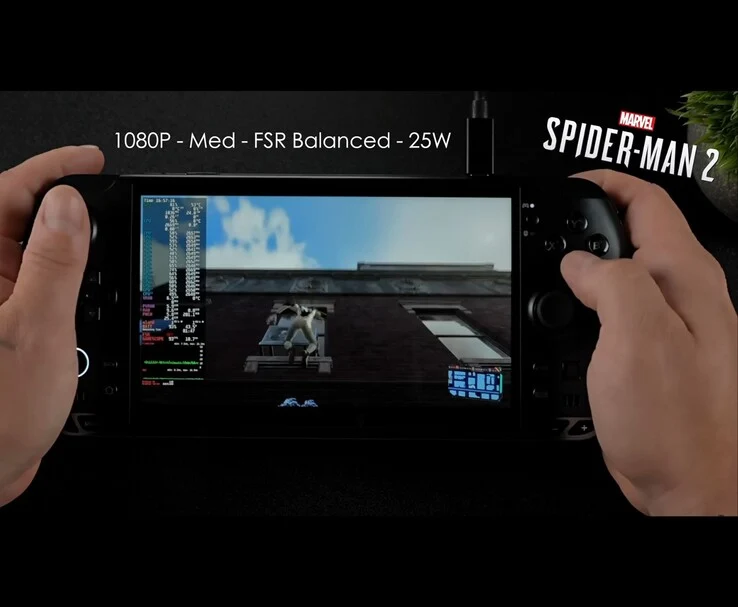
During their tests, Marvel’s Spider-Man 2 was the first game they tried. At 1080p, Medium settings, FSR Balanced, and a 25 W TDP, the game averaged about 71 FPS without frame generation. Switching to the “High” preset could yield similar performance by raising power to around 35 W, the YouTuber noted.
Next on the list was Cyberpunk 2077. Running at 1080p, Steam Deck preset, and a 25 W TDP, it averaged approximately 74 FPS. When set to 1080p, Ultra preset, FSR Quality, and a 45 W TDP, the game performed at roughly 71 FPS on average. The Ryzen Max chips were seen to scale effectively with power, with 45 W comfortably supporting 1080p Ultra gameplay. However, after 45 W, the Strix Halo chip’s performance begins to stabilize.
Borderlands 4 at 1080p, Medium settings, FSR Balanced, and a 45 W TDP sometimes dipped below 60 FPS. In comparison, the same game runs about 13 FPS faster on Windows 11 with similar settings, indicating it might not be fully optimized for SteamOS just yet.
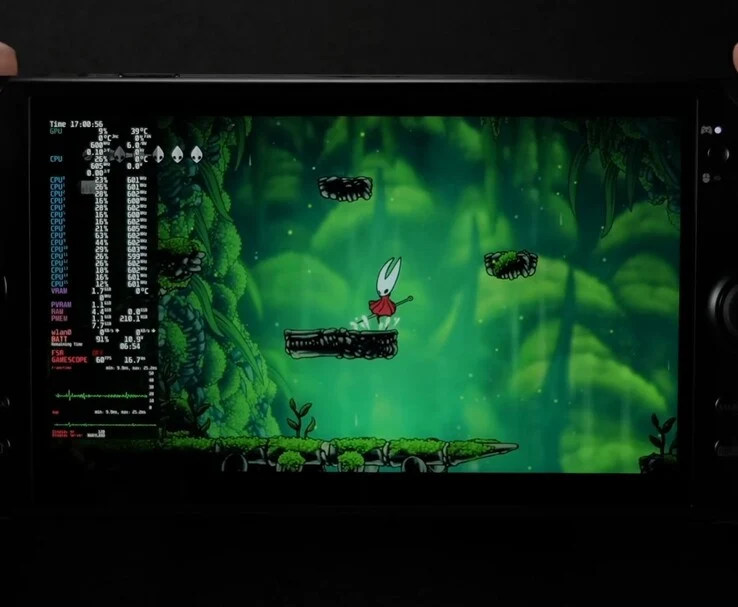
Lastly, Hollow Knight: Silksong, a 2D indie game, was tested at a 6 W TDP with a frame rate capped at 60 FPS. The total system draw was around 10.5 W, suggesting nearly eight hours of gameplay.
The YouTuber also checked out games like The Witcher 3: Wild Hunt, Elden Ring, and Doom: The Dark Ages in their video, which is linked below.
Conclusion
When looking at gaming performance between SteamOS and Windows 11 on the GPD Win 5, the results present a mixed picture. In Borderlands 4, Windows 11 has a clear advantage, averaging about 13 FPS higher at identical 1080p Medium settings and a 45 W TDP, implying better driver optimization on Windows’ part.
Marvel’s Spider-Man 2 shows almost equal results between the two systems, with both holding around 70–74 FPS at Medium settings in the 25–28 W power range, though the Windows 11 test did not clarify whether FSR was set to Balanced.
Battery life also remains roughly the same, offering about two hours of gameplay for AAA titles at 25 W on either operating system. Overall, while SteamOS 3.8 shows competitive performance in most cases, Windows 11 still holds a slight edge in more demanding games due to its well-developed drivers and broader game optimization.
This indicates that although SteamOS and various Linux distributions are becoming more popular, there is still some work needed from developers to reach the same level of performance as Windows 11 in gaming.
Source:
Link