Category: All News

  • Casio G-Shock Camouflage Face Watches Launching Soon

    Casio G-Shock Camouflage Face Watches Launching Soon

    Key Takeaway

    – Two new camouflage-faced G-Shock models: DW-6900CF-1 and GA-700CF-1A, listed by a Vietnamese retailer.
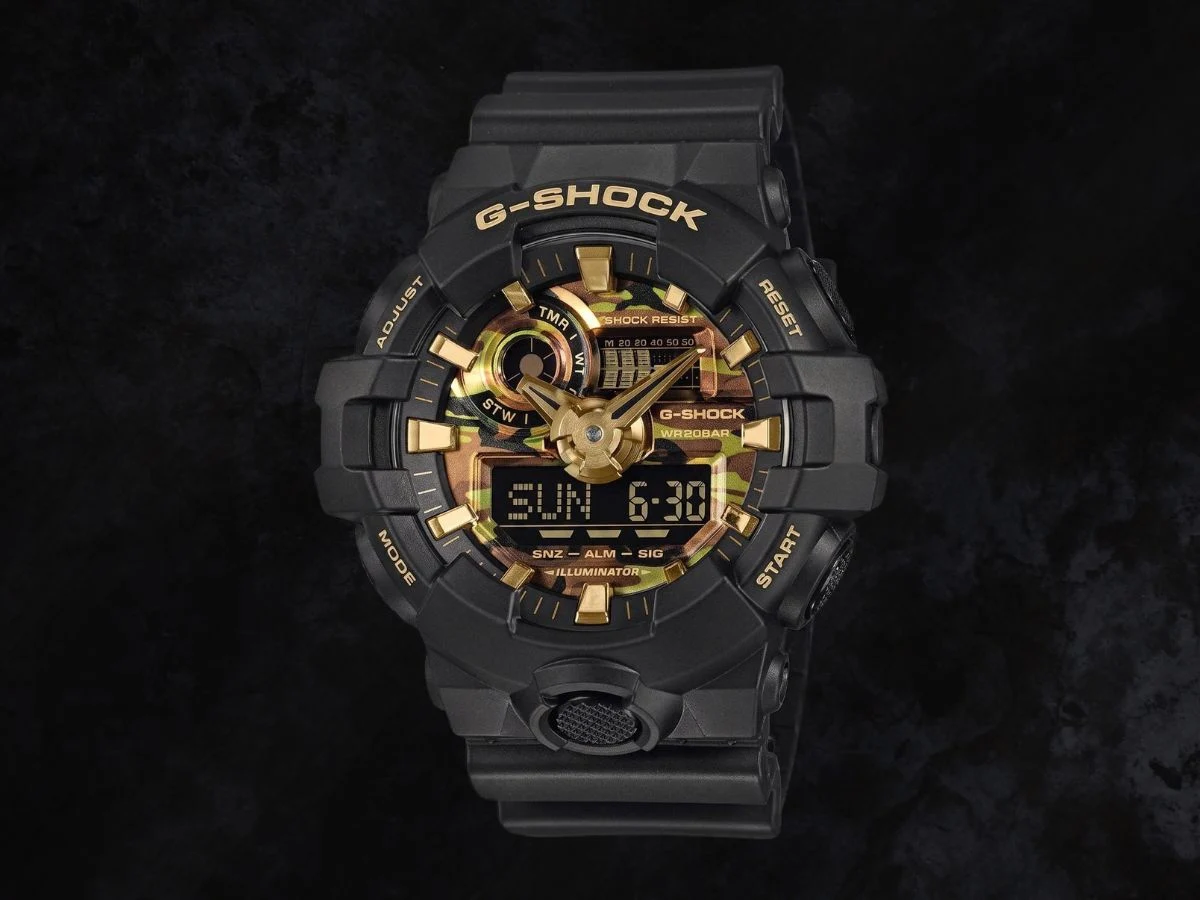
    – Distinct camouflage dial designs with black resin casing and strap; GA-700CF-1A features more prominent golden accents.
    – GA-700CF-1A is a round hybrid with two analog hands, stopwatch, LED backlight, and 200 m water resistance; DW-6900CF-1 is a digital Triple Graph with similar core features and 20 bar water resistance.


    Casio is releasing two new G-Shock Camouflage Face watches in the near future. The DW-6900CF-1 and the GA-700CF-1A were both recently listed at Vietnamese retailer G-Shock Hai Phong. They appeared shortly after a range of new Camo and Gold watches were spotted.

    Camouflage Face G-Shock models

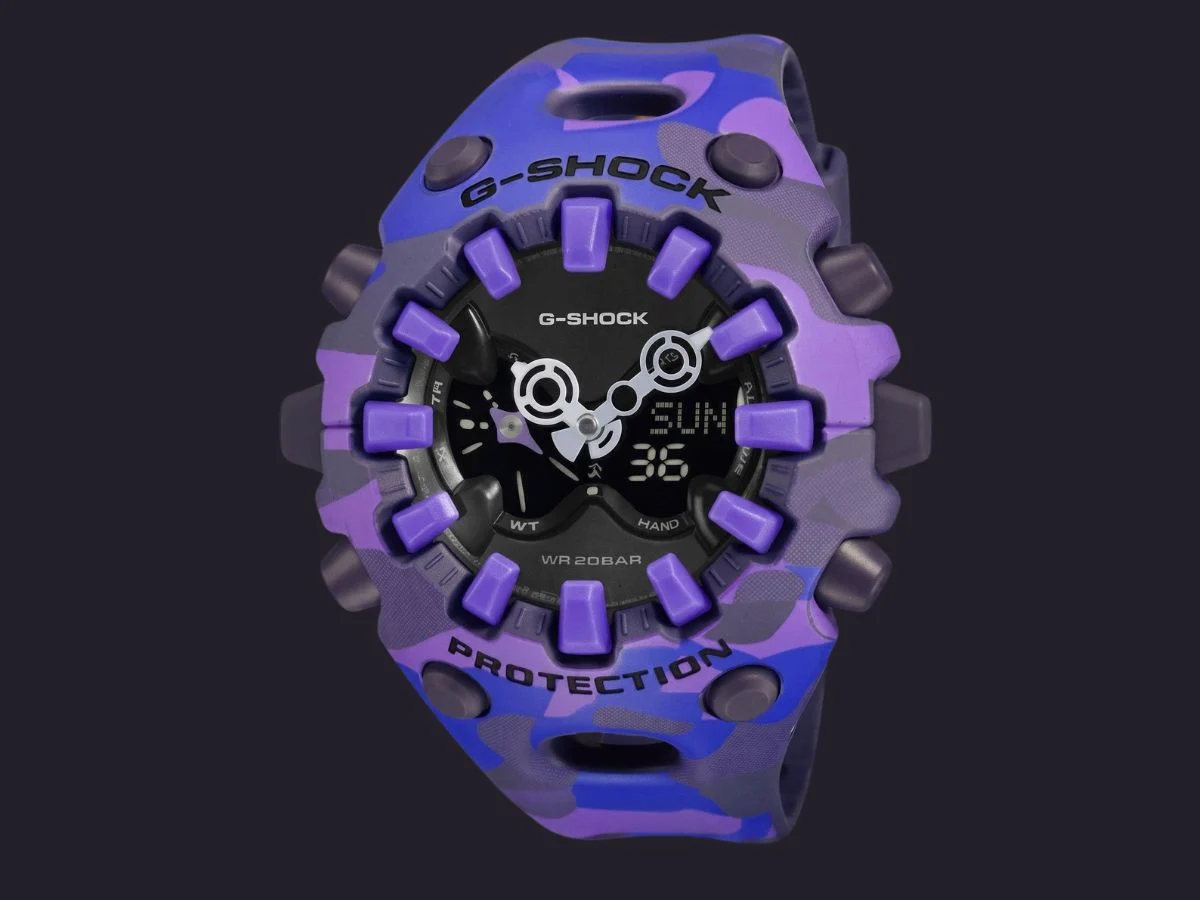
    With a camo pattern that blends blacks, browns, and greens, these watches sport black resin casings and straps, while the GA-700CF-1A showcases more pronounced golden accents. The style choice leans toward rugged boldness and a touch of metallic flash, making them stand out in a crowd, yet still remain practical for daily wear.

    GA-700CF-1A design details

    The GA-700 series is known for its chunky, round hybrid silhouette and a bezel that emphasizes ruggedness. It includes two analog hands, a stopwatch, an LED backlight, and 200 m water resistance. The camouflage finish adds a layer of urban toughness, while the gold accents provide contrast that catches the eye in certain lighting.

    DW-6900CF-1 design details

    The DW-6900CF-1 continues the round digital aesthetic with a Triple Graph (three sub-dials) on a dark backdrop. Like its sibling, it includes a stopwatch, backlight, and water resistance suitable for everyday use. The camo motif keeps the display practical yet stylish, integrating modern digital features with a classic G-Shock vibe.

    Release information

    According to the retailer, Casio will release the G-Shock Camouflage Face DW-6900CF-1 and the GA-700CF-1A watches in June 2026. However, this has yet to be officially confirmed by the brand, and the pricing also remains a mystery for the time being.

    Sources
  • Casio G-Shock GA-2100LXB: Metal Accent Watch Images Leak

    Casio G-Shock GA-2100LXB: Metal Accent Watch Images Leak

    Key Takeaway

    – Four new G-Shock GA-2100 variants (GA-2100LXB-1A, GA-2100LXB-1A9, plus GM-2100LXB-1A and GM-2100LXB-1A9) are tied to a Luxury Black collection with black resin casings.
    – The GA-2100LXB models differ in accent colors: 1A with dark metallic gray indexes and brown digits; 1A9 with golden-hued indexes and gold-toned inset display elements.
    – Official release timing and pricing are unconfirmed; Vietnamese retailer listing suggests June 2026 availability, but no pricing details are provided.


    Casio G-Shock GA-2100LXB Series Unveiled

    Two new Casio G-Shock GA-2100LXB models have been revealed, the GA-2100LXB-1A and GA-2100LXB-1A9, following rumors that also mentioned the GM-2100LXB-1A and GM-2100LXB-1A9 during May 2026. These four watches are being discussed under the banner of the Luxury Black collection.

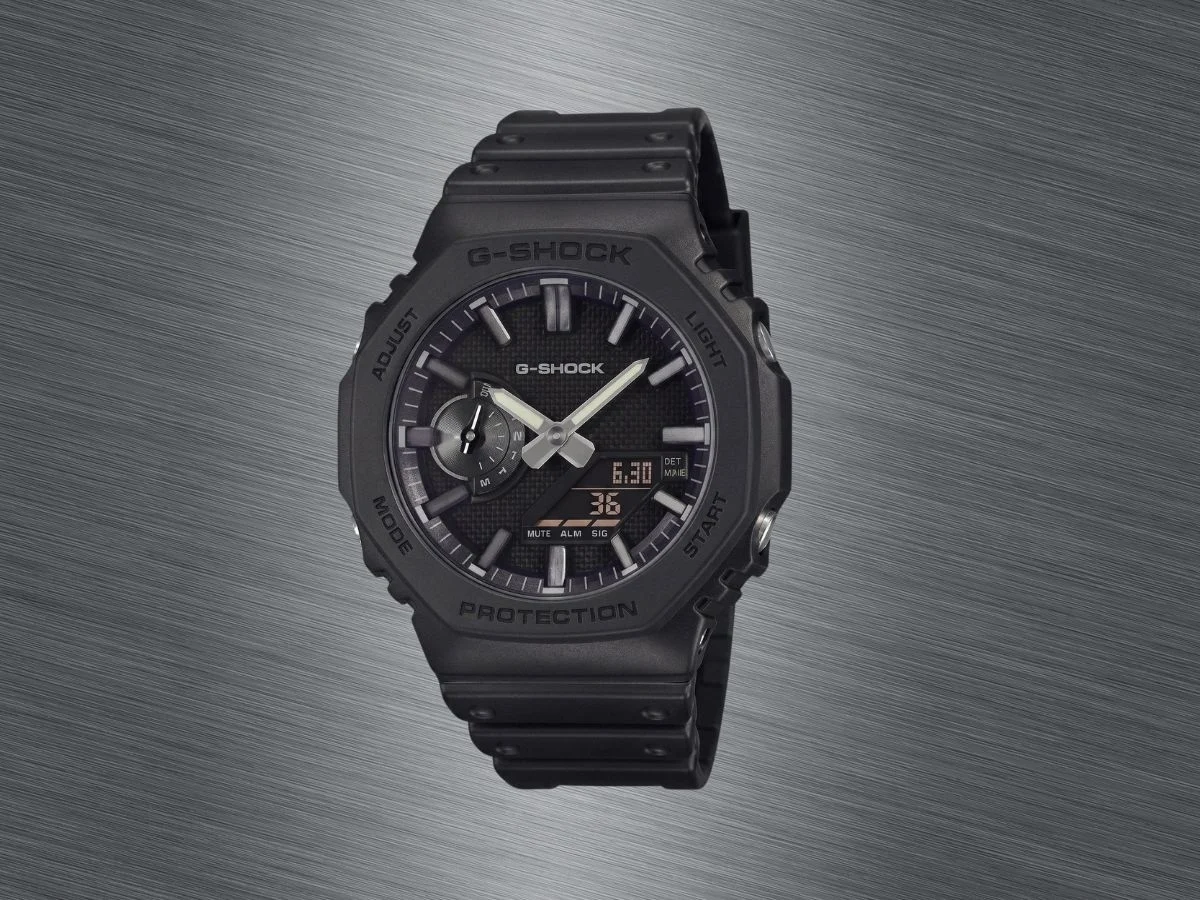
    The leaks came from a Vietnamese retailer, showing images of the GA-2100LXB watches. They sport black resin cases with dimensions of 48.5 x 45.4 x 11.8 mm and come with matching black straps. The two variants, however, differ in accent colors: the GA-2100LXB-1A features dark metallic gray indexes and a similarly colored indicator ring with brown digits on the black digital display, whereas the GA-2100LXB-1A9 presents golden-hued indexes and indicator elements with gold-toned numbers on the inset display.

    What makes the GA-2100LXB Standout

    The GA-2100 series stands out as an octagonal bezel model, often referred to as a CasiOak, continuing Casio’s Carbon Core Guard construction philosophy. It is built to endure up to 200 meters of water resistance and is powered by a long-lasting battery, typically around three years under normal use. The watch includes a 1/100th second stopwatch, a countdown timer, and multiple daily alarms, with a selection of 31 time zones across 48 cities for global timekeeping.

    Market Status and Pricing Uncertainty

    Official details about the GA-2100LXB-1A and GA-2100LXB-1A9 release dates beyond the June 2026 window marked by the Vietnamese retailer are not clearly disclosed. There is no confirmed information on pricing for these models in this or other markets yet, leaving enthusiasts waiting for Casio’s formal announcement.

  • Meshtastic: Off-Grid Mobile Communication Without Fees or Coverage

    Meshtastic: Off-Grid Mobile Communication Without Fees or Coverage

    Key Takeaway

    – LoRa emphasizes energy efficiency and long-range over high data rate, making it suitable for small data payloads (Kbit/s) and use cases like text messages or location data without relying on traditional networks.
    – Meshtastic creates a mesh network (and MeshCore as an alternative) to extend effective range via multi-hop relays, with devices acting as routers and clients.
    – ThinkNode M1 exemplifies typical Meshtastic hardware (LoRa + GNSS, e-ink display, Bluetooth phone pairing) and supports easy message sending and position sharing through the Meshtastic app.


    We have already covered LoRa several times. It is a rather special wireless standard. In principle, LoRa is a transmission method similar to IEEE 802.11 (WiFi), but LoRa has a very different focus: instead of enabling the fastest possible transmissions with low latency, LoRa is much more about energy efficiency and range. However, LoRa is only useful when relatively small amounts of data are being transmitted, meaning more in the KBit/s range. Sending and receiving images, for example, is not realistically practical, but sending longer texts is supported. Location data can also be transmitted. Such systems can be useful on factory sites or hikes, for example, or for communication independent of state network infrastructure in repressive countries.

    LoRa products, or in this specific case Meshtastic products, create a mesh network

    This means the message can be transmitted indirectly, increasing the effective range far beyond the range of a direct connection. MeshCore is also available as an alternative technology or implementation that effectively runs on the same hardware, although it does have some differences in detail. For example, MeshCore works with more clearly defined roles, such as router and client, which tends to make MeshCore better suited for more or less professional, permanent mesh networks.

    But how exactly does Meshtastic work? The answer is fairly simple. We took a look at the ThinkNode M1, a LoRa- and Meshtastic-compatible system. There is a wide selection of such systems, including on Amazon. The ThinkNode M1 comes with an e-ink display, a GNSS module, a rotary dial for powering it on and controlling brightness, two buttons, and a switch for the GNSS connection. The battery-powered system can communicate directly with other Meshtastic devices. A smartphone can be connected via Bluetooth, with the ThinkNode M1 then also acting as an external “LoRa modem.” The Meshtastic app supports setup and configuration of Meshtastic devices and also works as a messenger. This makes it easy to send messages from a smartphone.

    Operation and practical notes

    Operation via the two buttons is not entirely intuitive. The e-ink display remains easy to read even in direct sunlight, though overlapping image content can occasionally appear, which is partly due to the technology. This can happen with a partial refresh, although the ThinkNode M1 eventually performs a full refresh again. The e-ink display is relatively sluggish. Overall, we have little to criticize about the ThinkNode M1, although we simply lack the comparison base for a fully detailed assessment. Recording the user’s own position works without issues. This position can also be sent to the mesh network, and the location history of a device can be displayed. Users can receive notifications on their smartphone for incoming messages.

    At this point, however, one thing should be pointed out directly: ranges of hundreds of miles are unlikely to be achievable with two ThinkNode M1 handhelds and a network established only between those two devices. For that, several mobile devices or repeaters have to be integrated as relay stations. With 868MHz and the LONG-SLOW modem preset, around 1,600 feet was achievable near a river, while in inner-city areas the range was more like a few hundred yards, in both cases without line of sight.


    Sources

  • Xiaomi 240Hz Gaming Monitor Launches Globally

    Xiaomi 240Hz Gaming Monitor Launches Globally

    Key Takeaway

    – 240 Hz native refresh rate with 1 ms GTG and FreeSync Premium, aimed at esports/competitive gaming.
    – 24.5″ Fast IPS panel, 1080p (1920×1080), brightness ~400 nits, contrast ~1000:1; limited feature set with only tilt stand (no height/swivel).
    – Ports are limited to HDMI 2.0 and DP 1.4 plus audio out; no advanced ergonomic adjustments.
    – Price in Europe around €180 (listed by some retailers), but availability locally is uncertain.
    – Additional features: crosshair display and a night-vision/gradation color tuning capability.


    Xiaomi G25i 2026 gaming monitor: Europe launch details

    the Xiaomi G25i 2026 gaming monitor is coming to Europe. this is confirmed not only by a listing on Xiaomi’s global website, but the EU version of the monitor is also already listed by at least one distributor and a Finnish retailer. There, the Xiaomi Gaming Monitor G25i 2026 is listed at a price of €180, although this price should still be treated with caution for now. The monitor is not yet available through local retailers. Xiaomi also advertises the Xiaomi Gaming Monitor G25i 2026 as suitable for esports, which naturally primarily refers to the higher refresh rate and low response time. The native refresh rate is listed at 240Hz, and the gray-to-gray response time is specified at one millisecond. FreeSync Premium is supported.

    Display specs and panel details

    the Fast IPS panel measures 24.5 inches diagonally, while the resolution is listed as 1920 x 1080 pixels, which is not necessarily standard anymore. Higher-resolution and similarly fast displays are now also available at very mainstream prices, including on Amazon. The Xiaomi Gaming Monitor G25i 2026 is, to put it positively, pragmatically equipped, with just one HDMI 2.0 port, one DisplayPort 1.4 port, and the obligatory audio output. The limited feature set is not restricted to the ports, as ergonomic adjustment options are also missing. Only tilt adjustment is possible, not swivel or height adjustment. The typical contrast ratio is listed at 1,000:1, while typical brightness is specified at 400 nits. A crosshair can be displayed, and there is also said to be a kind of night vision feature. We suspect that some kind of sharp gradation or color curve is applied.


    Sources

  • Oppo Reno16 Pro: 200 MP + 50 MP Quad Rear Cameras

    Oppo Reno16 Pro: 200 MP + 50 MP Quad Rear Cameras

    Key Takeaway

    – High-end mid-range with flagship-level power: Dimensity 9500s processor, 12–16 GB RAM options, and up to 512 GB storage.
    – Impressive camera array and video potential: 200 MP main, plus three 50 MP sensors (ultra-wide, telephoto 3.3x, and selfie).
    – Fast charging and robust build: 7.7 mm, 205 g, IP69K waterproof, 80W wired and 50W wireless charging.


    The Oppo Reno16 Pro was officially unveiled in China today, and the device brings with it a slightly modernized look along with sturdy build quality. The IP69K-certified and therefore waterproof body measures a slim 7.7 millimetres in thickness and weighs 205 grams, which is not overly heavy given the hefty 7,000 mAh battery crammed inside. The blend of durability and practicality makes it a compelling choice for buyers who value resilience in a premium mid-range phone.

    Design and power delivery

    The charging options stand out, offering USB-C charging up to 80 watts or wireless charging at 50 watts. The most significant upgrade is the heart of the device: Oppo replaces the Dimensity 8450 with the newer Dimensity 9500s, aiming to push the Reno16 Pro toward flagship performance arenas. A remarkable 200-megapixel main camera sits at the fore, flanked by three 50 MP sensors that include a 50 MP f/2.0 ultra-wide, a 50 MP f/2.8 telephoto with 3.3x optical zoom, and a 50 MP f/2.0 selfie camera, creating a versatile camera trio for varied shooting scenarios.

    Display and features

    The rest of the package continues to impress, featuring a 6.78-inch LTPO AMOLED display capable of 120 Hz refresh, with a peak HDR brightness rated at 3,600 nits and a PWM frequency of 2,160 Hz to reduce visible flicker. The fingerprint sensor sits beneath the display, and a programmable action button is located on the left edge for quick access. Connectivity options include Wi-Fi 7, Bluetooth 5.4, and dual SIM support for flexible network use.

    Pricing and availability

    The Oppo Reno16 Pro is offered in China with 12 GB RAM and 256 GB storage for CNY 4,499, which converts to roughly $662, while the higher-end configuration with 16 GB RAM and 512 GB storage is priced at CNY 5,299, about $779. There has been no confirmation yet regarding an international launch from Oppo, leaving potential buyers outside China waiting for further announcements.

    Sources
  • Debian-Based Besgnulinux 4-0 Launches with Improvements

    Debian-Based Besgnulinux 4-0 Launches with Improvements

    Key Takeaway

    – Besgnulinux 4-0 is a Debian-based, lightweight distro (JWM, ~320 MB RAM usage; ~8 GB disk) targeting 64-bit systems, with a focus on staying fast on older hardware.
    – It uses Debian Trixie, kernel 6.12.90+deb13-amd64, Calamares installer, and supports both UEFI and BIOS GRUB installation; includes bes-own-dark and besgnulinux-dark themes.
    – Default credentials are besgnulinux/live; aims to minimize background processes for a cleaner, more stable user experience.
    – Downloadable as a single 2.7 GB ISO via SourceForge (version 4-0); older i386 version 02-09_0 available as a separate 2.4 GB ISO.


    Besgnulinux 4-0: A Lightweight Debian Spin for Old Hardware

    Besgnulinux is a one-man effort based on Debian that aims to prevent old machines from becoming garbage “and making people happy with a light system” while also being “a source of happiness” for its users. Version 4-0 arrives based on a Debian Trixie core and uses JWM as its desktop environment. Targeting 64-bit processors, it needs roughly 8 GB of disk space and uses an average of 320 MB.

    System Core and Requirements

    In addition to the above, it should also be mentioned that Besgnulinux 4-0 runs on the 6.12.90+deb13-amd64 kernel, uses the Calamares installer, rocks the bes-own-dark icon theme alongside the besgnulinux-dark, and it supports Grub installation via UEFI and BIOS. Those who take it for a spin should keep in mind that the user name and password are “besgnulinux/live” and, according to its maker, this version “has been purged of leaking, conflicting, or background processes” to provide the best experience possible.

    Updates and Visuals

    The update comes with several visual improvements and plenty of package replacements, such as:

    Besgnulinux is available for download via SourceForge. There is a single ISO file for version 4-0 and it has 2.7 GB in size. However, those who might want to try older versions can also find them available. An intriguing choice is version 02-09_0, which runs on the old i386 architecture and comes in the shape of a 2.4 GB ISO file.


    Sources
  • Honor Watch 6 Plus: 35-Day Battery, 3000 nits AMOLED Display

    Honor Watch 6 Plus: 35-Day Battery, 3000 nits AMOLED Display

    Key Takeaway

    – Large 1,000 mAh battery claims long life: up to 35 days in power-saving mode, 17 days normal use, 42 hours GPS-heavy use.
    – Bright 1.46″ round AMOLED display (up to 3,000 nits) with rugged build: 5 ATM waterproof, stainless steel case, aluminum or stainless bezel.
    – Rich health and sports features: heart rate, SpO2, AI Coach/running analysis, 120+ sports modes, GPS maps, NFC payments, and speaker/mic for phone calls.


    The first look at the Honor Watch 6 Plus gives nothing out of the ordinary, as Honor sticks with a round display, a slim printed bezel, and a right-side button plus a digital crown. The case is waterproof to 5 ATM, crafted from stainless steel, while the bezel comes in aluminum or stainless steel depending on color.

    Display and Battery

    The watch sports a round AMOLED panel measuring 1.46 inches diagonally, and it reportedly reaches a very bright 3,000 nits, aiming for legibility under direct sunlight. Yet the marquee spec is the battery, rated at 1,000 mAh and larger than most rivals. Honor claims this can push battery life to 35 days in power-saving mode, 17 days with normal use, or 42 hours with GPS activity running continuously.

    • Display: round AMOLED, 1.46 inches
    • Brightness: up to 3,000 nits
    • Battery: 1,000 mAh
    • Expected endurance: 35 days (eco mode), 17 days (typical), 42 hours (GPS)

    Sensors and Health Features

    The smartwatch includes a heart rate sensor and SpO2 monitoring. Honor notes the watch may assess the risk of high blood pressure, but it cannot perform true blood pressure measurements. The Honor Watch 6 Plus supports 120 sports modes, featuring an AI Coach and AI running analysis. For connectivity, it has speakers and a microphone for calls via a paired phone, a maps app for GPS navigation, and an NFC chip for contactless payments.

    Pricing and Availability

    In China, pricing ranges from CNY 1,199 to CNY 1,599, which converts to about $177–$235, depending on the case variant and strap. There has been no public confirmation yet about an international rollout. The prior model, the Honor Watch 5, did receive international availability.


    Sources

  • Huawei unveils 1.4nm chipmaking tech to rival TSMC

    Huawei unveils 1.4nm chipmaking tech to rival TSMC

    Key Takeaway

    – Huawei plans to reach TSMC’s 1.4 nm class through logic folding and advanced stacking, aiming for high transistor density without relying on EUV lithography.
    – China aims to field a functional EUV tool by 2031, plus techniques like SAQP, to move toward 5 nm and denser silicon with SMIC and Huawei.
    – Cooling and thermal management will be a critical challenge for stacked designs, requiring effective solutions within a five-year window.


    In this year, SMIC, china’s leading semiconductor manufacturing foundry, sits behind TSMC, Samsung Foundry and Intel by more than a few nodes, and that gap isn’t vanishing soon, though it might shrink. Huawei has announced it plans to compete with TSMC’s 1.4 nm node in 2031, which would still trail by a generation or so, but could keep China’s tech ecosystem reasonably aligned with Western peers.

    Logic Folding and the Path to Higher Density

    paragraph with a slightly different voice explains how logic folding would work. Huawei says it will use this approach to stack two chips on top of each other, meaning more transistor density within the same die area without relying on smaller patterning techniques. This avoids immediate reliance on EUV tools, which China currently lacks, at least in present capabilities. The next-gen Kirin 2026 is pitched as among the first commercial chips to employ logic folding.

    EUV Progress and 2 nm Ambitions

    Huawei notes that China has allegedly assembled a partially functional EUV machine with input from ex-ASML engineers. It isn’t fully operational yet, but could be by 2031. Paired with Huawei’s ongoing push to conquer the 2 nm barrier using methods like SAQP, this combination might enable Huawei and SMIC to challenge the 5 nm barrier and achieve denser silicon.

    • Cooling remains a critical challenge with stacked designs that generate more heat than traditional layouts.
    • The timeline remains uncertain, but Huawei has five years to resolve process inefficiencies.
    • Progress to date suggests uneven but notable advances in process technology.

    Huawei acknowledges the cooling challenge but stresses that for now it is still early to judge the overall feasibility, and that the strategic plan spans several years to iron out the technological kinks and optimize yields. The company asserts that the momentum is sufficient to keep expectations realistic while pursuing ambitious goals.

    Sources
  • AirPlay Monopoly to End with iOS 27 Update

    AirPlay Monopoly to End with iOS 27 Update

    Key Takeaway

    – iOS 27 (Sept) will allow system-wide third-party AirPlay alternatives, not just per-app.
    – Users can set a default streaming service (AirPlay, Google Cast, etc.) in system settings.
    – This could reduce ecosystem fragmentation by enabling cross-platform streaming across iOS, Android, Windows, macOS, and Linux, though EU applicability is uncertain.


    Overview of EU Influences on Apple’s Changes

    the european union has forced Apple to make numerous big changes over the past few years. due to eu regulations, the iPhone 17 ($789 on Amazon) not only has USB-C instead of Lightning, but also allows apps from third-party stores to be installed, standard apps to be changed and a third-party smartwatch to respond to incoming messages.

    Upcoming iOS 27 and System-Wide AirPlay Alternatives

    according to bloomberg the update to ios 27, which is expected to be released in september, will bring another major change. this is because Apple will allow third-party providers to offer alternatives to AirPlay in such a way that they are available system-wide. this is a big step, because until now AirPlay alternatives were usually limited to individual apps and were therefore only available if the same app was open on both the iPhone and the receiving device. iphone users will be able to choose between AirPlay, Google Cast and other services by selecting the default service in the system settings.

    Implications for Cross-Platform Streaming

    on the one hand, this means that it will be easier to stream music, photos and videos from an iPhone to devices that do not support Apple AirPlay. on the other hand, this change would also open the door for an open standard that is supported on iOS as well as on Android, Windows, macOS and Linux to put an end to fragmentation. as this change is likely to be limited to iPhones used within the european union, it remains to be seen whether an alternative can be established.

    Sources
  • Wuthering Waves Cyberpunk Collab Lands in June

    Wuthering Waves Cyberpunk Collab Lands in June

    Key Takeaway

    – Lucy (Lucyna Kushinada) debuts as Phase 1’s limited paid banner, a Spectro Pistol main DPS specializing in mid-range monowire hacking mechanics, with Rebecca acting as a free-to-claim burst-support/sub-DPS pairing to enhance Lucy’s hacks.
    – Rebecca, a free-to-claim Havoc/Electro Pistol character, supports Lucy’s hacking with direct combat synergy, featuring heavy shotgun/rifle animations true to Edgerunners.
    – Lucilla, a non-collab Glacio Rectifier, joins in Phase 2 as a standalone limited unit, while David Martinez appears in the trailer but playable status remains unconfirmed; the crossover uses dedicated collaboration systems rather than new open-world maps.


    Kuro Games has confirmed that Wuthering Waves is getting its first major cross-IP collaboration in Version 3.4, launching June 10 on PC, mobile, and PS5. Lucy and Rebecca from Cyberpunk: Edgerunners are both joining the roster as limited 5-star Resonators, with Rebecca available for free… one of the more generous collab rollouts the gacha genre has seen.

    Overview of the crossover details

    The official trailer “Good Morning, Solaris!” dropped on May 7 via the Wuthering Waves X account, showing Lucy and Rebecca inside the world of Solaris-3 alongside Rover and the new character Lucilla. Lucy, full name Lucyna Kushinada, is a spectro-element pistol user whose combat style leans on her monowire for mid-range attacks and hacking mechanics. She headlines Phase 1 of Version 3.4 as a limited paid banner character and is expected to be the game’s first true Spectro Pistol main DPS.

    Character roles and mechanics

    Rebecca takes an entirely different route into the game. Current data points to her being a Havoc or Electro Pistol character built around a burst-support and sub-DPS role, designed to feed directly into Lucy’s hack mechanics during combat. Her weapon slot is Pistol for gearing purposes, but her combat animations stay true to the anime… expect the signature heavy shotgun and rifle work that made her one of Edgerunners’ most memorable fighters. Kuro Games has confirmed she is free to claim, with community leaks pointing to an event-reward distribution tied to milestone tokens or an event shop during the collab window rather than a standard daily login calendar.

    Lucilla and other crossover specifics

    Lucilla, an original Kuro character and Glacio Rectifier, also debuts in 3.4 as the non-collab limited unit, with Phase 2 of the patch as her expected window. David Martinez, the protagonist of Cyberpunk: Edgerunners, appears in the trailer wearing his iconic yellow jacket, though Kuro Games has not confirmed whether he will be playable beyond a story role.

    Gameplay integration

    Rather than adding new open-world map areas, Version 3.4 integrates the Edgerunners crossover via dedicated gameplay systems centered on the collab characters. Leaked data points to a Tune Hack combat mechanic built specifically around Lucy and Rebecca’s kits and an Adam Smasher boss challenge that doubles as a usable one-piece Echo set effect… a direct nod to the chrome-plated antagonist of both the anime and Cyberpunk 2077. The Yaiba Muramasa motorbike, heavily rumored since the collab was first teased, is expected to arrive as an Expedition vehicle skin rather than a standalone map feature.

    Background and context

    Cyberpunk: Edgerunners is a 10-episode anime co-produced by CD Projekt Red and Studio TRIGGER, released on Netflix in September 2022. Set in Night City, the show revived the game’s player base at launch and pushed its Steam concurrent player count past 1 million. For Wuthering Waves, the announcement marks the game’s first external IP collaboration, and Kuro’s choice of Edgerunners as the debut partner puts it in direct competition with Honkai: Star Rail’s ongoing Fate/stay night: Unlimited Blade Works crossover.

    Banner timing and expectations

    The collab banner is expected to run separately from the standard rotation for the full patch cycle. Based on how Kuro Games has handled collaboration units in Punishing: Gray Raven, reruns are unlikely, making both Lucy and the free Rebecca among the highest-priority targets the game has offered. The Version 3.4 Preview Special Broadcast, which will confirm character kits and full event details, airs May 29, 2026, at 19:00 UTC+8 on the official Wuthering Waves Twitch and YouTube channels.

    Sources