
Key Takeaways
1. The sPHENIX particle detector has successfully passed a crucial test, confirming its readiness to study the early universe.
2. Quark-gluon plasma, a key focus of the research, is believed to have existed shortly after the Big Bang, before forming protons and neutrons.
3. The detector’s performance was evaluated through a standard candle test, revealing its ability to accurately measure charged particles from high-speed gold ion collisions.
4. sPHENIX can measure up to 15,000 collisions per second, significantly increasing the observation of rare events.
5. The successful test indicates that sPHENIX is poised to contribute valuable insights into the characteristics of the early universe.
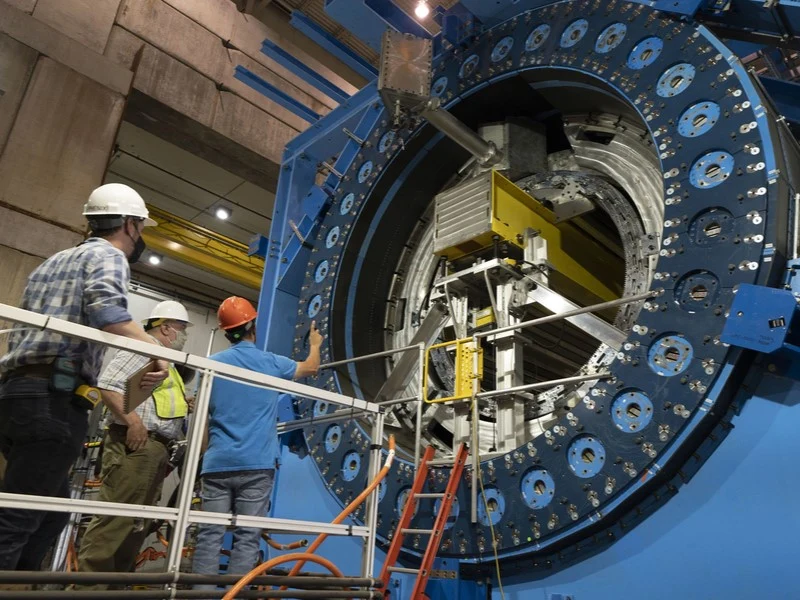
A powerful 1,000-ton particle detector named sPHENIX has passed a crucial test, demonstrating its readiness for its main goal — investigating the beginnings of the universe. This detector, situated at the Brookhaven National Laboratory’s Relativistic Heavy Ion Collider, is specially designed to accurately assess the aftermath of rapid particle collisions, aiming to recreate the characteristics of quark-gluon plasma.
Understanding Quark-Gluon Plasma
Quark-gluon plasma is a superheated mixture of subatomic particles thought to have existed for a mere few microseconds after the Big Bang, before it cooled and formed the protons and neutrons we recognize today.
Testing and Results
To evaluate the accuracy and speed of this new particle detector, researchers conducted a standard candle test. They collided gold ions nearly at light speed while gathering data. The findings, published in the Journal of High Energy Physics, confirmed that sPHENIX met expectations, accurately measuring the number of charged particles generated during the collisions. It even revealed that direct collisions produced 10 times more particles and 100 times more energy compared to glancing collisions.
“It’s like you’ve sent a brand new telescope into space after spending a decade crafting it, and it captures its first image. It may not showcase something entirely new, but it assures us that it’s primed to embark on new scientific journeys.” — Gunther Roland, a physics professor at MIT and a participant in the sPHENIX Collaboration.
Features of the sPHENIX Detector
The sPHENIX detector is a state-of-the-art device comparable in size to a two-story house, capable of measuring up to 15,000 collisions every second. This rapidity enhances research as rare events can be observed more often. When operational, it could assist scientists in exploring the characteristics of the early universe.
Leave a Reply