
Key Takeaways
1. NASA’s DART mission successfully impacted the asteroid Dimorphos in 2022 to test asteroid path alteration.
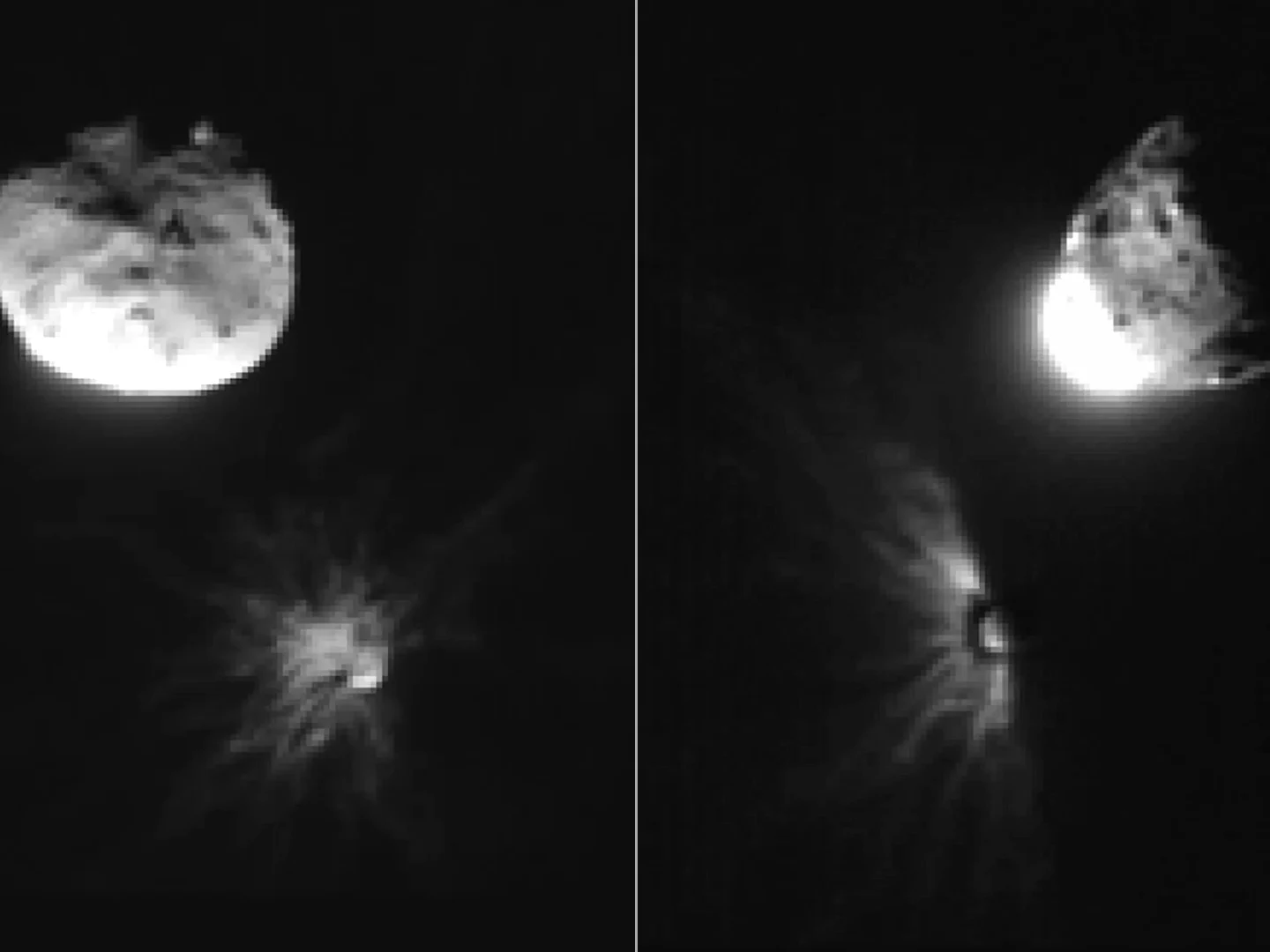
2. LICIACube, a satellite from the Italian Space Agency, captured images of the impact just minutes after the collision.
3. The DART impact ejected approximately 35.3 million pounds of debris, significantly altering Dimorphos’s path.
4. LICIACube provided the closest images of Dimorphos, capturing them from just 53 miles away.
5. Ongoing research is crucial as many near-Earth asteroids may have similar structures, with ESA’s Hera mission planned for late 2026 to further study the impact.
NASA’s DART (Double Asteroid Redirection Test) was a mission set up to see if a spacecraft could change an asteroid’s path. In 2022, DART hit its target, the asteroid Dimorphos, successfully. Alongside DART was a small satellite named LICIACube (Light Italian CubeSat for Imaging Asteroids), provided by the Italian Space Agency (ASI) to take pictures of the asteroid post-collision.
LICIACube’s Mission
On September 11, 2022, just fifteen days before DART crashed into Dimorphos, LICIACube separated from the main spacecraft. It was ready to take photos of the impact about two minutes and 40 seconds after the collision occurred. Traveling at an astonishing speed of 15,000 mph (24,000 km/h), LICIACube had only a minute to capture images of the asteroid, snapping approximately one photo every three seconds as it flew by.
Findings From the Impact
Scientists shared their discoveries in the Planetary Science Journal on August 21 after looking over the series of images gathered. They found that the impact caused Dimorphos to eject roughly 35.3 million pounds (16 million kilograms) of debris, which is nearly 30,000 times heavier than the spacecraft itself.
The debris created a dense cloud with darker inner sections, indicating it primarily consisted of larger particles. Research indicated that this debris altered the asteroid’s path more significantly than DART’s collision did.
Close Observations of Dimorphos
While earlier observations of the aftermath from Earth and space were conducted from millions of miles away, LICIACube provided the closest images thus far. The satellite managed to snap a picture just 53 miles (85.3 kilometers) from the asteroid.
Scientists believe that many asteroids near Earth share a similar “rubble-pile” structure as Dimorphos. Therefore, continuing this research is vital for developing spacecraft capable of diverting asteroids from colliding with our planet. ESA’s Hera is expected to arrive at the site in late 2026 to further investigate the DART-Dimorphos impact.
Source:
Link


Leave a Reply