
Key Takeaways
1. Traditional electronic hardware struggles with the speed and energy demands of complex AI models.
2. A new photonic chip developed by the University of Sydney uses light for mathematical calculations, reducing heat and power consumption.
3. The chip’s design utilizes tiny components smaller than a wavelength of light, achieving a computational density of 400 million parameters per square millimeter.
4. Calculations on the chip are completed in trillionths of a second as it relies on the movement of photons.
5. The prototype achieved nearly 90% accuracy in classifying biomedical images and offers a scalable, energy-efficient solution for future computing systems.
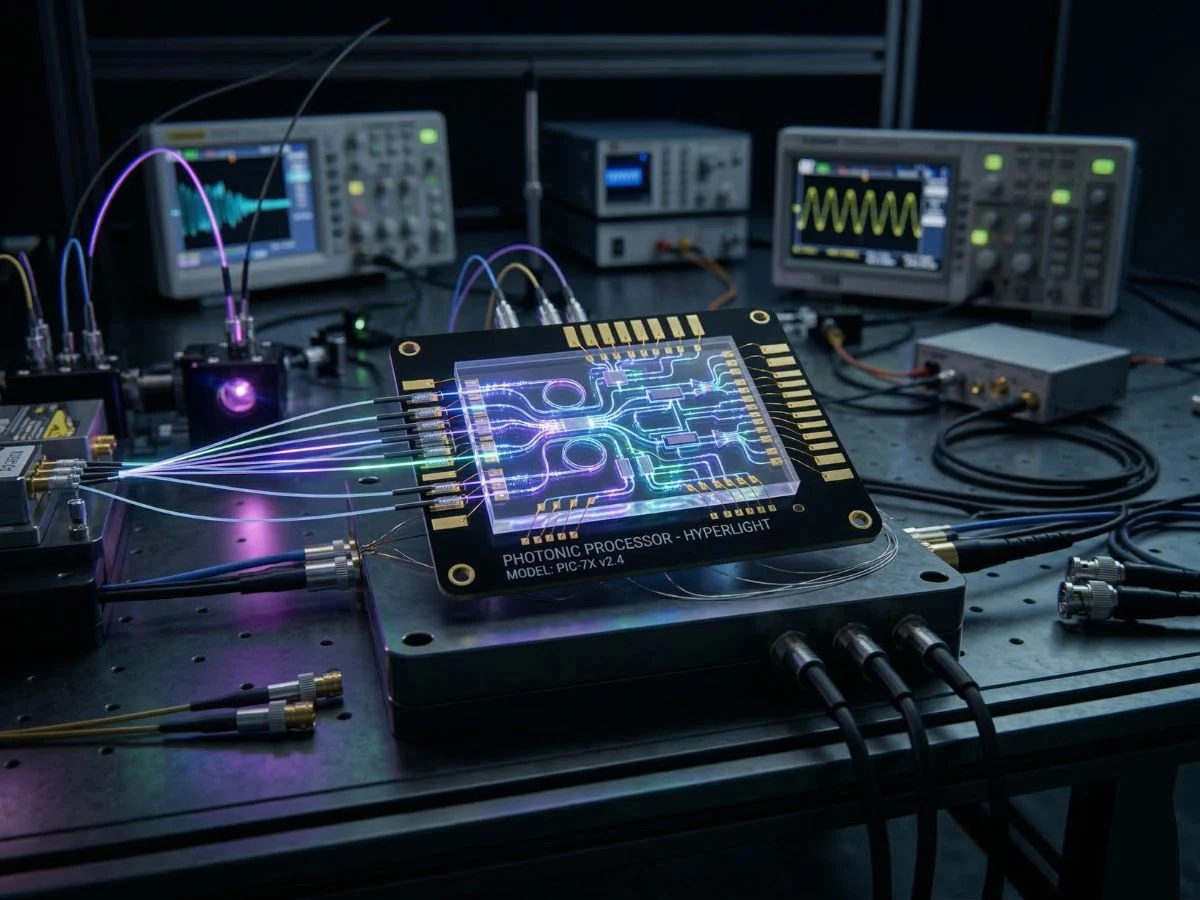
As artificial intelligence models become more complex, traditional electronic hardware is having a hard time keeping up with the speed and energy requirements. Regular computer chips work by moving electrically charged particles, a method that creates a lot of heat and needs a lot of power while also generating heat. To tackle this issue, scientists at the University of Sydney have developed a very small photonic chip that can carry out mathematical calculations using light.
Innovative Design Approach
The team created this processor through sophisticated computer simulations that closely examine how light waves interact in three-dimensional environments. This design technique enables them to utilize tiny physical components, each smaller than a wavelength of light, as adjustable data points. This unique method achieves an impressive computational density of around 400 million parameters in every square millimeter. These resulting nanostructures are incredibly tiny, measuring just a few tens of micrometers wide, which is about the same size as a human hair.
Fast Computation with Light
When light travels through these complex nanostructures, the chip’s physical shape automatically carries out the necessary mathematical functions for machine learning. Since the whole system relies on the movement of photons, calculations are finished in mere trillionths of a second.
To test their prototype, the research team challenged the photonic neural network to classify more than 10,000 biomedical images, which included chest, breast, and abdomen scans. The system reached a classification accuracy of nearly 90% in real-world tests and up to 99% in simulations. By integrating artificial intelligence directly into nanoscale structures, the researchers have created a highly scalable and energy-efficient platform that could significantly lessen the large environmental impact of future computing systems.
Source:
Link
Leave a Reply