Tag: Machine Learning

  • Ultra-Compact Light Chip Processes Data at Light Speed with Accuracy

    Ultra-Compact Light Chip Processes Data at Light Speed with Accuracy

    Key Takeaways

    1. Traditional electronic hardware struggles with the speed and energy demands of complex AI models.
    2. A new photonic chip developed by the University of Sydney uses light for mathematical calculations, reducing heat and power consumption.
    3. The chip’s design utilizes tiny components smaller than a wavelength of light, achieving a computational density of 400 million parameters per square millimeter.
    4. Calculations on the chip are completed in trillionths of a second as it relies on the movement of photons.
    5. The prototype achieved nearly 90% accuracy in classifying biomedical images and offers a scalable, energy-efficient solution for future computing systems.


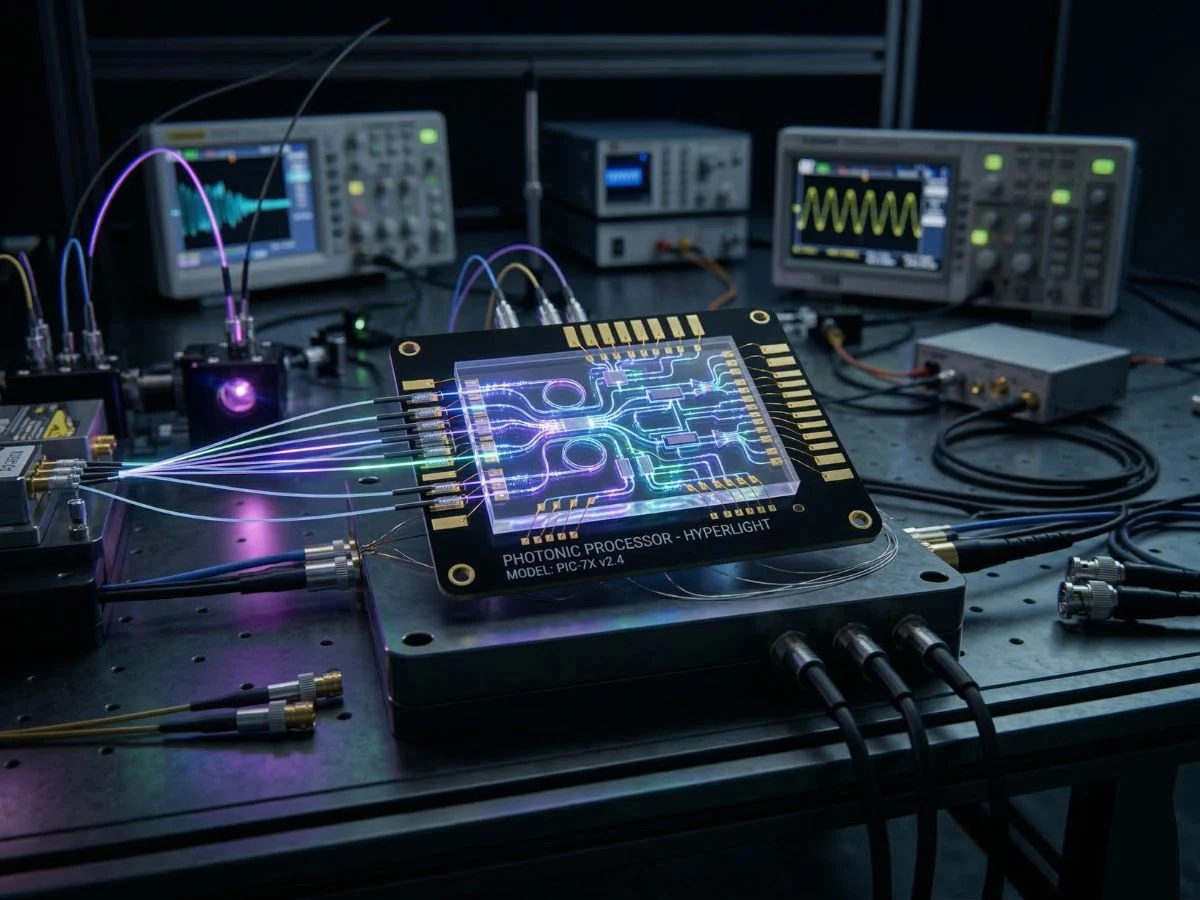
    As artificial intelligence models become more complex, traditional electronic hardware is having a hard time keeping up with the speed and energy requirements. Regular computer chips work by moving electrically charged particles, a method that creates a lot of heat and needs a lot of power while also generating heat. To tackle this issue, scientists at the University of Sydney have developed a very small photonic chip that can carry out mathematical calculations using light.

    Innovative Design Approach

    The team created this processor through sophisticated computer simulations that closely examine how light waves interact in three-dimensional environments. This design technique enables them to utilize tiny physical components, each smaller than a wavelength of light, as adjustable data points. This unique method achieves an impressive computational density of around 400 million parameters in every square millimeter. These resulting nanostructures are incredibly tiny, measuring just a few tens of micrometers wide, which is about the same size as a human hair.

    Fast Computation with Light

    When light travels through these complex nanostructures, the chip’s physical shape automatically carries out the necessary mathematical functions for machine learning. Since the whole system relies on the movement of photons, calculations are finished in mere trillionths of a second.

    To test their prototype, the research team challenged the photonic neural network to classify more than 10,000 biomedical images, which included chest, breast, and abdomen scans. The system reached a classification accuracy of nearly 90% in real-world tests and up to 99% in simulations. By integrating artificial intelligence directly into nanoscale structures, the researchers have created a highly scalable and energy-efficient platform that could significantly lessen the large environmental impact of future computing systems.

    Source:
    Link



  • “New Algorithm Enables Cheaper, Accurate, Lightweight AI Models”

    “New Algorithm Enables Cheaper, Accurate, Lightweight AI Models”

    Key Takeaways

    1. A new approach effectively manages symmetric data in machine learning, improving efficiency in calculations and data requirements.
    2. Symmetries are important as they convey essential information about data, and incorporating them into machine learning is crucial.
    3. The research introduces a novel algorithm that combines algebra and geometry principles to honor symmetry in learning.
    4. This method requires fewer data samples for training, potentially enhancing model precision and flexibility.
    5. The findings could lead to more robust and resource-efficient AI models, with applications in materials discovery, astronomy, and climate pattern analysis.


    A team of scientists has tackled a key issue in machine learning by developing the first approach that effectively manages symmetric data while ensuring efficiency in both calculation and data requirements. The primary difficulty lies in AI’s tendency to misinterpret symmetry; for instance, it may view a rotated molecule as a brand new entity rather than recognizing it as the same structure.

    The Significance of Symmetry

    Symmetries carry essential information that nature conveys about the data, and it is crucial to incorporate them into our machine-learning frameworks. “We’ve now shown that it is possible to do machine-learning with symmetric data in an efficient way,” stated Behrooz Tahmasebi, an MIT graduate student and one of the main authors.

    A New Approach to Algorithms

    Some existing models, such as Graph Neural Networks, are capable of addressing symmetry, but the reasons behind their effectiveness remain unclear. The MIT researchers adopted a novel strategy by developing a new algorithm that merges mathematical principles from algebra and geometry. This allows for a system that can efficiently learn while honoring symmetry.

    This method, which is proven to be efficient, needs fewer data samples for training, which can enhance a model’s precision and flexibility. The researchers believe their findings may pave the way for more robust and resource-efficient AI models applicable in various fields, “from discovering new materials to identifying astronomical anomalies and deciphering complex climate patterns.” Their research was recently showcased at the International Conference on Machine Learning.

    Source:
    Link


  • 44 New Earth-Like Exoplanet Candidates Discovered in Breakthrough

    44 New Earth-Like Exoplanet Candidates Discovered in Breakthrough

    Key Takeaways

    1. A research group from the University of Bern developed a machine learning model to identify planetary systems likely to host Earth-like exoplanets, achieving 99% accuracy.
    2. The model was trained using synthetic data from the “Bern Model of Planet Formation and Evolution.”
    3. After training, the model identified 44 planetary systems that may contain unknown Earth-like planets.
    4. The findings are crucial for upcoming space missions like ESA’s PLATO, which launches in 2026, to discover habitable exoplanets.
    5. The model will help select the best targets for future missions like LIFE, aimed at studying the atmospheres of distant planets for signs of life.


    A research group hailing from the University of Bern and the National Center of Competence in Research PlanetS has reached a key point in the quest for planets that may support life. Announced on April 9, 2025, this group has created a machine learning model that can accurately identify planetary systems likely to have Earth-like exoplanets. This advancement not only propels the search for habitable planets but also represents an exciting step toward finding alien life.

    Development of the AI Model

    The machine learning model was crafted under the direction of Dr. Jeanne Davoult during her doctoral studies at the University of Bern, with assistance from Prof. Dr. Yann Alibert and Romain Eltschinger at the Center for Space and Habitability (CSH). It underwent training using synthetic data produced by the acclaimed “Bern Model of Planet Formation and Evolution,” which mimics the physical mechanisms involved in forming planetary systems. The results are impressive: the model boasts a 99% accuracy rate in identifying systems that are very likely to host at least one Earth-like planet.

    Application to Real Data

    Once the training was complete, the model was tested on real observational data, leading to the identification of 44 planetary systems that might harbor previously unknown Earth-like planets. These results hold great importance for future space missions, including ESA’s PLATO and the proposed LIFE project, both of which aim to find and analyze Earth-like worlds.

    PLATO (PLAnetary Transits and Oscillations of stars), scheduled to launch in 2026, will employ the transit method along with asteroseismology to discover potentially habitable exoplanets, particularly focusing on those orbiting stars similar to our Sun. The best candidates chosen by PLATO will serve as the groundwork for future missions like LIFE (Large Interferometer For Exoplanets), which plans to study the atmospheres of distant planets through infrared spectroscopy and nulling interferometry in order to search for biosignatures such as water or methane. The novel machine learning model could significantly aid in pre-selecting the most viable targets, thus improving the effectiveness and success rates of these missions.

    Source:
    Link