

Tag: Tech

  • Framework Accuses Dell of Using Influencers to Undermine Marketing with Dell XPS Laptops

    Framework Accuses Dell of Using Influencers to Undermine Marketing with Dell XPS Laptops

    Key Takeaway

    1. Framework aims to provide highly customizable, upgradeable, and repairable laptops, gaining attention as a potential MacBook Pro alternative running Linux.
    2. Established OEMs like Dell are taking Framework seriously, possibly attempting to discourage consumer engagement with the brand due to competitive concerns.
    3. The laptop market is intensely competitive, especially with new entrants like the Apple MacBook Neo threatening market shares of companies like Lenovo, HP, and Dell.
    4. Framework’s success depends on its continued execution and refinement of its product offerings, exemplified by the positive reception of the Laptop 13 Pro.

    The Rise of Framework in the Laptop Industry

    Since its debut with the 13-inch Framework Laptop 13 back in 2021, the company has become a breath of fresh air in a usually predictable market. Uniquely, they focus on creating products that you *can* customize, upgrade, and fix – a rarity these days. Their latest model, the Framework Laptop 13 Pro, aims to match the power of a MacBook Pro but running Linux, which can really appeal to tech enthusiasts who want more control over their device.

    Industry Reactions and Competitor Moves

    Big brands are clearly paying attention as well. Framework claims that “every time we engage with an influencer on X dot com, Dell sends them an XPS.” This statement got quite a bit of attention, with over 320,000 views so far, making many users joke about trying to get an XPS by interacting with Framework. It’s like a little rivalry in the making, as Dell and other OEMs watch the growing popularity of Framework’s approach.

    Challenges in Mainstream Adoption

    To become a major player, Framework will need to keep pushing and improving. They are still building their reputation and competing with giants like Dell and HP on a much larger scale. Dell, for one, is likely trying to discourage consumers from switching over to Framework, especially if the company’s claims about influence and engagement are true. The competitive landscape in laptops is fierce, especially since the release of Apple’s MacBook Neo, which is reshaping market dynamics quite a bit.

    Market Impact and Future Outlook

    It’s becoming quite evident that the MacBook Neo might be taken significant market share from Lenovo, HP, and Dell, which are currently the top brands. For Framework, success hinges on whether they can keep executing their innovative vision and refining their products with each new release. The Framework Laptop 13 Pro appears to be a step in the right direction, but only time will tell if they can keep this momentum going and truly challenge the established giants.

    Sources

  • MacBook Neo excels in Windows 11 gaming performance test

    MacBook Neo excels in Windows 11 gaming performance test

    Key Takeaway

    1. The MacBook Neo, powered by the Apple A18 Pro SoC, demonstrates surprisingly strong performance in both macOS and Windows 11 gaming tasks.
    2. Virtualization with Parallels Desktop allows for effective gaming on Windows 11 ARM, especially for games without native macOS versions.
    3. The system can handle demanding games like Dirt 3, Portal 2, and Skyrim at reasonable framerates, though more resource-intensive titles like GTA V may require additional tools such as Crossover for better performance.

    Introduction to the MacBook Neo

    The MacBook Neo is a new kind of budget-friendly laptop from Apple, which is quite different because it comes with a mobile processor. This device runs on the Apple A18 Pro chip, the same one that powers the iPhone 16 Pro series. Many assumed that this processor might be a bottleneck, especially since it runs on MacOS, but real-world tests and benchmarks show it’s quite capable.

    Performance in MacOS and Windows

    Playing MacOS games on the Neo, the A18 SoC does better than what many expected. The device’s performance isn’t just limited to MacOS, as ETA Prime tested Windows 11 through virtualization software. Surprisingly, the Windows experience was quite impressive considering the hardware limitations.

    Using Virtualization for Windows 11

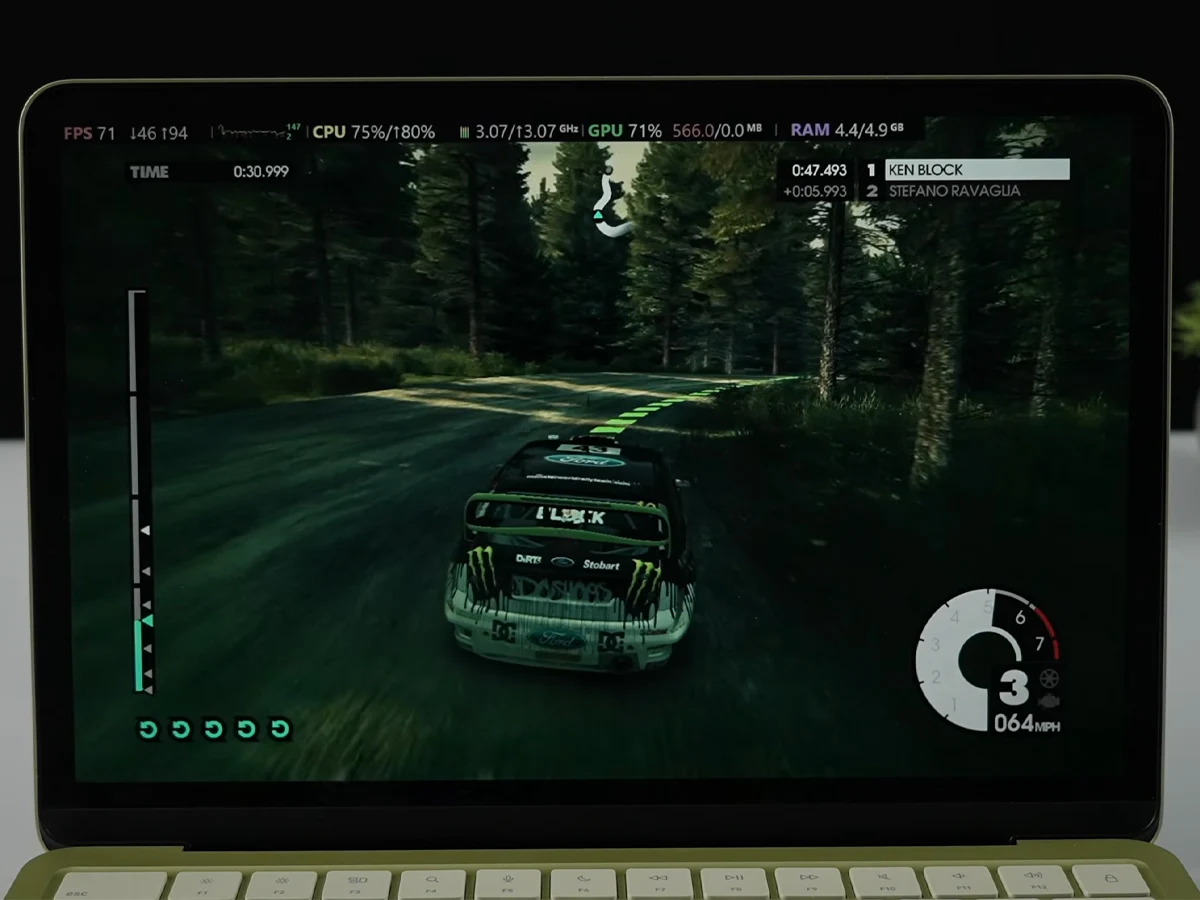
    ETA Prime used Parallels Desktop to run Windows 11 on the MacBook Neo. Other free options like UTM and VMware Fusion were tried, but they didn’t perform as well. It’s important to note that Windows 11 was tested via ARM version, without any x86 emulation, which helps keep performance smoother. The laptop’s RAM was allocated to 5 GB, which is tight since the device only has 8 GB total.

    Gaming Performance and Tests

    The focus of the gaming tests was on titles that don’t have native macOS versions, making virtualization a suitable option. Games like Marvel Cosmic Invasion ran at about 60 FPS at max settings. Dirt 3 was tested at 1200p resolution on high settings and managed around 75 FPS. Portal 2 at medium settings stayed above 100 FPS, and Skyrim kept steady at about 60 FPS at 1200p with medium visuals.

    Running Demanding Games Like GTA V

    GTA V didn’t hit a playable frame rate on the MacBook Neo using Parallels, but with special software like Crossover, which relies on Wine and Proton layers, it’s possible to play smoothly. Overall, the performance of Parallels on this setup is quite notable, considering the limited RAM. For more detailed insights, check out the video linked below.

    Sources