Tag: Supernova

  • “Underground Detector Reveals Supernova History of the Universe”

    “Underground Detector Reveals Supernova History of the Universe”

    Key Takeaways

    1. A supernova occurs when a massive star exhausts its fuel, leading to a core collapse and a powerful explosion that ejects the star’s outer layers.
    2. Visible light from a supernova represents only about 1% of the total energy released; the majority is emitted as neutrinos.
    3. Neutrinos, or ghost particles, have very small mass, no electric charge, and weak interactions with matter, making them difficult to detect.
    4. The diffuse supernova neutrino background is formed from signals of past core-collapse supernovae, which can be detected with advanced sensitivity.
    5. The Super-Kamiokande detector in Japan uses gadolinium to enhance neutrino detection capabilities, allowing for a better understanding of supernova outcomes and the history of stellar explosions.


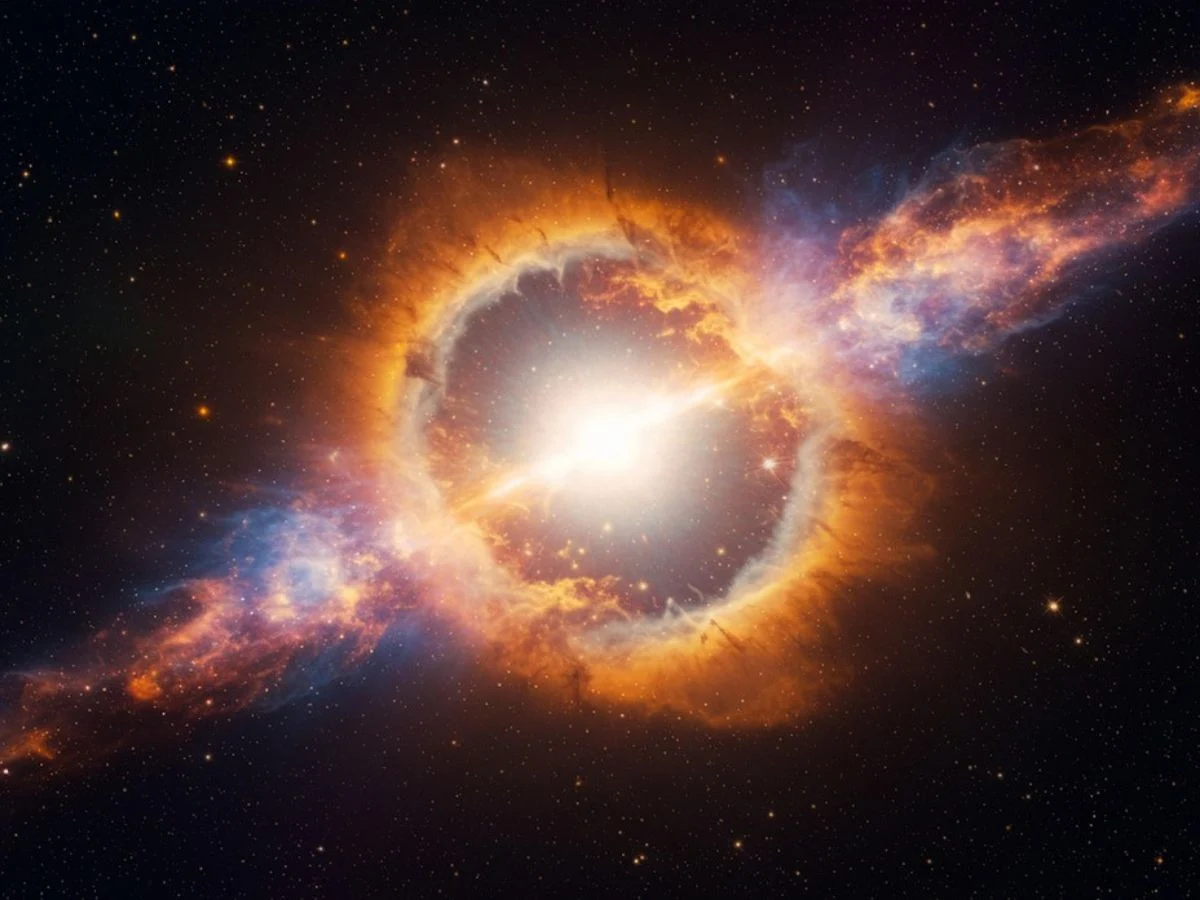
    When a huge star exhausts its fuel, the core collapses due to gravitational force, leading to a brilliant and powerful explosion that blasts apart the star’s outer layers. This cataclysmic event is called a supernova. Interestingly, what we see in visible light represents only about 1% of the total energy released, with the rest being emitted as neutrinos.

    Ghost Particles Explained

    Neutrinos, often referred to as ghost particles, are essential particles that possess a very small mass, lack electric charge, and interact very weakly with other forms of matter, making them extremely hard to detect. They can glide through stars, planets, galaxies, and even human bodies without being noticed. Because they can travel vast distances without interacting, they can provide direct information from the cores of stars that are exploding. This makes neutrino studies crucial for gaining insights into core-collapse supernovae.

    Observing Past Events

    An intriguing aspect is that the combined signals from numerous past core-collapse supernovae can be detected with better sensitivity from detectors. This signal is known as the diffuse supernova neutrino background.

    Super-Kamiokande is a massive detector located underground in Japan. This device is capable of identifying these particles by capturing flashes of light created when a neutrino strikes protons or electrons in water molecules. The sensors within the detector pick up these flashes.

    Enhancements and Future Insights

    To enhance its capacity to detect neutrons generated in neutrino interactions, gadolinium has been incorporated into this detector. Researchers believe that this enhancement will aid in detecting supernova neutrinos throughout the universe. Another critical inquiry is what remains after the explosion. By studying neutrinos, scientists can gain a better understanding of the outcomes of these events. Rather than just focusing on a single supernova, the broader history of stellar explosions can be examined.

    Phys.org

    Source:
    Link


  • Astronomers Observe Magnetar Birth Within Supernova for First Time

    Astronomers Observe Magnetar Birth Within Supernova for First Time

    Key Takeaways

    1. A supernova occurs when a star’s outer layers are ejected and its core collapses, forming a neutron star.
    2. Neutron stars can become magnetars, which have strong magnetic fields, rapid rotations, and high energy outputs.
    3. Superluminous supernovae shine significantly brighter and last longer than typical supernovae, linked to the presence of a magnetar at their core.
    4. Observations of SN 2024afav revealed brightness patterns and chirps, indicating interactions between the magnetar and surrounding material.
    5. Future surveys by the Vera C. Rubin Observatory aim to discover more chirping supernovae and deepen understanding of magnetars and their effects.


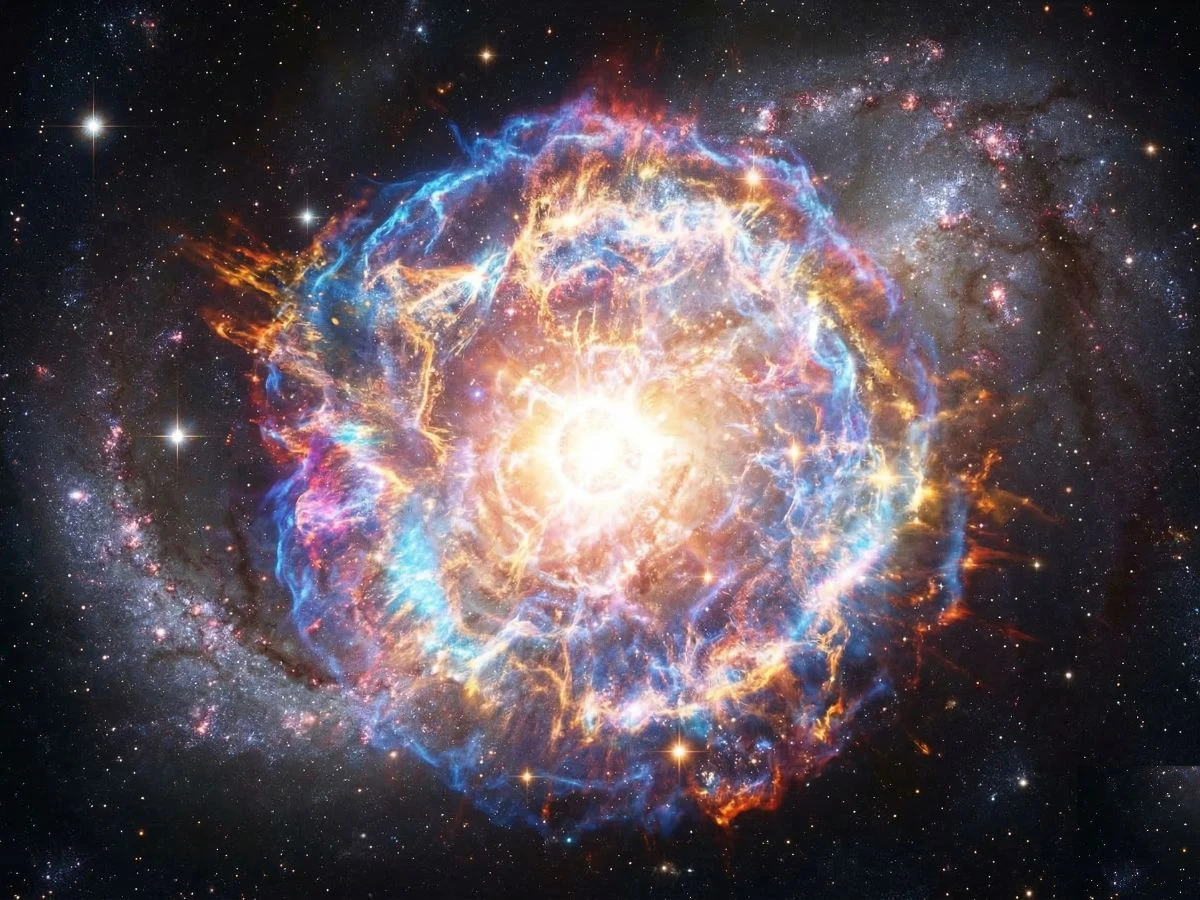
    At the end of their life cycles, some stars undergo a catastrophic event known as a supernova. During this process, the star’s outer layers are forcefully ejected, while the core collapses, creating a neutron star. This type of star is incredibly dense and primarily composed of neutrons. Among neutron stars, there are special ones called magnetars, which possess extremely strong magnetic fields, rotate very rapidly—sometimes over 1,000 times per second—and emit vast amounts of energy. This energy output significantly affects the area around them.

    Discovery of Superluminous Supernovae

    In the early 2000s, astronomers identified superluminous supernovae, which are explosions that shine 10 times brighter or even more than typical supernovae and can last for a longer period. In 2010, astrophysicists Dan Kasen, Lars Bildsten, and Stan Woosley introduced a theory suggesting that when a massive star collapses, it creates a fast-spinning magnetar at its core. This magnetar generates a magnetic field that accelerates particles, causing them to collide with the supernova debris, ultimately reheating it. As a result, the explosion appears brighter and endures for a longer time.

    Observations of SN 2024afav

    Recent studies have provided further understanding through the observation of SN 2024afav’s brightness over a period exceeding 200 days. The brightness revealed four bumps that occurred progressively closer together, accompanied by increased oscillation, a phenomenon known as a chirp.

    When a star explodes and results in a magnetar, some of the leftover material spirals in toward the magnetar, creating a rotating ring called an accretion disk. This disk is misaligned with the magnetar’s rotational axis, a situation that leads to general relativity frame dragging. As the disk moves closer to the magnetar, the chirp frequency accelerates. Future surveys conducted by the Vera C. Rubin Observatory are set to search for additional chirping supernovae, which may uncover more young magnetars and enhance our understanding of these explosive events.

    Nature via Phys.org

    Source:
    Link


  • Upcoming Supernova: A Celestial Event You Can See Soon

    Upcoming Supernova: A Celestial Event You Can See Soon

    Key Takeaways

    1. V Sagittae is a binary star system over 10,000 light-years away, exhibiting unstable activity and brightness.
    2. The system consists of a massive star and a white dwarf that orbits every twelve hours, leading to intense thermonuclear reactions.
    3. Researchers identified a large gas ring around the stars, indicating the white dwarf cannot absorb all the material from its companion star.
    4. Scientists predict a potential supernova explosion that could be visible even during the day due to the buildup of material and possible collision.
    5. The timing and intensity of the supernova event are uncertain, with other cosmic phenomena possibly affecting the timeline.


    The universe is full of unexpected wonders, like this interstellar object currently in our solar system, which brings up lots of questions. Before long, a supernova might be seen in the sky, even during the day.

    V Sagittae’s Unusual Behavior

    For over a hundred years, scientists have been watching V Sagittae, a binary star system situated more than 10,000 light-years away from our planet. This system shows very unstable activity and brightness. It consists of a gigantic star and a white dwarf, both in an orbit that takes just twelve hours to complete.

    The Cause of Potential Explosion

    This setup leads to intense thermonuclear reactions, as the white dwarf pulls in material from its companion star. Using the Very Large Telescope, researchers have identified a large gas ring surrounding the two stars, which highlights that the white dwarf cannot absorb all the material from the other star.

    Given this intense situation, scientists think that the buildup of this material might soon result in a significant explosion known as a supernova, which will be visible without any special equipment. Moreover, they anticipate that the two stars might collide, resulting in a supernova that could even be seen during daylight hours.

    Uncertain Timing and Intensity

    Determining when this spectacular event will happen and how strong it will be is challenging. There are also other cosmic phenomena that could occur before this event, potentially changing the timeline.

    Source:
    Link


  • AI Observes Star Exploding Near Black Hole for the First Time

    AI Observes Star Exploding Near Black Hole for the First Time

    Key Takeaways

    1. Artificial intelligence successfully observed a star explosion interacting with a black hole for the first time.
    2. The event, named SN 2023zkd, occurred 730 million light-years away and was detected by the Zwicky Transient Facility in July 2023.
    3. The star emitted light again months after its supernova, indicating changes in brightness four years prior to the explosion.
    4. Two theories were proposed regarding the black hole’s role: one involves gas stripping from the star, and the other suggests the black hole caused the star’s demise before the supernova.
    5. This breakthrough marks a significant advancement in astronomy, demonstrating the powerful application of AI in scientific research.


    Technological advancements have been rapidly progressing in numerous areas, including the field of astronomy. In a remarkable achievement, artificial intelligence has successfully observed a star that exploded during its interaction with a black hole for the very first time.

    Recent Discoveries

    This astonishing event took place in July 2023, but the findings were published on August 13 in The Astrophysical Journal. An astronomical survey conducted by the Zwicky Transient Facility at the Palomar Observatory in California, which employs an AI algorithm designed to identify anomalies in space, detected an event known as SN 2023zkd, situated 730 million light-years away.

    The Supernova Event

    To elaborate, this was a supernova that erupted, producing a powerful flash in the vastness of space. Surprisingly, several months after the explosion, the star thought to be extinguished began to emit light once more. Furthermore, following extensive analyses of this occurrence, researchers concluded that the star’s brightness had significantly altered roughly four years prior to its explosion.

    Theories Proposed

    Thanks to this groundbreaking discovery made possible by artificial intelligence, scientists have proposed two theories relating to the black hole to clarify this phenomenon. One possibility suggests that the star was caught in the gravitational pull of the black hole, which stripped away massive amounts of gas from it. This could explain the increase in brightness prior to the explosion. As the black hole’s density increased, the matter began to shine brighter until the star met its explosive end.

    Regarding the second theory, which researchers consider to be less probable, it posits that the black hole led to the star’s demise before it transitioned into a supernova. While both theories are still under investigation, it is clear that the black hole played a crucial role in the star’s unfortunate destiny.

    A New Era for Astronomy

    While such phenomena have been theorized before, they had never been directly observed until now. The remarkable use of artificial intelligence has made this breakthrough possible, marking a significant advancement for both scientific research and the application of this technology.

    Source:
    Link