
Key Takeaways
1. A supernova occurs when a star’s outer layers are ejected and its core collapses, forming a neutron star.
2. Neutron stars can become magnetars, which have strong magnetic fields, rapid rotations, and high energy outputs.
3. Superluminous supernovae shine significantly brighter and last longer than typical supernovae, linked to the presence of a magnetar at their core.
4. Observations of SN 2024afav revealed brightness patterns and chirps, indicating interactions between the magnetar and surrounding material.
5. Future surveys by the Vera C. Rubin Observatory aim to discover more chirping supernovae and deepen understanding of magnetars and their effects.
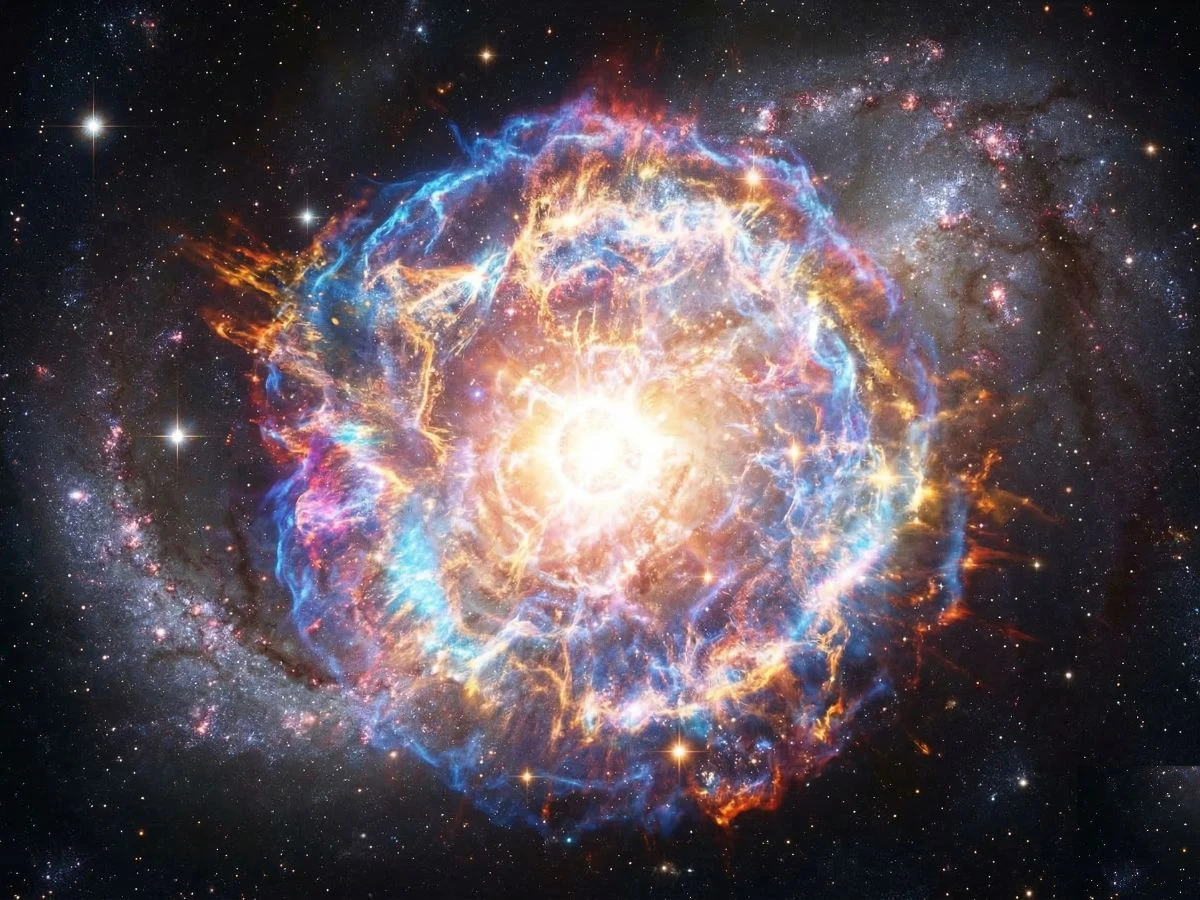
At the end of their life cycles, some stars undergo a catastrophic event known as a supernova. During this process, the star’s outer layers are forcefully ejected, while the core collapses, creating a neutron star. This type of star is incredibly dense and primarily composed of neutrons. Among neutron stars, there are special ones called magnetars, which possess extremely strong magnetic fields, rotate very rapidly—sometimes over 1,000 times per second—and emit vast amounts of energy. This energy output significantly affects the area around them.
Discovery of Superluminous Supernovae
In the early 2000s, astronomers identified superluminous supernovae, which are explosions that shine 10 times brighter or even more than typical supernovae and can last for a longer period. In 2010, astrophysicists Dan Kasen, Lars Bildsten, and Stan Woosley introduced a theory suggesting that when a massive star collapses, it creates a fast-spinning magnetar at its core. This magnetar generates a magnetic field that accelerates particles, causing them to collide with the supernova debris, ultimately reheating it. As a result, the explosion appears brighter and endures for a longer time.
Observations of SN 2024afav
Recent studies have provided further understanding through the observation of SN 2024afav’s brightness over a period exceeding 200 days. The brightness revealed four bumps that occurred progressively closer together, accompanied by increased oscillation, a phenomenon known as a chirp.
When a star explodes and results in a magnetar, some of the leftover material spirals in toward the magnetar, creating a rotating ring called an accretion disk. This disk is misaligned with the magnetar’s rotational axis, a situation that leads to general relativity frame dragging. As the disk moves closer to the magnetar, the chirp frequency accelerates. Future surveys conducted by the Vera C. Rubin Observatory are set to search for additional chirping supernovae, which may uncover more young magnetars and enhance our understanding of these explosive events.
Nature via Phys.org
Source:
Link