Tag: Snapdragon 8 Elite 2

  • Realme GT 8 Pro Expected to Feature Larger Anti-Glare Display

    Realme GT 8 Pro Expected to Feature Larger Anti-Glare Display

    Key Takeaways

    1. Realme has invested significantly in display technology for its smartphones, using a Samsung-sourced RealWorld Eco² OLED Plus panel for the GT 7 Pro.
    2. The upcoming GT 8 Pro is expected to feature cutting-edge enhancements, including a Snapdragon 8 Elite 2 chip and an “AR anti-glare” coating for its display.
    3. The Samsung Galaxy S25 Ultra boasts a 6.85-inch 2K screen, a major upgrade over the GT 7 Pro’s 1.5K resolution on its 6.78-inch display.
    4. Samsung has improved OLED technology with polarizer-free methods, resulting in thinner and more energy-efficient panels.
    5. The innovative display features for the GT 8 Pro may lead to a higher price, but Realme aims to keep it competitive, similar to the GT 7 Pro priced at €659 in Europe.


    Realme has reportedly put more money into improving the displays of its leading smartphone compared to any other Android manufacturer. They have used a RealWorld Eco² OLED Plus panel sourced straight from Samsung, which debuted exclusively with the GT 7 Pro in late 2024.

    Upcoming Features

    There are rumors that the same strategy may be in place for the expected GT 8 Pro. Speculation suggests it will feature a Snapdragon 8 Elite 2 chip and include all the latest display enhancements, such as an “AR anti-glare” coating.

    Display Comparison

    The standout feature of the Samsung Galaxy S25 Ultra is said to be its 6.85-inch screen, boasting a 2K resolution. This is a notable upgrade compared to the GT 7 Pro’s 1.5K resolution on its 6.78-inch display. Samsung has optimized this new technology using polarizer-free methods for OLED, making the panel thinner and more energy-efficient.

    Pricing Implications

    While this innovation is exciting for fans of mobile displays, it could lead to a higher price for the GT 8 Pro. On the bright side, Realme currently sells the GT 7 Pro for €659 on Amazon in Europe, which suggests they might keep the pricing competitive.

    Digital Chat Station shared this information through Weibo, providing insights into the future of Realme’s smartphone lineup.

    Source:
    Link

  • OnePlus 15 Leak: Smaller Display and Snapdragon Update Revealed

    OnePlus 15 Leak: Smaller Display and Snapdragon Update Revealed

    Key Takeaways

    1. The OnePlus 15 will feature a 1.5 K resolution 6.78-inch LTPO 2.5D flat display, offering better battery efficiency and brightness compared to the OnePlus 13.
    2. The design will include a “LIPO four narrow edge design” with ultra-slim bezels, focusing on lower power consumption and improved color consistency.
    3. An aesthetic option called “SuperBlack” is expected, which may have a matte black finish to reduce reflections and smudging.
    4. The device is likely to be powered by Qualcomm’s upcoming Snapdragon 8 Elite 2 chip and may include custom buttons with unclear functions.
    5. Overall, the OnePlus 15 is expected to provide refinements rather than major upgrades, with no significant changes in dimensions, camera specs, or material quality.


    A recent leak from Digital Chat Station has given us a glimpse into the upcoming OnePlus 15, and it seems the updates won’t be drastic. The rumors suggest some enhancements in display and design, but not much more at this point.

    Display and Design Features

    The OnePlus 15 is expected to come with a 1.5 K resolution 6.78-inch LTPO 2.5D flat display, specially created by BOE. This is a bit smaller than the OnePlus 13’s 6.82-inch QHD+ LTPO 4.1 display, but this new screen is said to provide better battery efficiency, more steady color tuning, and greater brightness levels.

    Aesthetic Improvements

    It’s also reported that the phone will showcase a “LIPO four narrow edge design.” This means the device will have ultra-slim, balanced bezels on each side, thanks to LIPO technology. Additionally, the focus seems to be on lowering power consumption, enhancing color consistency, and achieving more uniform brightness. These are the types of improvements often seen in annual refresh cycles.

    Color Options and Internal Specs

    On the aesthetic side, the OnePlus 15’s engineering sample is referred to as “SuperBlack,” which has a high capacity to absorb light, and DCS describes it as resembling a “black hole.” While this may be an exaggeration, it suggests that the OnePlus 15 may come in a matte black finish that reduces reflections and smudging.

    Internally, the device is likely to utilize Qualcomm’s upcoming flagship chip, the SM8850, anticipated to be known as Snapdragon 8 Elite 2. The leak also mentions “custom buttons” on the side, but their functions remain unclear.

    Expectations and Conclusion

    The leak does not provide information on dimensions, camera specs, or material quality yet, but it’s probable that we won’t see significant changes in those areas. The OnePlus 13 already features a 6000mAh battery, Snapdragon 8 Elite chip, and a triple 50MP camera system. Therefore, the expectations for the OnePlus 15 seem to center around refinement rather than major upgrades.

    Source:
    Link


  • Qualcomm to Launch Snapdragon 8 Plus Chip for 2025 Flagship Phones

    Qualcomm to Launch Snapdragon 8 Plus Chip for 2025 Flagship Phones

    Key Takeaways

    1. Qualcomm plans to launch the Snapdragon 8 Plus in late 2025 to target the premium mid-range market.
    2. The Snapdragon 8 Elite 2 is set to be Qualcomm’s flagship processor for 2025, featuring advanced 3nm technology and custom CPU cores.
    3. Snapdragon 8 Plus aims to deliver nearly flagship-level performance at a more affordable price compared to the Elite 2.
    4. Devices using the Snapdragon 8 Plus may feature larger batteries, potentially around 7,000mAh, enhancing battery life.
    5. Qualcomm is shifting its strategy to better position the Snapdragon 8 Plus between its budget-friendly “S” series and flagship offerings.


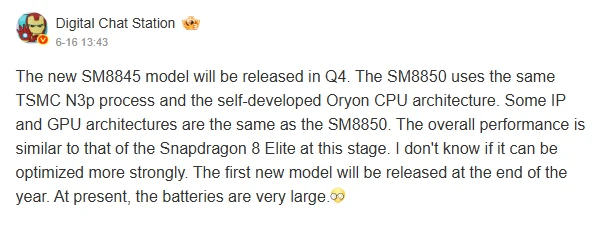
    Qualcomm might be getting ready to launch a new chip called the “Snapdragon 8 Plus” to disrupt the premium mid-range market in late 2025. Recent information indicates that this chip, referred to internally as the SM8845, could be a budget-friendly option compared to the Snapdragon 8 Elite 2, which is anticipated to be the powerhouse behind next year’s leading Android devices.

    Snapdragon 8 Elite 2 Overview

    The Snapdragon 8 Elite 2 is expected to be Qualcomm’s flagship processor for 2025, likely debuting in Q3. Built using TSMC’s advanced 3nm technology and featuring custom Oryon CPU cores, this chip should provide a significant boost in both performance and efficiency. High-end devices, such as the Galaxy S26 Ultra, are expected to incorporate it, although initial indications suggest that prices could rise even more than the already lofty cost of the 8 Elite.

    The Role of Snapdragon 8 Plus

    This is where the Snapdragon 8 Plus enters the picture. Anticipated to launch in Q4 2025, this chip won’t be a direct successor to the Snapdragon 8s Gen 4; instead, it will represent a new category. It is believed to have similar key features, like the same GPU architecture, as the Elite 2 but at a more competitive price point. The goal appears to be providing nearly flagship-level performance without the hefty price tag, which could be advantageous for “flagship killer” smartphones. Sources also suggest that devices using this chip might include much larger batteries—potentially around 7,000mAh—compared to those with the Elite 2.

    Qualcomm’s Strategy Shift

    Previously, Qualcomm marketed the Snapdragon 8s Gen 3 as a toned-down alternative to its elite Snapdragon 8 Gen 3. However, with the introduction of the 8s Gen 4, this strategy changed. Rather than offering a true substitute for the flagship chip, the 8s Gen 4 merely replicated the performance of last year’s Snapdragon 8 Gen 3. Now, Qualcomm appears to be realigning its strategy once again, seeking to fill the gap between the budget-friendly “S” series and its complete flagship range.

    Source:
    Link

  • 2026 Android Flagships May Feature 24GB RAM with AI Advancements

    2026 Android Flagships May Feature 24GB RAM with AI Advancements

    Key Takeaways

    1. New high-end chips, Qualcomm’s Snapdragon 8 Elite 2 and MediaTek’s Dimensity 9500, may lead to higher smartphone prices this year.
    2. These chips will offer AI computing capabilities that are twice as powerful as their predecessors.
    3. Smartphone manufacturers are considering models with 24GB of RAM and 1TB of storage to meet increased AI demands.
    4. Premium smartphone models are making a comeback, despite previous trends of moving away from higher memory options.
    5. Benchmark scores reveal the Snapdragon 8 Elite 2 and Dimensity 9500 have impressive performance, with both exceeding 11,000 in multi-core tests.


    Smartphones using Qualcomm’s Snapdragon 8 Elite 2 and MediaTek’s Dimensity 9500 could have higher prices this year. A leak from the tipster Digital Chat Station suggests that these new high-end chips will provide AI computing capabilities that are twice as powerful as those of their predecessors. Consequently, the tipster indicates that smartphone makers are contemplating offering devices with 24GB of RAM and 1TB of storage to accommodate the greater AI demands.

    Android Flagships to Feature 24GB of RAM

    Just a year back, many brands stepped away from releasing 24GB models due to the rising costs of memory. The brief trend towards larger memory in smartphones lost steam as prices increased and general demand remained low. This left the market to settle around 12GB and 16GB of RAM as the usual maximum options. However, the competitive landscape for AI hardware could change these priorities. The Snapdragon 8 Elite 2 is said to provide up to 100 TOPS (trillion operations per second) of AI performance, and similar capabilities are anticipated from the Dimensity 9500.

    Premium Models are Making a Comeback

    Because of this, DCS asserts that the top five smartphone manufacturers are getting ready to bring back premium models with 24GB + 1TB configurations. Nevertheless, the rise in memory specs may also mean an increase in smartphone prices. Although the tipster does not directly mention any specific pricing, an increase in memory specifications will likely result in higher costs for smartphones.

    Benchmark Scores Reveal Chip Power

    In related developments, leaked Geekbench 6 scores provide an early indication of just how powerful these chips could be. The Snapdragon 8 Elite 2 reportedly achieves over 4,000 points in single-core tests and exceeds 11,000 in multi-core performance. On the other hand, MediaTek’s Dimensity 9500 is not lagging behind, scoring over 3,900 in single-core tests and also surpassing 11,000 in multi-core benchmarks.

    Source:
    Link

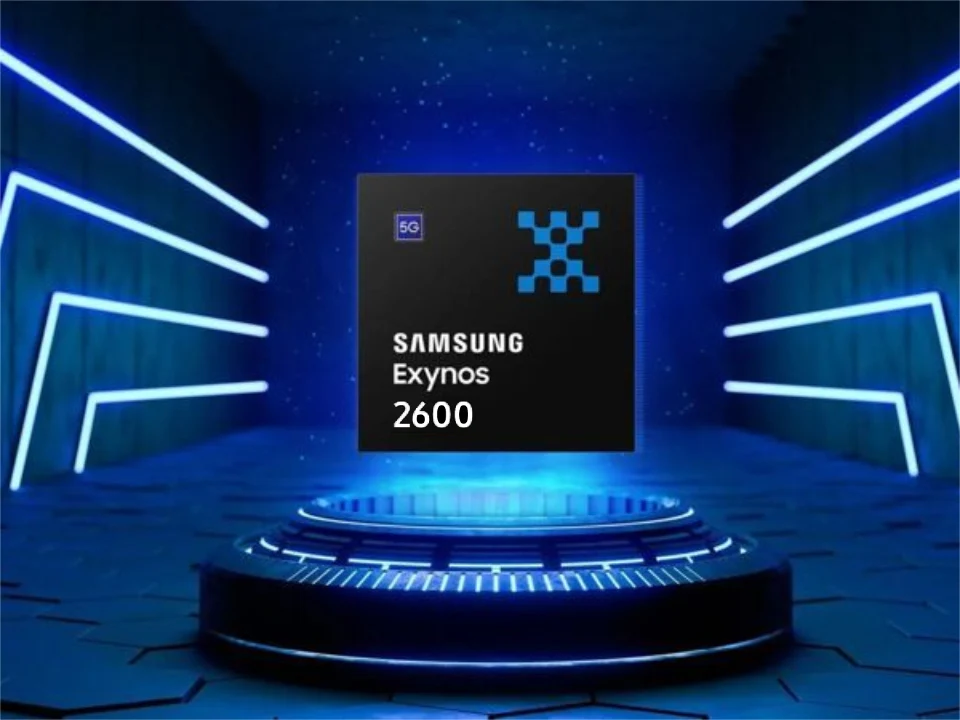
  • Exynos 2600 Specs and Expected Geekbench Performance Leaked

    Exynos 2600 Specs and Expected Geekbench Performance Leaked

    Key Takeaways

    1. The Exynos 2600 is expected to launch in 2026, competing with Qualcomm’s Snapdragon 8 Elite 2 and Dimensity 9500.
    2. Projected Geekbench scores for the Exynos 2600 are ~2,400 (single-core) and 9,400 (multicore), showing only slight improvements over its predecessor, the Exynos 2500.
    3. The Xclipse 960 GPU is anticipated to achieve around 5,800 points in 3DMark Wild Life Extreme, indicating a 62% improvement over the previous Xclipse 940 GPU.
    4. The CPU architecture will feature two Cortex-X Prime cores and six Cortex-A cores, similar to the Snapdragon 8 Elite, but performance could improve if new Arm cores are used.
    5. The Exynos 2600 is crucial for Samsung Foundry’s 2 nm manufacturing process and faces challenges from emerging competitors like Intel Foundry.


    With the Exynos 2600 getting closer to its mass production phase, people are buzzing about its performance. It’s set to debut in 2026 and will go up against competitors like Qualcomm’s Snapdragon 8 Elite 2 and Dimensity 9500. If the rumored Geekbench scores are true, Samsung’s flagship might have quite a bit of ground to cover. According to the well-known X leaker OreXDA, the performance of the Exynos 2600 might not meet expectations.

    Expected Geekbench Scores

    Reports suggest that the Exynos 2600 is projected to achieve a mere ~2,400 points in the Geekbench single-core test and 9,400 points in the multicore test. This is not too far off from the Exynos 2500 that was used in the Galaxy S25+ prototype last year, which scored 2,359 for single-core and 8,141 for multicore. Interestingly, recent results for the Exynos 2500 on Geekbench were even weaker at 2,012 in single-core and 7,563 in multicore. Some analysts believe that Samsung might be prioritizing stable production yields over raw performance.

    Graphics Performance

    Furthermore, the Xclipse 960 GPU on the Exynos 2600 is anticipated to register around 5,800 points in 3DMark Wild Life Extreme. This marks a significant 62% improvement compared to the Xclipse 940 GPU of the Exynos 2400. Additionally, its GFXBench Aztec Ruins score is expected to hit 85 FPS. However, OreXDA did not clarify whether this score is for the 4K test or the standard one, making it difficult to assess how much of an upgrade it actually is.

    CPU Architecture

    OreXDA also mentioned that the Exynos 2600 will include two Cortex-X Prime CPU cores along with six Cortex-A cores, a configuration similar to the Snapdragon 8 Elite but using Nuvia IP. It remains uncertain if Samsung will employ Arm’s latest Travis and Altos cores, but if they do, performance could surpass the earlier projections. The Dimensity 9500, one of the first smartphone system-on-chips to utilize these cores, is rumored to bring substantial improvements over its predecessor.

    All in all, the Exynos 2600 carries significant importance as it could shape the future of Samsung Foundry’s 2 nm SF2 manufacturing process. Although the chipmaker recently received financial support from the Nintendo Switch 2, that alone won’t suffice to ensure its survival in the upcoming years, especially with Intel Foundry emerging as a strong alternative to TSMC.

    Source:
    Link

  • Xiaomi 16 Pro Max May Feature Rear Sub-Screen, New Leak Reveals

    Xiaomi 16 Pro Max May Feature Rear Sub-Screen, New Leak Reveals

    Key Takeaways

    1. Xiaomi may reintroduce a full-sized secondary display on the back of its upcoming flagship phone, possibly called the Xiaomi 16 Pro Max.
    2. The device is rumored to use the Qualcomm SM8850 or Snapdragon 8 Elite 2 chip, providing high performance with impressive Geekbench scores.
    3. It will feature a periscope telephoto camera with a vertical hole-punch design on the rear and is designed as a “wide screen” type, not foldable.
    4. The rear sub-screen could offer functionalities similar to the Mi 11 Ultra, such as previewing messages and serving as a monitor for selfies.
    5. The phone is expected to include advanced memory options with LPDDR5X RAM and UFS 4.1 storage, likely starting at a configuration of 12GB + 256GB.


    Xiaomi seems to be gearing up to revisit one of its more unique design features. A recent leak from a popular source, Digital Chat Station, suggests that a new flagship phone might include a full-sized secondary display on the back.

    Clues from the Leak

    While the blogger didn’t explicitly mention Xiaomi, the hints were quite clear. The post discusses a flagship device using the Qualcomm SM8850 or Snapdragon 8 Elite 2, along with a design that showcases a “horizontal large matrix full-size sub-screen DECO.” Additionally, it’s rumored that the phone will have a periscope telephoto camera featuring a vertical hole-punch design on the rear. The leaker later mentioned that this device isn’t foldable, but rather a “wide screen” type.

    Possible Xiaomi 16 Pro Max?

    Many Chinese news sources are suggesting that this device might be called the Xiaomi 16 Pro Max. It appears this model will take the place of the Xiaomi 15 Pro, while the Xiaomi 16 and Xiaomi 16 Pro are expected to be smaller versions in the series.

    This information remains speculative. Regardless of the final name, the key highlight of this phone will likely be the reintroduction of the rear sub-screen. Back in 2021, the Xiaomi 11 Ultra had a small 1.1-inch AMOLED display on its back.

    Features of the Mi 11 Ultra

    This panel allowed users to preview messages quickly, offered always-on display features, and even served as a monitor for selfies. CEO Lei Jun acknowledged that the main challenge wasn’t the expense of the display but rather fitting it within the device without affecting battery life or the arrangement of other components.

    Regarding performance, this new phone is likely to come equipped with Qualcomm’s SM8850 chip, which is built on TSMC’s 3nm manufacturing process and features a custom-designed CPU core. Reports suggest that this chip scores over 4000 in single-core and surpasses 11000 in multi-core Geekbench 6 tests. It also includes a 16MB GMEM and the Adreno 840 GPU for high-quality graphics. The memory setup is expected to feature LPDDR5X RAM and UFS 4.1 storage, possibly starting at a configuration of 12GB + 256GB.

    Source:
    Link


  • Oppo Find N6 Flip Launch Leaked: Snapdragon 8 Elite 2 Inside

    Oppo Find N6 Flip Launch Leaked: Snapdragon 8 Elite 2 Inside

    Key Takeaways

    1. The Motorola Razr Ultra is currently the only high-end clamshell foldable smartphone available, priced at $1,299.99, featuring the Snapdragon 8 Elite chipset.
    2. By 2026, a major Chinese smartphone company is expected to re-enter the foldable market, potentially launching a new version of the Flip with advanced features.
    3. Rumored designs for the new foldable include a single punch-hole camera and a larger cover display, with potential upgrades like a periscope telephoto lens.
    4. The identity of the new foldable smartphone remains uncertain, with contenders like successors to the Vivo X Flip and Oppo Find N3 Flip.
    5. Vivo may not upgrade its upcoming X Fold5 to the Snapdragon 8 Elite, indicating Oppo could lead the market with a well-equipped smartphone similar to the Samsung Galaxy Z Flip.


    We are currently a little more than halfway through the year, but there’s only one high-end clamshell foldable smartphone available worldwide.

    The Motorola Razr Ultra, priced at $1,299.99, is the sole device in this category that features Qualcomm’s latest Snapdragon 8 Elite chipset for mobile devices. It is also marketed as the “most advanced flip” phone, boasting improvements in charging speed and rear camera technology.

    Competition on the Horizon

    By 2026, however, the smartphone landscape may change as one of China’s top five companies is expected to return to this market.

    The next version of the Flip is rumored to feature a main display with a single punch-hole camera, powered by the “SM8850” or Snapdragon 8 Elite 2 processor. This chipset is anticipated to be used in other upcoming non-foldable Android flagship models, such as the OnePlus 15 and Samsung Galaxy S26 Ultra.

    Mystery Surrounding the Next Generation

    The exact identity of this foldable counterpart remains unclear at this moment. However, strong contenders include potential successors to the Vivo X Flip or Oppo Find N3 Flip.

    Recent leaks suggest a Pixel-like bar design, which could accommodate a larger cover display. This is similar to Oppo’s latest clamshell foldable patent, although the camera bump’s orientation is reversed.

    The camera setup might also see an upgrade with a periscope telephoto lens, a feature not commonly found in clamshell devices. Yet, Oppo and Vivo have successfully integrated such specifications into smaller devices recently.

    Future Prospects

    On another note, Vivo seems hesitant to upgrade even its upcoming full-sized X Fold5 to the Snapdragon 8 Elite, despite its improved design and durability.

    Thus, it appears more probable that Oppo will take the lead and introduce a fully-equipped smartphone that shares a design similar to the Samsung Galaxy Z Flip in its next product cycle.

    Source:
    Link

  • MediaTek Dimensity 9500 Geekbench Score Shows Huge Single-Core Boost

    MediaTek Dimensity 9500 Geekbench Score Shows Huge Single-Core Boost

    Key Takeaways

    1. The Dimensity 9500 is expected to score 3,900 in single-core and 11,000 in multicore Geekbench tests, showing competitive performance despite lagging behind Qualcomm and Apple’s chips.
    2. It features a 16 MB L3 cache and a 10 MB System Level Cache, along with LPDDR5X-10677 MT/s memory and support for four-lane UFS 4.1 storage.
    3. The Dimensity 9500 is projected to be 49% faster in single-core and 36% faster in multicore performance compared to its predecessor, the Dimensity 9400.
    4. These performance gains may indicate a significant redesign in Arm’s architecture, particularly with the new Cortex-X925 (Lumex).
    5. The Dimensity 9500 is anticipated to launch in late September, potentially setting new standards in high-performance mobile processors.


    Weibo leaker Digital Chat Station, or DCS for short, recently shared insights on how the Apple A19 Pro and Snapdragon 8 Elite 2 will stack up against their predecessors. With the future of the Exynos 2600 being unclear, the only major player left in the high-end smartphone SoC arena is MediaTek’s Dimensity 9500. If DCS’s predictions hold true, it may fall just short of its rivals.

    Performance Insights

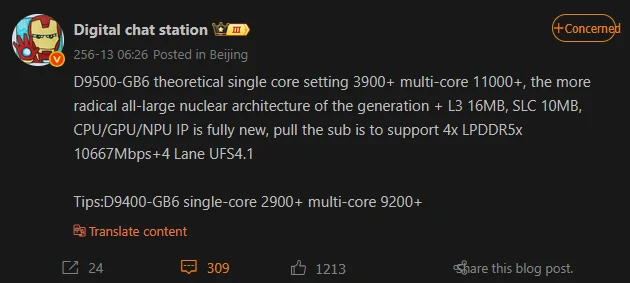
    The Dimensity 9500 is said to achieve scores of 3,900 in Geekbench’s single-core tests and 11,000 in multicore tests. While the single-core score is a bit behind Qualcomm and Apple’s offerings, the multicore score indicates it remains relevant in the competitive landscape. It will feature a 16 MB L3 cache and a 10 MB System Level Cache (SLC) for the GPU and other components. For memory, it will utilize LPDDR5X-10677 MT/s modules. It’s also compatible with four-lane UFS 4.1 storage.

    Benchmark Comparisons

    As per our benchmark database, the Dimensity 9400 averages scores of 2,605 and 8,078 in Geekbench 6.4. If DCS’s figures are on point, the Dimensity 9500 is expected to be 49% faster in single-core performance and 36% faster in multicore performance. These projections are exceptionally high and nearly impossible to achieve with just a slight node upgrade (from TSMC N3E to N3P). This suggests that Arm has a significant redesign in the works with the Cortex-X925, now referred to as Lumex. Ideally, we should see the SoC make an appearance on a benchmarking platform before its anticipated launch in late September.

    Conclusion

    Digital Chat Station on Weibo has provided these updates, giving us a glimpse into the future of high-performance mobile processors. The advancements in the Dimensity 9500 could set a new standard in the market, making it an exciting development to watch as it approaches its release.

    Source:
    Link


  • Exynos 2600 Achieves Key Milestone Ahead of Galaxy S26 Launch

    Exynos 2600 Achieves Key Milestone Ahead of Galaxy S26 Launch

    Key Takeaways

    1. Samsung has started mass production of the Exynos 2600 processor for the Galaxy S26 and S26+ smartphones.
    2. The Galaxy S26 Ultra will use a standard Snapdragon 8 Elite 2 processor instead of a specialized version.
    3. Samsung aims for 50% production yields for the Exynos 2600, with actual mass production requiring yields over 60%.
    4. Historical challenges with the Exynos 2500 may repeat, as it faced delays due to low yields on its SF3 node.
    5. It’s uncertain how the Exynos 2600 will perform compared to competitors like Snapdragon 8 Elite 2 and MediaTek Dimensity 9500.


    Samsung has begun mass production of its next-generation smartphone processor, the Exynos 2600. This chip is expected to power the Galaxy S26 and Galaxy S26+ in the upcoming year. Similar to the Galaxy S24 lineup, the Ultra version—known as the Galaxy S26 Ultra—will use a Snapdragon processor. However, this time, it will feature a standard Snapdragon 8 Elite 2 instead of the For Galaxy version typically seen in Samsung devices.

    Production Challenges

    According to reports, Samsung is aiming to achieve 50% yields for the Exynos 2600. This processor is set to be the first smartphone chip made on Samsung’s SF2 node. Previously, estimates suggested yields were around 40%, with some performance sacrifices involved. Actual mass production can only commence once yields exceed 60%, which seems unlikely until later this year.

    Historical Context

    We’ve witnessed a similar situation with last year’s Exynos 2500. While it was ready in a reasonable timeframe for the Galaxy S25, the chip’s release got delayed to mid-2025 due to low yields on its SF3 node. There is a significant possibility that history might repeat itself, as SF2 is reportedly just a renamed variant of SF3 (SF3P). The Exynos 2500 is planned to be used in the Galaxy Z Flip 7, but the more premium Galaxy Z Fold 7 will stick with the Snapdragon 8 Elite for Galaxy.

    Future Outlook

    At this point, it’s too soon to determine how the Exynos 2600 will compare to other processors. If the Exynos 2500 is any indication, there’s still much work to do, especially when stacked against the Snapdragon 8 Elite 2 and MediaTek Dimensity 9500, both of which are expected to deliver notable improvements from generation to generation.

    Source:
    Link

  • Snapdragon 8 Elite 2 Benchmarks Show Major CPU, GPU Boost

    Snapdragon 8 Elite 2 Benchmarks Show Major CPU, GPU Boost

    Key Takeaways

    1. Qualcomm will host the 2025 Snapdragon Summit from September 23 to 26 to unveil the Snapdragon 8 Elite 2 chipset.
    2. The Snapdragon 8 Elite 2 features Qualcomm’s second-generation Oryon CPU architecture, with significant performance improvements in CPU and GPU.
    3. It is expected to achieve over 4,000 points in single-core and more than 11,000 points in multi-core benchmarks, surpassing its predecessor.
    4. The chipset will include a 16MB GMEM cache and an upgraded Adreno 840 GPU for enhanced graphics performance.
    5. Xiaomi is likely to be the first brand to launch smartphones with the Snapdragon 8 Elite 2, along with other brands like OnePlus, iQOO, and Honor.


    Qualcomm is set to host the 2025 Snapdragon Summit from September 23 to 26 this year. During this event, the American chipmaker is anticipated to unveil the Snapdragon 8 Elite 2, which will be the driving force behind the upcoming flagship smartphones. A recent post on Weibo from trusted source Digital Chat Station indicates that this new SoC will offer remarkable enhancements in both processing and graphical capabilities.

    Snapdragon 8 Elite 2: Enhanced Performance in CPU and GPU

    According to the leaked information, the Snapdragon 8 Elite 2 will feature Qualcomm’s second-generation Oryon CPU architecture. In Geekbench 6 tests, this chipset is said to aim for over 4,000 points in single-core benchmarks and more than 11,000 points in multi-core performance. This marks a considerable upgrade from the first-generation Snapdragon 8 Elite, which achieved scores of about 3,100 and 9,800, indicating a significant performance leap.

    Specifications and Features

    The platform is also rumored to come with a 16MB GMEM cache and an upgraded Adreno 840 GPU, specifically designed to manage demanding visuals and graphics-intensive applications seamlessly. These enhancements point to an emphasis on efficiency and improved thermal management for future flagship devices.

    The Snapdragon 8 Elite 2 is expected to utilize a 2+6 CPU configuration, with a peak clock speed reaching 5GHz, showing notable advancements compared to its predecessor. It is likely to be manufactured using TSMC’s third-generation 3nm process, boasting a base frequency of 4.4GHz, which is a bit higher than the previous generation’s 4.32GHz.

    Anticipated Launches

    Following past trends, Xiaomi is predicted to be the first brand to release smartphones powered by this new chipset, particularly the Xiaomi 16 and Xiaomi 16 Pro. Other brands expected to adopt the chip early include OnePlus with its 15 series, iQOO’s 15 and 15 Pro, the Honor Magic 8 series, Realme’s GT 8 Pro, Nubia’s Red Magic 11 series, and the Redmi K90 series.

    Moreover, the Oppo Find X9 Ultra and Vivo X300 Ultra, set to debut next year, are also likely to feature this new chip. However, it remains uncertain if the Xiaomi 16 Ultra will use the Snapdragon 8 Elite 2 or opt for the company’s proprietary Xring SoC.