Tag: Samsung 9100 PRO

  • Reddit User Wins $6,000 in Free Samsung 9100 PRO SSDs Due to Error

    Reddit User Wins $6,000 in Free Samsung 9100 PRO SSDs Due to Error

    Key Takeaways

    1. A Reddit user received an unexpected delivery of two boxes of Samsung 9100 PRO 2TB NVMe SSDs, valued at over $6,000, instead of the two SSDs they ordered.
    2. The user humorously considered how to manage the surplus SSDs, thinking about creating a NAS or selling them.
    3. Amazon customer support confirmed that the user could keep the extra SSDs due to a regulation from the U.S. Federal Trade Commission.
    4. Other Reddit users suggested checking the authenticity of the drives and shared their own experiences with unrequested bulk items.
    5. Some skeptics questioned whether the event was a marketing ploy due to recent price increases in memory products.


    A fortunate Reddit user has hit the jackpot, or rather, a massive haul of NAND Flash memory. An unanticipated delivery from Amazon gifted this Redditor with two complete boxes of Samsung 9100 PRO 2TB NVMe SSDs, valued at over $6,000.

    Christmas Surprise

    User 1trollzor1 shared their amazing tale just before Christmas on the r/pcmasterrace subreddit regarding their Amazon order. Initially, the Redditor thought they were getting two Samsung 9100 PRO 2 TB SSDs, which are known for their speed and reliability, priced at $250 each.

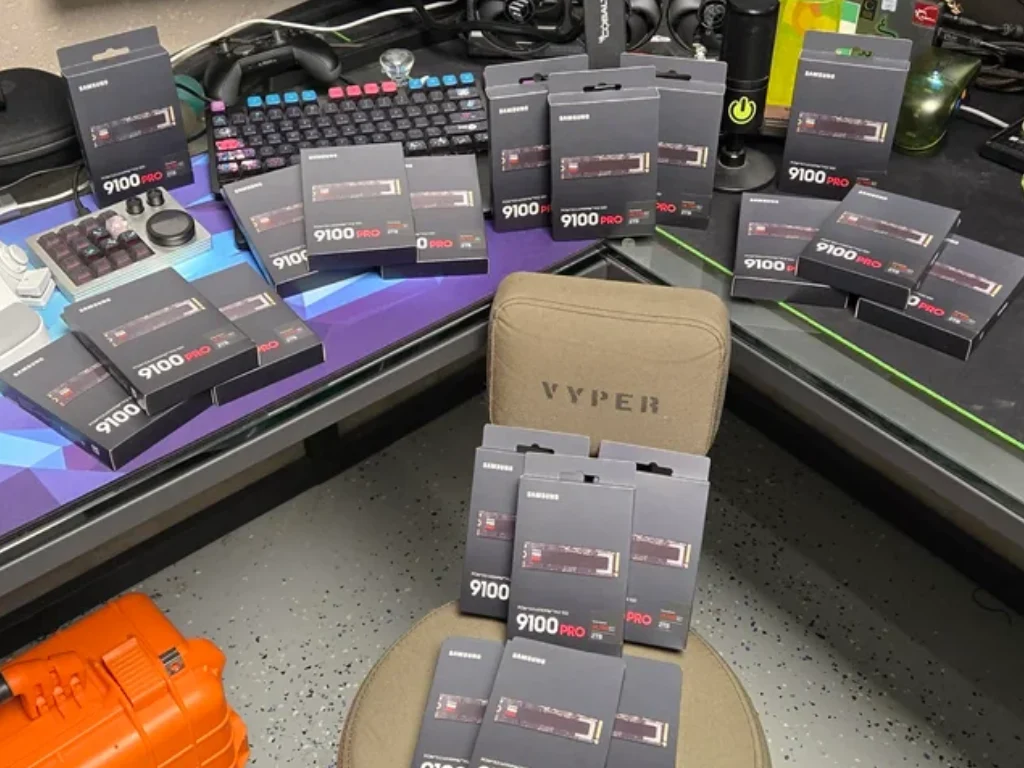
    To his surprise, he ended up with two entire boxes filled with Samsung 9100 PRO 2TB NVMe SSDs, worth an impressive $6,000. He shared a picture showing a collection of 9100 PRO NVMes on his gaming chair and desk, captioned, “Brothers, I have been blessed.”

    A Windfall of Storage

    It seems the user was gearing up to enhance their PC when they were surprised with an abundance of SSDs. They humorously expressed their dilemma, saying, “My steak is too juicy and my lobster too buttery. Whatever will I do?”

    Now, the Redditor is unsure how to handle the surplus of SSDs he received for free. He considered several options, like creating a 9100 PRO all-SSD NAS for personal use or selling the large stockpile to finance new ventures.

    Confirming the Good Fortune

    Feeling a bit guilty about this unexpected bounty, the user contacted Amazon customer support to ask whether he should keep the SSDs or send them back.

    Amazon’s customer support assured him that he could keep the extra Samsung 9100 PRO NVMes. This is due to a regulation enacted by the U.S. Federal Trade Commission, which indicates that recipients do not have to pay for or return items they didn’t order.

    What could’ve turned into a logistical nightmare for the Redditor became a remarkable win, making his Christmas even brighter.

    In the subreddit, other users advised him to check the authenticity of the drives with Samsung’s Magician software. On the other hand, some reminisced about their own experiences with receiving unrequested bulk items.

    However, there are skeptics who wonder if this might be a marketing ploy or a staged event, especially with recent price hikes in high-capacity memory and RAM due to supply chain troubles and manufacturers focusing on more profitable enterprise clients.

    Source:
    Link



  • UFS 5.0 Storage at 10.8 Gbps: Speed Close to PCIe 5.0 SSDs

    UFS 5.0 Storage at 10.8 Gbps: Speed Close to PCIe 5.0 SSDs

    Key Takeaways

    1. JEDEC has been standardizing flash memory since 2011, focusing on Universal Flash Storage (UFS) for smartphones and tablets.
    2. UFS 4.0, introduced in 2022, offers transfer speeds of up to 5,800 Mbps using two lanes, with UFS 5.0 promising even higher speeds of 10,800 Mbps.
    3. While UFS 5.0 narrows the speed gap with top PCIe SSDs, smartphones still lag behind the fastest laptops in terms of storage speed.
    4. UFS 5.0 is expected to be more reliable and easier to integrate into devices, featuring improvements in signal integrity and enhanced security.
    5. Real-world performance of UFS 5.0 may vary, as seen with UFS 4.0 devices that do not always achieve their maximum potential speeds.


    Since 2011, the JEDEC industry group has been working on standardizing flash memory for gadgets such as smartphones and tablets, which depend on Universal Flash Storage (UFS) rather than PCIe. UFS 4.0 was introduced in 2022, boasting transfer speeds of 2,900 Mbps on a single lane and 5,800 Mbps when using two lanes. Now, UFS 5.0 is almost complete and is expected to deliver even greater speeds.

    New Speed Expectations

    JEDEC has announced a peak speed of 10,800 Mbps for UFS 5.0. To put this into perspective, top-tier PCIe 5.0 SSDs, like the Samsung 9100 Pro (starting at $128 on Amazon), can reach around 14,700 Mbps. Although smartphones are still behind the quickest laptops, the difference is narrowing. JEDEC emphasizes that this enhanced storage capability will be essential to satisfy the increasing needs of AI applications.

    Reliability and Integration

    UFS 5.0 is anticipated to be more dependable due to improvements in signal integrity. It is also designed to be simpler to incorporate into devices thanks to a distinct power supply for the signaling unit and storage subsystem, while inline hashing bolsters security. As has been the case in the past, it may take a few years for this new UFS standard to become widely available, and even then, UFS 5.0 does not assure faster storage speeds. For instance, the Google Pixel 10 Pro with 256GB of storage or more uses UFS 4.0, but in our detailed assessment, the smartphone only achieved relatively low data rates of up to 1,492 Mbps, while rival devices typically perform more than twice as fast.

    Conclusion

    Overall, the advancements in UFS technology show promise for the future of mobile devices, but consumers should remain cautious as real-world performance can vary significantly.

    Source:
    Link


  • Samsung Launches 8TB 9100 Pro NVMe SSD for High-Performance Storage

    Samsung Launches 8TB 9100 Pro NVMe SSD for High-Performance Storage

    Key Takeaways

    1. Samsung will launch an 8 TB version of its 9100 Pro NVMe series on September 2, 2025, expanding its lineup which currently includes 1 TB, 2 TB, and 4 TB models.
    2. The 8 TB drive offers impressive speeds of up to 14,800 MB/s for sequential reads and 13,400 MB/s for writes, maintaining the same performance as the 4 TB version.
    3. Pricing for the standalone model is set at $1,050, while the heatsink version will cost $1,150, with expectations for lower retail prices upon market release.
    4. The 8 TB model is notable for its high capacity, surpassing many competitors in the PCIe 5.0 SSD market, making it a unique option for consumers.
    5. The drive is designed to be energy-efficient and well-balanced for gaming and productivity, expected to perform similarly to its smaller counterparts.


    Samsung is set to launch a new 8 TB version of its 9100 Pro NVMe series, with plans for it to hit the market on September 2, 2025. This M.2 drive will be the highest capacity option in a lineup that was first introduced earlier this year, which already includes 1 TB, 2 TB, and 4 TB models.

    Performance Specs

    The performance of the 8 TB drive is on par with the 4 TB version, boasting impressive speeds of up to 14,800 MB/s for sequential reads and 13,400 MB/s for writes. While Samsung has increased the storage capacity, the speed remains unchanged, as the same controller and settings are used to maintain consistent performance.

    Pricing Details

    However, the price is on the higher end of the spectrum. The standalone drive (MZ-VAP8T0BW) is priced at $1,050, while the version with a heatsink (MZ-VAP8T0CW) will cost $1,150. Typically, retail prices are lower; for example, the 4 TB model was launched at $673 but can now be found for around $478, so it’s reasonable to expect the 8 TB model might be priced below $1,050 when it comes to market.

    Unique Selling Proposition

    The main selling point remains its massive capacity. Many PCIe 5.0 SSDs that use Phison’s E26 or Silicon Motion’s SM2508 technology still do not reach 8 TB, making the 9100 Pro one of the few options available in this category. Another competitor is TeamGroup’s T-Force GE Pro M.2, which also offers an 8 TB PCIe 5.0 solution. Additionally, SanDisk is preparing to release an 8 TB WD Black SN8100 in 2025, but the exact launch date is still under wraps.

    Samsung’s drive will come equipped with a factory heatsink, allowing it to maintain performance and fit within the compact bay of the PlayStation 5, expanding its usability beyond just desktop computers. To give you an idea, 8 TB can hold approximately 80 modern AAA games, each averaging 90.6 GB.

    Balanced Performance

    Reviews of the smaller capacities of the 9100 Pro indicate a well-balanced and energy-efficient performance for both gaming and productivity tasks. Since the 8 TB model is designed to deliver the same performance, it’s expected that it will exhibit a similar profile in real-world usage.

    Source:
    Link


  • Samsung 9100 Pro PCIe 5.0 SSDs Offer 14,800 MB/s Read Speeds

    Samsung 9100 Pro PCIe 5.0 SSDs Offer 14,800 MB/s Read Speeds

    Key Takeaways

    1. Samsung’s new PCIe 5.0 M.2 NVMe SSDs can achieve read speeds of up to 14,800 MB/s.
    2. Available sizes include 1TB, 2TB, 4TB, with an 8TB version expected later this year.
    3. The SSDs come in both heatsink and non-heatsink versions, maintaining the 2280 form factor.
    4. All models are backed by a five-year limited warranty and adhere to advanced data encryption standards.
    5. Pricing starts at $200 for the 1TB model and goes up to $570 for the 4TB heatsink version.


    Samsung has just revealed its super speedy PCIe 5.0 M.2 NVMe SSDs, which can achieve read speeds of up to 14,800 MB/s. You can now order the 9100 Pro and the 9100 Pro with Heatsink directly from Samsung’s website or from a few chosen retailers. These SSDs come in 1TB, 2TB, and 4TB sizes. Samsung also announced that they will release 8TB versions in the second half of this year. While these SSDs redefine the capabilities of PCIe 5.0, they do come at a higher price.

    Product Specifications

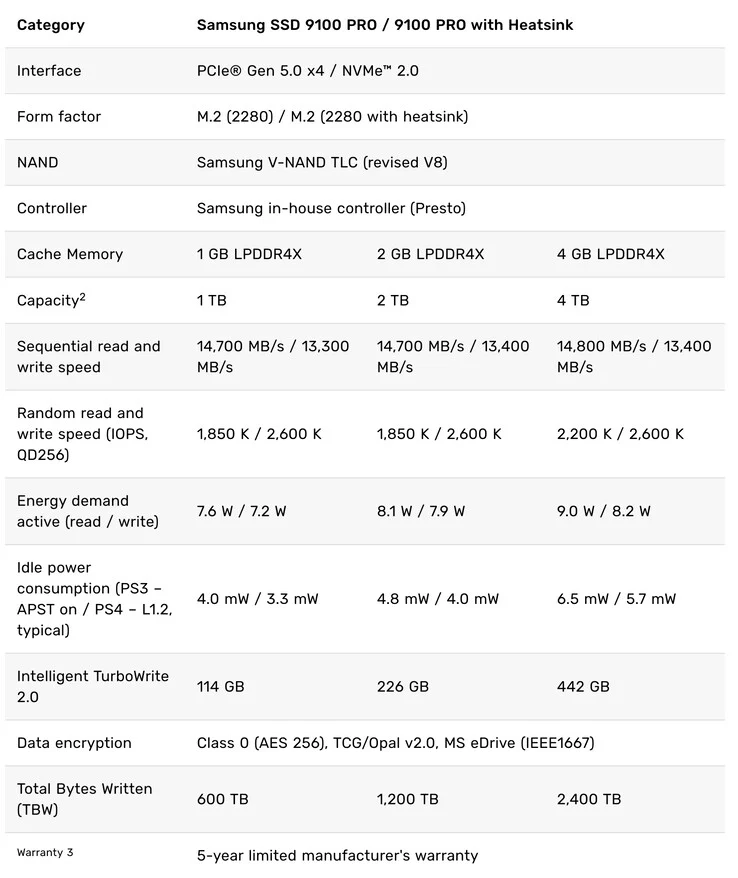
    Utilizing the PCIe 5.0 x4 interface, the 9100 Pro series maintains the 2280 form factor and offers both Heatsink and non-heatsink versions. Storage options include 1TB, 2TB, 4TB, and the upcoming 8TB (expected later this year), with comparable read and write speeds across the variants. The 4TB and 8TB options can achieve the maximum advertised sequential read speed of 14,800 MB/s and sequential write speeds of 13,400 MB/s. Meanwhile, the 1TB and 2TB models are slightly slower, reaching 14,700 MB/s for sequential reads, with the 1TB variant having the lowest sequential write speeds at 13,300 MB/s.

    Durability and Warranty

    All variants are equipped with Samsung’s V NAND TLC (V8) and come with a custom controller. Regarding durability, the 1TB model is rated for 600 TBW (Total Bytes Written), the 2TB version for 1,200, the 4TB for 2,400, and the 8TB for 4,800. Each model is backed by Samsung’s five-year limited warranty, which is typical for most Samsung SSDs. They also adhere to Class 0 (AES 256), TCG/Opal v2.0, and MS eDrive (IEEE1667) data encryption standards to keep your data secure.

    Pricing Information

    The pricing for the 1TB 9100 Pro SSD is set at $200, while the heatsink version costs $220. For the 2TB model, the price is $300 without the heatsink and $320 with it. The 4TB variant is priced at $550 for the non-heatsink version and $570 for the heatsink version. You can find all of these products available on Samsung’s online store, Amazon, Newegg, and Best Buy.

    Source:
    Link

  • Samsung 9100 PRO Launches with Upcoming 8TB Variant Later This Year

    Samsung 9100 PRO Launches with Upcoming 8TB Variant Later This Year

    Key Takeaways

    1. Samsung has launched the 9100 PRO, its first PCIe 5.0 SSDs, with significant upgrades over the 990 PRO.
    2. The 9100 PRO features write speeds of up to 13,400 MB/s and read speeds of 14,800 MB/s, alongside a new ‘Presto’ memory controller.
    3. Despite claims of increased energy efficiency, power usage actually rises to 9 W, but faster transfer speeds may lead to effective power savings.
    4. The series offers durability ratings of 600-2,400 TBW and comes with a five-year warranty, along with thermal management features.
    5. The 9100 PRO will be available starting March 18 in 1 TB, 2 TB, and 4 TB configurations, with an 8 TB version expected later this year.


    Samsung has officially unveiled the 9100 PRO, sharing insights about its first PCIe 5.0 SSDs today. Although some details about the 9100 PRO series were leaked ahead of the official announcement, the German press release provides a more thorough look at the upgrades Samsung has implemented compared to the previous 990 PRO.

    Updated Performance Specs

    Key improvements include a revamped TLC NAND and a new ‘Presto’ memory controller, achieving write speeds of up to 13,400 MB/s alongside the previously mentioned read speeds of 14,800 MB/s. The 9100 PRO is promoted as being more energy efficient than the 990 PRO, which currently retails for $124 on Amazon; however, this claim isn’t entirely accurate.

    Instead of being more efficient, the actual power usage increases by 2.5 W, bringing it up to 9 W. Yet, the enhanced transfer speeds could enable the 9100 PRO to finish tasks faster than the 990 PRO, leading to an effective power consumption reduction of about 49%.

    Endurance and Warranty

    Samsung designates the 9100 PRO series with a durability rating of 600-2,400 TB (TBW), depending on the specific model selected, and every SKU comes with a five-year warranty. Additionally, the series features a rear-mounted heat spreader and a nickel-coated controller aimed at maximizing lifespan. The cache included ranges between 1 GB and 4 GB of LPDDR4X, with more specifics available in the table below.

    The 9100 PRO series is set to be available starting March 18, offered in 1 TB, 2 TB, and 4 TB configurations, with prices beginning at €182.99. Samsung also mentions that an 8 TB version will be released later this year. Here’s the complete pricing for the Eurozone:

    Source:
    Link