
Tag: peak brightness

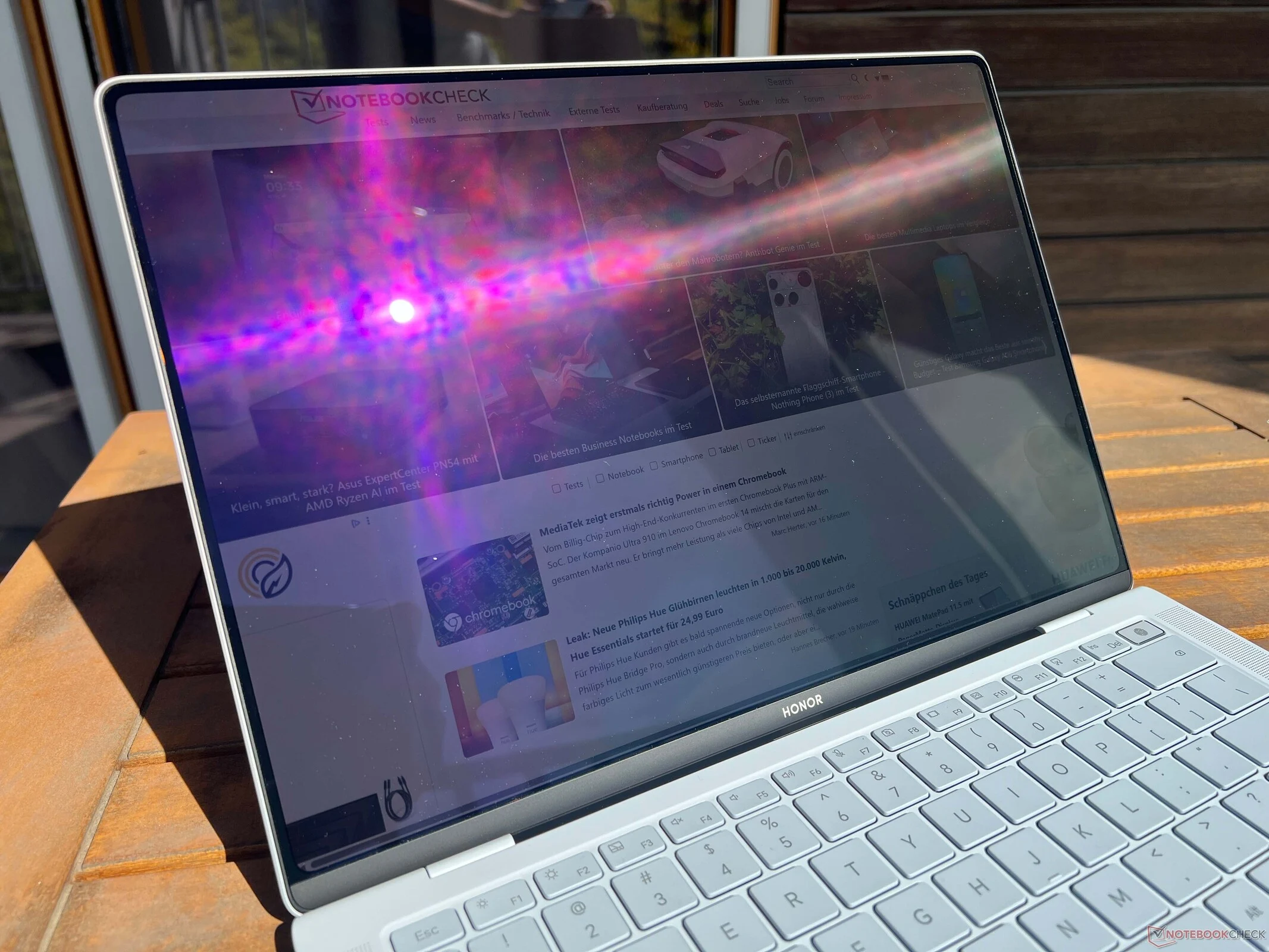
  • Honor MagicBook Art 14 2025 Brightness: 1600 nits vs 740 nits

    Honor MagicBook Art 14 2025 Brightness: 1600 nits vs 740 nits

    Key Takeaways

    1. The MagicBook Art 14 2025 features updated Intel Arrow Lake processors and a redesigned keyboard.
    2. The OLED touchscreen boasts a high refresh rate of 120 Hz and a peak brightness claim of 1600 nits.
    3. Achieving the claimed peak brightness requires enabling HDR mode and using compatible content, which may not be typical for laptops.
    4. The review found a maximum brightness of around 740 nits, which is lower than expected compared to other OLED models.
    5. Despite the brightness limitation, the display maintains excellent image quality, color accuracy, and no screen-door effect.


    The MagicBook Art 14, known for its sleek design, has received a refresh for 2025. Now, it comes with the latest Intel Arrow Lake processors and a revamped keyboard. The OLED touchscreen, which boasts a resolution of 120 Hz, was already impressive last year, and Honor asserts that its peak brightness has notably increased to a remarkable 1600 nits, despite the other specifications remaining the same. Typically, such brightness levels in laptops are found only in Mini-LED or Tandem OLED displays.

    Brightness Specifications

    The manufacturer outlines the peak brightness scenario in the technical specifications, but the details are somewhat vague. To access the maximum brightness, users need to enable HDR mode and utilize compatible HDR content, or ensure that the brightness sensor is turned on. This behavior is familiar to smartphone users, who can achieve higher brightness levels outdoors. Yet, this is not the norm for laptops. We attempted to reach the claimed peak brightness, but unfortunately, we were unsuccessful. We experimented with various settings, including the automatic brightness feature in Windows and a dynamic backlight option in Honor’s PC Manager software. Despite placing the laptop in direct summer sunlight and trying different external light sources to mimic bright conditions, we could only achieve a maximum brightness of around 740 nits.

    Performance Assessment

    While this is certainly not a poor outcome, many displays, such as Lenovo’s current OLED models, often hit peak brightness levels of 1,000-1,100 nits. Even though our review model didn’t meet the promised peak brightness, it doesn’t detract from the overall image quality, which remains superb with 120 Hz and precise color profiles. We even managed to enhance the color accuracy further with our calibration (the calibration profile is available for free download in our review). There’s no screen-door effect on bright backgrounds, and the DC dimming at 120 Hz with a very low amplitude is unlikely to cause any problems. For more details, check out our complete review of the new Honor MagicBook Art 14 2025.

  • According to reports, the Samsung Galaxy S24 Ultra is expected to provide a peak brightness of 2600 nits.

    According to reports, the Samsung Galaxy S24 Ultra is expected to provide a peak brightness of 2600 nits.

    Samsung Galaxy S24 Ultra to Feature Impressive Display

    As the unveiling date of the Samsung Galaxy S24 series approaches, more details about the flagship smartphone are starting to surface. One of the latest leaks suggests that the Galaxy S24 Ultra will boast a Dynamic AMOLED 2x display with a peak screen brightness of 2600 nits. This is 100 nits higher than the previously rumored peak brightness of 2500 nits for all models in the lineup, including the Galaxy S24, Galaxy S24+, and Galaxy S24 Ultra.

    Outshining the Competition

    If these leaks are accurate, the Galaxy S24 Ultra will surpass its competitors in terms of peak screen brightness. The iPhone 15 Pro Max, for example, has a peak brightness of 2000 nits, while the Google Pixel 8 Pro boasts 2400 nits. However, it's important to note that peak brightness doesn't necessarily translate to higher perceivable brightness in all scenarios. The rated peak brightness is typically achieved only in specific situations, such as playing HDR videos in well-lit environments. Factors like device temperature also play a role in determining display brightness. Nevertheless, the Galaxy S24 Ultra is expected to outshine its rivals in certain scenarios.

    AI-Powered Features

    The Galaxy S24 Ultra is rumored to be Samsung's first "AI Phone," incorporating various Generative AI features. These include AI-generated wallpapers, real-time voice call language translation, text summarization in Samsung Notes, and the ability to expand images by filling in non-existent content that matches the surroundings. Additionally, the Galaxy S24 series is said to support emergency texting via satellite connectivity.

    Enhanced Camera Capabilities

    The Galaxy S24 Ultra is anticipated to sport an impressive camera setup. It is rumored to feature a 200-million-pixel main camera, a 12-megapixel ultra-wide-angle lens, a 10-megapixel 10x telephoto lens, and a 50-megapixel 5x telephoto lens. Samsung is also reportedly improving the AI object recognition engine to enhance the smartphone's imaging capabilities in various lighting conditions.

    With its high peak screen brightness and advanced AI-powered features, the Samsung Galaxy S24 Ultra is shaping up to be a promising flagship smartphone. As the January 17, 2024 unveiling date approaches, consumers eagerly await further details about this highly anticipated device.