Key Takeaways
1. Performance Comparison: The AMD Radeon 9070 XT generally performed better on Linux than Windows at 1080p, while the Nvidia GeForce RTX 5080 had a slight edge on Windows.
2. Resolution Impact: At 1440p ultrawide, the RTX 5080 outperformed the 9070 XT on Windows, but performance differences lessened on Linux, affecting frame stability.
3. Ray Tracing Effects: Ray tracing did not significantly impact the performance of the 9070 XT on both operating systems, while the RTX 5080 struggled more on Linux.
4. Linux Improvements: The 9070 XT achieved nearly 98% of its Windows performance on Linux at 1080p, indicating significant improvements in Linux gaming.
5. Nvidia Performance Decline: The RTX 5080 only managed about 84% of its Windows performance at 1080p on Linux, highlighting a larger performance gap compared to the Radeon 9070 XT.
When it comes to gaming in 2025, gamers have a ton of options, especially in the PC gaming world. You can choose between Windows 11 or a Linux gaming distribution like Nobara 42, teamed up with either an AMD or Nvidia graphics card. With so many possibilities, it can be tough to figure out the best match between an operating system and a GPU. Fortunately, the YouTube channel Ancient Gameplays has done the heavy lifting to find the performance differences between Windows 11 and Linux using an AMD Radeon 9070 XT and an Nvidia GeForce RTX 5080.
Testing Setup
The YouTuber ran tests on 15 games at both 1080p and 1440p ultrawide resolutions using an AMD Ryzen 7 9700X with 32GB DDR5 RAM clocked at 6200MHz. The games included popular titles like The Witcher 3 and Cyberpunk 2077, tested with and without ray tracing enabled.
Performance Analysis
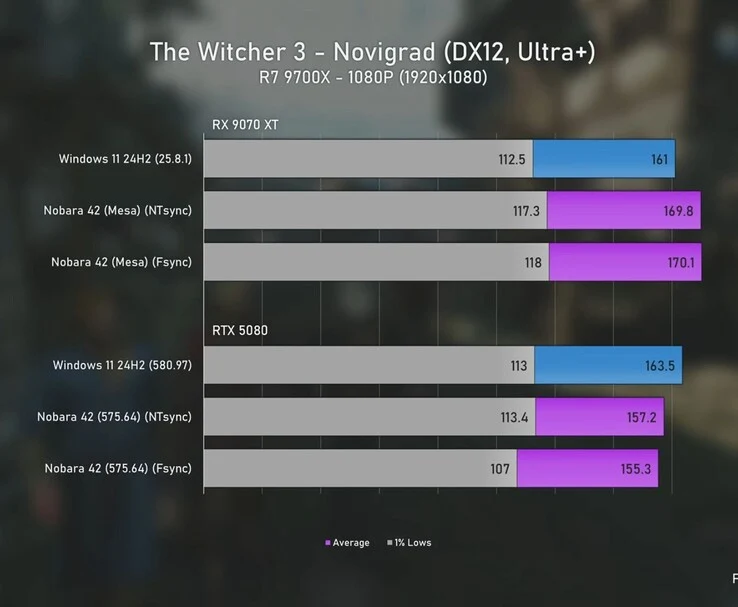
In The Witcher 3 at 1080p, the Radeon 9070 XT (currently priced at $749 on Amazon) performed a bit better on Linux, hitting an average of over 170 FPS, compared to 161 FPS on Windows. On the other hand, the RTX 5080 dropped slightly on Linux, scoring around 155 to 157 FPS, while it managed 163 FPS on Windows.
When the resolution increased to 1440p ultrawide, the RTX 5080 (currently $999 on Amazon) took the lead with 116 FPS on Windows, which is about 17 percent faster than the 9070 XT’s 99 FPS. However, on Linux, that advantage diminished, and frame stability suffered, with 1% lows dipping to as low as 50 FPS. The 9070 XT lost a few frames on Linux but still performed reasonably well with an average of about 91 FPS.
Ray Tracing Results
Turning on ray tracing didn’t significantly change the performance for the 9070 XT. At 1080p, it remained steady on both operating systems, even showing smoother lows on Linux in some tests. The RTX 5080, by contrast, matched the 9070 XT on Windows at around 98 FPS but struggled on Linux, where its averages fell into the low 80s.
At 1440p ultrawide, the RTX 5080 finally excelled with 88 FPS on Windows, extending its lead over the 9070 XT, which averaged 75 FPS. On Linux, the disparity grew larger, with the 5080 reaching nearly 77 FPS, while the 9070 XT lagged behind at 64 FPS.
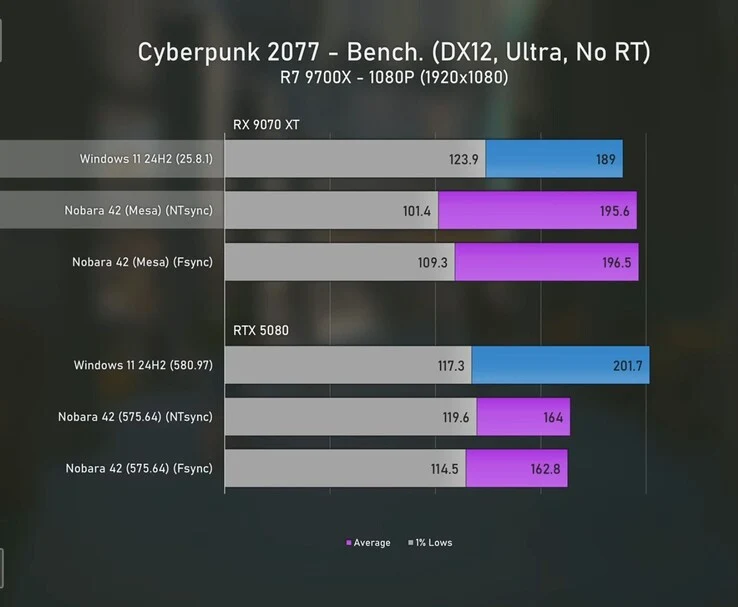
In Cyberpunk 2077, the Radeon 9070 XT actually ran quicker on Linux at 1080p, averaging nearly 196 FPS against 189 FPS on Windows, even though its 1% lows dropped from 124 FPS to 101 FPS. The RTX 5080 performed better on Windows with an average of 202 FPS but fell to about 163 FPS on Linux, also experiencing lower 1% lows.
Comparison at Higher Resolutions
At 1440p ultrawide, the 9070 XT recorded 101 FPS on Windows but jumped to 131 FPS on Linux, while its 1% lows fell into the low 50s. The RTX 5080 achieved 116 FPS on Windows and around 89 FPS on Linux, with its 1% lows also dropping below its Windows performance. The tester reran the game multiple times, and the unusual 29% increase for the 9070 XT on Linux was consistent throughout.
With ray tracing enabled, the 9070 XT again showed better averages on Linux at 138 FPS versus 131 FPS on Windows, although its 1% lows were halved. The RTX 5080 scored 142 FPS on Windows and about 121 FPS on Linux. At 1440p ultrawide, the 9070 XT fell from 73 FPS on Windows to the mid-50s on Linux, while the 5080 maintained 86 FPS on Windows and just over 71 FPS on Linux.
Final Thoughts
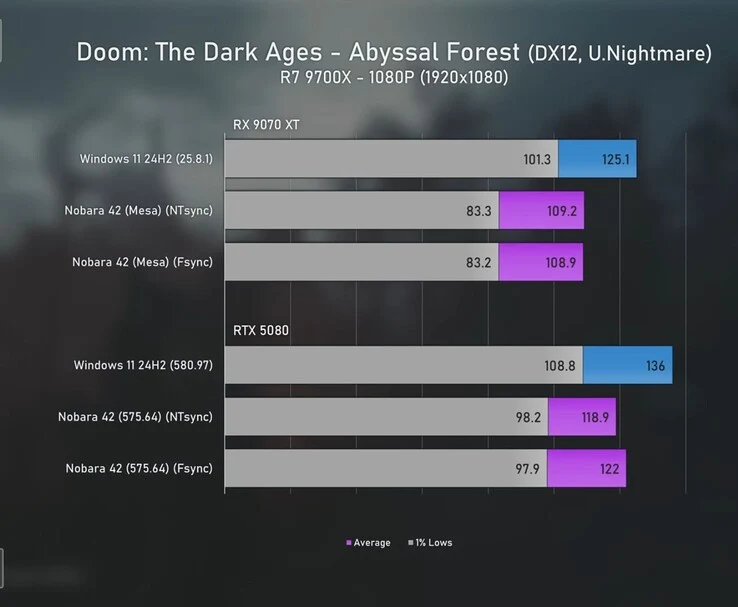
In Doom: The Dark Ages at 1080p, the Radeon 9070 XT hit 125 FPS on Windows with 1% lows at 101, while on Linux it averaged around 109 FPS with lows of about 83. The RTX 5080 was even faster, achieving 136 FPS on Windows and about 119 FPS on Linux, but its 1% lows dropped from 109 on Windows to roughly 98 on Linux.
At 1440p ultrawide, the 9070 XT averaged 74 FPS on Windows with lows near 60 FPS, while on Linux it dropped to about 65 FPS with lows under 50. The RTX 5080 again proved quicker, scoring 86 FPS on Windows with 1% lows at 71 FPS, compared to about 78 FPS on Linux where 1% lows were around 54 FPS.
Across the two resolutions, the RTX 5080 emerged as the stronger performer, maintaining higher averages in both Windows and Linux, even though it lost more ground in 1% lows when shifting to Linux compared to the 9070 XT.
The YouTuber assessed more games in the video, which you should definitely check out. In the overall findings, they concluded that Linux is no longer the underdog it used to be. Across 17 games, the Radeon 9070 XT surprisingly came close to its Windows performance, achieving 98% at 1080p and 95% at 1440p ultrawide. In simpler terms, unless you’re after the absolute highest frame rates, the differences are hardly noticeable.
The YouTuber also noted that Nvidia’s RTX 5080 didn’t keep up quite as well, managing only about 84% of its Windows performance at 1080p, yet it remained steady at 1440p with just a slight 1% decline. A few years back, such results on Linux would’ve been unimaginable, as drivers and optimizations lagged way behind Windows. Now, with platforms like Bazzite and SteamOS boosting Linux gaming into the mainstream, the gap is closing quickly, and in some instances, it’s even flipping the narrative.
Source:
Link