
Tag: NIRSpec

  • Webb Telescope Reveals First Look at Uranus’ Upper Atmosphere

    Webb Telescope Reveals First Look at Uranus’ Upper Atmosphere

    Key Takeaways

    1. Uranus has a unique, tilted magnetic field that differs from Earth’s alignment with its rotation.
    2. Researchers used Webb’s NIRSpec instrument to visualize Uranus’s ionosphere, which extends up to 5,000 km above its clouds.
    3. Auroral bands on Uranus are formed by charged particles colliding with atmospheric gases, creating a glow.
    4. Scientists identified two bright auroral bands near the magnetic poles and a darker area with lower emissions, linked to particle movement and magnetic shifts.
    5. These findings enhance our understanding of magnetic fields’ effects on planetary atmospheres and provide insights into ice giants and exoplanets.


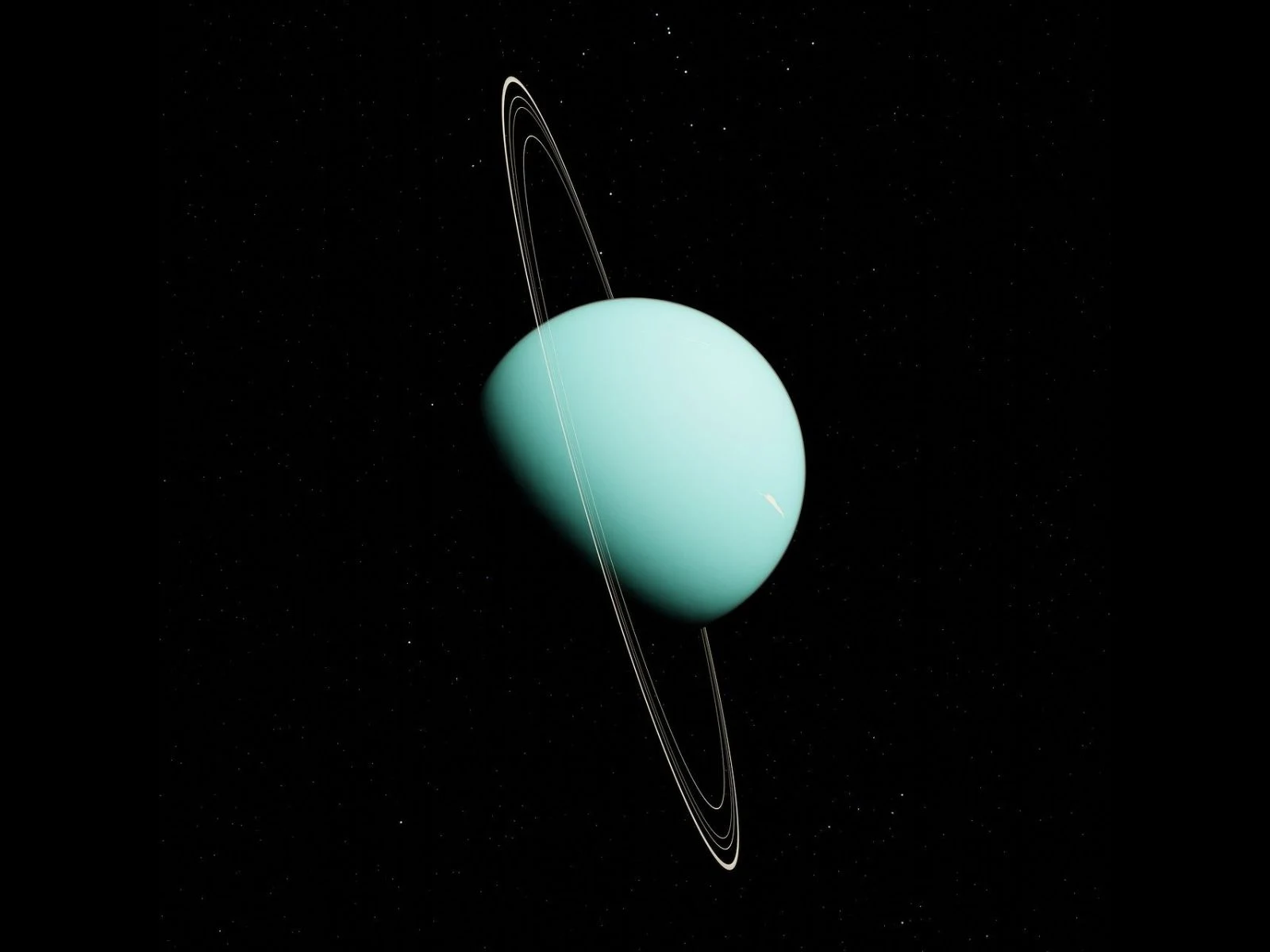
    Uranus is a massive icy planet known for having one of the most unusual magnetic fields within our solar system. Unlike Earth, its magnetic field is tilted and not perfectly aligned with the rotation of the planet. Utilizing Webb’s NIRSpec instrument (Near-Infrared Spectrograph), researchers have managed to visualize the upper part of Uranus, known as the ionosphere. This ionosphere extends up to 5,000 km above the cloud tops of Uranus, where gases become ionized. The interactions with the planet’s magnetic field create faint glows that were captured in infrared light.

    Auroral Bands and Magnetic Interactions

    Auroral bands are created when charged particles travel along magnetic field lines. As these particles collide with atmospheric gases, they produce a glow. Scientists identified two bright auroral bands near the magnetic poles, along with a darker area where the emission and ion density were lower. This may be related to variations in the movement of charged particles and shifts in the magnetic field lines. Similar behaviors have been noted on Jupiter.

    Significance of the Findings

    This finding is crucial for enhancing our understanding of how magnetic fields affect planetary atmospheres. It also sheds light on the workings of ice giants such as Uranus, aiding in the interpretation and understanding of far-off exoplanets.

    Source:
    Link


  • James Webb Telescope Maps 3D Auroras on Uranus for First Time

    James Webb Telescope Maps 3D Auroras on Uranus for First Time

    Key Takeaways

    1. The James Webb Space Telescope (JWST) created a 3D map of Uranus’s auroras, enhancing our understanding of this phenomenon.
    2. Uranus has a unique magnetosphere that is misaligned with its rotation axis, making it one of the most peculiar in the solar system.
    3. JWST’s Near-Infrared Spectrograph (NIRSpec) allowed astronomers to analyze Uranus’s atmosphere and energy balance in unprecedented detail.
    4. The telescope confirmed that Uranus’s upper atmosphere is cooling, with an average temperature of around 426 kelvins (150 degrees Celsius).
    5. Future discoveries from JWST are expected to deepen our knowledge of ice giants and their mysteries.


    The James Webb Space Telescope is a crucial instrument for astronomers, equipped with tools that achieve incredible results. Recently, it successfully created a 3D map of Uranus’s auroras, allowing scientists to examine this phenomenon with enhanced accuracy.

    Unique Magnetosphere

    Paola Tiranti, a researcher from Northumbria University in the UK, noted in a press announcement that Uranus possesses one of the most peculiar magnetospheres in the solar system due to it being misaligned with the planet’s rotation axis.

    Using the Near-Infrared Spectrograph (NIRSpec) of the James Webb Space Telescope, astronomers were able to analyze its rotation, marking a significant advancement in the field. Paola Tiranti elaborates:

    “By revealing Uranus’s vertical structure in such detail, Webb is helping us understand the energy balance of the ice giants. This is a crucial step towards characterizing giant planets beyond our solar system. This is the first time we’ve been able to see Uranus’s upper atmosphere in three dimensions. With Webb’s sensitivity, we can trace how energy moves upward through the planet’s atmosphere and even see the influence of its lopsided magnetic field.”

    Temperature Trends

    While the images captured illustrate auroras near Uranus’s poles, the James Webb Space Telescope has also validated a trend initially discovered by Voyager 2. Launched on August 20, 1977, as part of the Voyager project, it passed by Uranus in 1986 and found that the planet’s upper atmosphere was cooling, a finding now confirmed by JWST:

    “The team measured an average temperature of around 426 kelvins (about 150 degrees Celsius), which is lower than values recorded by ground-based telescopes or previous spacecraft.”

    Future Discoveries

    As a result, examining this planet could assist astronomers in gaining a better understanding of ice giants and unraveling the enigmas that surround them. Additionally, this telescope is poised to uncover more secrets in the near future.

    Source:
    Link