
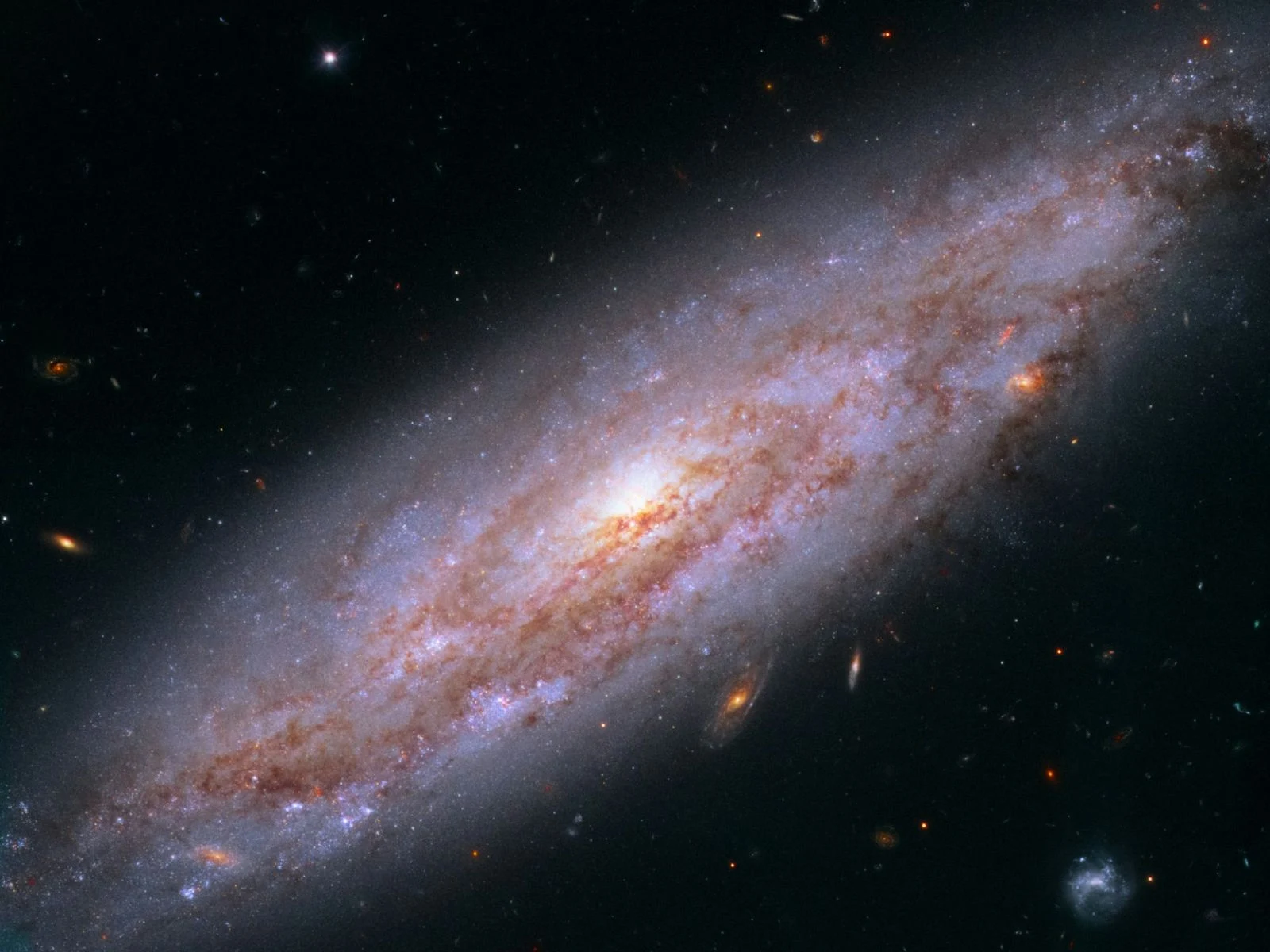
– M88 is a 121,000-light-year-wide spiral galaxy in the Virgo Cluster.
– Its bright center contains a supermassive black hole 100 million times the Sun’s mass.
– Symmetrical spiral arms contain pink and blue star clusters and dust clouds.
– M88 will approach the much larger M87 in 200–300 million years.
– This encounter will eject gas and reshape M88, affecting star formation.
Observing the Details of Galaxy M88
The universe contain many galaxies, and some are more interesting than others due to there shape and composition. This is the case for M88, a spiral galaxy located about 63 million light-years from Earth that was recently observed by the Hubble Space Telescope. It measures about 121,000 light-years in diameter and belongs to the Virgo Cluster, a region containing more than a thousand galaxies held together by gravity.
What the Image Reveals
In this image recently released by NASA, a bright light can be seen at its center. This glow is caused by a group of reddish stars orbiting a supermassive black hole with a mass estimated at 100 million times that of the Sun. It is also possible to observe symmetrical spiral arms composed of several clusters of pink and blue stars and dust clouds. However, although this image is remarkable, this galaxy may be headed for a tragic fate.
The Future Trajectory
Indeed, the galaxies located in the Virgo Cluster orbit the clusters center. According to astronomers, in 200 to 300 million years, M88 will be very close to M87, an elliptical galaxy with a supermassive black hole about 6.5 billion times more massive than the Sun. During this event, gas will be ejected from M88 and its shape will change considerably, which could alter its composition and its ability to form new stars.
- Distance: 63 million light-years
- Diameter: 121,000 light-years
- Black hole mass: 100 million solar masses
- M87 black hole mass: 6.5 billion solar masses
- Predicted close approach: 200-300 million years