Key Takeaways
1. Laptops with an RTX 5070 start around €1,500, but users are concerned about the adequacy of 8 GB VRAM for long-term relevance in gaming.
2. General gaming performance shows that VRAM usage isn’t a major issue, with games like Baldur’s Gate 3 and Cyberpunk 2077 running smoothly even at 4K.
3. Some games, like Assassin’s Creed Shadows, may exceed VRAM budgets without significant performance drops, indicating VRAM isn’t the sole factor affecting gameplay.
4. Indiana Jones and the Great Circle demonstrates more serious VRAM issues, crashing at higher settings, but is noted for being poorly optimized.
5. Overall, 8 GB of VRAM is generally sufficient for most current games, but certain poorly optimized titles may pose challenges, highlighting the need for future-proofing as games evolve.
Laptops featuring an RTX 5070 typically start at about €1,500, although many setups are priced much higher. For that kind of money, customers expect a machine that will remain relevant for a long time. However, discussions on Reddit and tech forums reveal that many users worry Nvidia’s 8 GB VRAM might be insufficient, which could lead to problems in certain games.
VRAM Examination
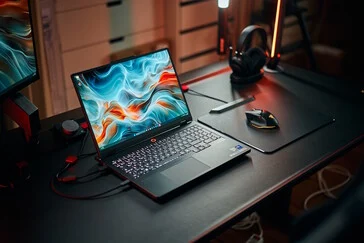
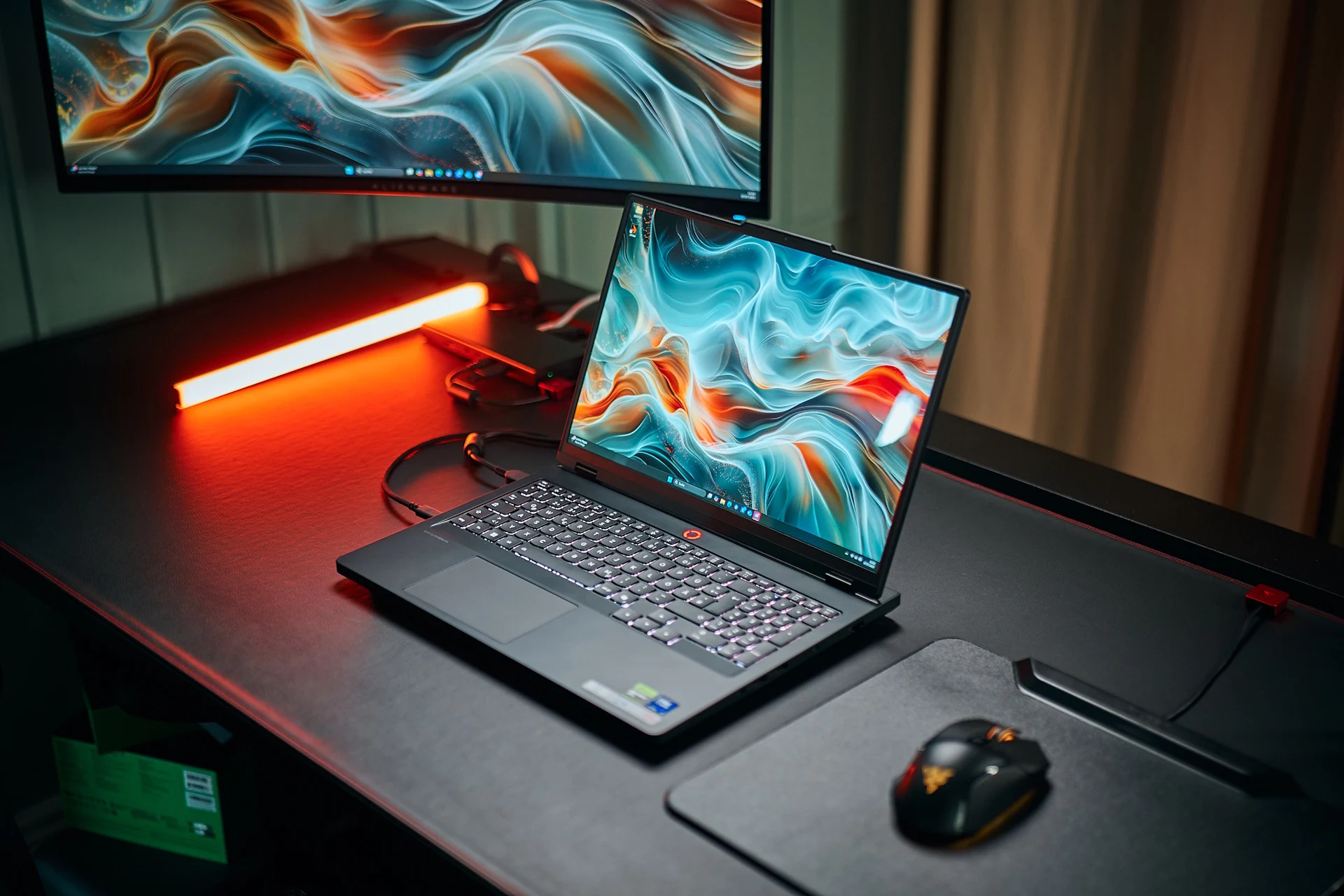
We examined the VRAM scenario with the Lenovo Legion Pro 5 16IAX10, aiming to provide a judgment specific to this laptop and a select number of games. A more detailed article on the larger VRAM topic is on its way.
Game Performance Analysis
In general, VRAM usage isn’t something that stands out while gaming. There’s no visible gauge, and we could run games like Baldur’s Gate 3, GTA V, and Cyberpunk 2077 seamlessly — even at 4K — without any noticeable memory issues.
Some games, however, do show a “VRAM budget” in their graphic settings. Depending on the resolution and detail level selected, that indicator can fill up quickly. For instance, Assassin’s Creed Shadows and Indiana Jones and the Great Circle are examples of this.
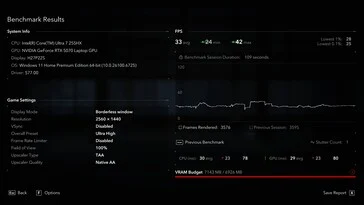
In Assassin’s Creed Shadows at 2,560 x 1,440 (QHD), the game indicates that the VRAM budget is exceeded by around 100 MB. Nevertheless, during the benchmark, frame times remained consistent — even if the average frame rate was around 38 fps. The internal stutter count was just 1.
Stress Testing VRAM
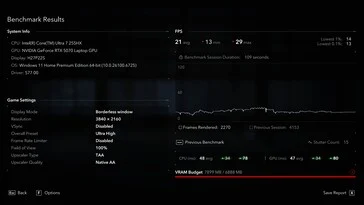
To put more pressure on the VRAM, we switched to native 4K. Now, based on the indicator, the VRAM requirements clearly exceeded the limit — and we noted a stutter count of 15. The tricky part here is that we dropped to an average of 21 fps at native 4K, making it tough to determine whether the stuttering was truly due to VRAM limits or just the GPU struggling overall.
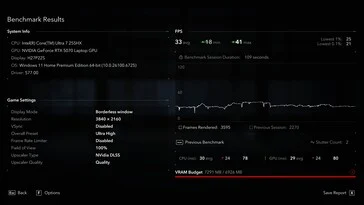
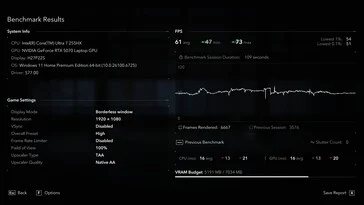
Switching to DLSS Quality mode raised the average frame rate back above 30 fps and lowered the stutter count to 2 — even though the game still indicated an overage in VRAM. When playing in Full HD on High settings, the VRAM limit was not breached, the stutter count remained at 0, and performance averaged 61 fps. In summary, Assassin’s Creed Shadows doesn’t serve as the best test for VRAM adequacy, since performance issues happen well before memory usage becomes a real concern. So, it’s less of an issue after all.
Indiana Jones Experience
Moving on to Indiana Jones and the Great Circle, we noticed a more evident negative effect from the RTX 5070’s “just” 8 GB of VRAM: at a certain moment, the game simply wouldn’t start or crashed on initiation. Even at Full HD with low settings, the game claims VRAM usage surpasses the limit — though in reality, we didn’t see any issues until we increased the detail levels. Beyond that point, the game crashes each time it tries to launch (every settings change requires a restart).
That said, Indiana Jones is somewhat of a unique case. As our colleague Florian mentioned in his benchmarking article, the game is in “a questionable technical state” and “poorly optimized, making its VRAM demands unreasonable.” Even GPUs with 16 GB of VRAM experience significant frame rate drops. However, at least you can start the game with higher resolutions and settings.
Conclusion on VRAM Sufficiency
Returning to our initial question — is 8 GB of VRAM inadequate? For most current games, the answer appears to be no. The few exceptions we’ve encountered seem more related to poor optimization rather than true hardware constraints. Still, those particular games do exist, and users with 8 GB GPUs may face challenges at certain resolutions and settings, while those with more VRAM can keep playing. Waiting for patches is the only solution — if they ever come. And considering that upcoming titles will likely require even more VRAM, the concerns are not entirely baseless.
As previously stated, this conclusion specifically pertains to the Legion Pro 5 16 and should be viewed as a general indication rather than a conclusive statement. A more thorough analysis with detailed benchmarks and comparisons will be available soon.