
Tag: Keele University

  • Astronomers: Red Dwarfs Devouring Earth-Like Planets

    Astronomers: Red Dwarfs Devouring Earth-Like Planets

    Key Takeaway

    – Red dwarfs unexpectedly contain lithium, which their internal heat should have destroyed.
    – The lithium likely comes from red dwarfs absorbing matter from Earth-like planets.
    – This discovery reveals the destructive behavior of red dwarfs toward planetary systems.
    – The finding may help researchers understand how planetary systems form.
    – Further studies with new instruments are needed to identify similar stars.


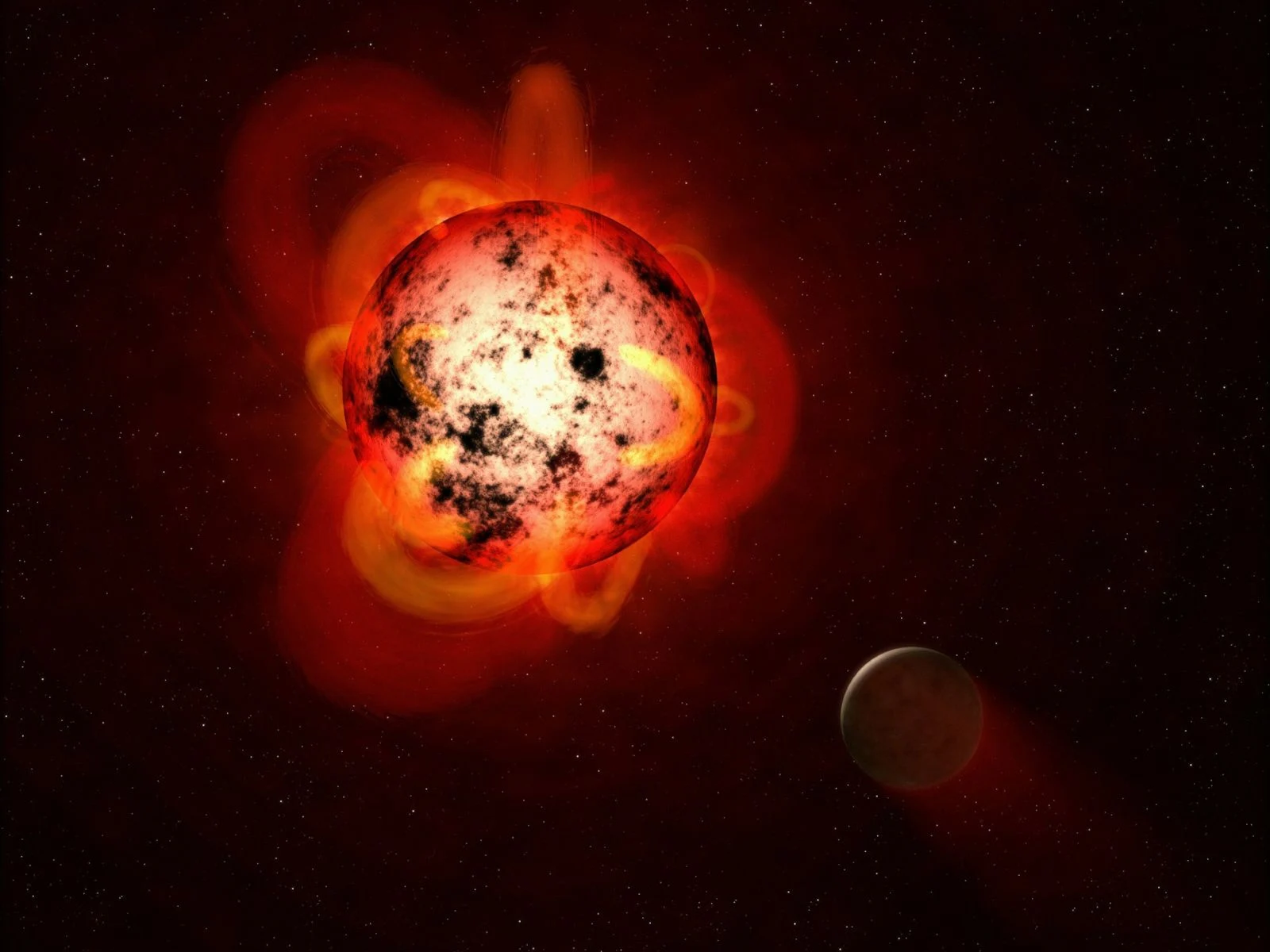
    By observing various regions of the universe, astronomers sometimes find surprising phenomenons. Indeed, after discovering a collision between two neutron stars and an exoplanet with a potential atmosphere, they have detected red dwarfs absorbing matter from Earth-like planets.

    A Surprising Discovery in Stellar Observations

    This discovery was revealed in a new study published in the Monthly Notices of the Royal Astronomical Society. Several researchers from Keele University and the University of Exeter have studied thousands of stars and discovered six red dwarfs exhibiting unusual behavior. The team spent months cross-referencing data and found that these specific stars were not acting as expected.

    Lithium Anomaly Detected

    After conducting various observations, they noticed that these stars contained lithium. However, this chemical element should not be present in these celestial objects, as explained by Professor Robin Jeffries of Keele University, and lead author of the study:

    “Red dwarfs are smaller and cooler than our Sun but inside they are extremly hot. This heat should destroy all of their fragile lithium in nuclear reactions shortly after they form.”

    Implications for Planetary System Formation

    Therefore, according to astronomers, these stars, which are the most common in the universe, could have absorbed matter from Earth-like planets. Thus, while this discovery highlights the destructive behavior of red dwarfs, it could also help researchers understand how planetary systems form. However, further studies will need to be conducted in the future using new instruments to identify stars with the same behavior.

    Monthly Notices of the Royal Astronomical Society


    Sources

  • Scientists Discover Surprising Truth About Star’s Explosion Risk

    Scientists Discover Surprising Truth About Star’s Explosion Risk

    Key Takeaways

    1. Behemoth, one of the largest known stars, is located 163,000 light-years from Earth and was thought to be on the verge of an explosion due to a decline in brightness.
    2. Recent observations confirmed that the star is surrounded by gas and dust, indicating it is not about to explode soon.
    3. Research from Keele University revealed the presence of titanium oxide in Behemoth’s atmosphere, confirming it as a red giant rather than a yellow hypergiant.
    4. A nearby small blue star may be affecting Behemoth’s brightness by drawing particles, explaining the observed circumstellar disk.
    5. Ongoing studies by Keele University aim to uncover more about Behemoth, emphasizing the importance of careful observation in astronomical research.


    The universe is still filled with wonders, and many of the estimates made by astronomers are occasionally incorrect. A prime example is Behemoth, one of the biggest stars known, situated 163,000 light-years away from our planet. Recently, astronomers have noticed a decline in its brightness, leading them to believe an explosion was imminent.

    A Mistaken Expectation

    Although witnessing such an event would have been spectacular, particularly because this star is 1,500 times the size of the Sun, it seems this was a misunderstanding. Indeed, an image captured in 2024 by the Very Large Telescope in Chile indicated the presence of gas and dust surrounding it, but its explosion is not anticipated in the near future.

    New Discoveries

    Researchers from Keele University in the UK utilized the spectroscope of the Southern African Large Telescope, revealing that titanium oxide exists in its atmosphere. This suggests that Behemoth remains a red giant and is not a yellow hypergiant, which would usually signal an upcoming supernova.

    To account for the changes in its brightness, scientists propose that a small blue star is in close proximity. The gravitational influence of this nearby star may be drawing certain particles, which helps to explain the circumstellar disk observed around WOH G64. Thus, further research could unveil more about this star, and patience will be essential before we can witness a supernova in the sky.

    The Journey Continues

    Keele University’s ongoing investigations may hold the key to unlocking some of the secrets surrounding Behemoth. As we continue to explore the cosmos, it’s important to remember that not all phenomena are as they seem. The excitement of discovery often comes with the necessity of careful observation and time.

    Source:
    Link