
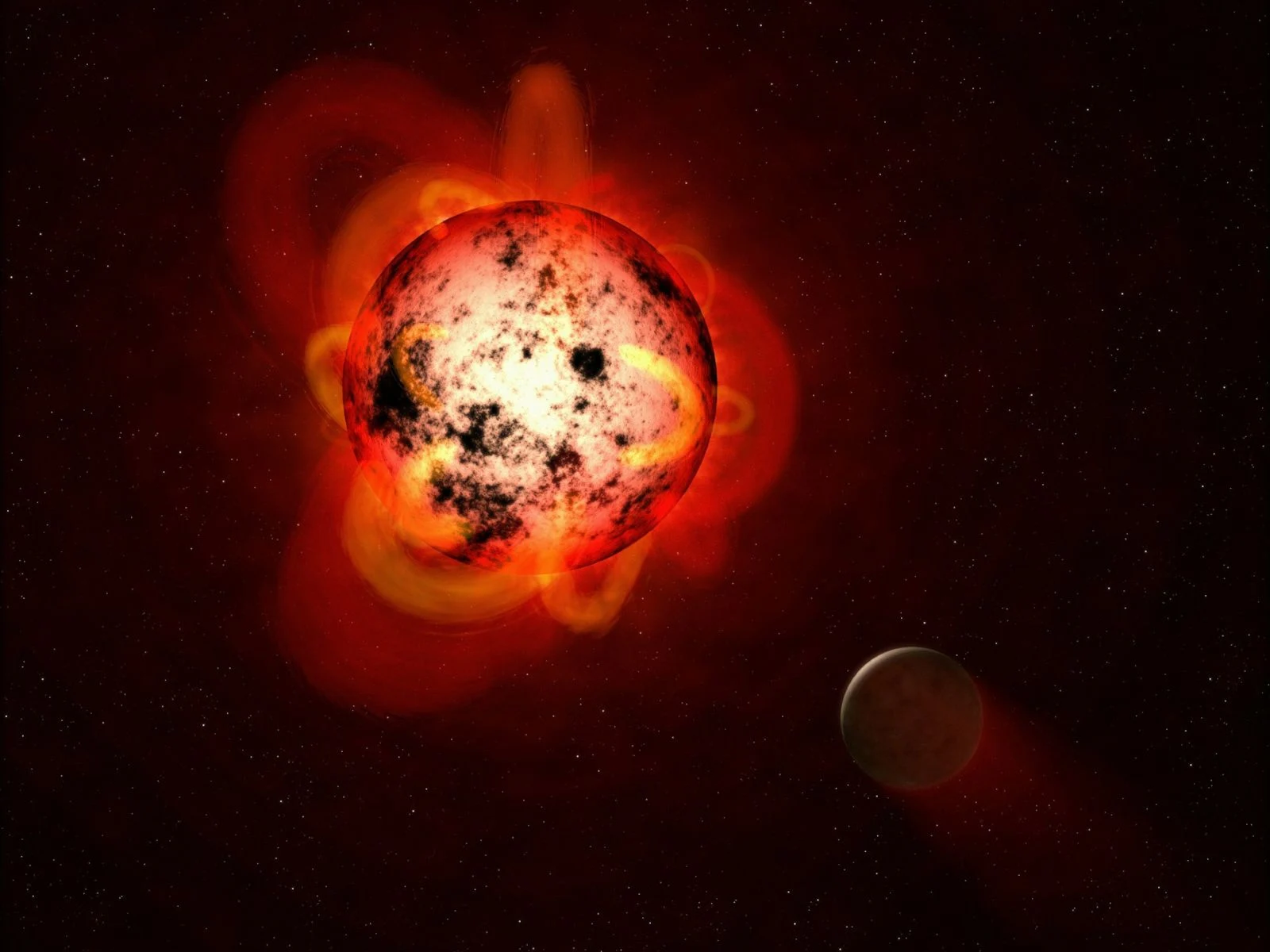
– Red dwarfs unexpectedly contain lithium, which their internal heat should have destroyed.
– The lithium likely comes from red dwarfs absorbing matter from Earth-like planets.
– This discovery reveals the destructive behavior of red dwarfs toward planetary systems.
– The finding may help researchers understand how planetary systems form.
– Further studies with new instruments are needed to identify similar stars.
By observing various regions of the universe, astronomers sometimes find surprising phenomenons. Indeed, after discovering a collision between two neutron stars and an exoplanet with a potential atmosphere, they have detected red dwarfs absorbing matter from Earth-like planets.
A Surprising Discovery in Stellar Observations
This discovery was revealed in a new study published in the Monthly Notices of the Royal Astronomical Society. Several researchers from Keele University and the University of Exeter have studied thousands of stars and discovered six red dwarfs exhibiting unusual behavior. The team spent months cross-referencing data and found that these specific stars were not acting as expected.
Lithium Anomaly Detected
After conducting various observations, they noticed that these stars contained lithium. However, this chemical element should not be present in these celestial objects, as explained by Professor Robin Jeffries of Keele University, and lead author of the study:
“Red dwarfs are smaller and cooler than our Sun but inside they are extremly hot. This heat should destroy all of their fragile lithium in nuclear reactions shortly after they form.”
Implications for Planetary System Formation
Therefore, according to astronomers, these stars, which are the most common in the universe, could have absorbed matter from Earth-like planets. Thus, while this discovery highlights the destructive behavior of red dwarfs, it could also help researchers understand how planetary systems form. However, further studies will need to be conducted in the future using new instruments to identify stars with the same behavior.
Monthly Notices of the Royal Astronomical Society
Leave a Reply