Tag: HBM4

  • Nvidia’s New Chips Set to Surprise the World with Major Announcement

    Nvidia’s New Chips Set to Surprise the World with Major Announcement

    Key Takeaways

    1. Nvidia’s CEO Jensen Huang announced a new chip launch at the GPU Technology Conference (GTC) in March 2026, focusing on artificial intelligence rather than gaming graphics.
    2. Discussions on Reddit suggest the new chip may be part of the Vera Rubin generation, which is expected to utilize high bandwidth memory (HBM4) to enhance AI model efficiency.
    3. A recent meeting with SK Hynix highlights the importance of advanced memory technology, as HBM4 is crucial for AI accelerators in data centers.
    4. The success of the Rubin generation will depend not only on HBM4 but also on advanced packaging and integration techniques to connect the memory with the processor effectively.
    5. If introduced, the Rubin generation is likely to target data centers and large AI systems, shifting Nvidia’s focus further away from consumer gaming graphics cards.


    Nvidia’s CEO Jensen Huang recently revealed an upcoming chip launch at the GPU Technology Conference (GTC), which is scheduled for March 16 to 19, 2026, in San José. In a chat with the Korea Economic Daily, he hinted at processors that “will surprise the world.” Although Huang did not go into specifics about the new hardware, it’s evident that the emphasis will be on artificial intelligence, moving away from gaming or standard consumer graphics cards.

    Speculation on Reddit

    On Reddit, discussions about Nvidia’s big reveal are buzzing. A lot of users are betting on the new Vera Rubin generation being the frontrunner. Just before his interview with the Korea Economic Daily, Huang had a meeting with SK Hynix, a prominent memory manufacturer from South Korea. He referred to the meeting as a “celebratory dinner with the world’s leading memory semiconductor team.” SK Hynix stands out as a major supplier of high bandwidth memory (HBM) and is making strides in developing HBM4. High memory bandwidth and low latency are crucial for AI accelerators in data centers, meaning advanced HBM technology is vital for the next-gen AI hardware.

    The Importance of HBM4

    The Rubin generation is seen as Nvidia’s next big architecture for this area. Analysts in the industry predict that Rubin will utilize HBM4 at scale for the first time, aiming to remove bandwidth limitations and enhance large AI model efficiency. However, HBM4 is not the only important element. Advanced packaging and system-level integration also play a significant role. Often, the main challenge is not the memory chip itself but how effectively it connects to the processor. If Nvidia rolls out new integration techniques in this sector, the technological impact could be as game-changing as the shift to HBM4.

    Looking Ahead

    Given the timing of Huang’s interview, his meeting with SK Hynix, and the announcement of the major chip reveal, it seems that Rubin combined with HBM4 is the most likely scenario. Some analysts have mentioned possible Rubin derivatives, like specialized inference versions. Others are speculating about a sneak peek of the more distant Feynman architecture, though that is generally viewed as unlikely. One key takeaway for consumers is that, if Nvidia does introduce the Rubin generation, it will most likely target data centers and large AI systems instead of new gaming graphics cards. All signs point to Nvidia continuing its focus on AI infrastructure.

    Source:
    Link


  • Nvidia to Increase Prices Due to Higher HBM4 Memory Costs

    Nvidia to Increase Prices Due to Higher HBM4 Memory Costs

    Key Takeaways

    1. Tim Sweeney warns that high prices for graphics memory threaten the premium gaming computer industry, as PC manufacturers can’t compete with AI giants like Nvidia and Google.
    2. RAM prices have surged significantly, with examples showing a jump from $240 to nearly $500 for 64GB Crucial RAM in just a month.
    3. Nvidia is projected to pay over $500 for HBM4 graphics memory by 2026, with memory manufacturers raising prices due to strong demand from Nvidia.
    4. The new HBM4 memory is expected to provide over double the bandwidth of the current HBM3E modules, but at a much higher price point.
    5. Upcoming memory technologies like LPDDR6 and GDDR7 from SK Hynix are set to offer significant speed improvements, with launches scheduled for February at the ISSCC.


    The CEO of Epic, Tim Sweeney, recently raised alarms about the premium gaming computer industry facing serious threats due to sky-high prices for graphics memory. He pointed out that PC and laptop manufacturers struggle to match the financial muscle of AI powerhouses like Nvidia, Google, and Meta, who are willing to spend a lot on their high-end GPU and AI data center initiatives. Sweeney’s concerns come in light of a surge in RAM prices, with one user noting that their 64GB Crucial RAM, which they purchased for $240 a month ago, has now skyrocketed to almost $500. At present, Amazon is offering two 32GB modules for sale, but the price is still significantly higher than what it was last October.

    Market Dynamics

    Interestingly, the $500 price tag is reportedly what Nvidia is getting ready to pay Samsung and SK Hynix for their upcoming HBM4 graphics memory in 2026. Insiders from the industry suggest that memory manufacturers are raising prices for Nvidia by as much as 100%, knowing they have the leverage. The production costs for SK Hynix’s HBM4 memory are expected to increase by 50% since it needs to have its base die produced at TSMC, and this increase will be fully transferred to Nvidia. Currently, SK Hynix provides Nvidia with its 12-layer HBM3E memory modules for around $350 each, while Samsung sells them for $100 less due to delays in certification.

    Future Pricing Trends

    By 2026, the high-end HBM4 memory for Nvidia’s AI chips is predicted to be priced in the mid-$500 range, which is more than double the cost of its HBM3E predecessor from Samsung. Insiders have indicated that Nvidia’s demand for HBM4 is so robust that Samsung Electronics has to ensure a supply, even at elevated prices. This could lead to increased costs for Nvidia’s products since the demand for its GPUs remains strong.

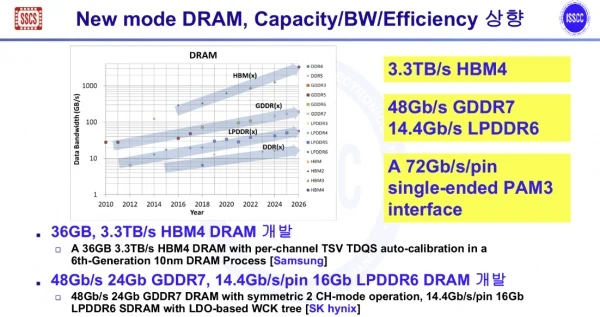
    In addition to the pricing of Samsung’s HBM4 memory, sources in the industry have provided updates on its specifications. Samsung has reportedly revamped the interface and stacking design, achieving a bandwidth of 3.3 TB/s for the 36GB module. The enhancements include “better signal accuracy in high-speed areas by using automatic compensation for the alignment signal (TDQS) of the channel-specific through-silicon via (TSV) path,” which is relevant for processing AI accelerator and LLM-specific data. For comparison, the existing HBM3E modules that Samsung supplies to Nvidia offer a bandwidth of 1.2 TB/s, meaning the HBM4 module will provide over double the bandwidth, albeit at a doubled price.

    Upcoming Innovations

    On top of the new HBM4 specifications, an SK Hynix spokesperson has also reiterated the specs for its LPDDR6 and GDDR7 memory. The LPDDR6 mobile DRAM modules deliver 14.4 Gb/s throughput per pin, featuring innovative low-voltage regulator technology that stabilizes the signal at these enhanced speeds. Conversely, the 24GB GDDR7 graphics memory modules are aimed at high-end gaming and AI inference, boasting speeds of 48 Gb/s per pin—three times the bandwidth of the current SK Hynix GDDR6 modules.

    The next-gen HBM4, LPDDR6, and GDDR7 memory technologies from Samsung and SK Hynix will be unveiled at the International Solid-State Circuits Conference (ISSCC) in San Francisco this February. Samsung is anticipated to start delivering HBM4 modules to Nvidia in the second quarter, on an expedited timeline at double the current price, likely leading to more expensive Nvidia GPUs by 2026.

    Source:
    Link