
Key Takeaways
1. GRB 250702B was a unique gamma-ray burst that lasted up to 7 hours, much longer than the typical duration of about 1 minute.
2. This event is believed to be caused by a black hole consuming a star, differing from the usual causes of neutron star mergers or massive star collapses.
3. One theory suggests the involvement of an intermediate-mass black hole, while another proposes a smaller black hole interacting with a helium star.
4. Ongoing research aims to understand the details of GRB 250702B, as conflicting evidence complicates the findings.
5. The energy output of this GRB is comparable to that of a thousand Suns shining for 10 billion years, highlighting its extraordinary scale.
Astronomers spotted a cosmic explosion on July 2, naming it GRB 250702B. This discovery isn’t unique, as around 15,000 gamma-ray bursts (GRBs) have been identified since the first one in 1973. Typically, these bursts are the result of two neutron stars merging, or a massive star collapsing into a black hole.
Unusual Duration
However, GRB 250702B was different from most. While most GRBs last only a minute, this one lasted up to 7 hours. Scientists agree that this extraordinary GRB was caused by a black hole consuming a star. The key questions are how this occurred and why it had such a significant effect.
Theories on the Cause
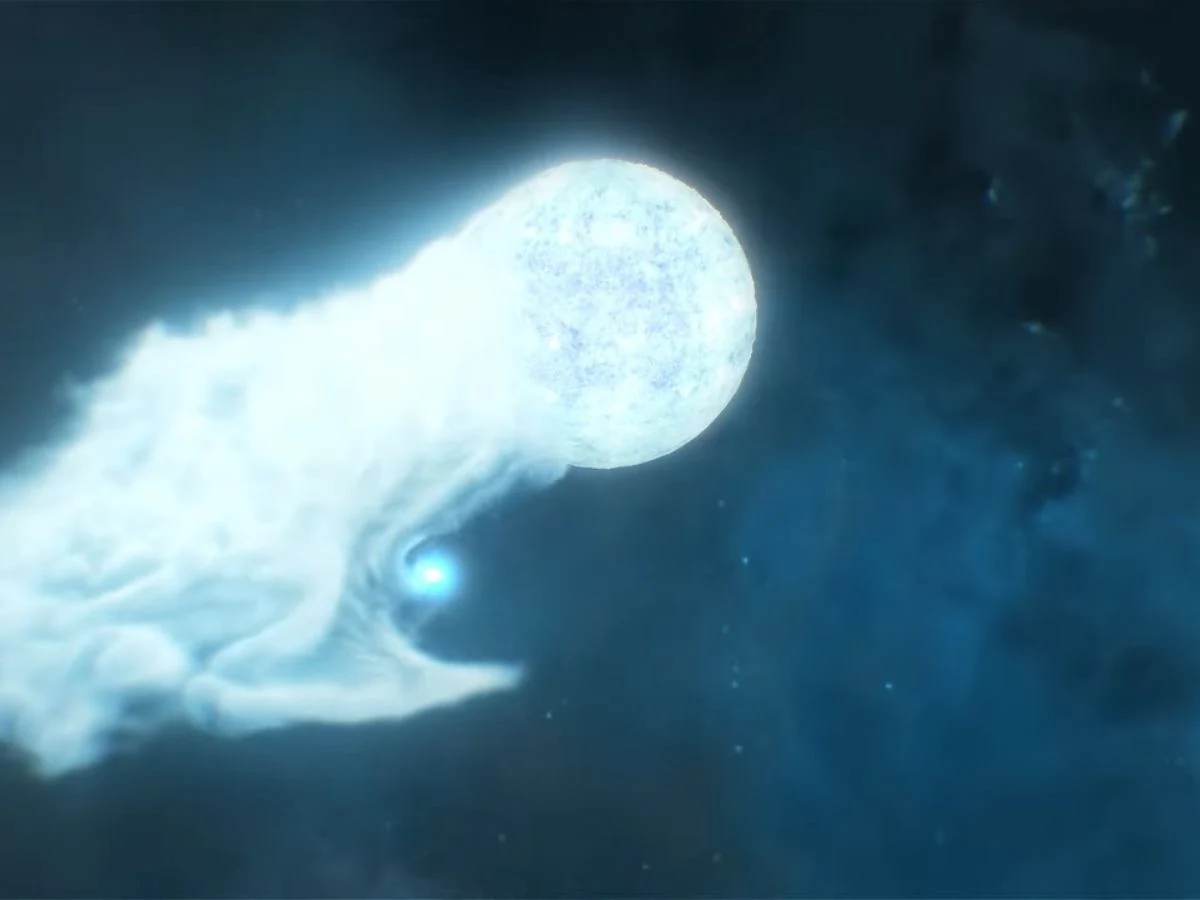
One theory suggests that this GRB resulted from the interaction between a star and a unique intermediate-mass black hole, which is a few thousand times heavier than the Sun. According to this view, a star ventured too close, and the black hole quickly began to devour it.
Alternatively, another theory proposes that a smaller black hole, approximately three times the mass of the Sun, was behind the event. In this case, the black hole may have been orbiting a helium star—one that has lost its hydrogen atmosphere—and was gradually siphoning gas from it. Eventually, it dove into the star and consumed it.
Ongoing Research
No definitive conclusions have been reached yet. The conflicting evidence adds to the complexity of the data. For instance, astronomers observed that the host galaxy is quite large, which is atypical for GRB galaxies. Nevertheless, scientists are committed to analyzing the information gathered from this GRB, whose energy output is comparable to that of a thousand Suns shining for an impressive 10 billion years.
Source:
Link