Tag: google

  • Google Tensor G6: Benefits of Using Tensor G4 GPU for Users

    Google Tensor G6: Benefits of Using Tensor G4 GPU for Users

    Google has been using its specially designed Tensor chips to power Pixel smartphones since the introduction of the Pixel 6. However, until now, these chips have not matched the performance or efficiency levels of their rivals.

    Upcoming Improvements

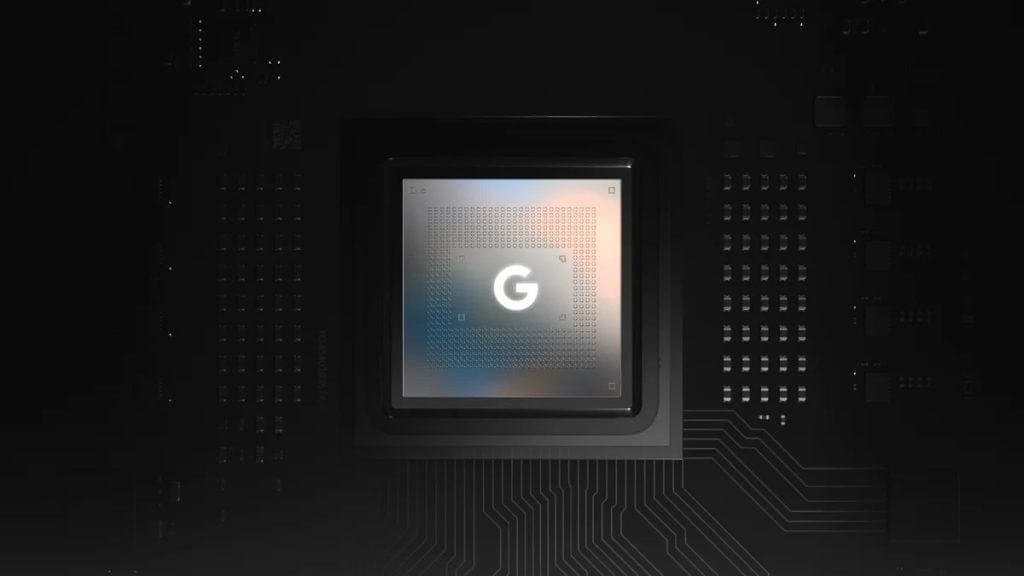
    This situation might soon improve, as Android Authority has obtained leaked internal documents that outline Google’s intentions with the new Tensor G6 chip, codenamed “Malibu.” The primary focus for the Tensor G6 seems to be on enhancing thermal management and efficiency. Major performance upgrades don’t appear to be expected, and even the Tensor G5 is only anticipated to deliver a slight increase in performance over the current chip.

    Changes in Strategy

    It appears that Google’s system-on-chip (SoC) strategy is not currently aimed at achieving significant performance enhancements. In fact, according to Android Authority, the Tensor G6 chip might experience some "downgrades" in certain aspects.

    GPU Decisions

    For example, it is reported that Google will not include a new GPU with the Tensor G6, instead opting for an older design that was initially meant for the Tensor G4. If this is true, the Tensor G6 might miss out on ray tracing support, which the Tensor G5 is expected to offer. This could be considered a step backward in certain respects.

    The choice to use the G4’s GPU in the G6 is thought to be driven by Google’s aim to minimize the chip’s die area. Reports indicate that the Pixel 10’s chip will be relatively large at 121 mm², built using TSMC’s 3nm process, while Apple’s A18 Pro, which utilizes the same process, measures only 105 mm².

    Google is targeting a die size of 105 mm² for the Tensor G6, aiming for a 4% area reduction from TSMC’s newer N3P process node (the G5 is built with N3E). Using the G4’s GPU is expected to help decrease the die area by around 12%. Additionally, Google is reportedly saving space by cutting down the DSP (digital signal processor) by one core and reducing the SLC (system-level cache) to 4MB. However, it seems that there will be no changes to the CPU size.

    In conclusion, Google is concentrating on creating smaller, more efficient chips, prioritizing space-saving measures over performance advancements.


    Image 1
  • Google Play Store Teases Upcoming New Android Device Category

    Google Play Store Teases Upcoming New Android Device Category

    Google is getting ready to broaden the reach of its Play Store to cover extended reality (XR) headsets, based on recent findings in the app store’s code. This development indicates that Google is setting the stage for a major entry into the XR market, possibly with its own devices or through collaborations with other companies.

    Play Store Welcomes XR

    The newest version of the Play Store app has a fresh icon showing an XR headset and mentions of “XR headset” in the app listings. This shows that Google is planning a special section for XR applications, much like the current categories for smartphones, tablets, and wearable devices.

    In the past, Google has dabbled in XR with projects like Cardboard and Daydream, but these were mainly focused on mobile virtual reality. The new support for XR headsets marks a more serious dedication to this technology and a wish to compete with other significant players in this field.

    Collaborations in the Works

    The timing of this update lines up with Google’s current partnerships with Samsung and Qualcomm on a new XR headset. This joint project is designed to create a premium XR device powered by Android and Qualcomm’s Snapdragon processors. By adding XR support to the Play Store, Google can build a strong ecosystem of applications and content for its forthcoming headset.

    While the specific aspects of Google’s XR ambitions remain uncertain, the detection of these code alterations hints that we might witness a major announcement soon. This could mean the unveiling of Google’s own XR headset, collaborations with other manufacturers, or merely an extension of the Play Store to accommodate current XR devices.

    Positive Outlook for XR

    No matter the exact direction ahead, Google’s initiative to welcome XR is a promising indicator for the technology’s future. With the backing of a significant player like Google, XR could potentially evolve into a mainstream platform for gaming, entertainment, and productivity.


    Image 1
  • Pixel 9a: Google’s Exclusive Smartphone Launching with Android 15

    Pixel 9a: Google’s Exclusive Smartphone Launching with Android 15

    Earlier this week, Google confirmed that it will launch the next big version of Android sooner than expected. This confirms earlier speculations, with the stable version of Android 16 set to roll out between April and June 2025. In a post on the Android Developers Blog, Google stated that this new timeline should coincide with the release of new Android smartphones.

    Timing for OEMs

    In theory, this timing should enable original equipment manufacturers (OEMs) to release new smartphones equipped with the latest Android version. But, of course, this doesn’t guarantee that it will happen. Recently, there have been rumors surrounding the Pixel 9a, indicating that it might not meet this timeline. Reports suggest that the Pixel 9a could be launched in March 2025.

    Pixel 9a’s Release

    As a result, the upcoming mid-range Pixel 9a will follow what the Pixel 9 has done (currently priced at $799 on Amazon), which missed getting Android 15 by roughly two months. Interestingly, the Pixel 9a seems to be the only phone from Google that will debut with Android 15, breaking from previous patterns. For context, the Pixel 9 series was released with Android 14, similar to its older models. In contrast, Google’s upcoming flagship devices are expected to come pre-installed with Android 16.

    Google via 9to5Google.


    Image 1
  • Tensor G5 Surprises on Geekbench but Lacks Performance

    Tensor G5 Surprises on Geekbench but Lacks Performance

    Google’s new Tensor G5 chip, which is set to be used in the next Pixel phones, has reportedly appeared on the Geekbench benchmarking site. While Google has not officially confirmed this, the listing provides insights into the potential performance and core setup of the system on chip (SoC).

    Tensor G5’s Geekbench Appearance

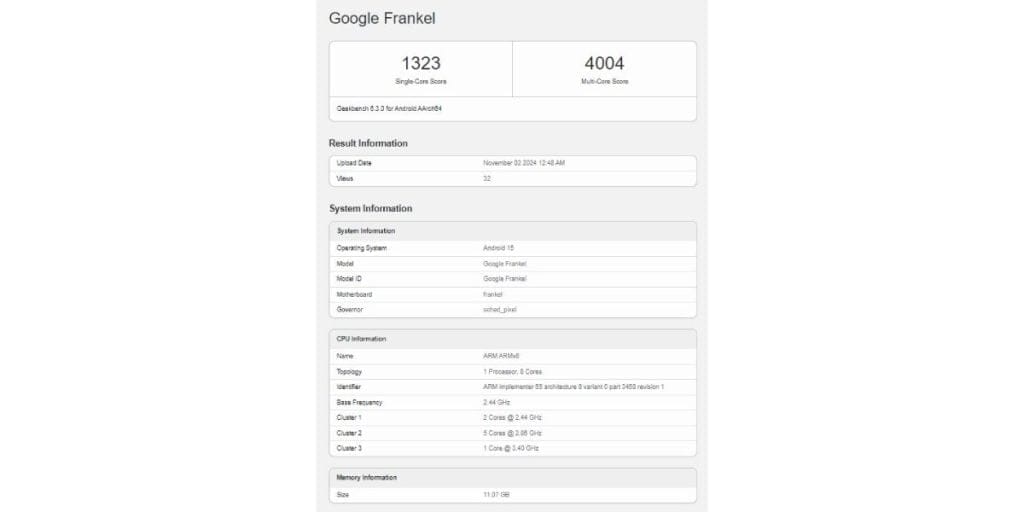
    The chip is listed under the model ID “Google Frankel” on Geekbench (previously known as “Laguna” in earlier leaks). It apparently achieved a score of 1323 in the single-core test and 4004 in the multi-core test. These results are lower than those of the Tensor G4, indicating that the G5 may not be able to compete with Qualcomm’s latest Snapdragon 8 Elite or MediaTek’s Dimensity 9400 flagship chips. It also seems tough for Google to surpass previous generation flagship chips from these rivals.

    Detailed Specifications

    The Geekbench entry matches earlier leaks, showing a core setup with one high-performance core running at 3.40 GHz, five mid-range cores at 2.86 GHz, and two low-power cores at 2.44 GHz. Additionally, it confirms that an Imagination Technologies PowerVR D-Series DXT-48-1536 GPU is part of the package. Prior reports suggested that Google would shift from Samsung to TSMC for the Tensor G5’s production. This chip is anticipated to be manufactured using TSMC’s 3nm N3E process node, with a die size around 121 mm².

    Future Outlook

    This benchmark test for Google’s upcoming SoC might indicate that the chip is still in the early stages of development, which could explain the lower-than-expected scores, or that Google isn’t focusing on achieving the highest performance. A company executive had previously mentioned that the Tensor G4 was not aimed at breaking records, but rather at enhancing the user experience.

    We hope the Tensor G5 doesn’t take a similar route, especially since it is expected to power devices priced above $1000. This initial version of the Tensor G5 likely requires considerable optimization to boost its performance in future benchmarks.


    Image 1
  • Microsoft Claims Google Funds Campaign Against Its Cloud Services

    Microsoft Claims Google Funds Campaign Against Its Cloud Services

    Through a blog entry written by Rima Alaily, who is Microsoft’s CVP and Deputy General Counsel, the tech behemoth from Redmond is claiming that Google is running a covert operation to tarnish its reputation before the European Commission.

    Google’s Complaint

    In September, Google officially lodged a complaint against Microsoft with the European Commission, alleging that the company engages in anti-competitive licensing methods. It accused Microsoft of employing outdated licensing strategies that keep customers locked into a single cloud environment.

    Google highlighted that Microsoft has interconnected Teams, its communication platform, with its main SaaS (Software as a Service) products, Office 365 and Microsoft 365. In the complaint, Google claimed that Microsoft is also doing this with Microsoft Azure, making it difficult for customers in Europe to “transfer their existing Microsoft workloads to other cloud services – despite there being no technical reasons preventing it – or impose what Microsoft acknowledges is a massive 400% price increase.”

    Microsoft’s Response

    Microsoft contends that Google is attempting to divert the attention of regulators from the ongoing legal challenges the company is currently facing. There are over 24 antitrust inquiries into Google in major digital markets around the globe.

    Microsoft asserts that Google is trying to skew the regulatory environment to its advantage instead of competing fairly in the cloud services market. The company argues that Google is using the OCC (Open Cloud Coalition) as a guise to gain regulatory support. This coalition, which was launched today, includes global companies like Civo and Gigas, as well as smaller firms such as Pulsant, Clairo, and Room 101.

    Coalition’s Goal

    Nicky Stewart, a spokesperson for the coalition and former ICT chief in the UK Cabinet, stated that the group aims to encourage lawmakers to examine restrictive contracts and support a more open and adaptable market for competitors.

    Microsoft, Google, European Commission, Gov.uk

  • Meta Developing New AI-Powered Search Engine

    Meta Developing New AI-Powered Search Engine

    Meta is working on creating its own AI-driven search engine that will offer answers and summaries about current events and individuals through its Meta AI chatbot. At the moment, this feature depends on Google Search and Microsoft’s Bing for information.

    Reducing Dependence on Major Players

    According to a report from The Information (via Engadget), Meta’s initiative aims to lessen its reliance on Google and Microsoft. A source who wished to remain anonymous mentioned that Meta is looking for a backup solution in case either Google or Microsoft decides to end their partnership in the future.

    New Partnership for Real-Time Updates

    Recently, Meta entered into a multi-year agreement with Reuters, which lets it present real-time news updates to users in the United States through the chatbot. A few months back, Business Insider (via The Verge) shared that Meta’s web crawler was collecting data to train its AI systems.

    Independent Data Indexing

    The Information confirmed this information through its contacts within Meta, who stated that the company has been gathering and indexing data for the past eight months. The strategy behind this move is to make Meta as self-sufficient as possible and minimize its reliance on other major tech companies.

    The Information, Engadget

    Image Credit: By Petar Adžaga – Own work, CC BY-SA 4.0, Link

  • Google Developing AI Agent to Control Web Browsers

    Google Developing AI Agent to Control Web Browsers

    According to a report from The Information, Google is developing an AI tool that can manage web browsers to make boring tasks easier, like filling out forms or reserving flights.

    Project Jarvis Unveiled

    This AI agent, known as Project Jarvis, is set to launch alongside the upcoming Gemini AI model, which might be released in December of this year. The name "Jarvis" stands for "Just Another Very Intelligent System," inspired by a fictional AI helper in the Marvel films who assists Tony Stark.

    Features of the AI Agent

    Google plans to restrict the agent’s functionality to browsers like Chrome. It will assist users with activities such as booking cinema tickets or buying goods online. People will have the ability to interact with the agent directly and give commands for various tasks.

    If this sounds a bit like something you’ve heard before, it’s because it bears a resemblance to Anthropic’s recent Claude 3.5 Sonnet, which enables app developers to "guide Claude to operate computers like humans do". OpenAI is also believed to be creating similar solutions.

    The Information, Anthropic, Reuters, Image Source.

  • Google Pixel 9a Leak Reveals Larger Size Than Anticipated

    Google Pixel 9a Leak Reveals Larger Size Than Anticipated

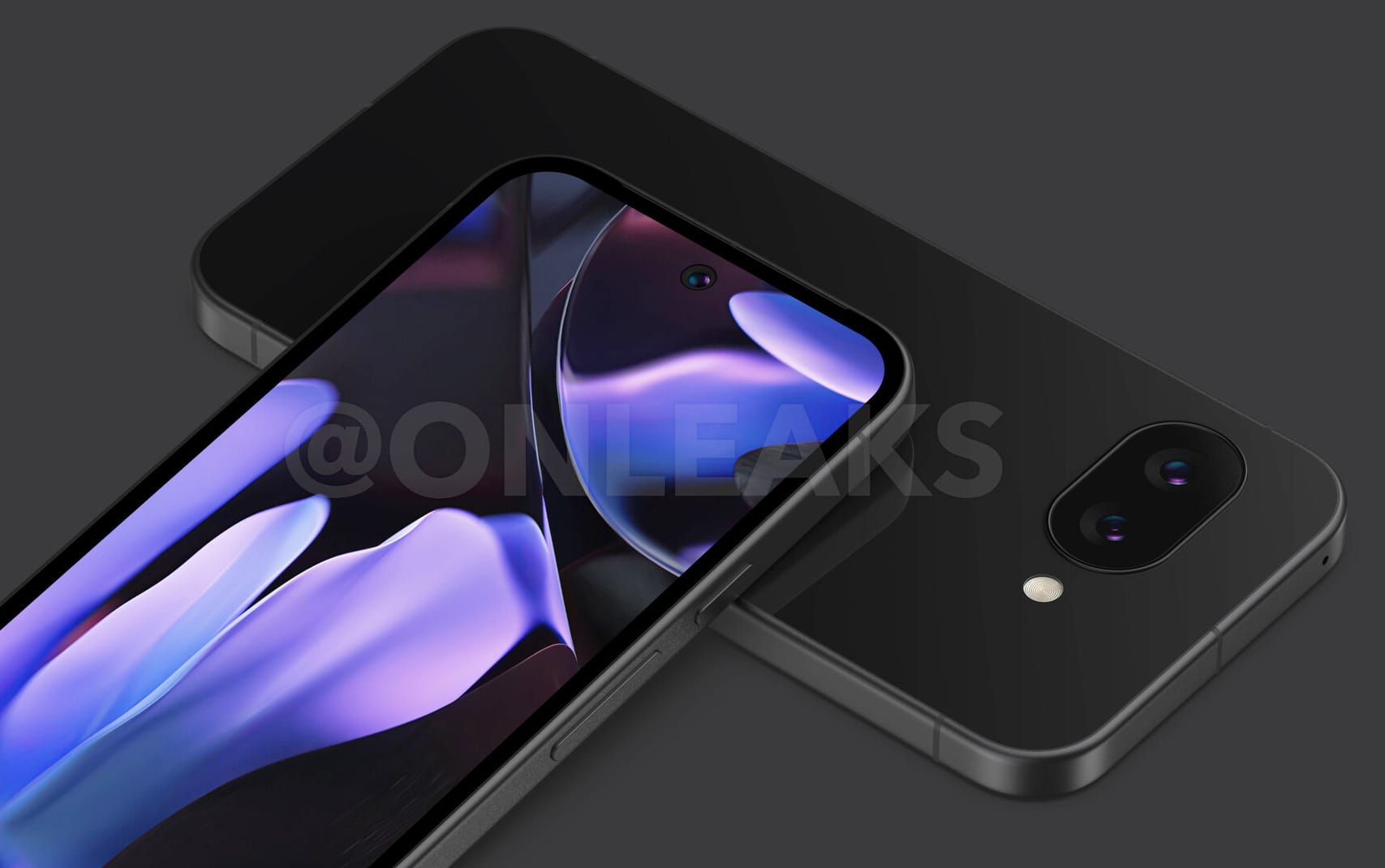
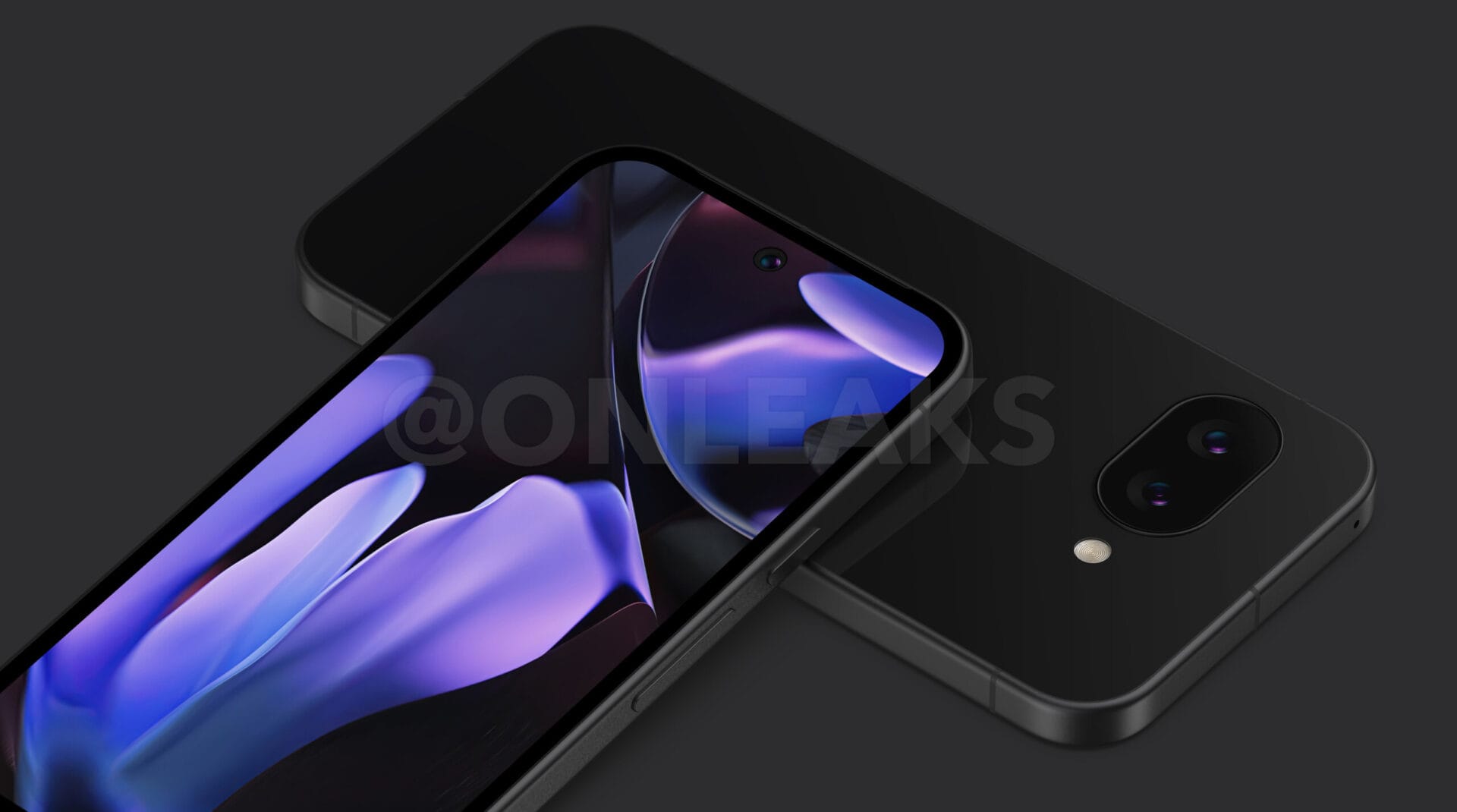
    @OnLeaks has released new insights into the Pixel 9a, which is believed to be the next mid-range smartphone from Google. This upcoming device is set to replace the Pixel 8a (currently priced at $499 on Amazon), but it will feature some notable differences from the prior model.

    Design Changes

    According to recent leaks, the Pixel 9a is likely to have a revamped rear design, particularly with its camera layout. As shown in the images, the phone appears to have minimal camera housing. However, this new design may result in a slightly larger device overall. @OnLeaks has indicated that the Pixel 9a will be a bit bigger than was previously anticipated.

    Size Specifications

    The expected dimensions of the Pixel 9a are reported to be 154.7 x 73.2 x 8.9 mm, making it taller, wider, and thicker than earlier reports suggested. Consequently, the Pixel 9a could be 2.6 mm taller and 0.5 mm wider than the Pixel 8a, while maintaining the same thickness of 8.9 mm. Despite the design changes, the camera housing is still said to measure 0.5 mm thick. Currently, the Pixel 9a is expected to be released in March 2025, just two months before the anniversary of the Pixel 8a.


    Image 1
  • Google Partners with Kairos Power for Nuclear-Powered Data Centers

    Google Partners with Kairos Power for Nuclear-Powered Data Centers

    Google is launching an ambitious initiative to employ small nuclear reactors to supply energy for its AI data centers. They have partnered with Kairos Power to realize this vision, aiming to have the first reactor operational by the decade’s end and to introduce additional reactors by 2035.

    Innovative Cooling Methods

    Unlike traditional reactors that use water, these new systems will utilize molten salt for cooling, enhancing efficiency and being more environmentally friendly. The technology from Kairos Power emphasizes smaller, adaptable reactors, which outperform the conventional large nuclear facilities that most people are familiar with.

    Meeting Energy Demands

    As the need for AI technology soars, finding a clean, steady, and dependable energy source has become critically important. Nuclear energy, being carbon-free and capable of delivering continuous power, aligns perfectly with the tech sector’s objective to lower its carbon emissions.

    Michael Terrell, who is Google’s Senior Director for Energy, emphasized that this innovative energy strategy will enhance AI capabilities while remaining environmentally responsible.

    Regulatory Hurdles Ahead

    However, the project faces some challenges. It must navigate rigorous regulatory frameworks. The arrangement requires clearance from the US Nuclear Regulatory Commission as well as local authorities in the regions where the reactors will be built. These approvals can take a long time and are accompanied by strict safety and environmental guidelines.

    Google isn’t the sole company exploring nuclear energy. Other major corporations, such as Amazon and Microsoft, are also considering it. Amazon intends to acquire a nuclear-powered data center in Pennsylvania, while Microsoft is working on reviving the old Three Mile Island nuclear facility.

    Future of Data Center Energy

    Nuclear energy presents a robust solution, especially since energy consumption in data centers is projected to double by 2030. It provides clean, uninterrupted power, which is a major advantage for tech firms looking to innovate while minimizing their carbon footprint.

    Nonetheless, nuclear energy continues to provoke discussion due to its waste production and safety concerns. Yet, its near-zero carbon emissions position it as a strong competitor in the industry’s efforts to reduce pollution.

    Google’s collaboration with Kairos Power is indicative of a larger movement, as technology giants pivot towards alternative energy solutions to satisfy the growing needs of AI and digital infrastructure while being mindful of sustainability.

  • New AI Scam Calls Threaten Billions of Gmail Users: Experts Warn

    New AI Scam Calls Threaten Billions of Gmail Users: Experts Warn

    A surge in AI-driven scams is now aiming at Gmail users, and even experienced professionals are struggling to dodge them. These phishing schemes, which imitate Google support, are becoming increasingly clever, and it’s alarming when experts in the field raise the red flag. Sam Mitrovic, a consultant at Microsoft, recently recounted how he nearly fell prey to a very convincing scam phone call.

    The Start of a Deceptive Scheme

    It all began with what seemed like a normal notification about a Gmail account recovery. Mitrovic decided to ignore it, but about 40 minutes later, he received a call from someone claiming to be from Google support. The caller, who spoke with an American accent, inquired whether Mitrovic had logged in from Germany and asserted that someone had been accessing his account for a week. Although Mitrovic sidestepped the trap, he highlighted just how polished and believable the scam was, even replicating Google’s official phone numbers (in his case, an Australian number) to lend it more authenticity.

    Another Victim’s Close Call

    Garry Tan, a venture capitalist and the founder of Y Combinator, also alerted others about a similar phishing scheme. In his instance, the scam suggested that a family member had submitted a death certificate to retrieve his account. The AI-powered caller pressured Tan to confirm his identity in a manner that was meant to induce panic, similar to Mitrovic’s experience.

    These scams are evidently leveraging AI’s capability to mimic genuine conversations and fabricate real Google processes. The attackers are even utilizing tools like Google Forms to enhance the authenticity of their scams, tricking users into thinking the threat is genuine. Both Mitrovic and Tan caution that anyone, no matter their level of tech savvy, could be caught off guard by these advanced strategies—especially in the wrong moment or situation. Moreover, these scams are likely to become more challenging to identify as AI technology evolves.

    Google’s Response to the Threat

    To combat these dangers, Google has teamed up with the Global Anti-Scam Alliance and the DNS Research Federation to introduce the Global Signal Exchange. This initiative aims to share real-time information about scams across various sectors. Furthermore, Google’s Advanced Protection Program now includes support for passkeys, providing an additional layer of security that could determine whether you keep your account or lose it.


    Image 1